Book 11 for 2025: “The Serviceberry”, Robin Wall Kimmerer


A tiny book by the author of “Braiding Sweetgrass” envisions a totally different economy than the kind we have now. She uses a plant, the serviceberry, as a symbol for what she calls the “gift” economy. Instead of everything being focused on maximizing profit, it focuses on sharing and exchange and the idea that natural resources are gifts from Earth, from nature, rather than commodities to be exploited for profit.

She notes that capitalist economies hinge on the concept of scarcity and personal accumulation of wealth often at the expense of others. Gift economies, which occur in many indigenous cultures, focus on the mutual benefit of all which encourages gratitude and trust. Later in the book, she discusses how gift economies can be implemented and flourish alongside the current capitalist economy.

There must be considerable appeal for her concepts because this book has been on the non-fiction best seller list for weeks.

Book 41 of 2024: “Crazy Horse”, Larry McMurtry


One of the saddest books I’ve ever read, this short piece of nonfiction details not only the life of Crazy Horse but also the demise of the traditional lifestyle of the Plains Indians. Crazy Horse has been the subject of endless legends and myths, many of which apparently have nothing to do with reality. He was not a chief; he often defied traditional Sioux customs. He was very much his own person. Among his people, he was especially known for his kindness and support of the poorest and weakest and for his prowess as a warrior. Crazy Horse died young due to not only white betrayal but also that of some of his own people.

I highly recommend this book if you are interested in this particular period of US history. At the end is a comprehensive list of sources with notes about each one of them.

An Abecedarian Poem for the Fourth of July


As many celebrate this day

because they see it as a joyous

cry in praise of the

day the United States declared

emancipation from English tyranny,

free to be its own country, self

governed, no longer ruled by kings,

humans, Black, enslaved,

indigenous, find celebration difficult.

Jefferson, in The Declaration of Independence,

knowingly called Native People

lacking in worth,

“merciless Indian Savages,”

never considering the contradictions, the

overt irony when compared to his view that

people are created equal.

Qualified, white male landowners, the

rich, voted, prospered.

Slaves, counted as only 2/3 a person, were

told to obey, work til death, be Christian.

Until all, regardless of race, gender, religion, are

valued as worthy humans, are free to prosper, can

walk proud throughout the United States,

xenophobia will destroy our founding ideals.

Yearn for, work toward, equity, kindness, be

zealous in our quest for a better country.

Canyon de Chelley–Part One


One of the most famous canyons in the country resides inside the Dine (Navaho) Nation. While administered by the National Park service, it is also the home of several Dine families. You can drive through the roads on the top freely, stop at various viewpoints, take photos, etc. Here are the various views I saw last week while there. The bottom of the canyon is restricted. To go there, you need a permit and a Dine (Navaho) guide. More about that in the next post.

Several families live in the bottom of the canyon, especially during the summer months. You cannot go into the bottom of the canyon without a permit and a Navaho guide.

One Book a Week-26: “Holding Fire: A Reckoning With The American West”, Bryce Andrews


If you LOVE the West, but sometimes struggle with its violent history, this is the memoir for you. Here is a quote from page 178: “I’m embarrassed at how long it has taken me to notice that a rancher’s view of the natural world is blindered in comparison to the hunter’s perspective; that driving livestock from one field to another is nothing like stalking free-ranging herds; that finding, gathering, and preparing a hundred different wild plants bears no resemblance to growing alfalfa or oats…”

Andrews also discusses the difference between sustainability and reciprocity. Before reading the book, I had never thought about this. He notes that sustainability is taking without damaging. Reciprocity entails giving back, e.g. nature, asking, “What can I give back? What can I do to take care of this place that feeds and shelters me?” This is quite different from “How much can I sustainably take?”

Andrews grew up in the West. However, after cowboying on several ranches in Montana, hunting annually, and later inheriting his grandfather’s Smith and Wesson revolver, he begins to question the gun violence and destructiveness of Western culture. This book details his journey. He continues to live on a farm in the Montana mountains, slowly transforming the land to make it profitable but also a place for nature, for wildlife to prosper.

A Book a Week-24: “The Water Museum”, Luis Alberto Urrea


What an amazing story collection!! As I read these incredibly diverse stories featuring so many different types of people, I kept wondering how does he know so much about different sorts of individuals:

-An older white lady in a tiny town in Idaho who runs a little restaurant.

-Chicanos in San Diego–this one I “get”; he grew up near there in Tijuana.

-A divorced white guy, wandering aimlessly cross country.

-A teen in Arizona who loves a nice girl from a dangerous family.

-A “weird” old man in a Mexican village.

-A young man trying to save his dead dad’s possessions from questionable friends.

-A strange magical realism Mexican story. I love magical realism so if I think it strange…

-A kids’ trip to a water museum ( the title) in the drought ridden plains.

-A sad South Dakota story of a white man married to an woman from Pine Ridge.

-In Iowa a widowed farmer trying his best to befriend and understand his Mexican neighbors.

The World in One Room


Four jaguar heads stare at me,

Mexican, Costa Rican.

A third guards the mantel,

partially hidden in tropical plants,

attack ready, tail raised, jaws open,

teeth bared.


My feet rest on a coffee table

carved in Kashmir.  I look at the photo

of the young man whose family made it.

He took me home to meet his mom,

to the floating market.

Once peace reigned there.

Now I wonder if he is safe, alive.


The Hoop Dancer raises his arms,

the Acoma pot exudes ancient

black on white beauty, painted

by the tips of yucca stems.

The Thai Spirit House begs

to appease evil spirits.

I should put food and flowers there;

I never do.


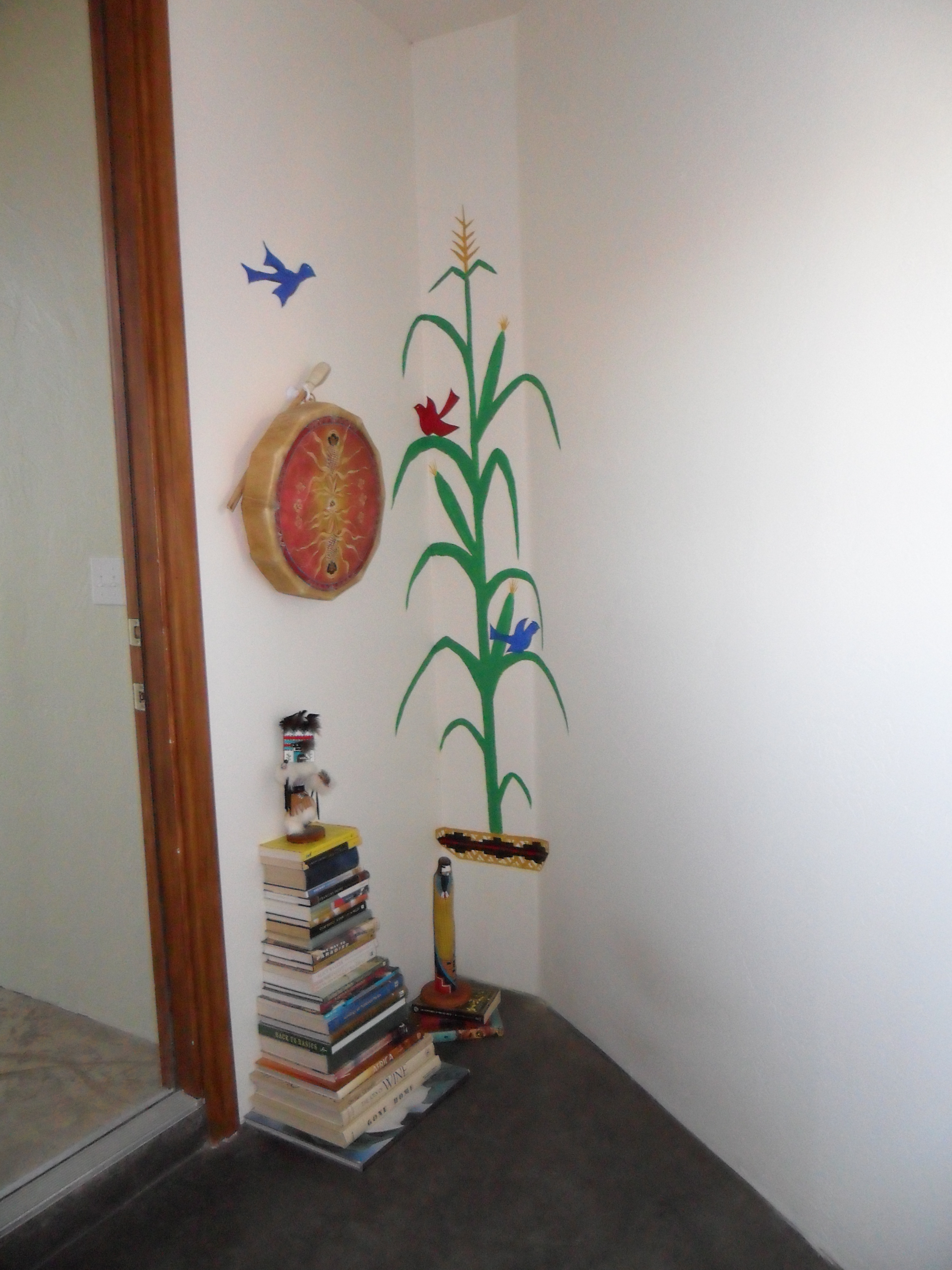
Corn plant of life–for Navaho, Hopi,

me, painted, growing up my wall,

blue and red birds flitting through

the stalks, singing ancient songs.

Corn Maiden rug hanging on the wall;

an Isleta Pueblo girl won a contest

with its design.  Four Corn Maiden

Kachinas watch the room.

Corn everywhere–Sacred Corn.


Three Ethiopian crosses, St. George

and the Dragon, Frida Kahlo doll,

Argentinian Madonna, Tohono O’odham

baskets, a painted cow skull, Nigerian carved

wooden elephants, including a Chieftains chair,

the stained glass transom window from the house

where my dad lived from birth to ten.


In a room filled with windows, there

is little room for paintings, yet–

purple bison glide across the prairie,

an Iraqi woman flies through an azure

sky filled with dark blue birds,

a 15th century mystic, Kabir, tells

a tale in poetry, Navaho spirits,

pumas walking toward me–

my obsession.


Rugs scattered–Kerman,

an unknown Persian city, Afghani,

Egyptian, Indian, Zapotec, scraps of old

Turkish rugs sewn together.


In one cabinet, Grandmother’s china,

Mom’s Czech crystal–a wedding present

decades ago, Grandson’s painted art,

the silverware Dad gave Mom on their

first wedding anniversary,  Mom’s

everyday dishes–flowers blooming.

I use them every day.


These objects–a testament to who I am:

World wanderer, seeker, citizen.

SAM_0912

SAM_0035


Blood Quantum: A Poem for Our Time


My grandson cuts himself into 16 equal pieces:

4/16 Urhobo from Africa

3/16 Spanish from Spain

4/16 European–two Swiss German great, great-grandfathers

(Werth and Kaiser), Irish, English and who knows what

3/16 Mexican–whatever mixtures that may be

2/16 Navaho


Who am I? What am I?

Who are you? What are you?

Do we really know?

Who sets the rules?

white men

black

Indian

Native American

Irish

English

German

from where and for whom?


He looks Navaho:

-blue black straight hair

-pale brown skin

-obsidian eyes.

One four year old girl asks him,

“Are you American Indian?”

His six year old self says nothing.

She repeats,

“Are you American Indian?”

He says, “It’s complicated.”


The Navaho won’t claim him, too little blood.

He needs 1/4, not 1/8.

Caddy and Fort Sill Apache allow 1/16, not Navahos.

1/4 blood is for

-Sioux

-Cheyenne

-Kiowa

-Navaho

1/8 works for Comanche and Pawnee.

Some Cherokees only want a Cherokee ancestor.


But he is none of those.

Is he Navaho?

Is he white?

The old South goes by the one drop rule:

one drop of Negro…

Is a person with 99/100 per cent white

and 1/100 black, black?

Who says?

Kids at school ask, “What are you?”

He tells them.

They say, “You’re lying.”


I only know specifically about two ancestors,

the Swiss Germans.

Another great grandfather disappeared during the Civil War.

I don’t even know his name.

Who am I?

Who are you?

I think I’ll get a DNA test.

Then I’ll know how many pieces I need to cut myself into.


Note:  This was originally published in my book “On the Rim of Wonder”.  I had a cousin send me 75 pages of ancestry information.  I looked up more myself.  That one great grandfather remains a mystery.  I had my DNA done.  It did not match what I expected from the ancestry work.

Blood quantum is the term the US government used to determine whether a person would be qualified as an Indian.  Now many Indian Nations use it to decide who can be on the tribal rolls and who cannot.


Blackwater Draw–Part One


Annually, I make a pilgrimage to this ancient place where people hunted on the shores of a lake nearly 12,000 years ago.  It continues to be the oldest evidence of human habitation in the Americas.  For a large part of the twentieth century it was a gravel pit.  The gravel mining created both positive and negative consequences.  Without it, the bones of giant bison, mammoths, dire wolf, saber toothed cat and camels might never have been discovered at all.  However, because the owners of the quarry refused to stop mining, some portions of the site were destroyed by big swoops of the excavator machines.  Frequently archaeologists worked simultaneously along with mining operations, continuing within sight of each other.    Various groups, including some private individuals, attempted repeatedly to buy the site to save its precious stash of bones, artifacts, and ancient wells.  The owners refused to sell.  Finally, in 1978, Eastern New Mexico University purchased the site and continues archaeological excavation there.  They also run the nearby museum adjacent to the university football stadium.

If you expect something wondrous and grandiose, you will be severely disappointed.  A small building houses a teensy museum, restrooms, a few sweat shirts and posters and books for purchase.  An individual sits by the door to take your meager entrance fee–at most five dollars–and answer questions.  These individuals explain they are majors in disciplines related to the site, archaeology, paleontology, anthropology, that sort of thing.  A simple gravel trail traverses the site and a smaller trail goes to an ancient well–16 have been found at or near the site–and to a dig inside a building where you can observe the layers unearthed, which group of people left which type of artifacts, and actual bones of mammoths, giant bison, and other animals from the end of the last Ice Age.

People react differently to such sites.  I always remain entranced, overwhelmed, reflective, thinking to myself, “I am walking where people walked and hunted and went about their lives more than 11,000 years ago.”  The most ancient evidence of people is labeled Clovis Man–Clovis, NM, is just up the road.  They never found human bones of these people here , just their spearheads stuck in the ribs and shoulders of mammoths which stood 15 feet at the shoulders.  The people who came later made a different type of spear, called Folsom points.  These people, Folsom Man, lived later by 1-2 thousand years.  Another site, called Folsom, is near the tiny town of Folsom, NM, farther north at the edge of the mountains.  This site is on private land and tours are available only twice a year.  Although I visited the town last year, I have not visited this site.  Other people arrived later and although the collection is smaller, their spearheads remain available for viewing at the nearby Blackwater Draw Museum on the main road between Clovis and Portalis, NM.

When I look at the list of animals who lived here at the end of the last Ice Age, I feel amazed because they include both camels and horses as big as our horses now.  Both of these became extinct as did the saber toothed cat with the humongous canine teeth and the dire wolf.  Giant sloths lived until modern times but nowhere near New Mexico.  How could all these animals live here?  It was wet and green then.  Until the last couple of decades, bodies of water of varying sizes have drawn animals and people to this area.  Giant fields of irrigated corn and dairy farms lowered the water table sufficiently to eliminate any evidence of water.  At the time of Clovis Man a large lake covered the site.  Later, during a 3000 year drought, people dug the ancient wells to reach water.  Because this remained the only place for hundreds of miles with a supply of water, people came.

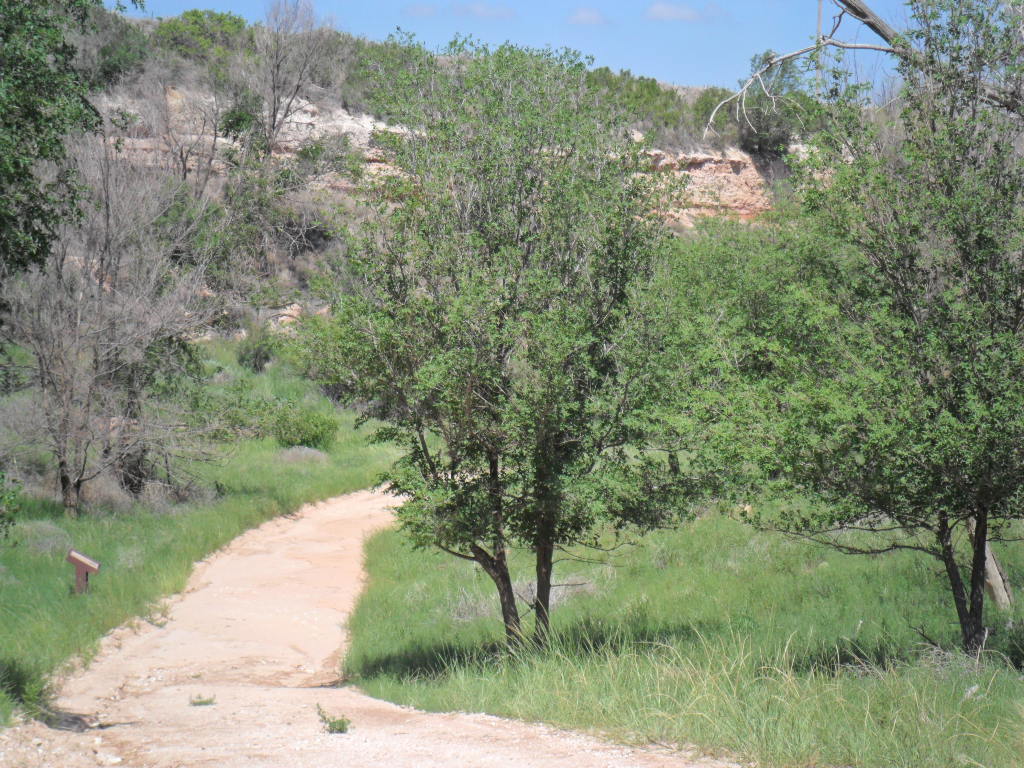
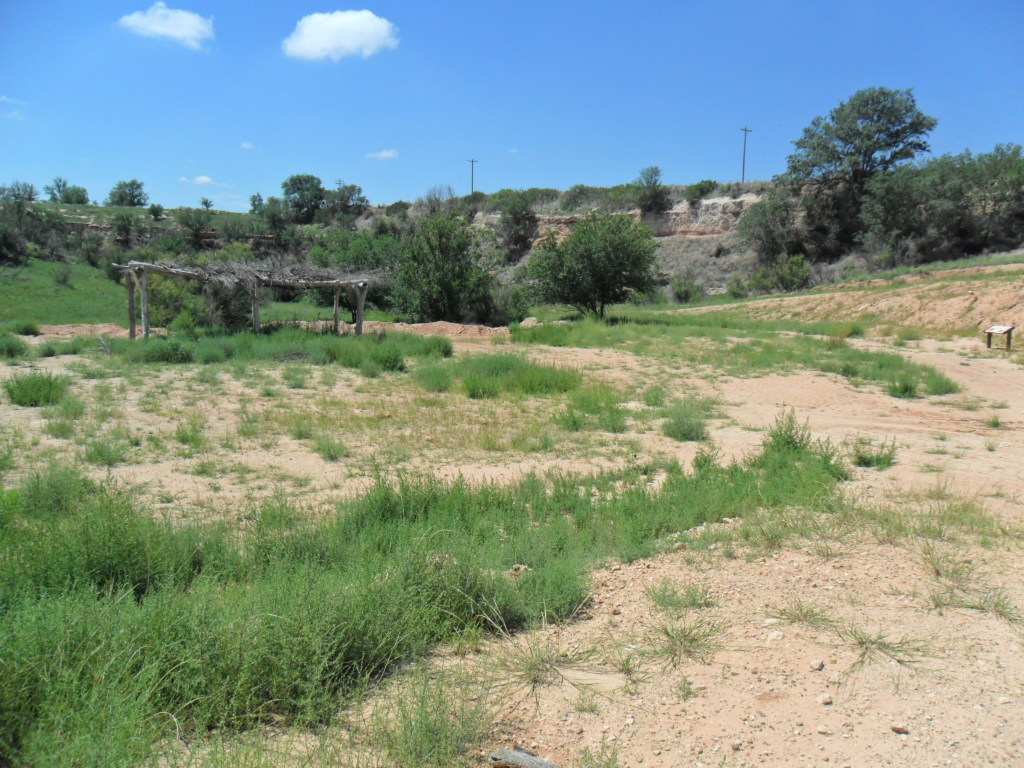
The trail begins just to the northwest of the tiny building and goes along the top for a couple of hundred feet before it drops down into the gravel pit remains.  The gravel was below all the layers containing human artifacts and ancient animal bones so the pit is wide and deep.

SAM_1302

SAM_1301

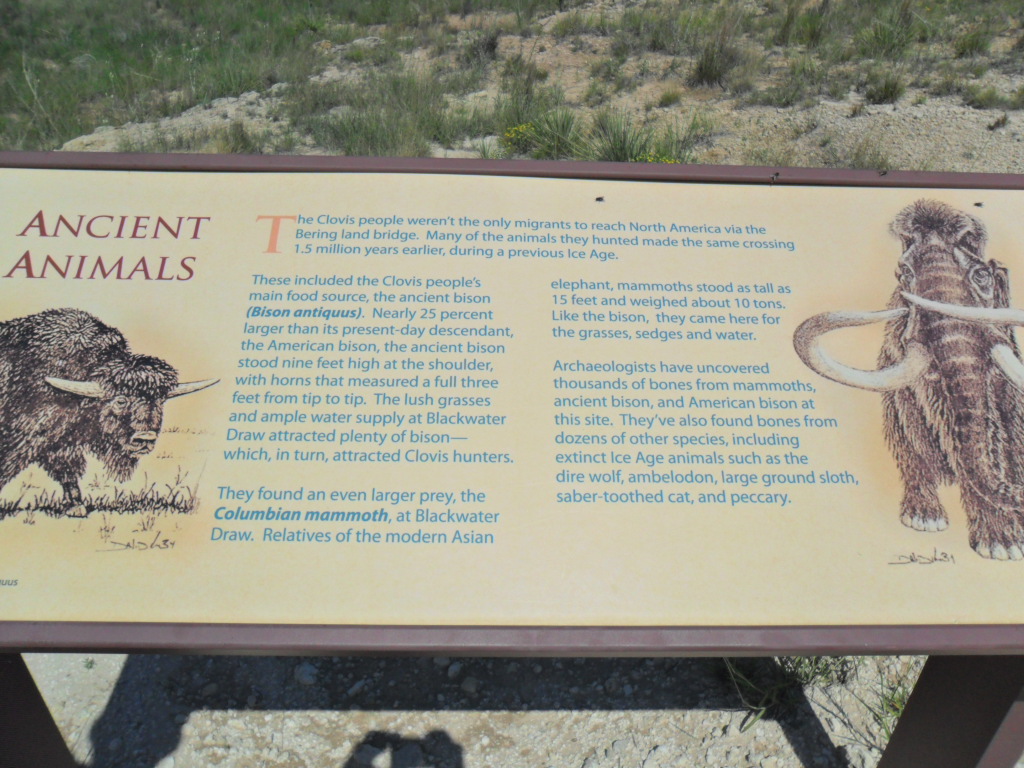
If your sight is good, you can read this.  The primary source of food for Clovis Man, giant bison and Columbian mammoths, came here for the water.  Archaeologists  theorize that hunters often killed these huge animals while they were in the water where it was more difficult for them to escape and move quickly.  In one place on the trail, evidence of a five bison kill complete with spearheads makes one think just how difficult and dangerous this hunting activity must have been.  I stand there, think about my own 5’4″ height, and wonder what it would be like to have a Columbian mammoth close to me.  Doubtless many died from injuries during such activities.

SAM_1304

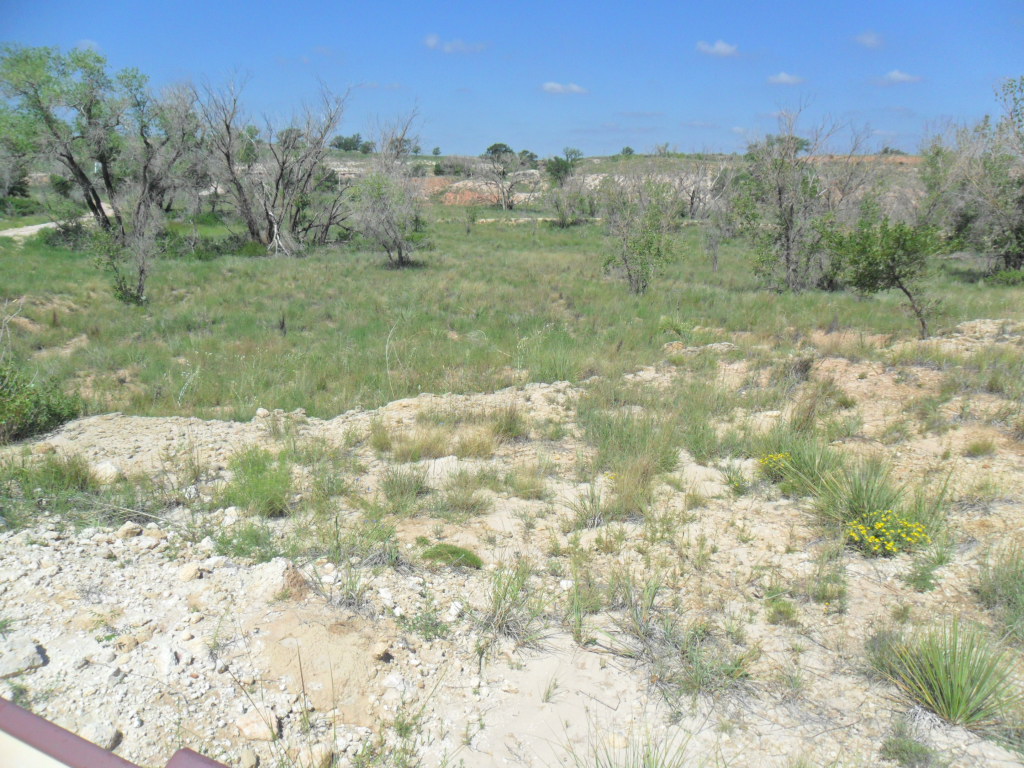
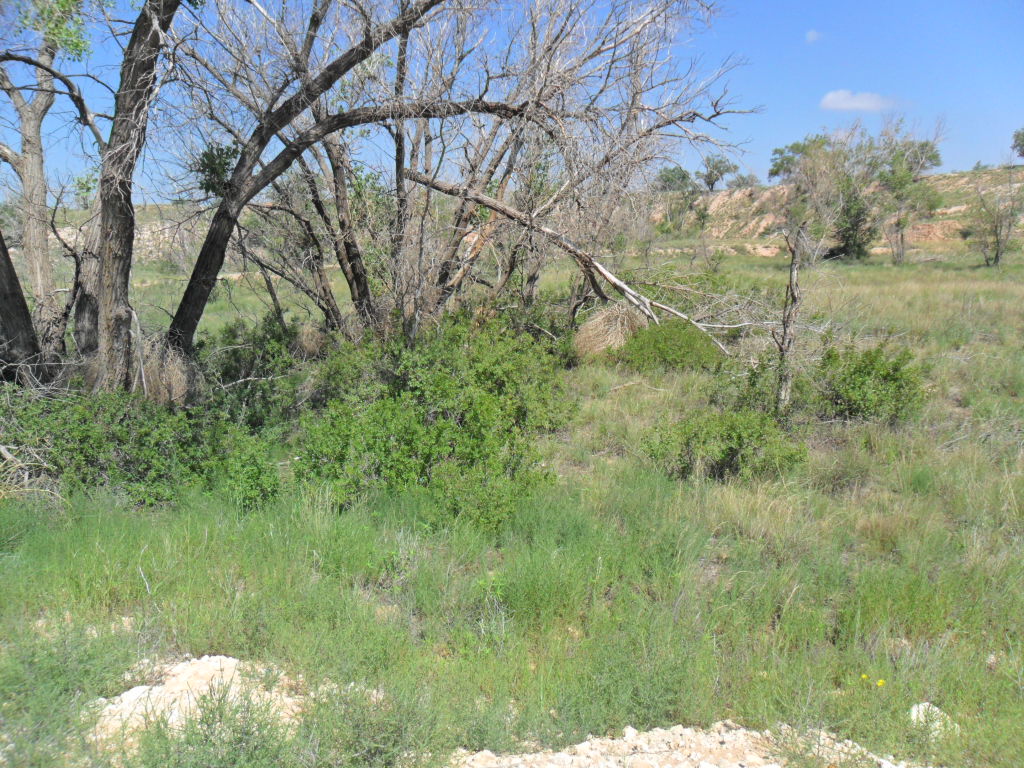
The train meanders along the bottom of the gravel pit.  This year, plentiful rain grows abundant grass.  During the last several years, little rain has fallen as evidenced by all the dead trees and bushes scattered around the site.  Normally, this area is semiarid with less than 18 inches of rain per year.

SAM_1303

If spectacular scenery appeals to you, do not go here.  Most of the bones and artifacts were found in the layers at the sides of the pit.  As you walk the trail, markers indicate the location of findings.  Few human remains are found at such sites because these were not permanent settlement places.  Ancient peoples roamed the land in search of water and food.

SAM_1305

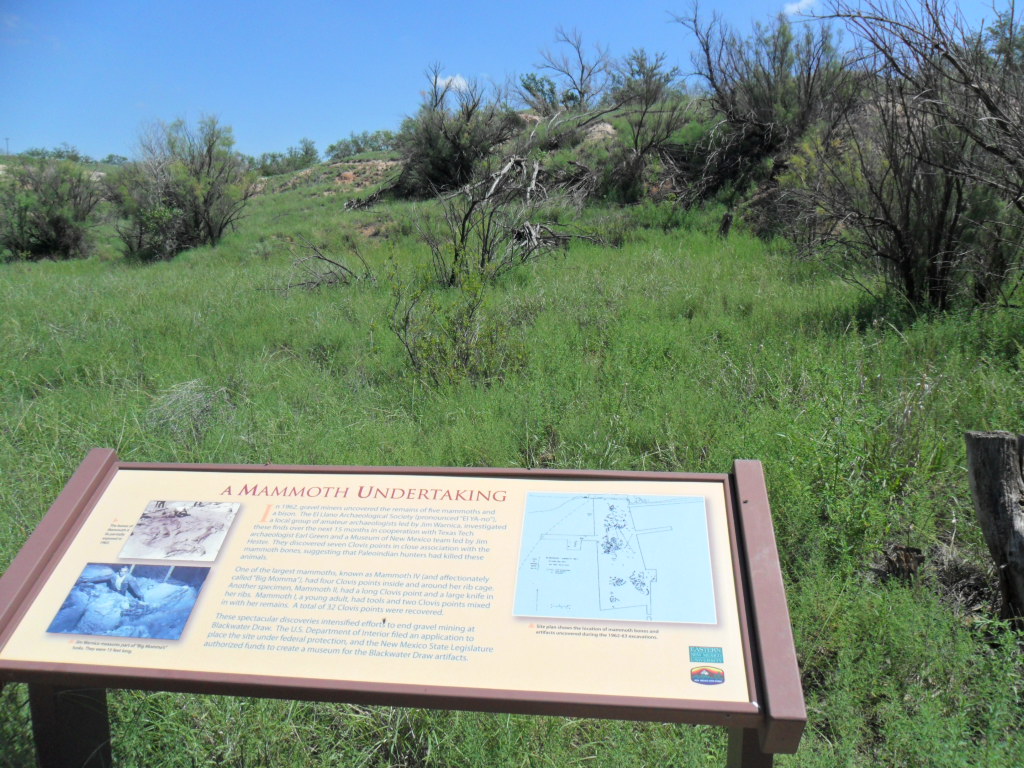
Signs, such as this along the trail, illustrate different places where specific bones and artifacts were found.  They also explain the different types of artifacts, their specific uses, and the history of the site.  Maps, like the one on this sign, help the viewer hone in on specifics in relation to where one is standing.  The photo illustrates archaeologists in action during site digs.

SAM_1307

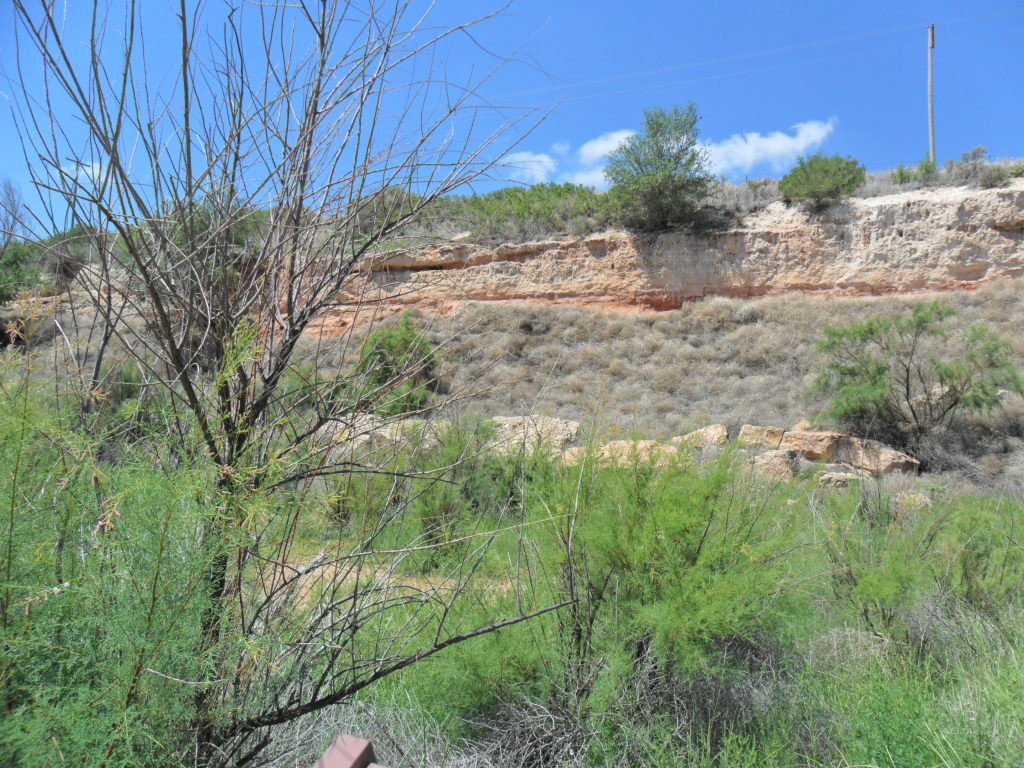
Cliffs, like the one here, surround the site.  In these small cliffs each layer indicates a different age of human activity by not only the type of sediment but also by the type of artifacts and animal bones found.  Just beyond this particular cliff at the west edge of the site, irrigation pivots run in a huge corn field.  The grey at the bottom of the cliff indicates an immense pile of dead, dried, tumble weeds.  This is dry country.

SAM_1308

Approximately three fourths through the trail, the site mangers have erected several structures.  This one is the most primitive.  Others are modern with picnic tables and in one place I saw a giant sand box.  Guessing, I think it must be used to illustrate how one sifts through layers of soil to carefully remove spearheads, bones, pottery, etc.  This is the perfect place for a field trip, not too long, but full of geological and paleontological information.

I go here usually once a year.  If you ask me why, I may articulate something about how it has the oldest artifacts and bones found in North America.  The real reason??  I am not quite sure.  This place fascinates me, connects me with something ancient and wondrous, something undefined and mysterious.

Ten Little White Indians, Final Volume! (Spoilers Already Spoiled!)


This post by a fellow blogger says a lot about what I think regarding certain movies in which American Indians are portrayed or in which they act. It also relates in some ways to my own previous posted poem, “Blood Quanturm”.

danielwalldammit's avatarnorthierthanthou

Bet y’all didn’t notice!

I am one short on my promise of 10 Little White Indians. Well, it turns out that my three-part series on White Indians has four parts, and there is surely a good Monty Python reference in there somewhere, but maybe we’ll save that for another day

***

Let us start with a brief consideration of the near misses.

WIND TALKERS (2002): I remember when this movie was on its way to the theaters, rumor had it that the flick was about the Navajo Code Talkers. Working as I did then on the Navajo Nation, I was (like a lot of my students and colleagues) really excited to see this part of American history portrayed on screen. My enthusiasm waned considerably when I realized it wasn’t about a Code Talker so much as a white guy who might have to kill a Code Talker if things took…

View original post 1,713 more words