Book Seven for 2025: “The Map of Salt and Stars”, Zeynab Joukhadar


Two young heroines dominate this fascinating novel which switches back and forth between the Syria of 2011 and the 12th century. The latter is a girl who disguises herself as a boy to join the quest of a famous mapmaker. Nour, the first girl, lost her father to cancer in NYC. Then her mother, a mapmaker, decides to move herself and the three daughters back to Homs, Syria. They barely settle into their new life when the civil war breaks out and a bomb destroys their house. They become refugees. This is the tale of their harrowing journey from Syria to Jordan to Egypt to Libya to Algeria, then Morocco and finally to Cuenta, the Spainish city on the north coast of Africa, where their uncle lives.

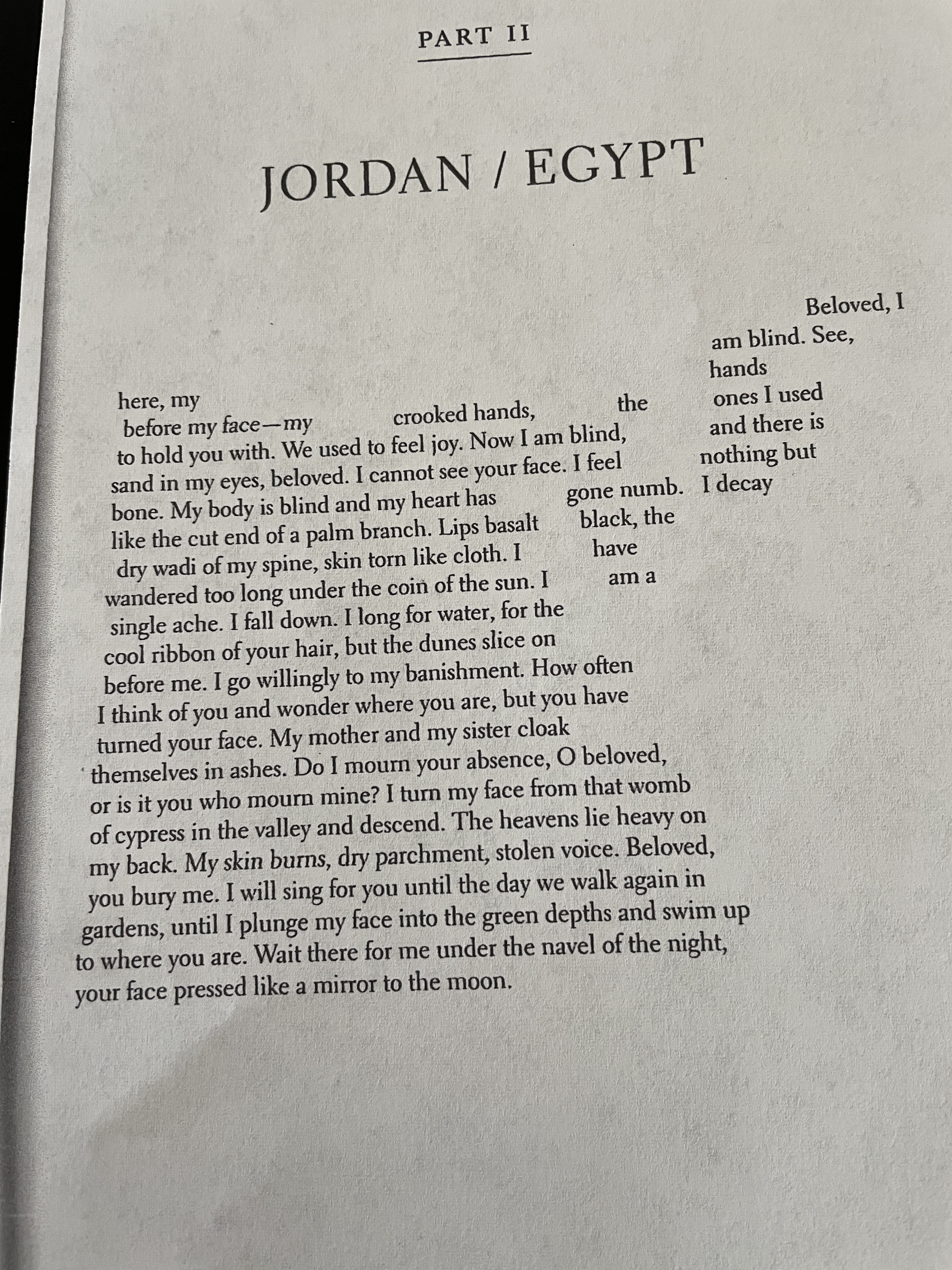
To keep sane, Nour repeatedly tells herself the story of Rawiya, the disguised girl who is an apprentice to the map maker. When he was alive, this was the favorite traditional story her father told her. The book alternates between what is really occurring to Nour and her refugee family and this ancient story. At the beginning of the section for each country through which they travel, there is a touching and beautifully written poem in the shape of the map of that country. The poem for Jordan/Egypt is printed below.
Book 39 for 2024: “The Return”, Hisham Matar


This book won the Pulitzer Prize in 2016. The subtitle, “Fathers, Sons, And The Land In Between” indicates a bit of the subject matter–how sons and fathers relate, but in this case it is a tale of horrible grief and suffering when Matar’s father is arrested and imprisoned in the notorious prison of Qaddafi in Libya. For decades Matar tried to find out what happened to his father. There is no record of his death and no one knows what happened to his body. The book details the lives of his family and their search for news of, hopes he might be alive, and what happened to Matar’s father. To this day no one knows. In 2012, 22 years after his father’s kidnapping when Matar was 19, he returned to Libya to try to learn more, met with uncles who had also been imprisoned, some for 20 years. This is the tale of his family’s suffering and hope. It also relates in detail the horrors of Qaddafi’s reign, what happened to many in his most notorious prison, and the resilience of so many who managed to survive, including close relatives of the author.

Note: After Qaddafi fell, there was hope for a new, unified government. However, as of the present, Libya is ruled by two rival administrations and is a divided country.