Book 29 for 2026: “The God of Small Things”, Arundhati Roy


The Booker Prize winner from decades ago, I decided to reread it (I read it when it was first published) after reading the author’s recent memoir. It is1969 in the southern Indian state of Kerala where a substantial proportion of the population belong to the Syrian Christian church. Does this keep them from adhering to the Indian caste system? No. Caste, wealth, social status, property–they all still matter.

The main characters are one family: Ammu and her twin children who love the wrong man according to their society, the blind grandmother who plays Handel on her violin, their uncle who was a Rhodes Scholar at Oxford and married and then divorced an English woman, their child, and an ex-nun grandaunt who is not a nice person and cannot get over her love for a priest. And then there are their servants and the man, an Untouchable, who is the brilliant carpenter, mechanic, fixer of everything. When the half English child and her mother come to visit after her new husband’s untimely death, everything changes in a day.

Even though written decades ago, the novel is definitely worth the read. Although the details and cultural representations are true to one particular area of India and its culture, the novel’s themes ring true for all cultures and countries, themes of Love, Joy, Hate, Prejudice, Hope.

Note: I also decided to research how much the caste system has changed life in the decades since it was written. In urban areas with new laws there is more leniency regarding rights especially for work and education, but people still usually marry those from the same caste. Rural areas have not changed much to the point that many villages still have a specific area where the Dalits (Untouchables) have to live.

Book 27 for 2026: “Mother Mary Comes To Me”, Arundhati Roy


Although Roy has written numerous books including the Booker Prize winning “The God of Small Things”, this is her first memoir. While the prose is easy to read, the subject matter is often heart wrenching. Roy’s mother, a single parent (divorced) in India when this was totally unacceptable, accomplishes remarkable achievements including the founding of a very successful school while acting what often seems very cruel as a mother to her two children, Arundhati and her brother. The mother’s treatment of Arundhati is so disturbing that when she is just 18 and in her third year of architecture school in Delhi, she quits going home to Kerala to see her mother and quits communicating with her for seven years. Yet, she admits to loving her mother irrationally.

Arundhati becomes involved in documentary film making, sometimes as writer and sometimes as an actor in the films. In addition to her activities as a writer and film maker, she becomes an ardent political activist against rising Hindu nationalism. She provides details of spending time with hunted activists in the jungle, getting arrested, and even tried for writing a piece the judiciary considered insulting. This is an unusually honest and intimate memoir about her family, her mother, and life and politics in India.

Book 26 for 2026: “The Loneliness of Sonia and Sunny”, Kiran Desai


By an author whose previous novel won the Booker Prize, this novel was long listed for the most recent Booker Prize. Although 670 pages long, it did not take me as long as I expected to read this because I found I kept going because I wanted to know what was going to occur. It is the tale of two families and two young people, both of whom have studied and lived in the United States. The background city for both families is the Indian city of Allahabad. The two, retired, family patriarchs get together frequently to play chess even though their families are sometimes rivals for status and influence.. The two do not live far apart and all the older family members know each other, including those who have moved away to Delhi and other places. The youngest members do not know each other and accidentally meet on an overnight train. At that point they do not know that their two grandparents had tried to match make them in an arranged marriage. Later, this becomes an embarrassment.

Sonia wants to become a novelist and is attending college at a small liberal arts college in New England where she becomes involved with a famous but cruel artist who becomes obsessed with her and whose influence she has become unable to escape, initially literally and later psychologically. Sunny lives and wants to stay in NYC to escape the overbearing influence of his mother and the violence between her and the two brothers of her deceased husband.

Not wanting to reveal all the complexities of the lives of these two young people who come to love each other but whose lives keep tearing them apart and the challenges they face as they try to make sense of their lives, I will simply say this is a novel I recommend. The reader learns a lot of about Indian culture and its variances, about the huge differences among different parts of India, e.g. Goa and Delhi, but also how universal family and personal struggles really are.

Book 22 for 2026: “A Guardian and a Thief”, Megha Majumdar


In the not too distant future the city of Kolkata in India is besieged with floods and famine. Ma, her elderly father, and two year old daughter are preparing to emigrate to the US where her husband has a good professional job. This is one of the families in the story. The other is a poor family from the Sundarban struggling to stay alive while the oldest son, Boomba, has gone to Kolkata to try to earn enough to save his family.

In the two weeks time of this novel, Boomba, driven to desperation and holding a secret about Ma, breaks into Ma’s house and steals her purse which contains the passports for her, her father, and her child. Both her actions previous to his, her current actions, and Boomba’s lead both down paths they could never have previously dreamed with dire consequences for all.

Due to the flooding and famine, everyone in the city is desperate except for the one billionaire who has stayed. Their desperation leads some to behave in undesirable ways, but the main “lesson” of this novel illustrates how just one action by one person can lead to dire consequences for two entire families and possibly others as well–actions have consequences you can never begin to imagine. Be careful.

Naked and Unafraid: Mahasveta Devi (1926-2016)


A powerful story of the power of woman and in this case of “right”.

Vibha Shetiya's avatarFeminism and Religion

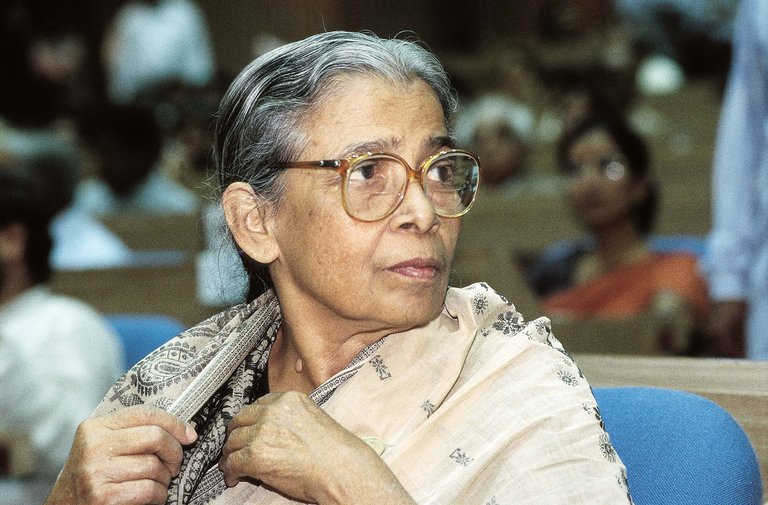
03devi-obit-master768 Photo credit: The New York Times

Mahasveta Devi died last month at the age of 90 in Kolkata, India. A widely acclaimed Bengali writer, she identified as an activist first, clearly evident in her meticulously researched “fiction.” Most of her stories champion the cause of those living on the margins of society, particularly the Adivasis or original inhabitants of India; poor, unemployed and itinerant, they traditionally subsisted off the land, and continue to struggle against exploitative upper caste landowners.

I cannot claim to be an expert on Devi or her activism, but there is a story I read a few years ago, which never fails to haunt me, whether because of the rawness with which she describes the harsh reality faced by tribal people or because of what can be seen as the violent but ultimate triumph of its female protagonist, I cannot tell. Perhaps because of both, or because…

View original post 1,120 more words