Intelligent Beings


Tonight the program Nature on PBS asked questions about animal intelligence as compared to humans.  This list portrays some of the things I learned, some new, some I remembered from past readings or other Nature programs:

-A few other animals besides humans recognize themselves in a mirror.  This list includes elephants, dolphins, and chimps.  Actually, humans do not demonstrate this ability until they are about 18 months old.

-Only a few species studied demonstrate a sense of social justice.  If they think they are being treated unfairly, they get mad and sometimes have a little fit.  This includes monkeys and dogs.

-Only one species studied demonstrated overt altruistic behavior and a sense of social justice toward others, the bonobo.  Of course, others may but have not been studied yet. Notably this is the same species that resolves social tension and conflict with sex rather than fighting.

-Humans grieve.  Many other mammals grieve immediately after the deaf of a loved one, e.g. their own young offspring, but few recognize the bones of long deceased members of their species.  The exception is elephants.  Elephants not only recognize the bones of other elephants, they frequently nuzzle them with their trunks and stay with them a while.

-Dolphins may seek out help when they need help.  The program showed a diver who was not looking for dolphins at all.  A dolphin who had a fish line and hook stuck in his side approached the diver and managed to stay very still while the diver removed the hook.  This took nearly ten minutes.  Of course, no one knows whether the dolphin was actually seeking help or simply stayed still when help was available.

-Chimps possess another behavior similar to humans, the ability to purposefully deceive.  A less dominant chimp was shown where a banana was hidden from a window outside an enclosure.  She and a more dominant female chimp were released into the enclosure at the same time.  The first chimp did not rush to the food.  Oh,no.  She waited and watched, played it cool,  and when the other chimp wandered off to the other side,  ran and ate the banana.

It is difficult to get inside of the mind of other animals.  Anyone who has pets thinks they are smart or at least dogs and cats seem to demonstrate considerable intelligence.  Horses do as well.  And yes, I have seen horses grieve.  When one of my horses died in a terrible and rather bizarre accident a few years ago, the other horses stood for hours in the place where the deceased horse had died.  They did not even leave to eat their alfalfa, a food they loved and always ran to.

I even think animals, in particular mammals,  know when they are headed to slaughter.  I think those who kill them know this but to admit it would be too painful.  They certainly know the smell of blood.  It incites terror.  Certainly animals can suffer at the hands of cruel humans.  Do animals besides us deliberately hurt others for the sheer, sick pleasure of it?  If there is a study regarding this topic, I have yet to see it.  I wonder.


The Farrier


He looks like the typical cowboy

with no cowboy hat.

A cowboy hat would get in the way

up against a horse.

Pale blue eyes,

grey, handlebar mustache,

pack of Camels

he chain smokes,

Australian shepherd, Chili, by his side.

After the trimming

he sits and talks to me

for two hours.

He tells me a story

he told me the last time.

I listen as if it were the first time.

People call him from Oklahoma City.

They want a shoer.

He tells them,

“Too far unless

there’s ten head at 85 a head.”

They agree.

He gets there with Chili,

a pup then.

He starts to tie her up.

“No need;

let her play with our puppy.”

He does.

They invite him out.

It is New Year’s Eve.

“The dive they took me to

was real rough, real rough,

so rough I’d worry about

my safety even with two 45s.

They had a friend singing there

somewhere in Southeast Oklahoma City.

Real rough.

Next morning I’m ready

for the other six horses.

There’s none.”

He packs up,

comes home.

Chili won’t eat,

won’t play.

He sits and waits at the vet.

It’s parvo.

She’s had the vaccine

but not enough time.

“The people in Oklahoma City

lied about the horses

about the parvo.

Chili stayed on IVs for five days.”

Today, Chili’s a dog dynamo,

no longer a puppy but

with puppy energy.

She and Isabella play

constantly for the two hours.

He says,

“You must be rich to build this place.”

I laugh.

“Rich, I’m not rick.

Lucky maybe,

no, not lucky.

I don’t believe in luck.”

A person makes her own luck.

Smart helps, sometimes.

Star


The phone rings.

“Star’s dead.  There’s blood everywhere.

He’s hanging from the gate.

Blood is all over Rosie’s face.

It’s dreadful.”

A tear choked voice.

“You can’t bring D’mitri home.”

D’mitri’s nine.  Star belongs to him.

Shock, tears, disbelief.

Last night he ran, bucked, reared,

chased around, playing.

How?

The pen’s all pipe, no sharp edges,

nothing harmful, consistently inspected.

D’mitri goes home with me.  He says,

“Nana, I have to see him;

I have to know what happened.”

Slowly, in dread, we walk behind the barn.

Star’s hanging by one hoof in the three inch

space between the gate and fence,

ankle broken.

The blood covered fence, gate, and ground

stare at me.

It’s hot, his body’s stiff.

He must be moved.

The coyotes will come in the night,

drawn by the smell of blood, of death.

The neighbor brings his big, red tractor;

a wench pulls Star’s young body free,

and gently lays him on the cold, grey, barn floor.

His shining copper coat no longer shines.

D’mitri and I remember bottle feeding him

after Miracle died, teaching him to lead.

We stare at Star’s body in disbelief.

Kindly, the neighbor says,

“He died quick, femoral artery cut by bone,

bled out.”

For hours Rosie and Cool stand at the spot

where Star died.

They do not even leave to eat alfalfa.

It takes me hours to wash away the blood.

It took D’mitri ten months to go back to the barn,

to ride Rosie again.

Miracle and Star as a newborn


Note:  This is a photo of Star and Miracle in July 2010 shortly after Star’s birth.  Miracle died of colic three days later.  Star died last May.

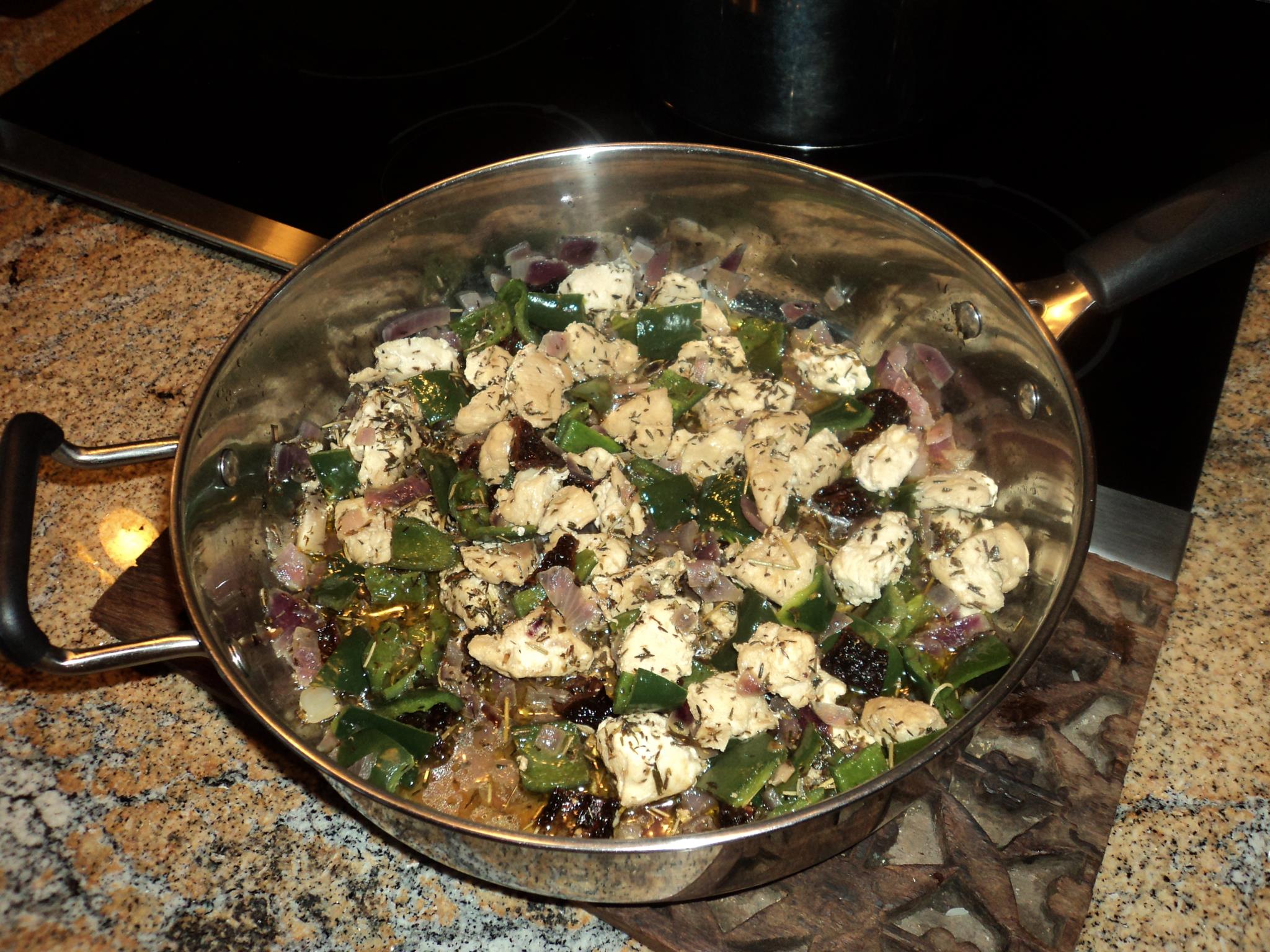
Chicken with poblano peppers, sun dried tomatoes and pasta


This recipe is posted as a tribute to Klara Kamper, from Austria.  Klara is an exchange student and nearly every week she has come over to ride my horse, Rosie.  After riding, I fix dinner.  Of all the different dinners I have fixed, this is Klara’s favorite.

4 pieces boneless chicken breasts, cut into bite sized pieces

2 large poblano peppers, deseeded and diced into bite sized pieces

1 large purple onion, chopped

5-6 pieces sun dried tomatoes, chopped into a large dice

Olive oil

Herbs de provence

Cover the bottom of a large skillet with olive oil.  Saute the onions until done.  Add chicken and more olive oil if necessary.  With your fingers sprinkle herbs de provence over the onion/chicken mixture.  When the chicken is nearly done, add the poblano peppers and sun dried tomatoes.  Saute until the poblano peppers are cooked but still a nice bright green.  You may also add mushrooms if you like.  Serve over your favorite pasta.  My daughter does not like herbs de provence so when I cook this for her, I use a  mixture of oregano, basil, and marjoram.

I am very, very picky about pasta.  My favorite is organic Montebello pasta produced by Monastero Di Montebello, Isola del Piano, Italy.  I especially like the conchiglie.  However, I use their spaghetti and other shapes as well.

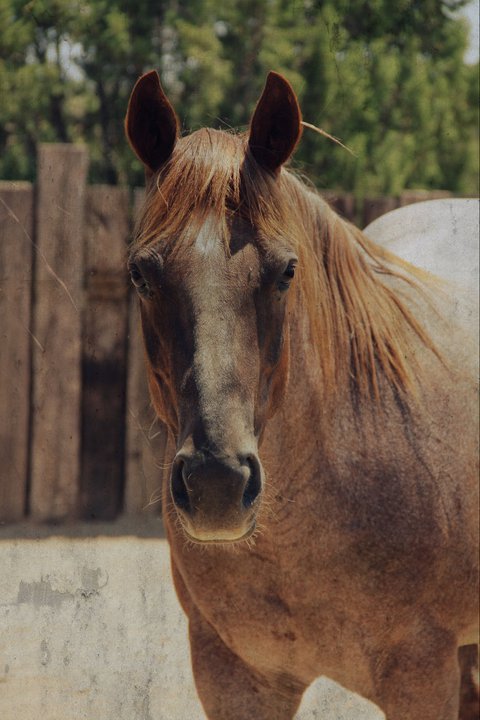
This is Rosie.  She will really miss Klara who leaves for home on June 25.


Rosie, who "adopted" Star after Miracle died.


A friend joined us to see the horses and for dinner.  Apparently, she took this photo just before I served dinner.

This is how you…


In preschool I had a few duties I remember, well maybe not remember—this story is part of family lore so old I cannot remember whether I remember only the lore or the occurrence itself.  At four, one chore involved walking from the house, across the backyard, across the drive, past the rose garden, then on the path between the big white barn and the huge vegetable garden to the chicken house behind the barn.  Each evening I took this trip before dark and shut the hen house door so the raccoons, skunks, and possums could not get in and eat the hens.  One night I forgot.  The night was dark, moonless.  Dad ordered me to the hen house.  He handed me a flashlight.  I refused, terrified.  He tried talking; I refused.  He tried force; I refused.  My mom understood my terror and finally intervened.  She told Dad, “You had better never ever do anything like that again!”  He didn’t.

By twelve, the terror had changed to pleasure.  I knew how to walk through the woods in the dark without a flashlight.  I knew how to walk through the woods in the dark silently so I could hear the animal sounds.  I knew how to walk through the woods in the dark happy and alone, free.  I still like to walk in the dark.

At twelve, I knew how to load a 22 rifle, to shoot raccoons and rabbits on the run, to clean the rifle afterwards.

I knew how to practice the piano for two hours straight.

I knew how to sing in front of a crowd of people.

I knew how to sew blouses, skirts, and dresses all by myself even though my mom could only sew on buttons.

I knew how to make fancy bows for the Christmas presents.

I knew how to fry chicken almost as well as my mom:

-this is how to check for pin feathers

-this is how you fill the paper sack with flour and salt

-this is how you fill the skillet with just the right amount of oil

-this is how you take the pieces out of the sack and put them in the hot

oil

-this is when and how you turn the pieces

-this is how you know when they are done

-this is how you drain the pieces on paper towels so it won’t be too

greasy.

I have not made or eaten fried chicken in years.

From six until I earned my Ph.D., this is how you make straight A’s in school:

-get organized

-be determined

-fill your soul with drive.

It helps if you are smart.

This is how you meet your parents’ expectations:

-keep your room neat

-keep your room clean

-keep your room perfect

-complete chores on time

-complete chores perfectly

-complete chores cheerfully

-study hard

-complete all homework

-make perfect grades

-dress nicely

-dress modestly, but not too prim

-dress in clean underwear in case you get in a car wreck.

I still get straight A’s.  I still have an overdose of drive.  I still write, play the piano, cook, ride horses, and sing.

It helps if you are smart.

As a rancher years later, I learned how to work cattle without my father’s help:

-this is how you “cut” or “band” yearling bulls

-this is how you give shots

-this is how you brand

-this is how you drive cattle on horseback down a road full of traffic

-this is how you save a  newborn, freezing calf:

-be brave and get it away from its mother

-carry it into the house or pickup truck

-wipe it down with towels

-blow it dry with your hair dryer.

This is how you train a horse to send to the race track:

-teach it to lead as a baby

-handle it every day if possible

-pick up its feet repeatedly

-rub your hands all over its body, especially on sensitive spots

-brush and comb it

-after it is older, rub a saddle blanket all over it and flap it in the wind

-hang plastic bags on its corral

-jump around a lot and desensitize it

-when it is a long yearling, put a saddle on it

-put a bridle or hackamore on it

-get long lines

-string them through the stirrups and teach it to drive in a round pen

-teach it to stand still

-get a flat saddle

-get on and ride

-do not teach it to neck rein

-ride often but for short periods of time.

Today as a teacher:

-this is how you solve for X and Y

-this is how you solve quadratic equations

-this is how you solve exponent problems

-this is how you solve word problems

-this is how you rationalize radicals

-this is how you determine how many grams are in one mole of a

chemical compound

-this is how you balance chemical equations

-this is how you conjugate common Spanish verbs

-this is how you write a sentence in Spanish

-this is how you translate a Mexican folk tale

-this is the date of the Magna Carta, the….

-this is how you write an essay

-this is how you learn new words from the context

-this is how you read for layers of meaning

-this is how…

It helps if you are smart.