Shafak is a popular Turkish writer. One of my all time favorite books is her novel about the life of Rumi.
“Three Daughters of Eve” takes place one evening in Istanbul in 2016. Peri, one of the daughters from the title, is on her way to a fancy party when a thief snatches her purse out of the back seat of her car which is stalled in traffic. She parks the car and chases him through back alleys. As she fights him for her purse, an old photo falls to the ground. It portrays three young women and their university professor. This photo jars her mind, takes her back to her time at Oxford University when she was a student there in 2000-2002, her childhood in Istanbul in the 1980s and 90s, and her life. She thinks back to her life with her two friends, Shirin, an adventurous Iranian young woman, and Mona, a devout Egyptian Muslim who word a headscarf out of choice. And then there is the famous professor Azur, whose class on God either makes students hate or love him and the scandal that caused Peri to return to Istanbul.
Until her daughter, who was in the car and eventually chases her mother down in the alley, sees the photo, no one, except her husband, seems to have known Peri even went to Oxford. Her daughter mentions it at the party while everyone is arguing about East and West and politics and who has the most money and how they acquired it. Peri tries to deflect questions, changes the subject, and keeps remembering her past: her parents, a father quite irreligious, her mother a devout Muslim, their endless arguments and hostility, her brothers, her childhood and her stint at Oxford.
Through the story of Peri’s life, this novel explores personal identity, East-West history and politics, the meaning of marriage and friendship.
Barbara Lewis Duke, pretty, petite, blue eyed and blond, my
mother, one fearless, controlling woman. Long after Mom’s
death, Dad said, “Barbara was afraid of absolutely no one
and nothing.” They married late, 34 and 38. He adored her
unconditionally. She filled my life with horses, music, love,
cornfields, hay rides, books, ambition. Whatever she felt she
had missed, my sister and I were going to possess: books,
piano lessons, a college education. Her father, who died long
before I was born, loved fancy, fast horses. So did she. During
my preschool, croupy years, she quieted my hysterical night
coughing with stories of run away horses pulling her in a wagon.
With less than one hundred pounds and lots of determination,
she stopped them, a tiny Barbie Doll flying across the Missouri
River Bottom, strong, willful, free.
Note: This poem about my mother has been published in at least one anthology and my book of poetry. My mother loved roses, had a rose garden. I now grow roses too.
Several months after Maclear’s father (who was a famous journalist) dies, she decides to take a DNA test to find out more about her family health and personality history, mainly because of the stories about a particular grandmother. She wonders if certain traits she and her sons have might possibly be inherited. The results of the test are a shock. Her father, the father she adored, who raised her and adored her, is not her biological father. At first, she thinks perhaps it was a sperm donor, but then she discovers this is not the case. Through the DNA test and her detective work, she finds two biological half-brothers (she was an only child before this discovery) who are willing to communicate with her, send her photos, etc. She tries relentlessly to acquire more information from her mother, who is often unforthcoming or tells her contradictory information. Then her mother gets dementia.
This is also a story of plants, of gardening. Both she and her mother are amateur botanists and expert gardeners. When nothing else works in their mother-daughter relationship, their love of plants and gardening holds them together. Even with dementia, her mother knows plants. Their other joint endeavor is ink drawings and love of art.
Additionally, this is the story of family, family secrets, inter-racial marriage, and challenging relationships. Kyo’s mother is Japanese living originally in England and later in Canada who often struggled with her status as a Japanese immigrant. Her “real” father, the one who raised her, was of British and Irish descent; her biological father was a Jewish formula one race car driver.
The author of this book, Guadelupe Rivera, is the daughter of Diego Rivera by the woman to whom he was married before he married Frida. Diego went on a trip to Russia and his then wife, the author’s mother, became attached to her previous boyfriend, the poet Jorge Cuesta. She and Diego divorced and then he married Frida. Eventually, the two couples became friendly and at one point they all lived in the same house.
Thirteen years after Diego married Frida, the author moved in with them. This book details her life living with Frida and her father, how Frida learned to cook, how she decorated the Blue House in Coyoacan, the fiestas, the food, the adventures. The book includes photos and recipes of Frida and Diego’s favorite foods, photos of the house, and places the author visited with Frida. It is also a story of many of Mexico’s famous people at the time.
I own several books about Frida but this one is the most revealing and intimate in many ways. If you like Mexican food and find the life and art of Frida and Diego of interest, read this book.
Note: It was also written by the journalist Pierre Marie-Colle with photos by Ignacio Urquiza.
A heart wrenching Prologue begins this contemporary novel about race, family, and friendship. Two children, one white (Jen) and one black (Riley), became best friends in kindergarten. Their close friendship endures to adulthood and through distance. Finally, once again in the same city, their bond is tested when Jen’s husband, a police officer, shoots an unarmed 14 year old black boy. Riley, a TV reporter, is assigned to interview the boy’s mother.
Their story, told from the viewpoints of both women, covers the effects of such a tragedy on family and fellow police officers and the community, illustrates the trauma of current events, and demonstrates how such a disaster tests all involved.
Note: This poem is published in my book “You’re Gonna Eat That? Adventures with Food, Family, and Friends”. My grandmother, Mom’s mom, rarely smiled. When Mom went to the hospital to have my sister, the family story is that Grandmother fed me so many bread, butter, and sugar sandwiches, I became fat. I was two. I remember a mint patch in her backyard. She’d gather mint, boil water, and make mint tea with cream and sugar. I liked it. When Aunt Julia traveled out of town, I remember seeing Grandmother eat butter and smile. This is Grandmother’s wedding photo.
Today I made the first leg of my journey from living in the Panhandle of Texas to living in the San Gabriel Valley in LA County, Ca. I have crossed New Mexico many times at various times of the year. I doubt I will ever again drive all the way across it again. One thing was very different this time, green. Usually, by this time toward end of summer, it is dry and hot. Not this time. Emerald green contrasting with the red rock outcrops proved quite lovely and dramatic. The green prevailed all the way to Flagstaff. The hottest temperature today along I-40 was 83 in NM and briefly a bit above 90 for a few miles in Arizona.
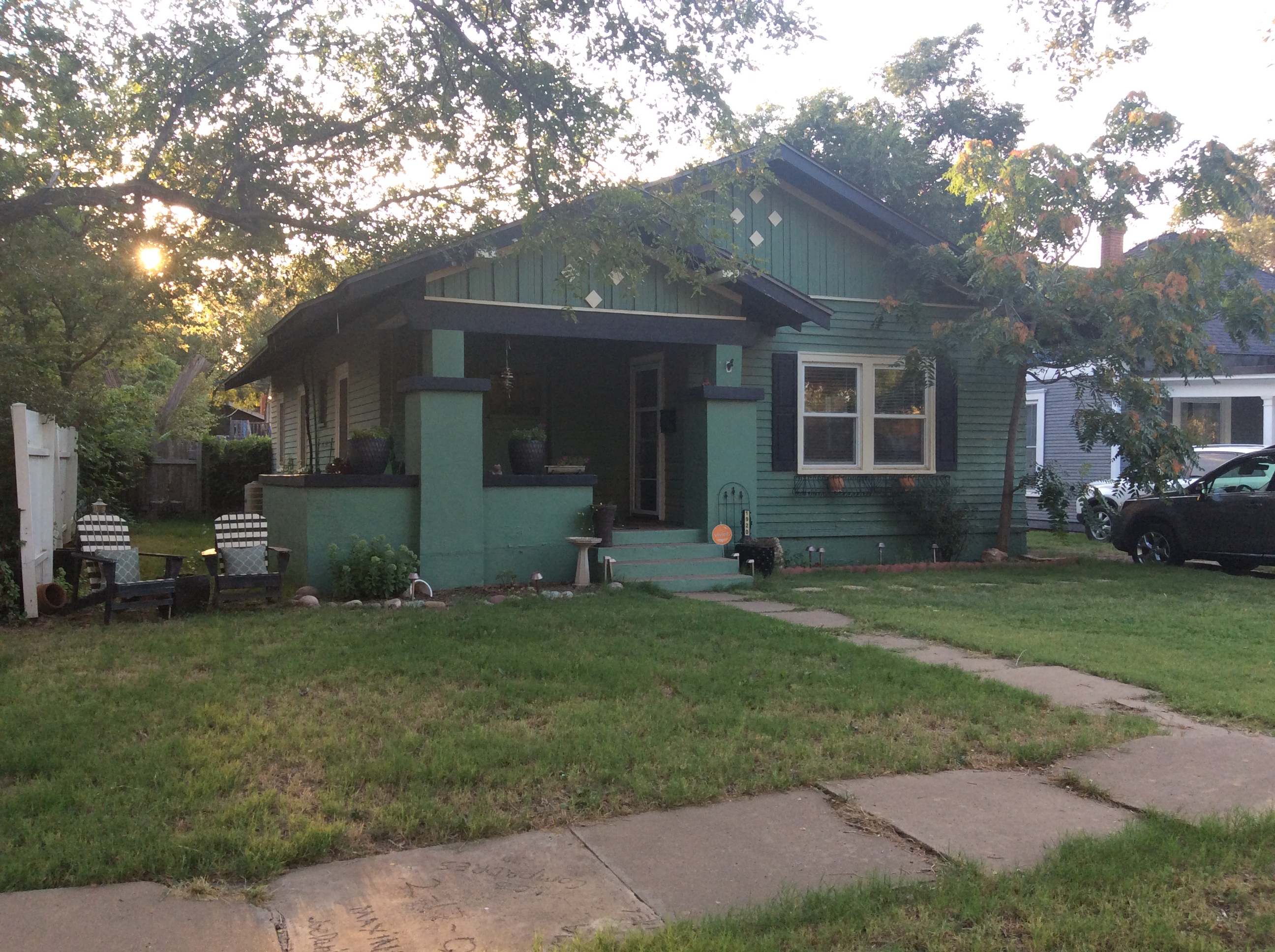
Just before I left my daughter’s house in Amarillo, I took a few photos. I have been going to her house for more than 18 years. My 17 year old grandson has spent almost his whole life there until a month ago. Will I ever return? Probably not. Nevertheless, the lovely memories of their life in this house will linger for the rest of my lifetime.