Book 19 for 2024: “Unearthing”, Kyo Maclear


Several months after Maclear’s father (who was a famous journalist) dies, she decides to take a DNA test to find out more about her family health and personality history, mainly because of the stories about a particular grandmother. She wonders if certain traits she and her sons have might possibly be inherited. The results of the test are a shock. Her father, the father she adored, who raised her and adored her, is not her biological father. At first, she thinks perhaps it was a sperm donor, but then she discovers this is not the case. Through the DNA test and her detective work, she finds two biological half-brothers (she was an only child before this discovery) who are willing to communicate with her, send her photos, etc. She tries relentlessly to acquire more information from her mother, who is often unforthcoming or tells her contradictory information. Then her mother gets dementia.

This is also a story of plants, of gardening. Both she and her mother are amateur botanists and expert gardeners. When nothing else works in their mother-daughter relationship, their love of plants and gardening holds them together. Even with dementia, her mother knows plants. Their other joint endeavor is ink drawings and love of art.

Additionally, this is the story of family, family secrets, inter-racial marriage, and challenging relationships. Kyo’s mother is Japanese living originally in England and later in Canada who often struggled with her status as a Japanese immigrant. Her “real” father, the one who raised her, was of British and Irish descent; her biological father was a Jewish formula one race car driver.

Book 11, 2024: ” Frida’s Fiestas: Recipes and Reminiscences of Life with Frida Kahlo”


The author of this book, Guadelupe Rivera, is the daughter of Diego Rivera by the woman to whom he was married before he married Frida. Diego went on a trip to Russia and his then wife, the author’s mother, became attached to her previous boyfriend, the poet Jorge Cuesta. She and Diego divorced and then he married Frida. Eventually, the two couples became friendly and at one point they all lived in the same house.

Thirteen years after Diego married Frida, the author moved in with them. This book details her life living with Frida and her father, how Frida learned to cook, how she decorated the Blue House in Coyoacan, the fiestas, the food, the adventures. The book includes photos and recipes of Frida and Diego’s favorite foods, photos of the house, and places the author visited with Frida. It is also a story of many of Mexico’s famous people at the time.

I own several books about Frida but this one is the most revealing and intimate in many ways. If you like Mexican food and find the life and art of Frida and Diego of interest, read this book.

Note: It was also written by the journalist Pierre Marie-Colle with photos by Ignacio Urquiza.

One Book a Week-29: “We Are Not Like Them”, Christine Pride and Jo Piazza


A heart wrenching Prologue begins this contemporary novel about race, family, and friendship. Two children, one white (Jen) and one black (Riley), became best friends in kindergarten. Their close friendship endures to adulthood and through distance. Finally, once again in the same city, their bond is tested when Jen’s husband, a police officer, shoots an unarmed 14 year old black boy. Riley, a TV reporter, is assigned to interview the boy’s mother.

Their story, told from the viewpoints of both women, covers the effects of such a tragedy on family and fellow police officers and the community, illustrates the trauma of current events, and demonstrates how such a disaster tests all involved.

National Poetry Month-2: Butter Love


Is it inherited?

Six year old me watched Grandmother

look around, take silver knife, cut into pale

yellow rectangular prism, plop a chunk into

her mouth, close her eyes,

smile.

In Aunt Julia’s presence, this never occurred,

Was it our shared secret,

Grandmother and me?

Yesterday, I told the cafeteria lady,

“Please bring me biscuits, extra butter.”

Less courageous than Grandmother,

I use blue corn pancakes, homemade bread, pasta,

excuses to eat butter, lots of golden, melted

butter.

Who eats butter on conchiglie?

I do, scooping out a tablespoon

from the butter bowl, watch it melt

in hot, drained Italian pasta from a

six-hundred-year-old monastery,

sprinkle on some sea salt, plop

a spoonful in my mouth, close my eyes,

smile.

Note: This poem is published in my book “You’re Gonna Eat That? Adventures with Food, Family, and Friends”. My grandmother, Mom’s mom, rarely smiled. When Mom went to the hospital to have my sister, the family story is that Grandmother fed me so many bread, butter, and sugar sandwiches, I became fat. I was two. I remember a mint patch in her backyard. She’d gather mint, boil water, and make mint tea with cream and sugar. I liked it. When Aunt Julia traveled out of town, I remember seeing Grandmother eat butter and smile. This is Grandmother’s wedding photo.

Moving 4–Bittersweet


Today I made the first leg of my journey from living in the Panhandle of Texas to living in the San Gabriel Valley in LA County, Ca. I have crossed New Mexico many times at various times of the year. I doubt I will ever again drive all the way across it again. One thing was very different this time, green. Usually, by this time toward end of summer, it is dry and hot. Not this time. Emerald green contrasting with the red rock outcrops proved quite lovely and dramatic. The green prevailed all the way to Flagstaff. The hottest temperature today along I-40 was 83 in NM and briefly a bit above 90 for a few miles in Arizona.

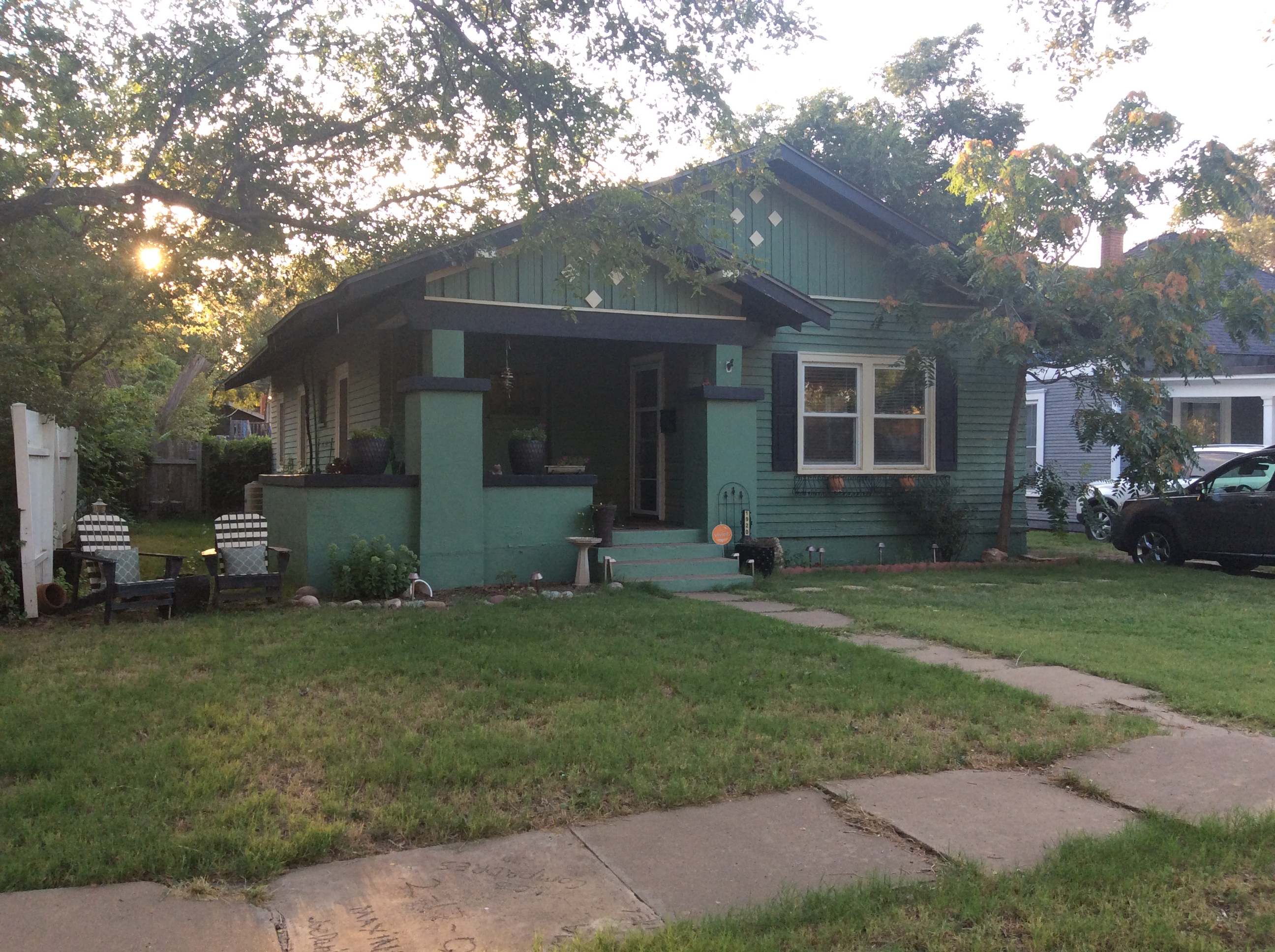
Just before I left my daughter’s house in Amarillo, I took a few photos. I have been going to her house for more than 18 years. My 17 year old grandson has spent almost his whole life there until a month ago. Will I ever return? Probably not. Nevertheless, the lovely memories of their life in this house will linger for the rest of my lifetime.

Barbie Doll– a poem about my mother


Barbara Lewis Duke, pretty, petite, blue-eyed and blond, my

mother, one fearless, controlling woman. Long after Mom’s

death, Dad said, “Barbara was afraid of absolutely no one

and nothing.” They married late, 34 and 38. He adored her

unconditionally. She filled my life with horses, music, love,

cornfields, hayrides, ambition. Whatever she felt she

had missed, my sister and I were going to possess: books,

piano lessons, a college education. Her father, who died long

before I was born, loved fancy, fast horses. So did she. During

my preschool, croupy years, she quieted my hysterical night

coughing with stories of runaway horses pulling her in a wagon.

With less than one hundred pounds and lots of determination,

she stopped them, a tiny Barbie Doll flying across the Missouri

River Bottom, strong, willful, free.

My mother many, many years later with Dad. I took a photo of a photo I have hanging in the hall–the sun reflecting in the windows.

In Honor of My Father


The Nap

He lays on his back on the cold, hard, blue linoleum floor after

the midday dinner of homegrown roast beef, potatoes, wilted

lettuce salad, hot coffee, coconut topped cake.  His left arm

forms a right angle at the elbow as the back of his wrist rests

on his forehead, touching the slight curliness of his not quite

black hair.  His left leg stretched out straight, right one drawn

up, knee jutting out.  The sleeves of his worn, pale blue dress

shirt rolled up; his overalls show signs of wear and washing.

Every day after dinner he naps in the same spot in this same

position for exactly fifteen minutes before returning to the field.


My father.


Seventeen years after his death, one day as I napped, slowly

driving off, astonishment stuck.  There I lay exactly as my

father used to so many years ago, my left arm forming a right

angle, wrist on my forehead, left leg stretched out straight, right

one drawn up, knee jutting out.  I remember not just in heart

and mind.


The body always knows.


10010469_10201104950059786_1020986835_o

Taken at the top of Mt. Evans in Colorado when I was a child.


The World in One Room


Four jaguar heads stare at me,

Mexican, Costa Rican.

A third guards the mantel,

partially hidden in tropical plants,

attack ready, tail raised, jaws open,

teeth bared.


My feet rest on a coffee table

carved in Kashmir.  I look at the photo

of the young man whose family made it.

He took me home to meet his mom,

to the floating market.

Once peace reigned there.

Now I wonder if he is safe, alive.


The Hoop Dancer raises his arms,

the Acoma pot exudes ancient

black on white beauty, painted

by the tips of yucca stems.

The Thai Spirit House begs

to appease evil spirits.

I should put food and flowers there;

I never do.


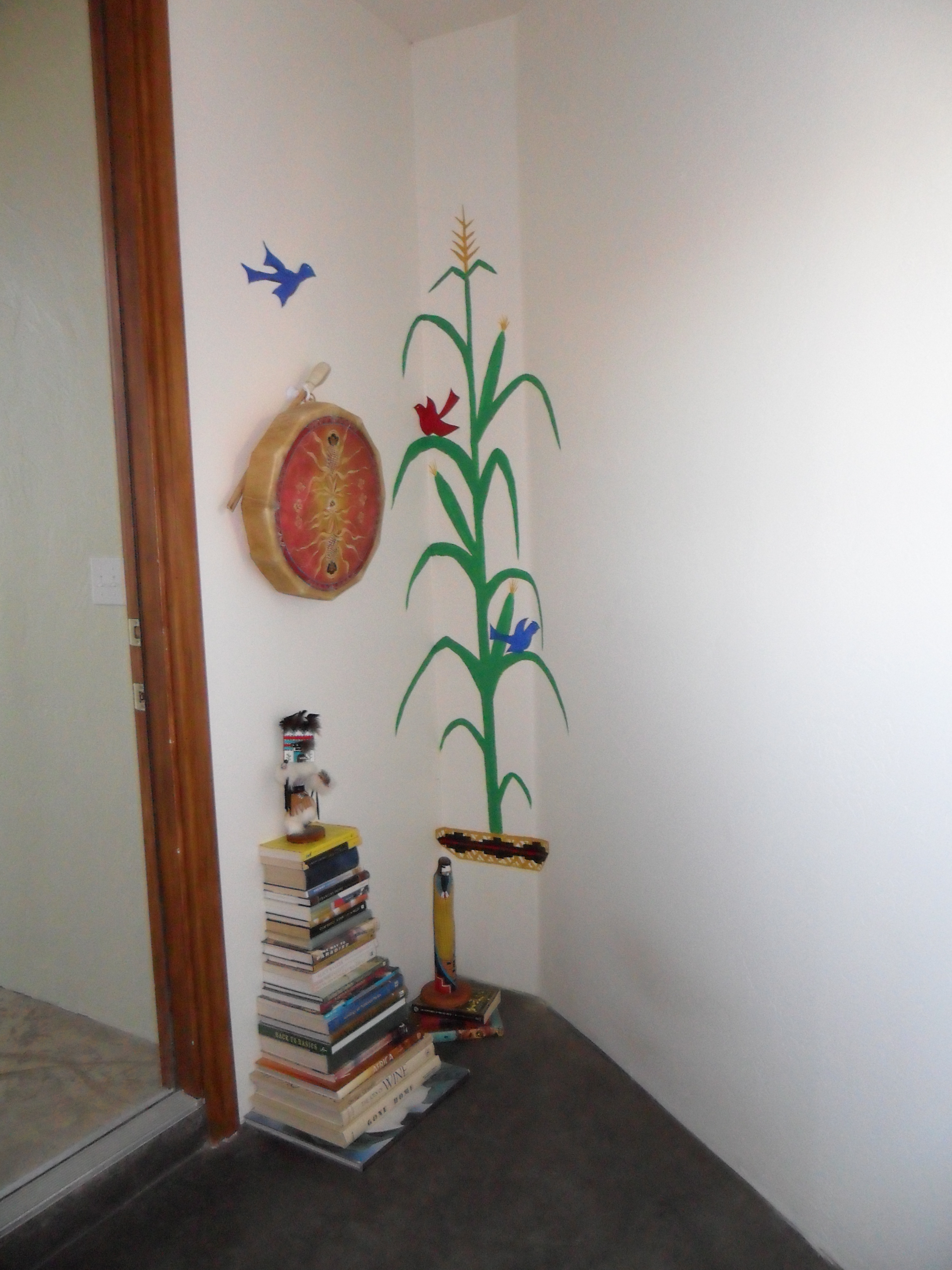
Corn plant of life–for Navaho, Hopi,

me, painted, growing up my wall,

blue and red birds flitting through

the stalks, singing ancient songs.

Corn Maiden rug hanging on the wall;

an Isleta Pueblo girl won a contest

with its design.  Four Corn Maiden

Kachinas watch the room.

Corn everywhere–Sacred Corn.


Three Ethiopian crosses, St. George

and the Dragon, Frida Kahlo doll,

Argentinian Madonna, Tohono O’odham

baskets, a painted cow skull, Nigerian carved

wooden elephants, including a Chieftains chair,

the stained glass transom window from the house

where my dad lived from birth to ten.


In a room filled with windows, there

is little room for paintings, yet–

purple bison glide across the prairie,

an Iraqi woman flies through an azure

sky filled with dark blue birds,

a 15th century mystic, Kabir, tells

a tale in poetry, Navaho spirits,

pumas walking toward me–

my obsession.


Rugs scattered–Kerman,

an unknown Persian city, Afghani,

Egyptian, Indian, Zapotec, scraps of old

Turkish rugs sewn together.


In one cabinet, Grandmother’s china,

Mom’s Czech crystal–a wedding present

decades ago, Grandson’s painted art,

the silverware Dad gave Mom on their

first wedding anniversary,  Mom’s

everyday dishes–flowers blooming.

I use them every day.


These objects–a testament to who I am:

World wanderer, seeker, citizen.

SAM_0912

SAM_0035


A Birthday Tale


Several weeks ago, the tail of my favorite horse, Miracle, disappeared.  When she died from colic after giving birth several years ago, one young lady at the vets took hairs from her tail, made a braid, and gave it to me.  Since then, it had hung in the hallway next to Dad’s spurs and a photo of the family farm above Dad’s parade saddle. Suddenly, it disappeared.  Where could it have gone?  No one had recently been to the house except Martina, my Italian exchange student, and me.  My daughter and grandson had stopped by, but no one else.  Nothing else had disappeared.  It was a mystery like the time I found a handful of dry dog food under the saddle.  I never solved that one and had given up on solving this one.  I had even considered looking for something else to hang in its place.

On my birthday yesterday, the principal walked to my room with a bouquet of flowers and a package.  The bouquet was from my grandson.  I opened the package. Much to my astonishment, there was Miracle’s tail, the top of the braid carefully and colorfully wrapped, a thin copper wire winding through it, and and then wrapped around the bottom.  My daughter had managed to take it without my seeing her do so, took it home, and had wrapped it so it would not come apart.  When I originally told her about it, she and my grandson commented how strange it was and made note of the dog food incident as if some mystery lurked in that particular place in my house.

IMG_3599

IMG_3591

My grandson had picked out each individual flower.  He obviously knows my favorite color is orange.

Then to top off the day my son also sent flowers.  It dropped 50 degrees from yesterday afternoon to late last night, the wind shrieks, clouds loom dark and ominous.  It is a good day for bright flowers.

IMG_3601

An “Italian” Evening–Two


My daughter and grandson arrived shortly after six.  First course included nuts, cheeses, crackers, blue corn chips and salsa–I know, not Italian.  For the adults, Stella Rosa Black from Italy.  For the non-adults organic apple juice.

While we snacked on the first course, we created two versions of Pasta alla Carbonara, one for my vegetarian grandson and one without much parmesan cheese for everyone else.  Traditionally, this dish requires parmesan cheese; however, my daughter is lactose intolerant so we created the other one for her.  The rest of us just topped off our dish with grated parmesan at the dinner table.

We used conchiglie from Monastero di Montebello in Italy for the pasta and for version two, pancetta cut into cubes.  For the vegetarian version we used Morning Star bacon.  Here is the basic recipe for pasta alla carbonara:

cooked pasta

bacon or ham, cut in cubes or small pieces

whipped eggs, approximately one egg for every two people

finely chopped onions sautéed in olive oil–we used one large onion for four

grated parmesan cheese–1/8 to 1/4 cup per person (you can use half parmesan and half pecorino)

Saute onions until translucent.  If you are using any bacon except pancetta, cook it first but not until too crispy.  Add the bacon and heat through.  Add the cooked pasta and the whipped egg/cheese to the onion/bacon mixture.  Continually stir until thoroughly combined and the eggs are cooked.

When to start cooking the pasta so it is cooked and ready to combine with the other ingredients depends on the type of pasta you use.

We served this with a large salad:  leaf lettuce, shredded purple cabbage, chopped red bell peppers, onions, chopped carrots,  balsamic vinegar and olive oil.  We concluded the evening with three different ice cream choices for dessert.

img_3542

img_3499

img_3540

In case you are wondering why the Christmas tree is still there, well, Martina and I like the lights so we keep procrastinating taking it down.  I keep telling myself today it will be dismantled and then it is not.  Tonight it will come down–maybe.