Book 12 for 2025: “Girls of Riyadh”, Rajaa Alsanea


I was not looking for this, but rather accidentally found it while strolling through the stacks at the local library. What an informative and entertaining book. When it was first published in Lebanon in 2005, it sort of shocked the Arab world causing public debates about the subject matter and story both pro and con. The novel centers on the lives of four upper class Saudi young women who have known each other for years and are friends. Because the book openly discusses the difficulties young educated Saudi women have pursuing education and careers while also trying to find suitable men to marry, the religious conservatives found the novel blasphemous and wanted it banned. Others said it disrespected Saudi women. Black market copies showed up everywhere and the author became an overnight sensation.

The book focuses on the difficulties these women experience as they navigate the modern world while still living in a society founded in very conservative patriarchal cultural conditions. They want to believe in love and hope they will find someone to marry they also love. However, traditions get in the way of this goal more often than not. Some of them find someone they love and who loves them but families forbid it–the person is not high enough status or has been divorced, or…the barriers seem endless, focused on family connections. Love is considered a frivolous, unhealthy distraction.

Contrary to what I believed before reading this, most of these higher class Saudi young women are going to college, often in subjects like medicine and dentistry, and plan to pursue careers in their fields. Many have travelled to Europe where they are freer to roam, not dress conservatively, etc. Yet they return home because of close family ties and love of country. Several of the fathers in this novel are considerably more liberal than the girls’ mothers. Like any society the view of progress and tradition vary greatly by family and individual.

Because as a reader you get to “know” these young women, I found myself reading nonstop because I really wanted to know what was going to happen, whether any of them would be allowed to marry someone they loved or would be heartbroken and forced into unwanted situations. The latter never occurred thankfully. None were forced to marry someone they disliked. It is a great read for those who are curious about other cultures and how women navigate their lives in a place dramatically different from what is more common in Europe and the US.

Nostalgia


Today is the first day of National Poetry Month. I am committing myself to write a poem a day. Here is the first one for the month.

Easter yesterday made me sad,

remembering children, grandson,

egg dying, egg hunting, family

together, laughter, joy.

Found photos of my family,

I, a child, dressed in Easter finery,

a family tradition. Dad bought us

corsages to wear every Easter,

pretty dresses in spring colors–

my favorite a pink dress trimmed

in scarlet, a unique combination

explained why I liked it so much,

felt special wearing it.

Today I wear pink and orange

together, admire the deep purple

and red bougainvillea, scarlet rosebuds,

snowy freeway daisies,

shining in the sun and wonder

will I live long enough to teach

a great grandchild to color

Easter eggs.

The Christmas Tree


In childhood, no fake tree for us.

Just after Thanksgiving, the family search transpired.

Mom and Dad preferred Douglas fir, six feet tall.

Dutifully, we kept the tree holder filled with water,

never used real candles.  We put on lights, big ones,

blue, green, red, an inch long, then carefully hung on delicate,

colorful, round balls.  The most difficult task: the icicles,

long, silver, reflective.  They had to go on just so.

Years later, children gone, Mom and Dad bought an

artificial tree, fake Douglas fir, incredibly real in appearance.


When they left Missouri for Arizona every winter after harvest,

they abandoned Christmas trees, gave me the fake Douglas fir.

I still have it.  How long?  Decades, several at least.  State of the art

when they bought it, it requires work, assembly, strings of lights.

Every year, I tell myself it is time to get one of those new trees with lights

already installed, so much easier to take up and down.  I never buy one.

I cannot bear to part with Mom and Dad’s tree.  One year, annoyed with

putting on lights, I decorated it lightless.  I missed the lights.  Now every year,

decades later, I assemble it, take the time to string the lights.  Some of the lower

branches no longer stay, but I work around that, hang the colorful, delicate

Christmas ornaments I love, collected over years and years, wrap the base in

the red and white cloth given to me from Africa. On cold evenings, like this one,

I turn off the other lights, drink tea like my mother did, and remember my

childhood.

IMG_3526

IMG_3530

IMG_3534


Rye Bread with Cardamon and Golden Raisins


Every year for so many years I fail to recall, I have made this bread during the holiday season.  Why then, I have no idea because the bread is not just for winter or anything in particular.  It makes three loaves and a good present; maybe that was the original reason.  It also takes more time than ordinary bread; I usually have time off during this season.

2 packages yeast

1/2 cup warm water

1 1/2 cups light cream or evaporated milk

2 cups unsifted, unbleached flour

3 eggs

2/3 cup sugar

1 cup butter, melted and cooled

2 tsp. fresh ground cardamon

1 cup golden raisins

1 cup milk

2 cups rye flour

1 cup whole wheat flour

3 – 3 1/2 cups unbleached flour

In a large bowl dissolve yeast in water. Stir in the cream or evaporated milk.  Add the 2 cups flour; beat until smooth.  Cover and let rise in a warm place until doubled.  Stir in the eggs, sugar, butter, golden raisins, and cardamon.  Beat until smooth.  Add the milk and rye flour and stir until combined.  At this point using a dough hook makes it easier.  Add the whole wheat flour and enough of the unbleached flour to make a stiff dough.  Sprinkle remaining flour onto a board or granite counter top.  Knead until smooth.  Oil a large bowl, place dough in bowl and turn to grease both sides.  Let rise until doubled.  Punch down and work into a smooth ball.  Divide into three equal portions.  Place in three pans of your choosing (I use one regular loaf pan and two cake pans).  After dough has risen to double in size, bake in a 350 degree oven.  While loaves are still hot, brush with butter.  Allow loaves to cool before removing from the pans.

This bread is especially good with Swiss cheese or other similar cheeses and makes a tasty left over turkey sandwich.


Mom’s Pumpkin Pie Recipe


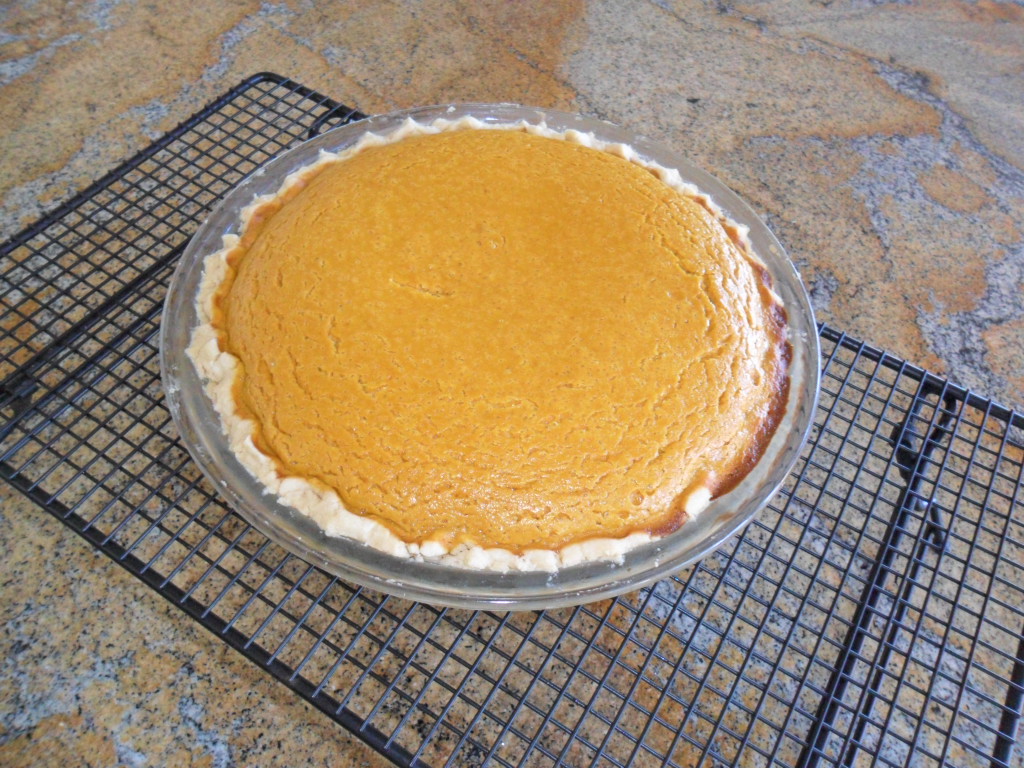
Today, Thanksgiving Day, I will make Barbara Duke Lightle’s (my mother)  pumpkin pie, using a recipe and blender she gave me decades ago.  The recipe includes a small hand written note about her preferred way of combining the ingredients.  My grandson loves this pie and the idea that what he is eating is a recipe from his great grandmother, a woman he will never know.  He tries other pumpkin pies but likes only this one.  Dad loved this pie, too.  After Mom died and he discovered he was gluten intolerant, he taught himself to cook.  He made this for himself sans the crust–pumpkin pudding.

1 1/2 cups cooked or canned pumpkin

1 1/2 cups milk or milk combined with cream or evaporated milk

3 eggs

3/4 cup brown or white sugar

1 tsp ground cinnamon

1 tsp ground nutmeg

1/2 tsp ground ginger

(or use 1/2 tsp nutmeg and 1 tsp ginger for a more spicy flavor)

Place all ingredients in a blender.  Place your hand over the blender cover before starting the motor.  Blend just  a few seconds, until smooth, and pour into pastry lined pie shell.  Bake at 450 for ten minutes, then bake at 350 for 30 minutes longer or until firm in the center.  A piece of outer peel of orange can be blender grated into the pie mixture–if you do this, place in blender with 1/2 cup milk and blend fine before adding other ingredients.

You may use squash instead of pumpkin.

The hand written note says, “Juliana, if you use half evaporated milk it gives wonderful flavor and I like white sugar best”.

I use evaporated milk totally and white sugar like Mom recommended.  I have never used orange peel.  The cinnamon I am using today comes from a tree at my friend’s mother’s house in Ethiopia.

This seems a great day to also thank my mother for all she taught me:  cooking, singing and playing the piano, a love of beauty–flowers, wildlife, good food, the list is endless.  She taught me think positively, to believe in myself, to make the most of what life brings, to never give up.  Thank you, Mom!!!

SAM_1381