Book 18 for 2026: “The Hakawati”, Rabih Alameddine


In Lebanese, a hakawati is a traditional teller of legends, tales, all sorts of stories. Two basic sets of stories run parallel in this 500 plus page novel. One set is the family story of the narrator whose grandfather was a famous hakawati. This part of the novel portrays life in contemporary Lebanon and the life of the narrator who emigrated to the US to attend UCLA engineering school and stayed in the US. He tells about his family history and his growing up, the various invasions of Israel into Lebanon and how it affected his family and friends, and how his family deals with their blended ethnicities, e.g Druze, Maronite, Orthodox. The novel alternates between this family’s story and traditional Middle Eastern tales of military heroes, jinn, magic, the underworld, etc. That portion of the novel is a sort of more modern One Thousand and One Nights.

My favorite quote from the novel is this: “Uncle Jihad used to say that what happens is of little significance compared with the stories we tell ourselves about what happens. Events matter little, only stories of those events affect us.” I reread this several times and thought about how even in the same family, individuals remember an event totally differently. This novel is also a reminder that even though Lebanon is in a totally different part of the world, families everywhere are more similar than different–the likes and dislikes, the family feuds, the emotions–in this all families remain the same no matter where on Earth.

“Barbie Doll”–in honor of my mother


Barbara Lewis Duke, pretty, petite, blue-eyed and blond, my

mother, one fearless, controlling woman. Long after Mom’s

death, Dad said, “Barbara was afraid of absolutely on one

and nothing.” They married late, 34 & 38. He adored her

unconditionally. She filled my life with horses, music, love,

cornfields, hay rides, books, and ambition. Whatever she felt she

had missed, my sister and I were going to possess: books,

piano lessons, a college education. Her father, who died long

before I was born, loved fancy, fast horses. So did she. During

my preschool, croupy years, she quieted my hysterical night

coughing with stories of run away horses pulling her in a wagon.

With less than one hundred pounds and lots of determination,

she stopped them, a tiny Barbie Doll flying across the Missouri

River Bottom, strong, willful, free.

Note: This was first published in an anthology and later in my poetry memoir, “On the Rim of Wonder.” My mom loved the color pink and roses, had a rose garden. In the summer there were always crystal bowls on the dining table with roses floating. Today I have roses floating in two stemmed crystal bowls in my kitchen.

Book Nine for 2025: “Martyr”, Kaveh Akbar


“She was Christian but American Christian, the kind that believed Jesus just needed a bigger gun”–part of the description of the main character’s rich, not dentist mom rich but oil, trust fund rich, blue-eyed, blond girlfriend. Cyrus, the main character is an Iranian American whose father immigrated to the US when Cyrus was a baby after Cyrus’ mom was killed when the US shot down an Iranian passenger plane thinking it was a bomber (July 1988). His dad acquires a job at a Midwestern chicken farm, counting eggs, but special eggs. This farm breeds chickens to grow faster to get to market faster. He works six days a week, long hours, until Cyrus, who excelled in elementary and high school, becomes a sophomore in college. Suddenly, his dad dies.

Cyrus becomes an addict using alcohol and drugs and writes poetry and eventually finishes college. He becomes obsessed with and researches martyrs throughout history–people like Hypatia of Alexandria, Bhagat Singh, Emily Wilding Davison, the Soulit Women. He gets sober and obsessed with his own past. This eventually leads him to travel to Brooklyn to talk to a famous artist whose last exhibit is herself talking to visitors as she dies of cancer. In researching this woman’s paintings, he discovers a strange painting of a young man dressed as an angel whose job as a soldier is to ride at night with a flashlight through the fields of the dead and dying Iranian soldiers consoling them during the Iran/Iraq War. Cyrus knows that his mom’s brother had this actual job during that war and wonders can there be a possible the connection.

Throughout these events the reader is lead to not only explore Cyrus’ thoughts and beliefs but also those of his father, mother, uncle, and best friend, Zee. It is rare for a novel to be both heart wrenching and funny. Akbar accomplishes this task. One moment I found myself laughing out loud and the next almost in tears. I could not stop reading even though the paperback is long. Perhaps my knowing something about Iranian culture, food, etc. helped me appreciate some of the book more than I might have otherwise. Nevertheless, this is a universal story about love, discovering oneself, relationships, parenthood, human nature. It is definitely worth taking the time to read.

Book Seven for 2025: “The Map of Salt and Stars”, Zeynab Joukhadar


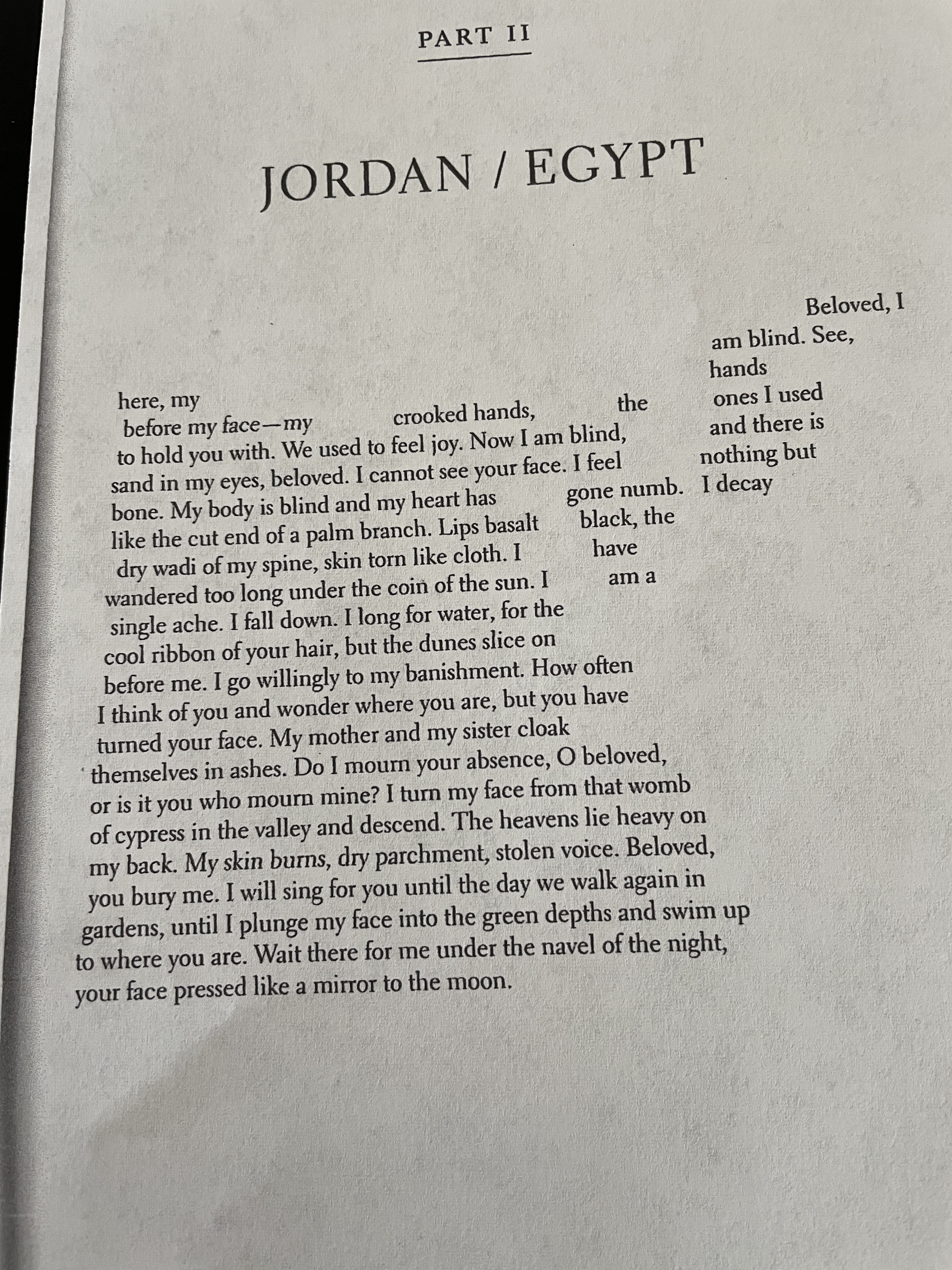
Two young heroines dominate this fascinating novel which switches back and forth between the Syria of 2011 and the 12th century. The latter is a girl who disguises herself as a boy to join the quest of a famous mapmaker. Nour, the first girl, lost her father to cancer in NYC. Then her mother, a mapmaker, decides to move herself and the three daughters back to Homs, Syria. They barely settle into their new life when the civil war breaks out and a bomb destroys their house. They become refugees. This is the tale of their harrowing journey from Syria to Jordan to Egypt to Libya to Algeria, then Morocco and finally to Cuenta, the Spainish city on the north coast of Africa, where their uncle lives.

To keep sane, Nour repeatedly tells herself the story of Rawiya, the disguised girl who is an apprentice to the map maker. When he was alive, this was the favorite traditional story her father told her. The book alternates between what is really occurring to Nour and her refugee family and this ancient story. At the beginning of the section for each country through which they travel, there is a touching and beautifully written poem in the shape of the map of that country. The poem for Jordan/Egypt is printed below.

Book Two for 2025: “Memory Wall Stories”, Anthony Doerr


While wandering around in the library, I found this book. His two more recent novels, ” All the Light We Cannot See” and “Cloud Cuckoo Land” remain two of the most touching and fascinating novels I have ever read so decided to try what he started with, short stories. These stories do not disappoint.

The title of the book comes from the first of the stories. It is a combination of science fiction and paleontology. Via an operation to his head a young boy in South Africa possesses the memories of an old woman. Through her memories he learns of a her deceased husband’s interest in rocks and fossils. This allows him to make a discovery that changes lives. In the next story, due to the death of her parents, a young girl in Kansas has to move to Lithuania to live with her grandfather and makes a myth come true. The following story, “Village 113”, won the O. Henry Prize. It details what happens to one woman, a keeper of seeds for an entire village, when the Three Gorges Dam was built in China. Another story tells what happens to a couple in Wyoming when they desperately want a child but cannot conceive. The shortest of the stories, “The Demilitarized Zone”, is well about that–sort of. The final story, like several others, is about memory, in this case the memories of a Holocaust survivor, who like many who survive horrible events when others they know do not, wonders why her.

I liked these stories so much that I ordered his earlier collection of short stories, “The Shell Collector.” He has won the O. Henry Prize for short stories five times and the Pulitzer for “Cloud Cuckoo Land” in 2015. I keep wondering how he knows so much about so many places. His short stories and novels are set in countries all over the world. The research must never end.

Book 46 for 2024: “What Happened to Ruthy Ramirez”, Claire Jiménez


The Puerto Rican Ramirez family lives on Staten Island. The book begins years after one of the three daughters, Ruthy, disappears at the age of 13 while on her way home after her school track practice. Twelve years later while watching TV, Jessica, the oldest daughter, sees someone on a reality show who looks like Ruthy. The woman on the TV has red hair like Ruthy and the same birthmark mole. Jessica tells her younger sister, Nina. They concoct a plot to go to the reality show site and bring Ruthy (if she is really Ruthy) home. They avoid telling their mother, Delores, who has never ceased struggling over Ruthy’s disappearance. Delores discovers their plot and insists on not only joining them, but also bringing her older Pentecostal friend who frequently falls into spiritual spells on the floor at church. Eventually, they all head to Boston where the show is located and all kinds of turmoil occurs.

The novel is told from the viewpoint of each sister and their mother, providing endless details about their Puerto Rican culture, their jobs, their views, and how they feel about each other, all done with dialogue. Sometimes it is loving, sometimes snarky as it deals with their experiences with racism, sexism, family secrets, and violence. As a reader, I, too, wanted to know what happened to Ruthy. Definitely worth the read.

Book 32 for 2024: “The Premonition”, Banana Yoshimoto


Translated from Japanese, this short novel tells the story of a 19 year old young woman, Yayoi, who lives with a loving family–her mother, father, and brother. Yet she has a premonition that she has missed something from her childhood, forgotten something. She decides to move in with her aunt, Yukino, a gifted eccentric who sometimes awakens Yayoi in the middle of the night to eat and drink, who watches “Friday the 13th” over and over, who just throws unwanted stuff in the back yard and leaves it there among the weeds. While living in the midst of Yukino’s disordered life, Yayoi’s memories begin to resurface. When her aunt disappears, Yayoi and her brother go in search of her and learn mysteries of Yukino’s life. Later, while still searching for Yukino, Yayoi discovers the truth of her own life.

This novel was a best seller in Japan when it was first published there in 1988. It was not translated into English until 2023. Eleven other novels by this author were already available in English.

Book One for 2024: “Rain of Gold”, Victor Villaseñor


The lady in charge of the College Center at Mendez Learning Center told me about this book, one of her favorites. I received it for Christmas from my grandson. It is the first book I read this year.

Although it reads like an epic novel, it is non-fiction, the story of Victor Villaseñor’s family tracing back to his four grandparents in Mexico, one set from Jalisco and the other from the rugged mountains closer to the US border. All left Mexico to escape the violence of the Mexican Revolution and eventually settled in Southern California.

Some of the events in this story are heart wrenching incidents of violence, even death, blatant prejudice, and economic poverty. On the other hand, I often found myself laughing out loud, it was so funny. The author’s parents remain perfect examples of strong people who never give up, whose persistence and determination lead to prosperous lives as successful business owners. The author continues to live on the ranch where he grew up in northern San Diego County. Now 83, he has authored many books including a sequel to this one. His website not only talks about his life and writing, but also struggles with dyslexia.

National Poetry Month-2: Butter Love


Is it inherited?

Six year old me watched Grandmother

look around, take silver knife, cut into pale

yellow rectangular prism, plop a chunk into

her mouth, close her eyes,

smile.

In Aunt Julia’s presence, this never occurred,

Was it our shared secret,

Grandmother and me?

Yesterday, I told the cafeteria lady,

“Please bring me biscuits, extra butter.”

Less courageous than Grandmother,

I use blue corn pancakes, homemade bread, pasta,

excuses to eat butter, lots of golden, melted

butter.

Who eats butter on conchiglie?

I do, scooping out a tablespoon

from the butter bowl, watch it melt

in hot, drained Italian pasta from a

six-hundred-year-old monastery,

sprinkle on some sea salt, plop

a spoonful in my mouth, close my eyes,

smile.

Note: This poem is published in my book “You’re Gonna Eat That? Adventures with Food, Family, and Friends”. My grandmother, Mom’s mom, rarely smiled. When Mom went to the hospital to have my sister, the family story is that Grandmother fed me so many bread, butter, and sugar sandwiches, I became fat. I was two. I remember a mint patch in her backyard. She’d gather mint, boil water, and make mint tea with cream and sugar. I liked it. When Aunt Julia traveled out of town, I remember seeing Grandmother eat butter and smile. This is Grandmother’s wedding photo.

Mother, Barbara Lewis Duke


Mom was tiny, tough, and pretty.  She acquired the name Lewis because my grandparents had hoped for a boy and, for reasons I do not know, wanted a child named Lewis.  My grandparents named her younger brother Louis.  The following poem about my mother is one of the prose poems in my new book of poetry, On the Rim of Wonder, published last month by Uno Mundo Press.  Currently you can purchase it from Amazon or if you are in Amarillo, at Hastings on Georgia.  Shortly, it will be available on Kindle and signed copies can be ordered from me.


Barbie Doll


Barbara Lewis Duke, pretty, petite, blue-eyed and blond, my mother, one

fearless, controlling woman.  Long after Mom’s death, Dad said, “Barbara was

afraid of absolutely no one and nothing”.  They married late:  34 and 38.  He

adored her unconditionally.  She filled my life with horses, music, love,

cornfields, hayrides, books, ambition.  Whatever she felt she had missed,

my sister and I were going to possess:  books, piano lessons, a college education.

Her father, who died long before I was born, loved fancy, fast horses.  So did she.

During my preschool, croupy years, she quieted my hysterical night coughing

with stories of run away horses pulling her in a wagon.  With less than one hundred

pounds and lots of determination, she stopped them, a tiny Barbie Doll flying

across the Missouri River Bottom, strong, willful, free.