Book 14 for 2025: “About Grace”, Anthony Doerr


This is one of the most heart wrenching books I have ever read. As a child, the main character, David Winkler, discovers he possesses the ability of premonition via dreams that come true. Only his mother understands him; unfortunately she dies while he is still young, leaving him with father who is only physically there. He becomes an hydrologist, specializing in the structure of snowflakes, leading a rather lonely life as a weatherman in Alaska. While at the grocery store, he meets a woman. He knows what she is going to do before she does it. Eventually, they develop a relationship. The remainder of the novel details the consequences of their relationship and their having a child, Grace. David dreams that he will not be able to save Grace from flood waters, his wife thinks he is crazy, and then to avoid what he perceives will be Grace’s fate if he stays, he disappears. Eventually, he arrives hungry and destitute on a Caribbean island where he is taken in by a kind family who have escaped imprisonment in Chili during the military dictatorship there. He agonizes over whether his running away saved Grace and is unable to find out what happened to her. Eventually he saves up enough money to search even though he has no idea where she might be or how she will react of he finds her alive. Will her mother forgive him, will Grace if he finds her? He is driven to find out no matter the consequences.

This novel’s main themes include love, longing, forgiveness, the meaning of friendship, and the human search for grace.

Note: I have now read everything published by Anthony Doerr. His works contain beautiful prose and detailed descriptions. One of the most impressive things about his work is the amount of research required to write in such great detail about so many subjects, e.g. structure of snow flakes, the anatomy of different types of shells, the history of the city now called Istanbul and its ancient neighborhoods.

Celebration in Downtown LA


As a counselor for College Match LA, I joined a group of current students in college and alumni at Perch LA, a restaurant in downtown with a rooftop venue. The views there are fantastic, the finger food yummy, and seeing some of my students delightful–they are at Oxy and loving it. Here are a few photos.

The view after dark.

Ice skating.

Autumn


As a summer person, I’m less excited than others I know to see it end. This abecedarian poem allowed me to experiment with words without searching for profound meanings, allowed me to play.

Autumn

brings

chills

dreary

evenings

fog.

Gone

heat

intense

joy.

Kindness

lingers while I

meander

near

oceans

playing

quickly,

running in

sunshine.

Tomorrow

under a

vanishing

wind in a

xeroscape

yard, I will

Zoom my next meeting.

Books 3-5 for 2024: “Happening”, “The Young Man”, “Simple Passion”, Annie Ernaux


In the last few days, I’ve read three books by Annie Ernaux who won the Nobel Prize for literature in 2022. Although she is a major writer in France, I had never previously heard of her. Since the local library possessed none of her books, I drove to Claremont and checked out all of her books that were available. The publication dates range from 1974 to 2022.

Most of her books defy categorization. The librarian helped me find them because some were in fiction and some nonfiction. From just reading them, it is impossible to determine whether what I’m reading is real or imaginary or a combination. She writes about women’s lives mostly and issues that only women experience.

“The Young Man”, copyright 2022, tells a detailed account of a love affair between a young male student and a 50 something woman, thirty years older than he. They meet on weekends often at his apartment, make fervent love, visit sidewalk cafes, wander. The narrator notes that people sometimes look askance at them in a way they never view an older man and a younger woman. She finds love making helps her write, “Often I have made love to force myself to write.” At the end of the book are photos of Ernaux over the years (she was born in 1940) and a detailed biography.

Next I read “The Happening”, (2001) a detailed account of a young female student seeking an abortion when it was illegal in France. She manages to hide her state from most people including her parents. She finally finds an elderly nurse, but later experiences complications and ends up in the hospital where a young doctor, who thinks she is just some poor woman off the street, treats her badly. When he discovers she is a university student, he finds her and apologizes. It seems mistreating the poor is okay but not someone from his own class status.

Then I read “Simple Passion” (1991), a short (64 pages) detailed account an illicit love affair between a young, married man from Eastern Europe and the narrator. The telling part of this story is the narrator’s (the author?) obsession with this man she calls A. She waits for his calls 24/7. She thinks about him every waking moment and dreams about him at night. I kept thinking of myself and many women I know who have become obsessed with some man to their own detriment.

A a writer, I find her work totally fascinating in its extreme courage. She writes in detail about experiences few would dare to even talk about, but many experience and keep silent. Much of it is autobiographical, an even great demonstration of bravery. Who dares tell the truth of many of our own experiences? Very few of us.

At the Coffee Shop–Part One


I did not know we were coming here.

I say, “I didn’t bring any money.”

He says, “That’s what they all say.”

I’m shocked, speechless.

Does he think women just want

a man’s money? What?

It’s too late to cancel my coffee order.

I wish I’d turned around, walked out,

walked home.

It’s only two miles.

One Book a Week-49: “Anything Is Possible”, Elizabeth Strout


Her books are deceptively simple with so much to say about people and life. This is the fourth book I have read of hers this year. It interweaves many of the characters in the books I previously read back to the towns where they were born and grew up. One part of the book discusses one family who were so poor the children dug food out of dumpsters and everyone made fun of them at school. Only one truly escapes and finds success. One lives a lonely life at the home place, and the other is filled with anger and resentment. Much of the book is about how even if persons escape a horribly poor and dysfunctional family and find success later in life, the terrible things that happen to them as children are always there lurking in the shadows. This includes a lot of resentment and anger from some family members who do not manage to escape. Other parts of the book detail the lengths to which people will go to find solace often secretly with few or no one having a clue about how their lives really are. How well can we really know another person?

Beauty


Once I was married to a man who sarcastically commented that I could find beauty anywhere.  It’s probably true.  Taking a hike in semi-arid country, I find tiny flowers, hidden lichens, cactus the size of my thumbnail.  I keep thinking of the miniscule lavender flowers near the rock walkway by the garage.  They only appear briefly in the spring.  They are so tiny, tinier than my pinkie nail.  How can I see them?  They stand out so brightly against the rocks, they’re hard to miss.  Well, hard for me to miss.

Every natural place has its own beauty.  I can only think of one place I’ve been where I questioned this:  a place on the Interstate east of LA next to the Arizona border.  In June when it was 118 and the hot wind nearly knocked me over, I recall asking myself, “How can anyone live here?”  Yet I’ve seen photos of the same desert carpeted with hot pink flowers in the spring.

Every natural place has its own beauty.  You just have to be open to seeing., feeling, experiencing  its magic.


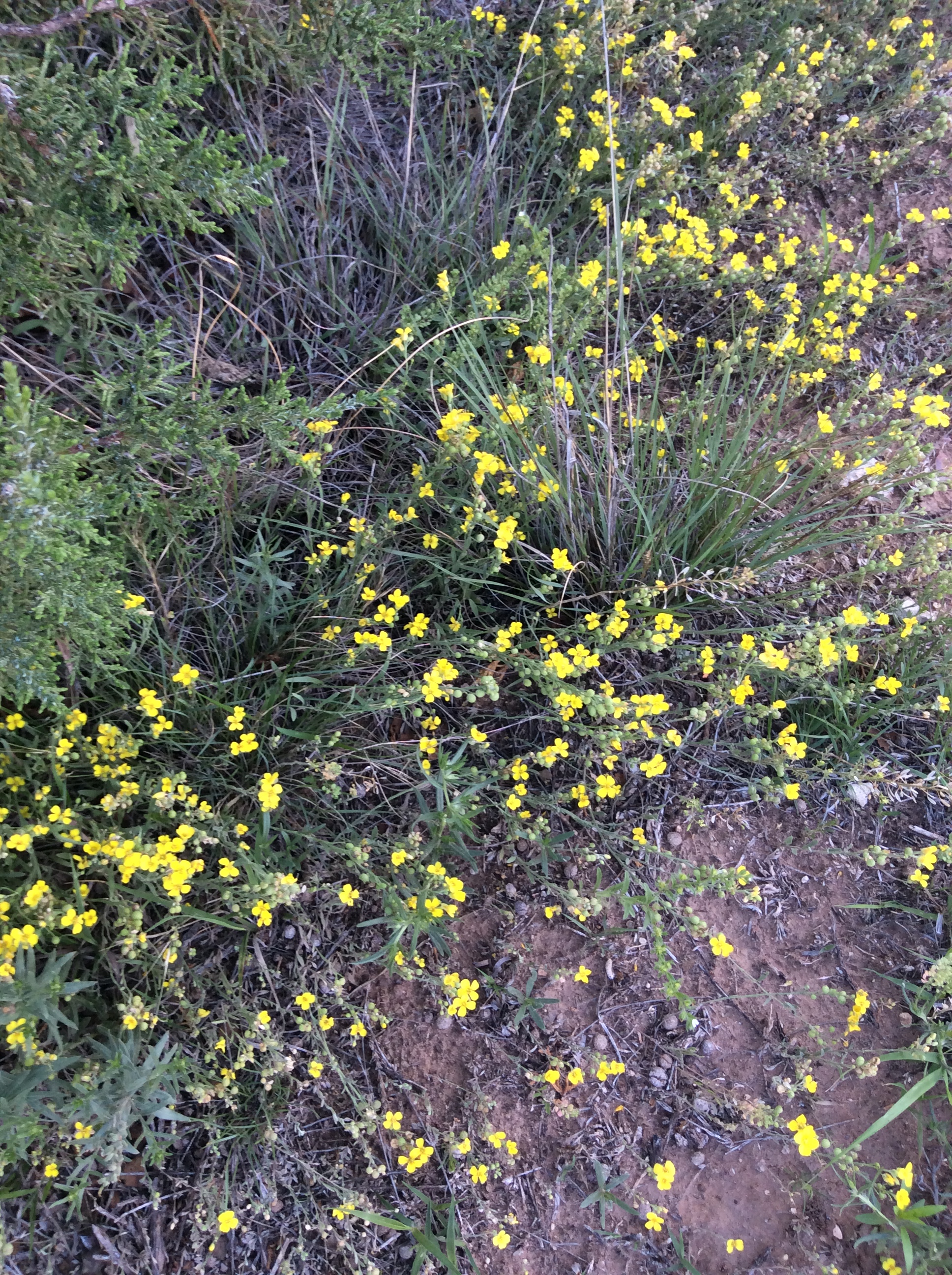
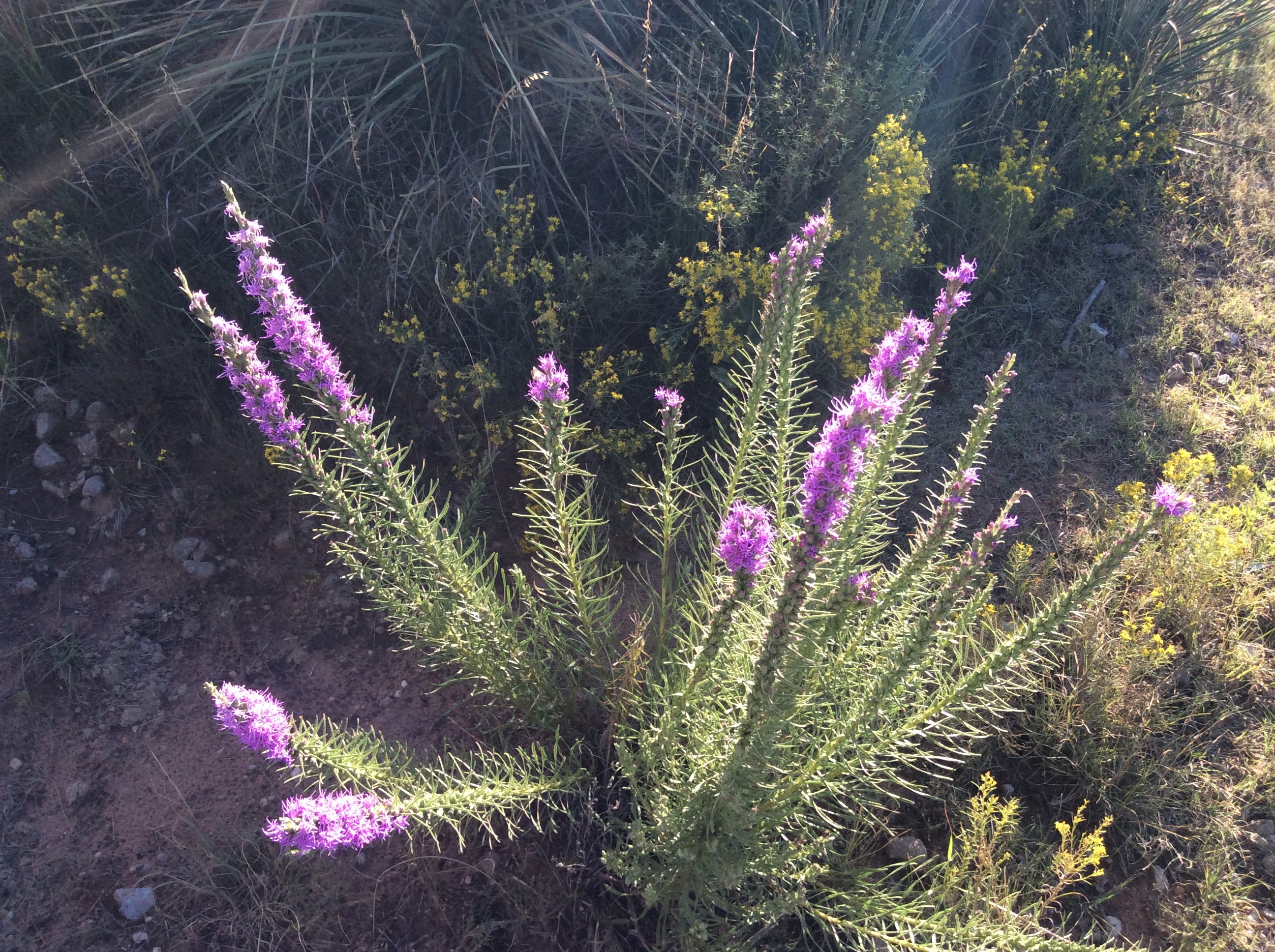
Note:  This essay was part of an assignment for a writing class from the Story Circle Network.  The assignment is to write six minutes each day using just one word to get you started and writing about that word. You can make a list of topics or just pick a word out of a book.  The teacher is Yesim Cimcoz. It would seem I never took of photo of the tiny flower mentioned above.  Below are photos of native flowers taken around my house.

IMG_3631

IMG_3630

IMG_4028

IMG_3340


Cutting Yucca


Yucca will take over if you let it.


Every summer after the blooms dry, I tackle them with long,

red-handled clippers and cut off  long stalks.

Not bothering to put on boots, I set out in black and grey Chacos,

cutting stalks in places unreachable by tractor.


I climb down to a rough area, open these long, red-handled clippers,

chop off the dead blossoms, then look down.

She lies there, her body slightly bigger than the size of my upper arm,

fat, not long.

A snake stretched out, only 1/8 inch from the front of my Chacos.


I look again.  Crap.  She’s a rattlesnake, one of those short,

stout prairie rattlers, perfectly blending with the grey and brown

rocks and soil.


Slowly, I inch backward, taking care not to fall on the steep slope.

When several feet away, I run to the barn, grab two shovels off their hooks,

run back.  She’s gone.  I search everywhere around.


I never find her.


SAM_1546


Poetry Reading


23622546_10212763863162805_8472929759460388736_n

A busy time of year, this holiday season.  Here is what I will be doing this week on Thursday.  Now I have to decide which poems to read, the Puma Poems, Hot Pink Toenails, Star–the sad one about the death of my grandson’s horse, poems about aging, death, what?

Sunday Poem


A few years ago Uno Mundo Press published my second book, a book of poems.  Reviewers say it is a memoir.  Oddly, that was not the plan; in retrospect, it seems apt.  The poems’ topics are not chronological but rather via topic with quotations before each topic as a sort of introduction.  For the foreseeable future, while I continue writing another book, I will post one poem from the book every Sunday.

The book begins with this quotation:

“Do something scandalous to give your descendants something

to talk about when you are gone.”  Vanessa Talbot


The first section begins with this quote by Judith Jameson, the famous dancer and choreographer:

“I always tell my dancers.

You are not defined by your fingertips,

or the top of you head,

or the bottom of your feet.

You are defined by you.

You are the expanse.

You are the infinity.”


The first poem in the book goes like this:

I Have Lived

Depression, sad days, melancholy.

Gone!

At 26, I said, “To hell with this!

You control you life, live it!”


I tried forbidden liaisons, trained horses,

Traveled around the world, a cobra wrapped around my neck,

Walked the Shalimar Gardens in Kashmir,

Stood before the Jama Masjid in Old Delhi,

Watched the Taj Mahal reflected in still waters,

Walked the streets of Katmandu,

Talked to monks at Shwedagon Pagoda,

Bargained with sticks in dirt, math our only common language,

Downed raw turtle eggs in Costa Rica,

Danced on table tops, sang “Adonai”,

Roamed empty roads across the Navaho Nation,

Divorced four times,

Raised two talented children.


I have lived, running on the rim of wonder.

IMG_2675