Book 35 for 2025: “How The South Won The Civil War”, Heather Cox Richardson, Part One


Rather than summarize or evaluate, I am going to provide some quotes from the book. I will say that if you want to understand the current state of affairs in the United States of America, this book provides excellent insights based on history.

From the Introduction:

“America began with a great paradox: the same men who came up with the radical idea of constructing a nation on the principle of equality also owned slaves, thought Indians were savages, and considered women inferior…it was a key figure of the new democratic republic…the ringing phrase ‘all men are created equal’ did not actually include everyone. In 1776, it seemed self-evident to leaders that not every person living in the British colonies were capable or worthy of self determination. In their mind, women, slaves, Indians, and paupers depended on the guidance of men like themselves…So long as these lesser people played no role in the body politic, everyone within it would be equal. The principle of equality depended on inequality. That central paradox–that freedom depended on racial, gender, and class inequality–shaped American history as the cultural, religious, and social patterns of the new nation grew around it.”

From The Triumph of Equality:

“The accomplishment of white male equality under the law was extraordinary…They argued that their new system made their new nation different from the Old World, which was split between a corrupt aristocracy and the lazy poor.”

“On March 4, 1858, prominent South Carolina slaveholder James Henry Hammond gave a speech in the Senate–to which he had been elected the year before despite the fact that he admitted two years earlier he had sexually assaulted his four young nieces…The greatest strength of the South was not its economy…but rather ‘the harmony of her political and social institutions.’ Every society had ‘a class to do the menial duties, to perform the drudgery of life’…the people who make up the ‘mudsill of society supporting that other class that leads progress, civilization, and refinement.’ The men in the latter group are wealthy and well connected…In the South whites had made an ‘inferior race into mudsills, dull but loyal people who are content to have their labor directed by their betters.”

“Now a national figure, Lincoln articulated a democratic vision for America, one that refuted the mudsill version of Senator Hammond…he explained that Hammond’s theory divided the world into permanent castes: capitalists driving the economy and workers stuck at the bottom.”

The West:

The last stand of the Alamo became the foundational event for western American history, offering a vision of self-sacrifice and heroism. It prompted the formation of the Republic of Texas, and inspired Texans under Sam Houston to defeat Santa Anna’s troops…In the retelling of what happened at the Alamo, what got lost was the reality that the defenders were rebelling against the Mexican government in Mexican territory, and that they were fighting to defend the right to enslave people. The myth also ignored the fact that many of the defenders were Mexican opponents of Santa Ana, and that some of the defenders–including Davy Crockett–surrendered.”

Cowboy Reconstruction:

After Lincoln’s death, Johnson wanted no part of Lincoln’s and the “Union’s democratic vision. To rebuild the South, Johnson turned not to the Army, or to the ex-slaves who had supported the Union, but to former Confederates. He offered pardons to all but 1500 Confederate leaders…states codified the racial violence that swept across the South in the summer of 1865. As employers cheated workers out of wages, gangs beat and raped African Americans into submissive behavior, and whites attacked their black neighbors, southern state legislatures created the Black Codes.”

The West and The South Join Forces:

“The resurgence of the South’s ideology came from the nation’s new bloc: the western states. Easterners had made the mistake of thinking the westerners would join their coalition, only to discover that due to their peculiar history and extractive economy , westerners had more in common with white antebellum southerners than with easterners. By the 1890s a few wealthy men dominated western society. Poor white men had little opportunity. people of color and women even less, and leaders worked to keep it that way. Still, as in the East before the Civil War, the myth of the individualist convinced Americans that the west was the land of opportunity…Theodore Roosevelt’s war record took the western ideal and put it on the national stage. By the end of the century, Americans embraced the cowboy image and vowed to spread it across the globe, putting into law that some people are better than others. Once again freedom was hierarchical.

“In the early part of the twentieth century, southern towns began to erect statues of Confederates, making them into western style heroes and individualists. The rewriting of the past created momentum for women’s suffrage…Rebecca Latimer Felton was a reformer who wanted educational and prison reform as well as women’s suffrage. She was also in favor of lynching her black neighbors who wanted equal rights…The Ku Klux Klan reformed and rebounded in the 1920s…Meanwhile in the West, immigrants and Indians were falling victim to a legal system that established castes. In Texas, officials were hardening a racial system that classified migrants across the Mexican border by race. In Arizona, a state law singled out ‘treason against the state’ as punishable by death aimed at Apache and Navahos who might fight the legal system ensnaring them. In Oklahoma…corrupt legislators arranged affairs to steal valuable land from Indians.

Book 32 for 2025: “My Name Is Emilia del Valle”, Isabel Allende


The last two books of hers that I read were set in the more recent times when Salvador Allende and later Pinochet were presidents of Chile. This one dates back to the 1800s and the Chilean Civil War. In 1866 a nun of Irish descent living in San Francisco has a passionate affair with a Chilean aristocrat and becomes pregnant. He abandons her; their daughter becomes the woman in the title of this novel. She is raised by a loving step father, an intellectual teacher from whom she learns to be independent and defy societal norms. At a young age she becomes the writer of short pulp fiction novels using a fake male name. The income from these helps her family live a reasonably good life.

Bored with writing these lucrative little books, she convinces a San Francisco newspaper to hire her as a journalist where she works along with a more seasoned journalist, Eric Whelan. Eventually, the two are sent to Chile to cover the civil war and violence occurring there. She sees this as not only an opportunity to satisfy her adventurous spirit but also an opportunity to find her biological father. She encounters dangers, almost gets killed, and sets off to find herself in the far southern reaches of the Chilean wilderness, learning from the indigenous people who live there how to survive in remote mountains.

Note: One of the places she goes was nearly impossible for non indigenous people to find during the 1800s and many never made it. Today, it is a popular area for hiking, camping, and exploring nature.

Book Seven for 2025: “The Map of Salt and Stars”, Zeynab Joukhadar


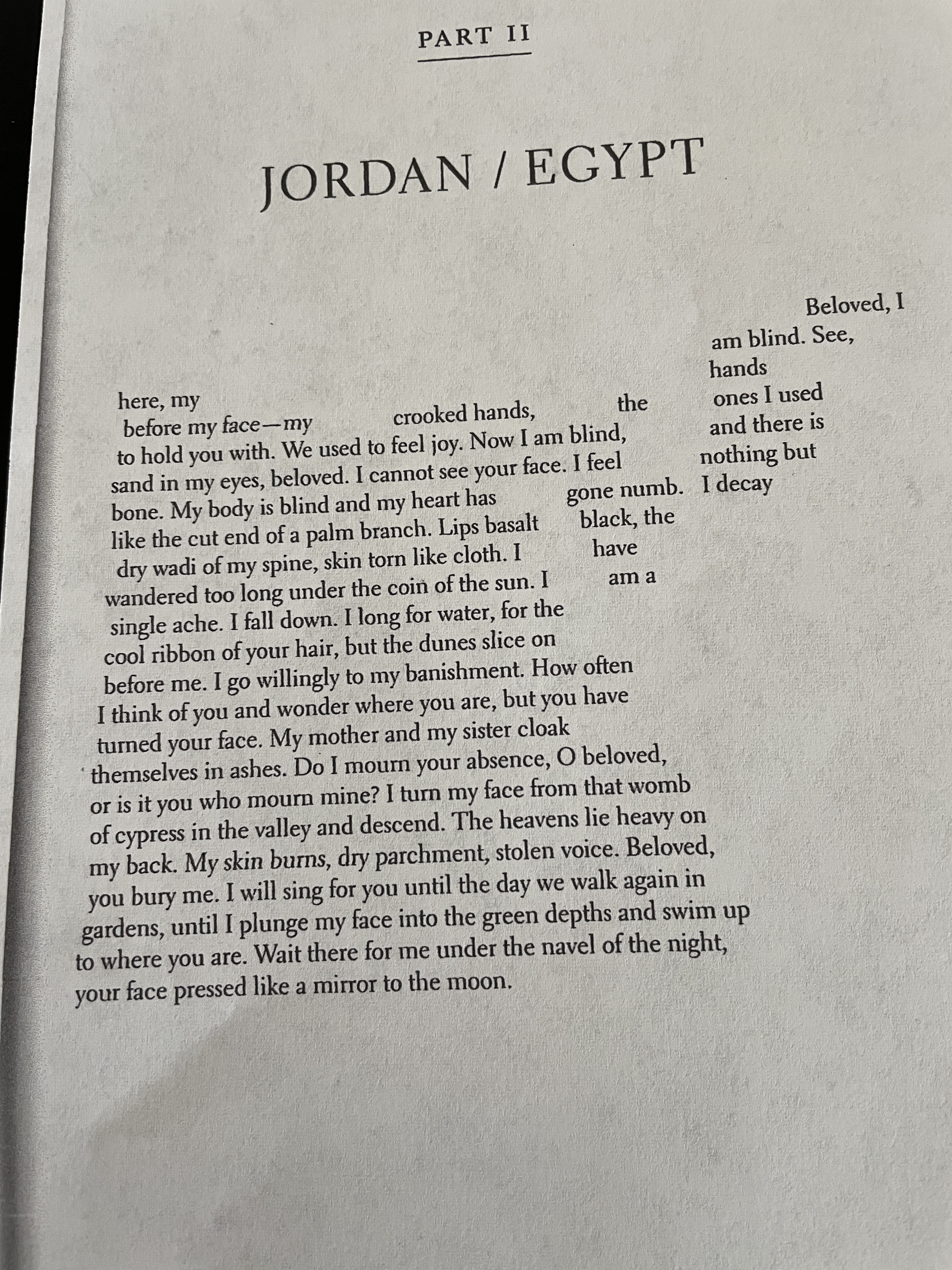
Two young heroines dominate this fascinating novel which switches back and forth between the Syria of 2011 and the 12th century. The latter is a girl who disguises herself as a boy to join the quest of a famous mapmaker. Nour, the first girl, lost her father to cancer in NYC. Then her mother, a mapmaker, decides to move herself and the three daughters back to Homs, Syria. They barely settle into their new life when the civil war breaks out and a bomb destroys their house. They become refugees. This is the tale of their harrowing journey from Syria to Jordan to Egypt to Libya to Algeria, then Morocco and finally to Cuenta, the Spainish city on the north coast of Africa, where their uncle lives.

To keep sane, Nour repeatedly tells herself the story of Rawiya, the disguised girl who is an apprentice to the map maker. When he was alive, this was the favorite traditional story her father told her. The book alternates between what is really occurring to Nour and her refugee family and this ancient story. At the beginning of the section for each country through which they travel, there is a touching and beautifully written poem in the shape of the map of that country. The poem for Jordan/Egypt is printed below.

One Book a Week-8:”The Seven Moons of Maali Almeida”, Shehan Karunatilaka


The Booker (previously Mann-Booker) Prize winner in 2022, this book is filled with gruesome events and dark, graveyard humor. Since if takes place in Sri Lanka, if you know little about Sri Lanka history in the last 50 years, you might want to do a quick review so you know about the civil unrest and the various Sri Lankan ethnicities, e.g. Tamil, Sinhalese, Burgher. Written from the viewpoint of the title character, a war photographer, after being murdered, he resides in a sort of celestial purgatory while he tries to save his two best friends and male lover who are still alive and discover the identity of his murderer. He is given seven moons in which to accomplish this task. Not a book for the faint of heart, it contains gruesome war and torture details but frequently is also quite funny and filled with “truths”. In an interview the author explained, “Sri Lankans specialize in gallows humor; it is our coping mechanism.” As I read, I underlined passages I found especially meaningful, profound, or fascinating. Here are some of them:

“-There are only two gods worth worshipping. Chance and electricity.

-Hell is all around us and it is in session as we speak.

-Evil is not what we should fear. Creatures with power acting in their own best interests; that is what should make us shudder.

-There has never been an era of peace in all recorded history.

-Interest in fair play and democracy are not always the same thing.

-I have a superb name for God. Whoever.

-Laws are needed because made-up religions are not enough.

-The universe is nothing but mathematics and probabilities…we are nothing more than accidents of our births.

-They say the only thing worse than being talked about is not being talked about.

-Your race, your school, your family will dictate how the dice of life will fall for you.

-All religions keep the poor docile and the rich in their castles.

-People are ok if bad things happen to people who are not them.

-Do not be afraid of demons; it is the living we should fear.

-I have thought long and there are no answers. There is only this. There is only now.

-We must all find a pointless cause to fight for, or why bother with breath?

-The kindest thing you can say about life. It’s not for nothing.

-I cannot understand why humans destroy when they can create. Such a waste.”

White Trash and Rednecks


Nearly everyone lies about an important aspect of US history even historians. School history books avoid the discussion totally, this significant part of US history, much of which explains past and current racism.

Americans pretend that social class does not matter, that anyone can rise to the top given enough effort.  This myth depends on the continuation of a very selective historical memory, indeed, a lie.

It began with the British and those who intentionally left there to come here.  Even colonists divided the classes with poor people and criminals at the bottom–whores, discharged English soldiers, robbers, highwaymen; the saddest of the lot were the orphans, rounded up, loaded on ships bound for America, sold as indentured servants. Often these contracts were repeatedly resold with no routes for the individuals to escape.  The rigid English class conditions continued here.  People of higher classes in the colonies referred to the poor as waste, rubbish, and trash.

John Locke, often considered the father of constitutional government, favored slavery and aristocratic society.  He endorsed an aristocratic constitutional government and called the poor, landless, lazy lubbers. Because the southern colonies lacked sufficient land lubbers and land owners believed Africans more suitable for hot, humid swamp clearance, they petitioned for slaves–previously illegal in Georgia, for example.  These wealthy landowners also viewed poor whites as too lazy to work.

Even the esteemed Ben Franklin believed in the concept of class as inevitable.  Both he and Jefferson saw expansion westward as the solution to potential class conflict.  Franklin thought the new colonies needed more people and advocated for the freedom of slave women who bred many children and for white women to be allowed to gain property rights for the same.  More people would move west and alleviate class conflict. Franklin was not an advocate for the poor, whom he considered lazy, slothful.  He even endorsed their forced migration westward and referred to them as “the meaner Sort, i.e. the Mob, or the Rable”.

If this sounds shocking, Jefferson went even further, calling the poor, “rubbish”.  He did feel they could improve, given land and education.  He did not include slaves in this theory.

If you ever wondered about the origin of the term “cracker”, look back to the era of Andrew Jackson, the era of “squatters” in a log cabin in the thickly forested frontier, people who squatted on land they did not even own.  Many saw them in both positive and negative terms:  half strong, hard working pioneers and half robbers.  Two terms applied to these people, “cracker” and “squatter”, none of whom legally owned the land where they lived, troublemakers with no hope of upward mobility, people who championed crudity, distrust of civil society and city dwellers, and held on to a kind of crude arrogance.  Both terms came from England where such people were considered lazy vagrants.  The more educated and “civilized” viewed them as degenerate, low class fornicators.  These squatters saw Andrew Jackson as their champion and Davy Crockett as their hero.

The phrase “white trash” became common in the 1860s and after.  These were the southern poor with dirty faces, ragged clothing, distended bellies without possibility of improvement, who for a brief time were viewed as even lower than slaves.  Southern aristocrats pushed the concept of bloodlines for people as well as livestock.  They advocated a criteria for human as well as livestock breeding to justify slavery and Anglo-Saxon superiority.  Native Indians were a biologically inferior, degraded race, doomed to extinction.  Later Texans used similar arguments to deter intermarriage with Mexicans.  Sam Houston championed this cause apparently ignoring his own personal history.  He had lived with Natives and married two of them.  In the long run these beliefs did not help poor whites or raise their status.  They lived off the worst land and were continually referred to in derogatory terms, e.g. white trash, sand eaters.

Just before the Civil War some elite Southerners advocated to keep certain classes ignorant.  They defended the planter class as having the best bloodlines, whose destiny was to rule over poor whites and black slaves. When they realized they needed poor white support to secede, and that many did not support them, they convinced them the war was necessary to save them from a state worse than slavery.  Some were promised land and other rewards.  Since most were illiterate, they remained unaware that they were referred to as “perfect drones”, “the swinish multitude”, and other pejorative terms; and that some saw them as trash who contaminated whatever they touched. It was not the Southern elite who died in masses during the Civil War; it was the poor, recruited with Davis’ rhetoric about the superiority of the white race.

Later, during Reconstruction, William Percy wrote a description of poor whites as those who lynch Negroes, lack intelligence, attend religious revivals then fornicate in the bushes afterwards.  He also explicitly referred to them as Anglo-Saxons.  Teddy Roosevelt saw this a bit differently.  He wanted Anglo-Saxons to work, to join the military, and breed, but he excluded poor whites from this group and his plan.

The term “rednecks” came into use in the South during the 1890s.  It referred to people who lived in the swamps and mill towns, wore overalls, heckled at political rallies.

The Great Depression exacerbated the situation for poor whites and increased their numbers dramatically.  Those who had never been considered white trash joined the ranks of the poor.  Many Southern writers went back to discussions about the Civil War and argued about the current poverty and how to solve the problem.  One, Jonathan Daniels, even wrote that Rebel pride blindfolded all classes.

Later, one way to overcome the prejudices against the poor was through music and TV shows, e.g. Elvis Presley and “The Beverly Hillbillies”.  It allowed the country to feel better about prejudices and pretend they did not exist.

Today this manifests itself through politicians who “pretend” to be white trash and rednecks to gain votes, but in reality live the lifestyle of the upper class.


Note:  For those who wish to read more about class and the writings of the individuals mentioned above here is a partial list.


Writings and speeches of Benjamin Franklin and Thomas Jefferson

Sherwood Anderson’s “Poor White”

Writings of John Locke

Works of James Agee

“White Trash:  The 400-Year Untold History of Class in America”

Speeches of Jefferson Davis