Book 34 for 2025: “Samarkand”, Caroline Eden and Eleanor Ford


I enjoyed the previous book by Caroline Eden so much I searched for this one. I doubt I will ever make it to Samarkand or Tashkent, places sort of on my bucket list, so what I do is read everything I find about these fabled cities on the Silk Road. The sub-title of this one is “Recipes and Stories From Central Asia and The Caucasus”. It starts with Samarkand and the story of Tamerlane, the legendary hero who conquered a lot of this area and a large portion of surrounding areas in 1370. He was a military genius who loved chess and made up his own chess game with twice the number of pieces.

What foods show up in both the stories and recipes? Beets, fruit–dried and fresh for which the area is famous, tomatoes, cucumber, pomegranates, cabbage, lentils, rice, lamb and mutton, and all sorts of kebabs and flatbreads. I learned there is a huge beach on Lake Issyk-Kul in Kyrgyzstan. It is one of the world’s largest alpine lakes and in summer people from Russia and all over Central Asia flock to its shores. People who own guest houses there make all their money for the entire year in the brief summer between mid-July and mid-August.

In the remote mountains of Azerbaijan lies the small town of Gyrmyzy Gasaba above the Qudiyaleay River, a town where all the people are Jewish. Even though Azerbaijan is a predominantly Shia Muslim country, the people in this town have peacefully lived here for hundreds of years. This town is considered the last surviving pre-Holocaust Jewish town untouched by WWII.

If you are a lover of apples, then consider this country, Kazakhstan, the place where apples originated. All apples in the world today come from the original apples here. The name of the largest city, Almaty, whose older name was Alma-Ata means fatherland of apples. In Ile-Altalan National Park on the northern slopes of the Tien Shan mountain chain thousands of acres of wild apples flourish.

Even though this book was published less than ten years ago in 2016, a lot of people must have been interested in reading the stories and recipes because the copy the library found for me is not in the best condition. Before I return it, I will copy some of the recipes to try.

Langston Hughes in Uzbekistan


It’s 1932.

Movie roles promised to 22 Black Americans.

“Black and White” in the

Uzbek Soviet Socialist Republic.

Treated like royalty, wined, dined, at

their own expense.

Hughes–ridiculous script. All went

home except Hughes. He stayed,

traveled, saw cotton grown from Aral

Sea water–now no water, desolate

desert.

In Tashkent, Uzbeks, Turkmen, Tartars

honored him, flowers, fruit.

No English.

He met a Red Army Captain from

high Pamir Mountains. Hughes

described him, Black with Oriental eyes.

Hughes called him Yeah Man.

He called Hughes Yang Zoon.

Weeks together never understanding

each other’s words.

Hughes’ poetry book

“The Weary Blues” first

American book translated to

Uzbek. Original English version

lost. He describes this new place:

“Look: here

Is a country

Where everyone shines.”

Note: You can find a version of this book translated into English from Uzbek by Muhabbat Bakeava and Kevin Young.

The World in One Room


Four jaguar heads stare at me,

Mexican, Costa Rican.

A third guards the mantel,

partially hidden in tropical plants,

attack ready, tail raised, jaws open,

teeth bared.


My feet rest on a coffee table

carved in Kashmir.  I look at the photo

of the young man whose family made it.

He took me home to meet his mom,

to the floating market.

Once peace reigned there.

Now I wonder if he is safe, alive.


The Hoop Dancer raises his arms,

the Acoma pot exudes ancient

black on white beauty, painted

by the tips of yucca stems.

The Thai Spirit House begs

to appease evil spirits.

I should put food and flowers there;

I never do.


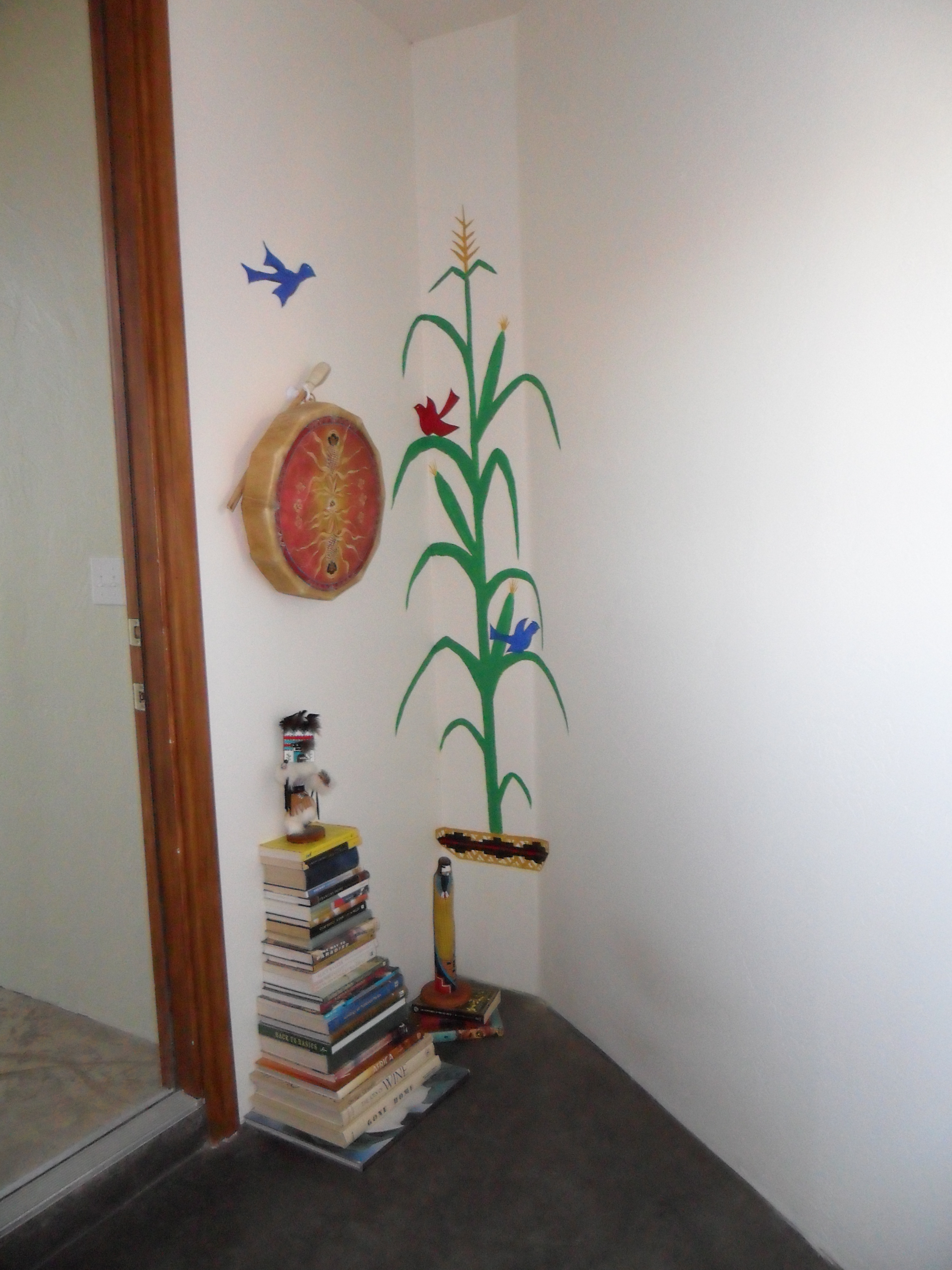
Corn plant of life–for Navaho, Hopi,

me, painted, growing up my wall,

blue and red birds flitting through

the stalks, singing ancient songs.

Corn Maiden rug hanging on the wall;

an Isleta Pueblo girl won a contest

with its design.  Four Corn Maiden

Kachinas watch the room.

Corn everywhere–Sacred Corn.


Three Ethiopian crosses, St. George

and the Dragon, Frida Kahlo doll,

Argentinian Madonna, Tohono O’odham

baskets, a painted cow skull, Nigerian carved

wooden elephants, including a Chieftains chair,

the stained glass transom window from the house

where my dad lived from birth to ten.


In a room filled with windows, there

is little room for paintings, yet–

purple bison glide across the prairie,

an Iraqi woman flies through an azure

sky filled with dark blue birds,

a 15th century mystic, Kabir, tells

a tale in poetry, Navaho spirits,

pumas walking toward me–

my obsession.


Rugs scattered–Kerman,

an unknown Persian city, Afghani,

Egyptian, Indian, Zapotec, scraps of old

Turkish rugs sewn together.


In one cabinet, Grandmother’s china,

Mom’s Czech crystal–a wedding present

decades ago, Grandson’s painted art,

the silverware Dad gave Mom on their

first wedding anniversary,  Mom’s

everyday dishes–flowers blooming.

I use them every day.


These objects–a testament to who I am:

World wanderer, seeker, citizen.

SAM_0912

SAM_0035


Soybeans


SOYBEAN CHECKOFF

If you grow soybeans, there is this program–not sure what else to call it–named the Soybean Checkoff.  Basically, when you sell soybeans, you get docked a few cents per amount sold to advertise, etc. soybeans.  I received my latest issue of the Lonestar Soybeans recently.  For those of you reading from afar, Lonestar refers to Texas.  It is the Lonestar state and our flag has one lone star on it.  Back to soybeans.  First, there is a report on soybean production issues.  Research is to the point in terms of soybean physiology that they are about to zero in on optimal planting time, conditions, latitude, etc.  Here in this part of Texas, generally no one grows soybeans.  We grow irrigated corn and wheat, milo, sorghum, and crops that do not require as much water as soybeans.

EXPORTS AND ETHANOL

I grew up on a farm where we raised both soybeans and corn–I still do.  We raised some wheat also; tried milo, but it was too wet in Missouri.  Never thought a lot about where my soybeans went after I sold them so I learned something new today.  Compared to all other crops, we export more soybeans than anything else–to the tune of 20 billion dollars a year.  We also export a lot of wheat–about the same as soybeans, but soybeans trump wheat if you include soybean meal and oil.  Meanwhile corn exports have dropped steadily since 2007 or so.  Why?  Ethanol.

GMO

This report does not tell the reader some other notable facts.  While almost all corn grown commercially in the United States is GMO, such is not the case for soybeans.  The big market for soybeans is Asia and at least China will pay more for non-GMO soybeans.  60 per cent of all soybean exports go to China.  For those of you out there who are adamant about GMO, perhaps the solution is demand for non-GMO.  Currently, the only way I know to get non-GMO corn is to find a company that sells heirloom seeds and plant and harvest the corn yourself or find a small farmer who does this.