Book 11 for 2025: “The Serviceberry”, Robin Wall Kimmerer


A tiny book by the author of “Braiding Sweetgrass” envisions a totally different economy than the kind we have now. She uses a plant, the serviceberry, as a symbol for what she calls the “gift” economy. Instead of everything being focused on maximizing profit, it focuses on sharing and exchange and the idea that natural resources are gifts from Earth, from nature, rather than commodities to be exploited for profit.

She notes that capitalist economies hinge on the concept of scarcity and personal accumulation of wealth often at the expense of others. Gift economies, which occur in many indigenous cultures, focus on the mutual benefit of all which encourages gratitude and trust. Later in the book, she discusses how gift economies can be implemented and flourish alongside the current capitalist economy.

There must be considerable appeal for her concepts because this book has been on the non-fiction best seller list for weeks.

An Abecedarian Poem for the Fourth of July


As many celebrate this day

because they see it as a joyous

cry in praise of the

day the United States declared

emancipation from English tyranny,

free to be its own country, self

governed, no longer ruled by kings,

humans, Black, enslaved,

indigenous, find celebration difficult.

Jefferson, in The Declaration of Independence,

knowingly called Native People

lacking in worth,

“merciless Indian Savages,”

never considering the contradictions, the

overt irony when compared to his view that

people are created equal.

Qualified, white male landowners, the

rich, voted, prospered.

Slaves, counted as only 2/3 a person, were

told to obey, work til death, be Christian.

Until all, regardless of race, gender, religion, are

valued as worthy humans, are free to prosper, can

walk proud throughout the United States,

xenophobia will destroy our founding ideals.

Yearn for, work toward, equity, kindness, be

zealous in our quest for a better country.

Blood Quantum: A Poem for Our Time


My grandson cuts himself into 16 equal pieces:

4/16 Urhobo from Africa

3/16 Spanish from Spain

4/16 European–two Swiss German great, great-grandfathers

(Werth and Kaiser), Irish, English and who knows what

3/16 Mexican–whatever mixtures that may be

2/16 Navaho


Who am I? What am I?

Who are you? What are you?

Do we really know?

Who sets the rules?

white men

black

Indian

Native American

Irish

English

German

from where and for whom?


He looks Navaho:

-blue black straight hair

-pale brown skin

-obsidian eyes.

One four year old girl asks him,

“Are you American Indian?”

His six year old self says nothing.

She repeats,

“Are you American Indian?”

He says, “It’s complicated.”


The Navaho won’t claim him, too little blood.

He needs 1/4, not 1/8.

Caddy and Fort Sill Apache allow 1/16, not Navahos.

1/4 blood is for

-Sioux

-Cheyenne

-Kiowa

-Navaho

1/8 works for Comanche and Pawnee.

Some Cherokees only want a Cherokee ancestor.


But he is none of those.

Is he Navaho?

Is he white?

The old South goes by the one drop rule:

one drop of Negro…

Is a person with 99/100 per cent white

and 1/100 black, black?

Who says?

Kids at school ask, “What are you?”

He tells them.

They say, “You’re lying.”


I only know specifically about two ancestors,

the Swiss Germans.

Another great grandfather disappeared during the Civil War.

I don’t even know his name.

Who am I?

Who are you?

I think I’ll get a DNA test.

Then I’ll know how many pieces I need to cut myself into.


Note:  This was originally published in my book “On the Rim of Wonder”.  I had a cousin send me 75 pages of ancestry information.  I looked up more myself.  That one great grandfather remains a mystery.  I had my DNA done.  It did not match what I expected from the ancestry work.

Blood quantum is the term the US government used to determine whether a person would be qualified as an Indian.  Now many Indian Nations use it to decide who can be on the tribal rolls and who cannot.


Sacred Corn


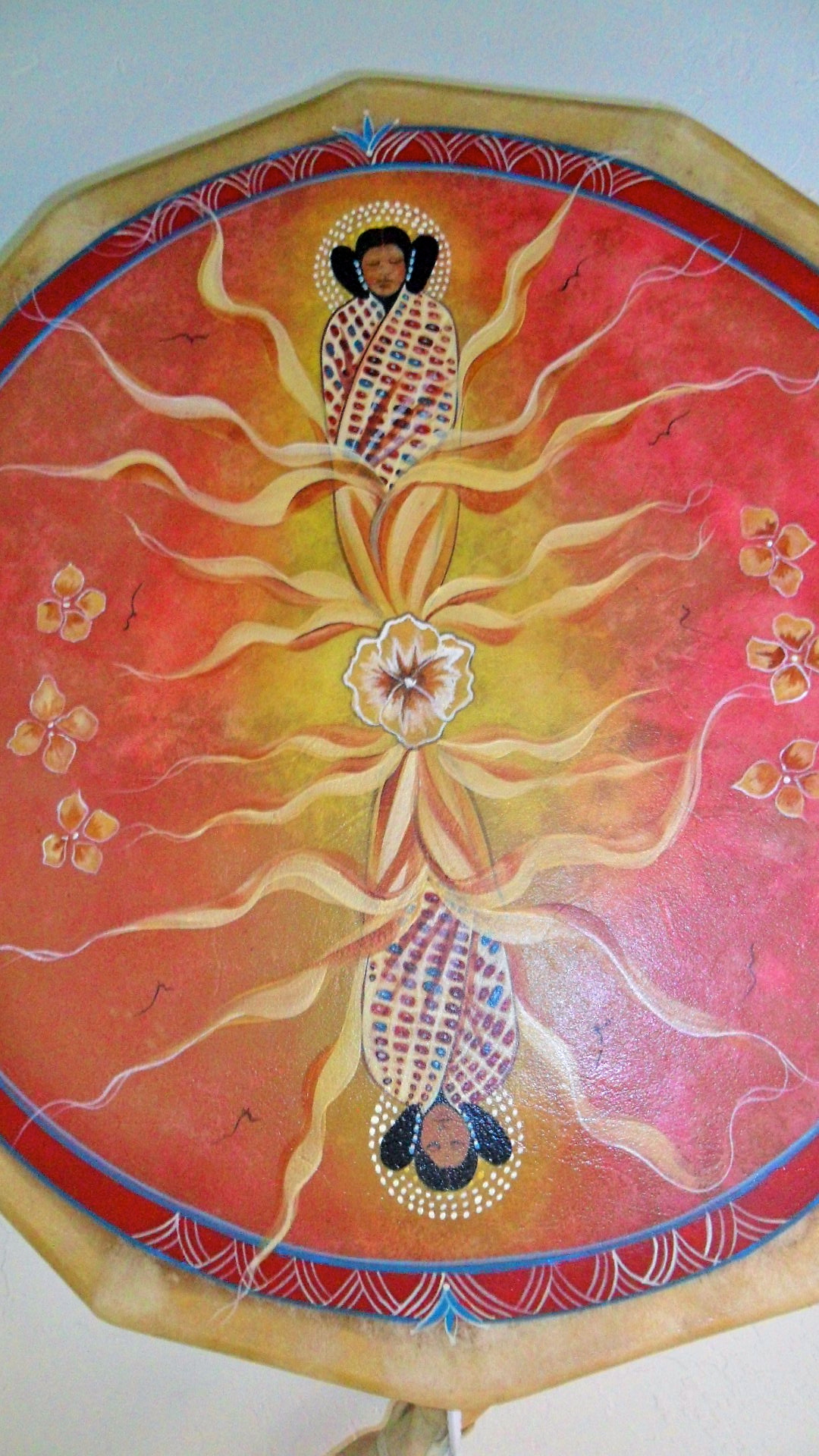
SAM_0035   In the summer on hot, humid nights, you can hear the corn grow.  My great grandfather, my grandfather, and my father grew corn.  I grow corn in that same rich loess soil of Northwestern Missouri.  Soil laid down by Ice Age glaciers thousands of year ago.  Only on a few hill tops, here and there, will you find non glacial soil. Repeatedly, daily, I walk by the sacred corn plant of life painted on my hall corner.  This sacred corn corner houses three corn maiden kachinas and a drum decorated with corn maidens.  I give thanks to corn for my house and the life I lead.

Corn Song

I sing the song of ancients:

pueblo peoples,

Anazazi, Hopi, Zuni.

I sing the song of an America long gone.

Maya, Aztec, Tolmec.

I sing the song of life:  colors of the rainbow

golden, red, white, blue.

I sing the song of now:  thick, endless

identical rows.

Pioneer, Monsanto,

anhydrous ammonia,

atrazine.

I sing the song of hope and joy:

an ancient reclaiming,

a klaidescope of colors,

butterflies and fireflies.

I sing the eternal human song.

SAM_0913

SAM_1489

This is a Navaho kachina.  Kachina are actually Hopi, but Navaho artists now make kachinas as well.  The first corn maiden kachina I bought.

SAM_1490

Spotted corn kachinas, on the left, are unusual.  It took me years to find one.  The kachina on the right was created by R Pino, who is both Hopi and Navaho.

SAM_1491

Every year Pendleton runs an art contest among Native American students.  The winner’s art work is transformed into saddle blankets.  This design, created by Mary Beth Jiron, is the latest in this Student Series. There are three corn  maidens  on each side of the blanket, representing the different varieties of corn grown by native peoples, yellow, red, blue, white, black, and spotted.

Ten Little White Indians, Final Volume! (Spoilers Already Spoiled!)


This post by a fellow blogger says a lot about what I think regarding certain movies in which American Indians are portrayed or in which they act. It also relates in some ways to my own previous posted poem, “Blood Quanturm”.

danielwalldammit's avatarnorthierthanthou

Bet y’all didn’t notice!

I am one short on my promise of 10 Little White Indians. Well, it turns out that my three-part series on White Indians has four parts, and there is surely a good Monty Python reference in there somewhere, but maybe we’ll save that for another day

***

Let us start with a brief consideration of the near misses.

WIND TALKERS (2002): I remember when this movie was on its way to the theaters, rumor had it that the flick was about the Navajo Code Talkers. Working as I did then on the Navajo Nation, I was (like a lot of my students and colleagues) really excited to see this part of American history portrayed on screen. My enthusiasm waned considerably when I realized it wasn’t about a Code Talker so much as a white guy who might have to kill a Code Talker if things took…

View original post 1,713 more words