Water, Water, Where?


Today, I drove about fifty miles to watch a play especially produced by my friend, King Hill, for the Gem Theatre in Claude.  I almost did not go because of high winds and blowing dust.  Between 8 and 10 this morning visibility was so low  it was impossible to see the horizon.  High wind and blowing dust warnings started yesterday.   Now, as I write this, these warnings have continued for more than 24 hours.  Red flag warnings flash across the TV screen. Thankfully, not quite the dust bowl extremes, not yet anyway.

Originally, a green sea of grass covered all the land where I live in the Panhandle of Texas, the Llano Estacado. Immense herds of buffalo roamed free.  This prairie grass protected the land from erosion.  Rivers and an occasional canyon interrupted this endless sea, including the Canadian River, Palo Duro Canyon and the network of canyons running into it.  Once the Spanish brought horses, Kiowa and Comanche ruled this sea for more than a hundred years.  Under a full moon, the Comanche reigned by night raids from Nebraska to Mexico.

What happened?  Plows brought by people from the East dug up the grass.  These people planted the crops they knew, wheat, corn.  They settled in towns and homesteaded the country. They brought cattle and in some areas developed gigantic ranches.  Hunters killed all the buffalo except a few the famous rancher Charlie Goodnight and his wife managed to save.  Remnants of this southern herd now live at Caprock Canyons State Park near the tiny town of Quitaque, Texas.  Those who farmed dry land farmed.  In a normal year crops grew, the people prospered.  In dry years dust blew because there was no grass to hold the dirt.

Today, giant pumps pull water from the aquifers, the Ogallala, the Santa Rosa. My well is 400 feet deep, some are nearly 900.  More and more people move here from other parts of the United States.  They want lawns like the ones they had where it rains forty inches a year.  It does not rain much here, twenty in a good year, ten in a bad year.  These aquifers lose much more water to irrigation in a year than are replenished by rain.  Farmers grow corn,wheat, cotton, and milo, all irrigated.  In some places where  the water became to saline for crops, the pumps sit abandoned.

Today, I drove by miles and miles of dry, thirsty grass, perfect fuel for the wind driven wildfires which sometimes start this time of year.  In other places irrigation pivots rained water on immense emerald fields of wheat.  I could not help but wonder how much of this water evaporated in the sixty mile an hour wind.  As I finish writing this with the TV on  weather watching, I see Fire Weather Watch, High Wind Warning, Red Flag Warning flash across the screen. I hear the wind roar and heavy outdoor furniture slide across the patio.  I’ve seen wildfires, had a half mile of cedar post fence burned down.  All it takes is a tiny piece of cigarette thrown from a truck or car, a flash of dry lightning.  They predict three more days of this.

I love the space, the vermillion sunsets, the intense blue of the sky.  I watch my neighbors water, water, water their new houses in the country.  I think about those pivots irrigating in the wind, and I wonder what will happen when all the water’s gone.


SAM_1369


Dinner Parties and Commitments


When I committed to writing daily and then blogging, it never occurred to me that this might entail writing in the middle of the night after hosting a dinner party and then cleaning up.  Some people just go to bed and clean up in the morning.  Yuck!!!  Who wants to wake up to a big mess with bits of food solidified to plates and remnants of red wine looking like dried blood in the bottom of wine glasses.  No me.  So here I am fulfilling my commitment to write daily.

Usually, I invite a lot of people over and work like crazy or give up and do potluck. This time I decided on something simple for six friends (three couples).  One friend is a vegetarian so everyone ate vegetarian.  The menu included homemade refried black bean casserole–the favorite of two of these friends.  The recipe for this dish is on a previous blog post.  In honor of my former exchange student son, Gaston Luis Zulaica del Sueldo, I made one of my best salads ever.  When he lived with me, he made salad almost every night, spectacular, colorful salads.  I made a mixture of Jasmine and several other kinds of rice and the following casserole which has no name so guess I will need to invent one.

Vegetarian Casserole with Soyrizo

Pour enough olive oil into the bottom of a heavy casserole dish to cover it.  Thinly slice purple potatoes (I think they are called blue, but they look purple to me), and cover the bottom with a layer of these.  Cover the potatoes with a layer of chopped onions, then a layer of coarsely chopped poblano peppers–I added a few halved and seeded jalapeños.  The next layer is soyrizo crumbled to completely cover the previous layers.  If you are not vegetarian, use chorizo.  Repeat the previous layers.  Combine 3 T of flour and 1 cup milk.  Pour over the top of the casserole.  Bake until the potatoes are done.  You can make all this several hours in advance and pour the milk mixture over it just before it goes in the oven.  I actually used the grill outside on low to bake it this time–warm day and did not want to heat up the house.  We finished off dinner with chocolate chip mint ice cream with Chambord poured over the top.  We also enjoyed a while dessert wine called Electra.

SAM_1497


Salad a la Gaston


SAM_1498


Good friends.


SAM_1499


Pretty ladies

Myanmar Then and Now-Part Two


?????????????????????????????????????????????????????????????????????????????????

Something happened to my camera while in Burma when it was Burma years ago.  For this essay, I tried downloading current photos and found the panoramic view of the Shwedagon Pagoda above and the close up below.


?????????????????????????????????????????????????????????????????????????????????????????????

I looked at current photos of the Inya Lake Hotel and stared in astonishment.  The current luxurious resort bears no resemblance to the hotel I stayed in all those years ago.  Only the garden photos seem familiar.

As Myanmar attempts modernization, downsides exist.  One concern is deforestation and the consequences for the abundant rare and endangered wildlife there.  Much of Myanmar is rainforest and remains one of the most biodiverse areas in the world.  Fifty years of isolation and limited development have protected wildlife.  Foreign development and investment endanger wildlife.  New laws and polices are created daily.  The Irrawaddy dolphin, a close relative to the killer whales, live in both the Mekong and Irrawaddy Rivers.  Rare Indochinese tigers, Asian elephants, gibbons, and langurs thrive in the remote forests.  Between 1990 and 2011 the amount of forests dropped from 60 per cent to 48 per cent.  So much of the country is relatively unexplored that it is difficult for scientists to even know exactly what species live there.  Many questions arise:  how can Myanmar successfully development economically and simultaneously save their rich wild heritage, how can they merge the old and new, how can they build the proposed new highway between Bankok, Thailand and Dawei, Myanmar without destroying precious natural resources.  Hopefully, they will find a way to prosper and save their natural heritage at the same time.

Myanmar Then and Now-Part One


More than twenty years ago, I went to Myanmar when it was still called Burma.  I flew there from Katmandu.  Compared to the cool, crystalline mountain air of Nepal, the hot, moist, Burmese air felt stifling, thick.  Day one, we left the Inya Lake Hotel and traveled to downtown Yangon to purchase tickets to Pagan.  We never left Yangon because the first of many revolts against the military government started.  Everyone strongly opposed going there by the night train and the last plane headed that way had been shot down.  Personally, I was willing to take the risk but could find no one else willing to go with me.  Everyone was under a 6 pm to 6 am curfew.  Unexpectedly, hundreds of hotel guests were confined to the hotel and its grounds, thankfully rather expansive.  This unusual circumstances provided unexpected opportunities.   To accommodate feeding everyone dinner, the hotel staff asked guests to share tables.  I shared a table with a man from South Korea there to build a sport shoe factory, two women from Germany headed to a medication retreat, and a gentleman with an English accent.  We shared life stories except the “Englishman”.  His sharing seemed a little “off”.  Later, when the rest of us chatted and put together what little he shared, we decided perhaps he was an arms dealer.  One evening guests experienced the privilege of watching the guests for an elaborate Burmese wedding, complete with traditional wedding clothing.

Although clean and orderly, this “one of the best hotels in Burma” looked more like photos of Russian army barracks than the hotels to which most of the guests were accustomed and absolutely nothing like anything else near Yangon.  Few cars roamed the streets.  The most common vehicles were small pickup trucks in which the bed had been transformed into an open air van complete with seats and a cloth roof.  The populace exuded an air of dejection.  Those who bothered to save money saw it devalued to nearly nothing.  The once elegant, ornate buildings showed signs of disrepair and decay.  A country which was once the world’s largest exporter of rice was rationing it as well as gasoline.

Unless you sleep twelve hours a day, curfews present challenges.  What do you do with yourself for all those evening hours after 6 pm hits besides eat a leisurely dinner.  I walked the glorious hotel gardens repeatedly and became acquainted with the hotel gardener who spoke perfect English and whose father had attended Columbia University.  His roses were as tall as I am.  He asked me repeatedly, ” How does my garden measure up to modern standards?”  When I offered tp send him horticulture magazines, he told me they would be confiscated as evil, foreign influences.  Paddle boats lined the lake’s edges.  Guests could use them free but  guests were told not to go far out because we might get shot at.  The luxurious villas of the ruling military elite lay readily visible on the distant opposite shoreline.

During the day, everyone rushed out to make the most possible out of the 12 free hours.  Mainly, I recall an overwhelming sense of gold, glitter, and glass tiles reflecting the tropical light.  At first, it induced a feeling of slight nausea, so much sensory input I felt slightly sick.  But I adjusted.  As if scattered, glittery golden temples were not enough, there rose the Shwedagon Pagoda, 99 meters covered in gold, real gold.  I spent an entire day there, wandering its environs and still missed some of it. Saffron clad monks, vendors selling “sacred” items and snacks, nearly a city within itself,  old, originally  built in 1372 and 344 feet high, repeatedly rebuilt after earthquakes and foreign raids.  Impressive is an understatement.

If Burmese history and culture interest you, I recommend three fascinating novels:

To Save Fish From Drowning by Amy Tan

The Piano Tuner by Daniel Mason

The Glass Palace by Amitov Ghosh

All three focus on one or more of the ethnic groups that inhabit Myanmar and on their relationships with each other.  The latter two are historical novels and in particular Ghosh’s book provides a fascinating history of that part of Asia.


Intelligent Beings


Tonight the program Nature on PBS asked questions about animal intelligence as compared to humans.  This list portrays some of the things I learned, some new, some I remembered from past readings or other Nature programs:

-A few other animals besides humans recognize themselves in a mirror.  This list includes elephants, dolphins, and chimps.  Actually, humans do not demonstrate this ability until they are about 18 months old.

-Only a few species studied demonstrate a sense of social justice.  If they think they are being treated unfairly, they get mad and sometimes have a little fit.  This includes monkeys and dogs.

-Only one species studied demonstrated overt altruistic behavior and a sense of social justice toward others, the bonobo.  Of course, others may but have not been studied yet. Notably this is the same species that resolves social tension and conflict with sex rather than fighting.

-Humans grieve.  Many other mammals grieve immediately after the deaf of a loved one, e.g. their own young offspring, but few recognize the bones of long deceased members of their species.  The exception is elephants.  Elephants not only recognize the bones of other elephants, they frequently nuzzle them with their trunks and stay with them a while.

-Dolphins may seek out help when they need help.  The program showed a diver who was not looking for dolphins at all.  A dolphin who had a fish line and hook stuck in his side approached the diver and managed to stay very still while the diver removed the hook.  This took nearly ten minutes.  Of course, no one knows whether the dolphin was actually seeking help or simply stayed still when help was available.

-Chimps possess another behavior similar to humans, the ability to purposefully deceive.  A less dominant chimp was shown where a banana was hidden from a window outside an enclosure.  She and a more dominant female chimp were released into the enclosure at the same time.  The first chimp did not rush to the food.  Oh,no.  She waited and watched, played it cool,  and when the other chimp wandered off to the other side,  ran and ate the banana.

It is difficult to get inside of the mind of other animals.  Anyone who has pets thinks they are smart or at least dogs and cats seem to demonstrate considerable intelligence.  Horses do as well.  And yes, I have seen horses grieve.  When one of my horses died in a terrible and rather bizarre accident a few years ago, the other horses stood for hours in the place where the deceased horse had died.  They did not even leave to eat their alfalfa, a food they loved and always ran to.

I even think animals, in particular mammals,  know when they are headed to slaughter.  I think those who kill them know this but to admit it would be too painful.  They certainly know the smell of blood.  It incites terror.  Certainly animals can suffer at the hands of cruel humans.  Do animals besides us deliberately hurt others for the sheer, sick pleasure of it?  If there is a study regarding this topic, I have yet to see it.  I wonder.


Earth Day


Sometimes when you love nature, the environment, wildlife, wild places, it is easy to become extremely discouraged.  News about the dramatic increase in poaching in Africa condoned by some governments there does little to help.  Data illustrating how the United States is a hub for wildlife trafficking, the push to kill wolves, big oil’s persistence to explore and open fields in the Arctic and other more delicate environments, water waste, climate change denial, a seemingly endless lists of negatives, can make one think about giving up.  The Colorado River is under siege.  The drought ridden Southwest of which I am a part has too many people fighting over too little water. The EPA just approved a new pesticide known to kill bees which are already disappearing, posing a huge threat to our food supply (see a previous blog highlighting how our food supply depends on these same rapidly disappearing bees).  Another mountain top removal coal mine is being proposed in Kentucky and it is next to a school.  The US Army Corps of Engineers issued the permit.  I could probably spend this entire evening adding to this list of negatives.  I could give up, but I never do.  I keep looking for positives and for changes created by people who care.


In honor and praise for those who care and for the positives occurring, I am creating another list:

-Ralph Maughan, an Idaho native, continues to work on the saving the pristine wilderness of the River of No Return Country.  He wants to save wolves in a state where politicians have proposed a law to kill 60 per cent of the state’s wolves.  The Idaho Department of Fish and Game plans to professionally exterminate them so there will be more elk for hunters.  No, I did not make this up.  Maughan says, “the wilderness is supposed to be a place where large carnivores, like wolves, grizzly bears, and mountain lions can exist as they did before humans arrived.”  Now the agency wants to come into a proclaimed wilderness to suit their own purposes. This fight continues.

-In Hawaii many housetops and businesses now glitter with solar panels.  Isaac Moriwake’s consumer advocacy efforts support consumers who want to generate their own electricity through clean energy.  Solar panels totally cover the roof of the new parking garage at the Kapl’olani Medical Center in Oahu.  Hawaii has been able to create a clean energy framework with considerable solar success in spite of traditional utilities’ efforts against it.

-In more remote places like Nepal the WWF helped locals replace wood burning stoves with biogas burners so they would not have to cut down their forests for fuel.

-As Myanmar develops economically and joins the international stage, huge areas of prime forests and native animals are at risk.  Conservationists work with the new government to create national parks and other areas to preserve Myanmar’s rich biodiversity and to listen to local wishes as to how to preserve their valuable natural heritage.

If I wanted to stay up half the night, obviously I could add more and more to each list.  And it is easy to wonder just what can one person do.  For starters, use less water, get rid of all the junk mail that arrives–a later post will describe methods to do this–so it will not add to the landfill and the demise of trees, do not buy furniture made from slow growing tropical wood, adjust your thermostat to warmer in summer and cooler in winter, carry your own bags so you won’t have to use the plastic ones at the store, become politically vocal about conservation.  If you wonder is all this effort worth it, take a walk in the woods, along a beach, through the jungle, on a desert path; fill yourself with wonder.


Trivia


This marks week one of my commitment to write for at least twenty minutes every day.  A good way to “force” myself to do this is to blog daily.  In this past week I have heard from new people and received more comments than usual.  I had something already written out and then decided against posting it.  Because I am at least one hour behind on what I planned to do when I arrived home from work, this blog may be a bunch of trivia, depending on what you consider trivia.

I had not planned on cleaning my barn in preparation for fifty 100 pound bales of hay, but when they told me they would deliver Wednesday instead of Friday, it changed this evening’s plans dramatically.  I had to move the remaining hay from last November’s delivery to a different spot because I do not want “old” and “new” hay mixed.  100 pound bales do not weigh all that much less than I do so moving them is not all that easy.  Once moved, I sweep the loose hay up, lay down pallets, and sweep up everything.  I do not like hay to lay directly on the cement floor of the barn.  All that took over an hour.  Then it dawned on me that I should probably eat something.  Time mandated simplicity so I made a salad. Suddenly it reminded me of salads Gaston used to make.  Gaston lived with me for six months–a handsome exchange student from Argentina, who rode horses, played the piano while I cooked dinner, and then when I gave the word, made beautiful salads, kaleidoscopes of color, orange, red, green, yellow, purple.  Tonight, in a rush, I finally managed to make a salad as beautiful as Gaston’s.  In addition to his other assets, Gaston’s name is a song for the ears and the heart:  Gaston Luis Zulaica del Sueldo.  I love his name so much that it is the title of one of the poems in my new book of poetry, “On the Rim of Wonder”.  His counselor at school here loved it so much that she insisted on practicing it over and over and over to get it right when she announced it at graduation.

Salad eaten, once this post is complete, I must finish the baby blanket I promised today to deliver tomorrow.  More than eight years ago, I taught freshmen English.  One of my students, who has since gone to college, graduated, and now works for the school district where I work will soon be a father.  His wife, through her work as a neonatal ICU nurse, became a good friend of my daughter’s.  Their baby is due in a week or so.  I am running out of time.  I MUST finish this tonight.  Since I have to get up at 5:30 to get to work on time–I work 25 miles from where I live–it would seem that since it is now 7:49, I had better quit writing this and get to work.  Tomorrow I promise more exciting material.

Apocalyptic Planet-Part Five: Civilizations Fall


Whether it is my innate ambition, something my parents instilled in me, or something else unknown, I try to learn something new every day.  Craig Childs starts this chapter of his book by talking about a Phoenix landmark.  Back when I travelled to Phoenix regularly, I knew this place as Squaw Peak.  Now its name Is Piestewa Peak.  The name change is probably a good thing.  I never knew before reading this how dreadfully pejorative the word squaw is.  Basically, it means Indian bitch as well as other things related to the privates of women.  All languages seem to possess an accumulation of dreadful words geared to putting women down one way or another.  Slang words for the private parts of a man rarely mean anything pejorative, at least not that I know of.  The new name, a Hopi name, a blessing word, is a word that calls water to this place.  Not a bad idea in Phoenix or most of the Southwest for that matter.

The name Phoenix fits.  Underneath modern day Phoenix, an ancient city lays buried, a quite sophisticated city with ball courts, temples, irrigation canals.  This city existed at least a thousand years ago.  Its inhabitants grew corn, cotton, beans, and agave.  Farmers, hunters, carvers, all sorts of artisans and merchants apparently lived there.  Now they are called Hohokam taken from an O’odham word meaning “ancestors”, the “ones who have gone”.  We find forgotten cities all over the world, Palmyra, Machu Picchu, Angkor Wat.  What causes these sophisticated civilizations to fall?  If you read a bit, look further, you find common themes:  environmental decay, resource depletion, conflict, disease, social problems.  Angkor Wat fell because it could not maintain its complex irrigation network.  Ur in Iraq fell because a drought caused its port to dry up.  Usually, the demise of particular civilizations occur over time, e.g.Rome.

Childs notes that human patterns often follow animal patterns, or at least mammalian patterns.  For example, when over population occurs, behavior changes.  Parental care and cooperation become replaced with aggression, violence, competition for resources, dominant behaviors.  These types of behaviors are particularly detrimental to females and the young without whom the society (or animal population) cannot replace itself.  Generally, in animal populations, when this occurs, reproduction slows for several generations and the imbalance corrects itself.  For humans, it is not so simple.  Hohokam bones indicate mass starvation and malnutrition.  Other civilizations, e.g. the Anasazi, seem to have disappeared without a trace.

Today, most of the world’s largest cities have immense infrastructures that keep them going, miles of underground sewage tunnels, water mains, etc.  Here in the US in our oldest cities, much of what we take for granted is very old and deteriorating.  New York City and Chicago have water main systems that some experts claim are near collapse or at the very best badly in need of repair.  Doubtless such conditions exist in old cities throughout the world, most of which are much older and larger than the majority of cities in the US.  Yet, they continue to prosper.  Have we passed a point when civilization cannot fall?

Childs completes this discussion by describing his visit with his wife to Guatemala.  They visited all the best known Mayan sites, visited with natives.  His wife managed to get invited to a Mayan fire ceremony, a renewal ceremony.  History books tell us the Mayan civilization is dead, ended.  But it is not.  The Mayan culture still exists.   At least six million still live in the Central America.  What would have happened to Mayan cities if the Europeans had not brought epidemic diseases and better fire power?  We will never know, of course, but no matter how many civilizations rise and fall, change continues and humans continue to inhabit the earth.

The new question is this:  can this planet we live on sustain the ever increasing numbers of humans who inhabit it??

Sacred Corn


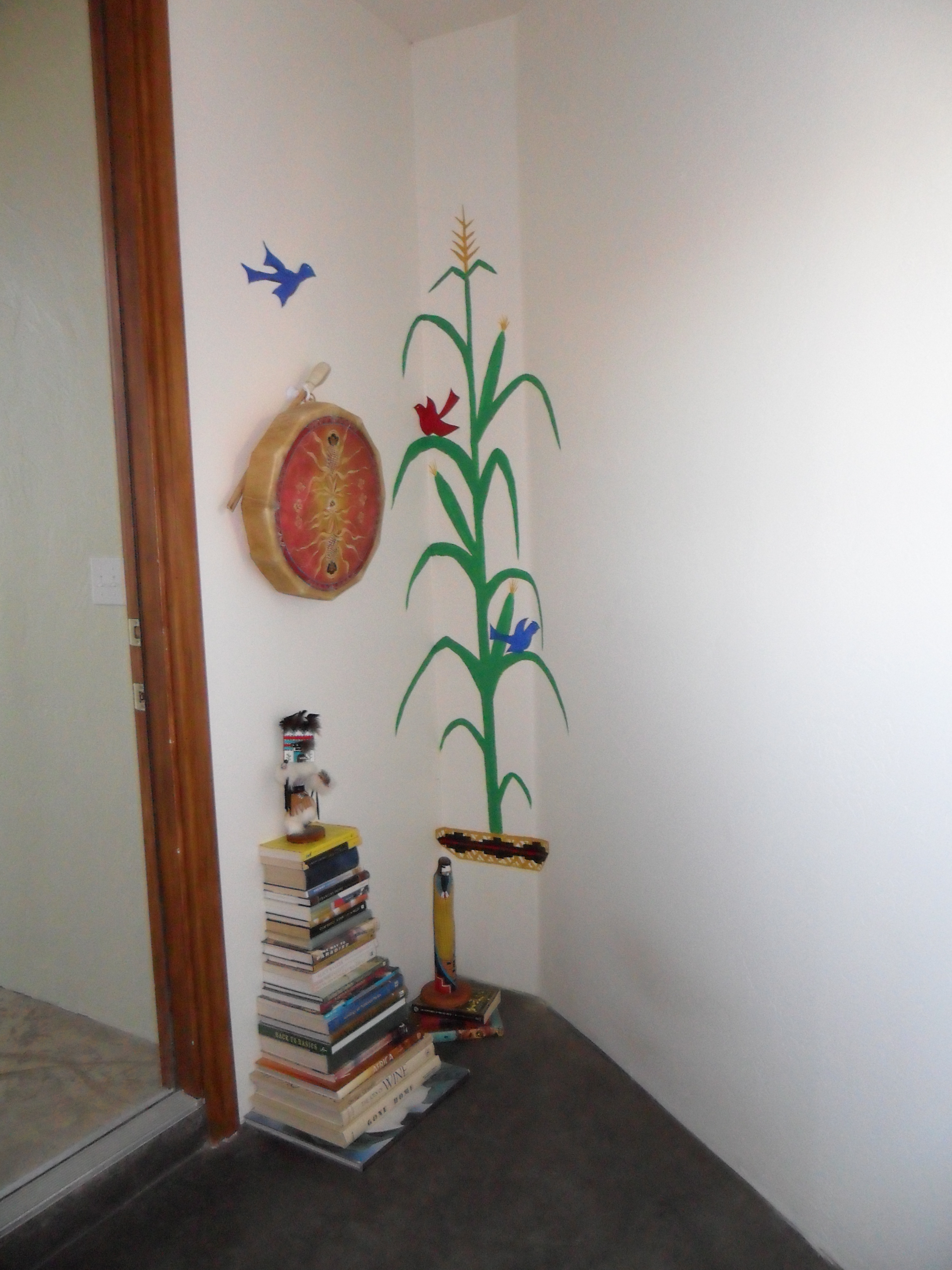
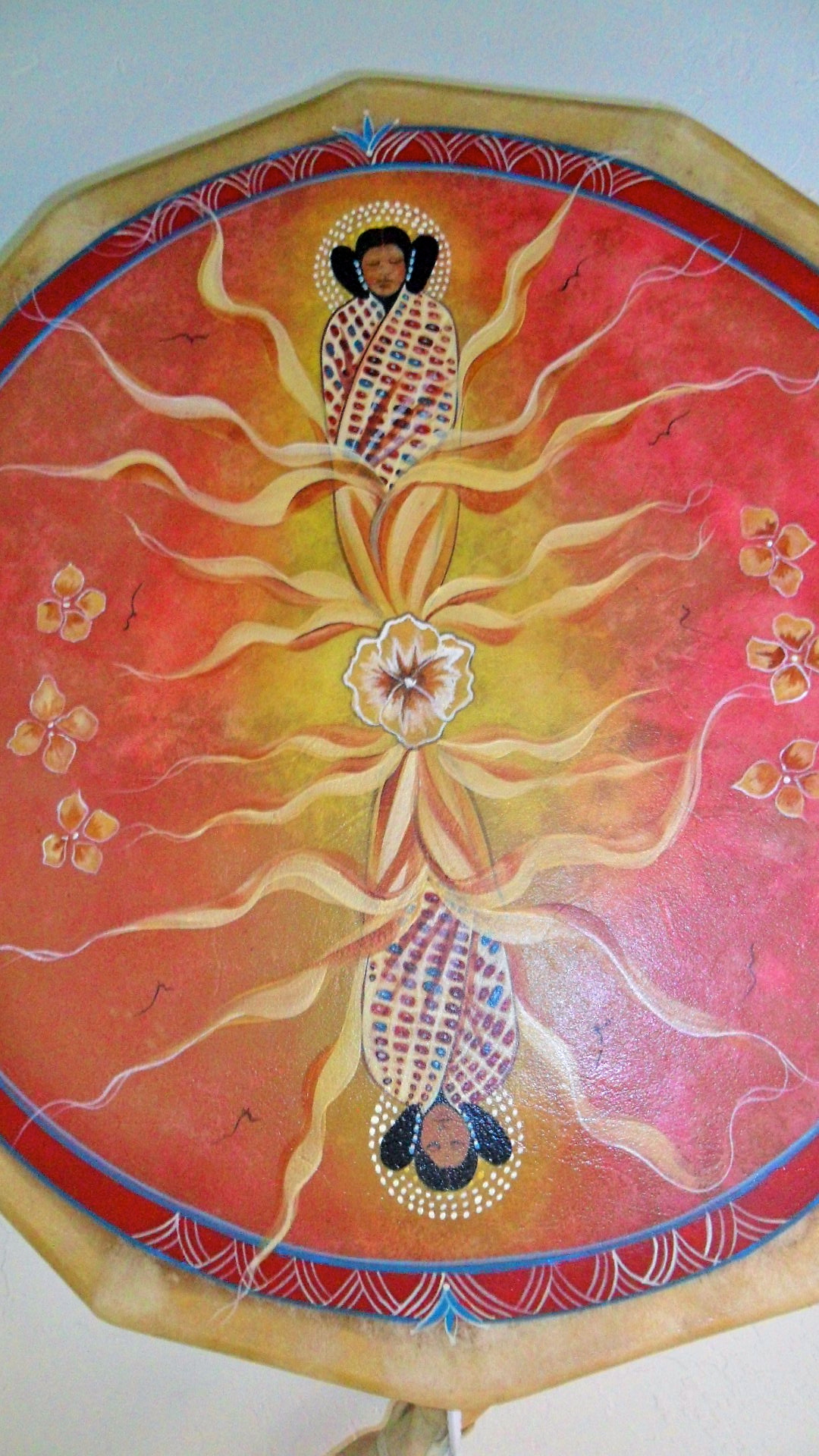
SAM_0035   In the summer on hot, humid nights, you can hear the corn grow.  My great grandfather, my grandfather, and my father grew corn.  I grow corn in that same rich loess soil of Northwestern Missouri.  Soil laid down by Ice Age glaciers thousands of year ago.  Only on a few hill tops, here and there, will you find non glacial soil. Repeatedly, daily, I walk by the sacred corn plant of life painted on my hall corner.  This sacred corn corner houses three corn maiden kachinas and a drum decorated with corn maidens.  I give thanks to corn for my house and the life I lead.

Corn Song

I sing the song of ancients:

pueblo peoples,

Anazazi, Hopi, Zuni.

I sing the song of an America long gone.

Maya, Aztec, Tolmec.

I sing the song of life:  colors of the rainbow

golden, red, white, blue.

I sing the song of now:  thick, endless

identical rows.

Pioneer, Monsanto,

anhydrous ammonia,

atrazine.

I sing the song of hope and joy:

an ancient reclaiming,

a klaidescope of colors,

butterflies and fireflies.

I sing the eternal human song.

SAM_0913

SAM_1489

This is a Navaho kachina.  Kachina are actually Hopi, but Navaho artists now make kachinas as well.  The first corn maiden kachina I bought.

SAM_1490

Spotted corn kachinas, on the left, are unusual.  It took me years to find one.  The kachina on the right was created by R Pino, who is both Hopi and Navaho.

SAM_1491

Every year Pendleton runs an art contest among Native American students.  The winner’s art work is transformed into saddle blankets.  This design, created by Mary Beth Jiron, is the latest in this Student Series. There are three corn  maidens  on each side of the blanket, representing the different varieties of corn grown by native peoples, yellow, red, blue, white, black, and spotted.

Apocalyptic Planet-Part Four: Seas Rise


As I write this title, it seems a bit counter intuitive that one of the first things I saw this morning was a newspaper discussing many small cities around the Texas Panhandle which are running out of water.  And on the TV news as I write this, the city of Amarillo announces measures being taken to curtail water use, followed by a detailed discussion, explaining how one of these smaller towns plans to address the lack of water.  Drought expands while ice melts and seas rise.

Childs explains sea behavior by comparing it to pouring water back and forth among a bunch of pans.  Ocean behavior varies from place to place.  Louisiana has been losing seacoast at the rate of twelve meters per year and large parts of the Nigerian coastline has lost as much as thirty meters per year, one of the fastest losses on earth–erosion.  The moon causes tides twice a day changing sea levels on the average of two meters each time.  Historically most sea level changes are long term changes.  A major cause of sea level change is temperature.  Half the current sea level rise can be attributed to thermal expansion.  Water warms and spreads out.  Not only does heat expand near the sea surface, but now also expands into depths not previously affected.  Findings by two oceanographers, Purkey and Johnson, indicate an increase in ocean heat 16 per cent greater than previously thought.  Oceans are the largest reservoirs of heat on earth.  Once heated, their size makes them slow to cool.

Purkey also notes that even in the depths of the seas, waves transfer heat.  However, because of the size of the Pacific, an event that occurred forty years ago in the southern Pacific will not reach the northern Pacific for approximately those forty years.  Thus, the warming and subsequent ice melt we see in the north Pacific started in the south Pacific forty years ago.  Another scientist, Carl Wunsch, notes that earth changes remarkably without human intervention.  Nevertheless, he recommends humans do something to reduce carbon dioxide emissions as a precautionary measure in addition to discouraging people from settling in low lying areas.  Unfortunately, rising seas do not bode well for much of the earth’s population who live in exactly these low lying areas:  all of Bangladesh, Venice, Shanghai, New Orleans, Bangkok, the Marshall Islands, and many US coastal cities to name just a few places.

St. Lawrence Island north of the Aleutians provides a perfect example of what is happening.  Sea ice breaks up too early, fish species they used to see are gone replaced by new ones they never saw before, and the population of seals and sea lions has altered.  Cancer rates in the villages there have risen dramatically caused in part by the toxic poisons concentrated in the meat of the seals, whales, and salmon they harvest from our polluted oceans.  In 2008, they brought a lawsuit against Exxon, Chevron, and Mobil, claiming that these companies are the world’s major contributors to global warming.  They want these companies to pay for moving their villages to higher ground.  Sea rise necessitates the move.  They lost in District Court, but the case is under appeal.  The court cited that the chain of events causing their predicament is too long to lay blame in one place.  Childs notes that we really need such places to endure, places where people know how to lead minimalist lives, places where people know how to survive.