Barbara Lewis Duke, pretty, petite, blue eyed and blond, my
mother, one fearless, controlling woman. Long after Mom’s
death, Dad said, “Barbara was afraid of absolutely no one
and nothing.” They married late, 34 and 38. He adored her
unconditionally. She filled my life with horses, music, love,
cornfields, hay rides, books, ambition. Whatever she felt she
had missed, my sister and I were going to possess: books,
piano lessons, a college education. Her father, who died long
before I was born, loved fancy, fast horses. So did she. During
my preschool, croupy years, she quieted my hysterical night
coughing with stories of run away horses pulling her in a wagon.
With less than one hundred pounds and lots of determination,
she stopped them, a tiny Barbie Doll flying across the Missouri
River Bottom, strong, willful, free.
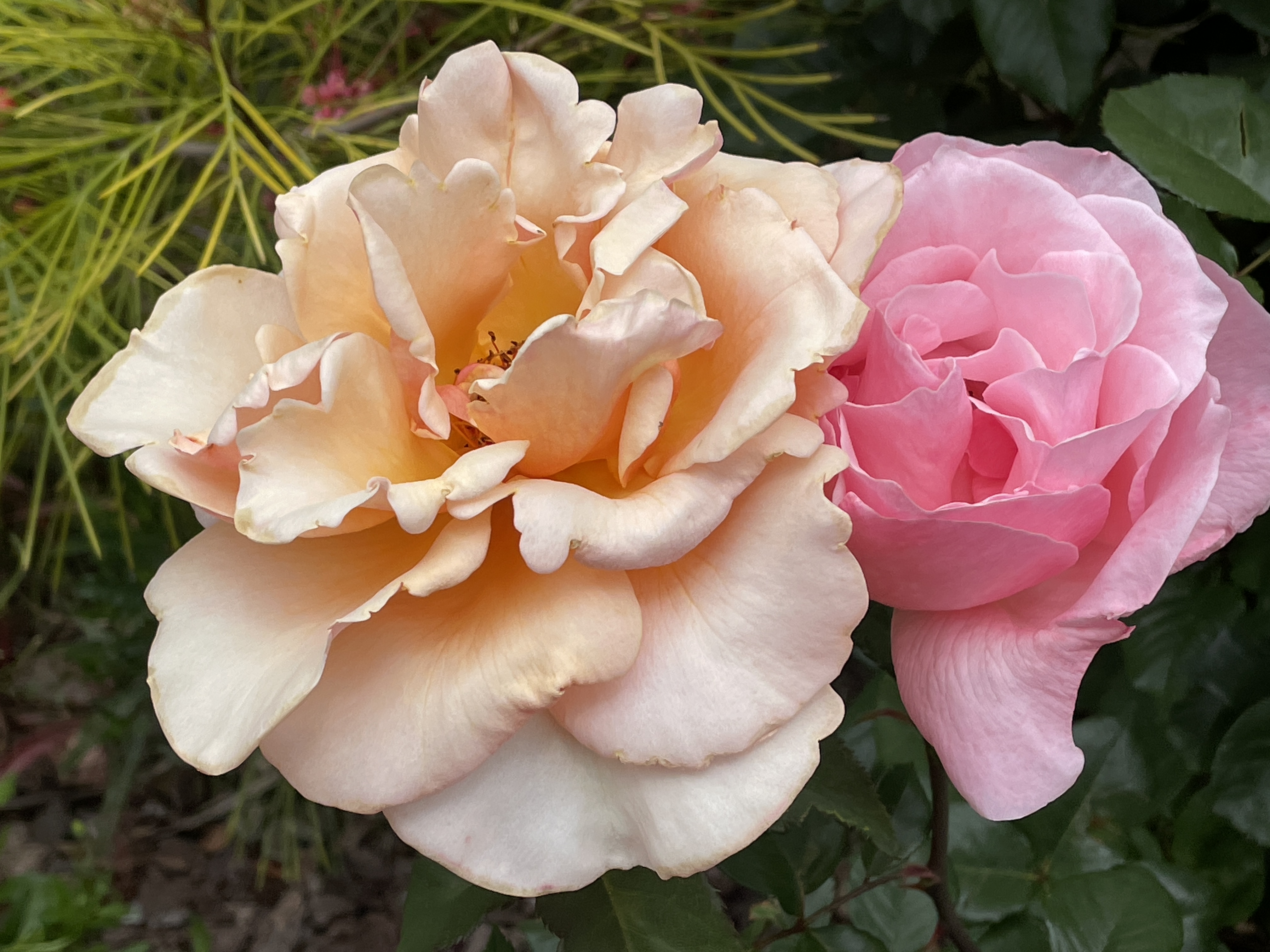
Note: This poem about my mother has been published in at least one anthology and my book of poetry. My mother loved roses, had a rose garden. I now grow roses too.
Regrets and depression seem to have overwhelmed the main character, Nora. She’s lost her job, a car ran over her cat, she thinks she has failed at everything, and she says she wants to die. But does she really. Through a series of parallel universe experiences she gets to try out many different lives based on her long list of regrets. None really work because none of them exemplify her real self. She thinks she might like this new life or that new life, but none fulfill her, reflect her true self. She learns that money, fame, riches are not necessarily the answer. But what is the answer? What is the best way to live?
One of the most famous canyons in the country resides inside the Dine (Navaho) Nation. While administered by the National Park service, it is also the home of several Dine families. You can drive through the roads on the top freely, stop at various viewpoints, take photos, etc. Here are the various views I saw last week while there. The bottom of the canyon is restricted. To go there, you need a permit and a Dine (Navaho) guide. More about that in the next post.
Several families live in the bottom of the canyon, especially during the summer months. You cannot go into the bottom of the canyon without a permit and a Navaho guide.
Several months after Maclear’s father (who was a famous journalist) dies, she decides to take a DNA test to find out more about her family health and personality history, mainly because of the stories about a particular grandmother. She wonders if certain traits she and her sons have might possibly be inherited. The results of the test are a shock. Her father, the father she adored, who raised her and adored her, is not her biological father. At first, she thinks perhaps it was a sperm donor, but then she discovers this is not the case. Through the DNA test and her detective work, she finds two biological half-brothers (she was an only child before this discovery) who are willing to communicate with her, send her photos, etc. She tries relentlessly to acquire more information from her mother, who is often unforthcoming or tells her contradictory information. Then her mother gets dementia.
This is also a story of plants, of gardening. Both she and her mother are amateur botanists and expert gardeners. When nothing else works in their mother-daughter relationship, their love of plants and gardening holds them together. Even with dementia, her mother knows plants. Their other joint endeavor is ink drawings and love of art.
Additionally, this is the story of family, family secrets, inter-racial marriage, and challenging relationships. Kyo’s mother is Japanese living originally in England and later in Canada who often struggled with her status as a Japanese immigrant. Her “real” father, the one who raised her, was of British and Irish descent; her biological father was a Jewish formula one race car driver.
Want to know how the top 1 percent, the super wealthy live and control nearly everything in the US? Read this book. In a mere 117 pages, McDonell explains his own life and that of fellow 1 percenters. He details his early life, the private school he attended, the family connections, summers taking sailing lessons in the Hamptons, and vacations using private jets to places like the Galapagos Islands. At 18, he was able to get his first novel published in part because of his family connections to a famous publisher. Eventually, he left this life behind to become a foreign correspondent in Iraq and Afghanistan.
In this book he details how the super wealthy hoard wealth, pass it from one generation to another, and how outsiders, the poor and those not white, are kept out. Here are a few quotes from the book:
“I began to see how, in the United States of America and elsewhere, success almost always, and predominantly, depends upon wealth–and frequently comes at the expense of the less wealthy.”
“We in the one percent like to believe in meritocracy, even fairness.” At this point he lists several of famous people who rose to wealth and power from poorer circumstance and explains how this is used to make the “one percenters feel good, they distract from the possibility of a more humane distribution of wealth.”
Why do the one percenters behave as they often do? He interviews several whom he knows through his private school connections. “The fear they share was loss of wealth. Without ever saying so, they were very much afraid of losing their country houses, the barn converted for their kids sleepovers, the space for the grand piano, the green houses, pied-a-terre where their mother-in-law stayed without interfering in everyone’s business, the airport lounge that allowed them to enjoy pleasures among their own, in quiet. They were afraid of supermarket processed cheese, preferred organic stuff which they believed would keep them alive longer….they were afraid of losing their Prada bags…the cashmere….They feared losing wealth not for its own sake but because it was justified, in their own minds, by intelligence, hard work, determination—that is by character.” They truly seem to believe they are smarter and harder working than other people.
This is the perfect book for those interested in hominid evolution. I’ve been fascinated by Homo naledi ever since I first learned about them more than a decade ago. In 2013, paleoanthropologist Lee Berger first discovered them in a sizable cave system in South Africa. The initial discovery included the largest pile of hominid bones ever found.
In “Cave of Bones” Berger details his and his teams repeated visits to this cave system and their discoveries over time which allowed them to find evidence that naledi buried their dead, used fire, and drew designs on the walls near passages from one part of the cave system to another. Before their discovery, it was thought that only homo sapiens did any of these things with exception perhaps of neanderthal. The naledi walked upright, lived during the same time as early homo sapiens, and had a feet and body structure like homo sapiens (except they were smaller than most people today), but their fingers were somewhat curved indicating they used them for climbing. Their brains were smaller than homo sapiens. This has made some scientists question the validity of the findings since it has long been held than brain size relates to intelligence and many of the abilities that are distinctively human. The book contains photos of the cave system, of some of the skeletons, the drawings, and other relevant material as well as an extensive bibliography.
I started out thinking I would write a poem per day for National Poetry Month. Well, I’m a bit behind on that, but here are two of several I have written so far.
Spring
The mockingbird awakens me with his song.
A hummingbird, dressed in green with an iridescent
orange collar, flits by my head then sips nectar
from a scarlet bougainvillea blossom.
The neighborhood barn owl hoots at dawn and dusk.
A black and red/orange bird I’ve never seen before
lights on a palo verde limb.
A Western Bluebird dips its beak repeatedly in
the talavera birdbath.
Remember
In this world steeped in senseless violence remember






 writingontherim