The Mabel Dodge Luhan House in Taos


For years I had read and heard about this place, even attended a lecture by a descendent of one of her frequent guests who actually knew her when he was a child.  This past weekend good friends from Rociada took me there with my best friends from college years, friends from long ago, visiting from California.

I already knew something about Mabel and her friends, famous people who frequented her salon, created the artistic mystique that still hangs over Taos.  When I returned home, I wanted to know more.  Born into Buffalo, NY, high society, she had been married and widowed by the age of 23.  As a young woman she was openly bisexual; her memoir, “Intimate Memories”, provides a frank discussion of this part of her life.  Several years after her first husband’s death, she married the architect Edwin Dodge.  They lived near Florence, Italy, for seven years where she entertained such notables as Gertrude Stein, Alice B. Toklas, and Andre Gide.  After affairs and two suicide attempts, she separated from her husband and moved to Greenich Village.  Eventually, she married her third husband, the painter Maurice Sterne and became a patron of the arts.

In 1917, she and her husband moved to New Mexico.  This changed her life; she lived there until she died 45 years later.  She preferred Taos to Santa Fe, finding the latter “too civilized”.  She found New Mexico “alive” and fell in love with Pueblo culture eventually even cutting her hair to mimic Pueblo style.  Sterne did not find New Mexico to his liking and left.  After their divorce she married her long standing love, Antonio Luhan, a Taos Pueblo man.  They remained married 40 years.

Mabel entertained a nearly endless array of famous artists, writers, and intellectuals:  D.H. Lawrence, Georgia O’Keefe, Willa Cather, Ansel Adams, Carl Jung, Emma Goldberg, Margaret Sanger, the founders of the Taos Society of Artists.  She introduced New York and the east coast to New Mexico through her columns in “The New York Journal”.  Mabel died in 1962.

IMG_2284

A view of the main entrance and the largest portion of the house and grounds.
IMG_2274

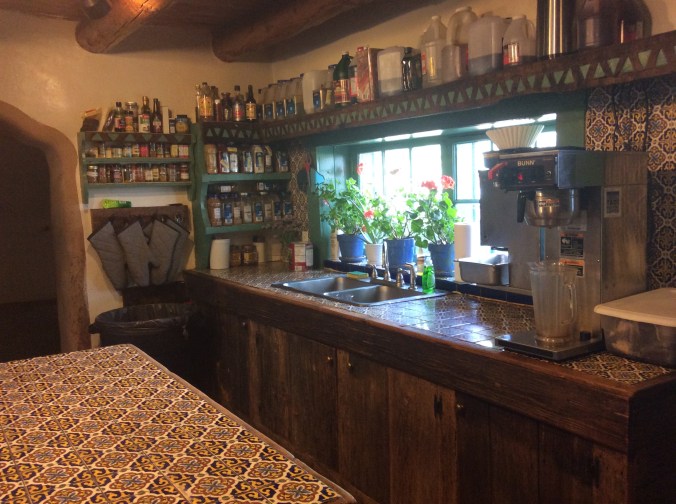
A small portion of the kitchen.  Cookies, coffee, fruit infused water, and tea were available in the dining room for hotel guests. Books with historical photos lay out for visitors to read in an adjoining room.

Dennis Hopper bought the house in 1970 and recreated her “salon” hippie style.  In 1977, he sold it to George Otero.  Because of years of neglect, it required extensive restoration.  The Oteros turned it into a non-profit where they held workshops.  The Attiyeh Foundation, its current owners, purchased it in 1996 and run it as a hotel and conference/retreat center.  It costs nothing to visit and wander around.

IMG_2281

This photo was taken from the same spot as the first one, looking to the right instead of toward the entrance.
IMG_2282

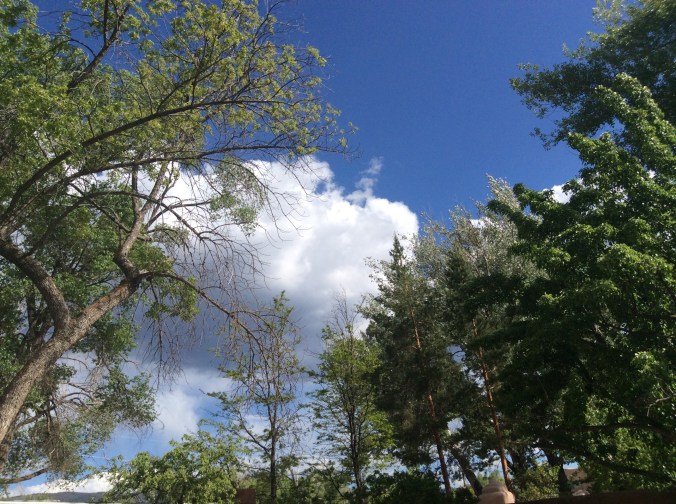
While standing there, I looked up into that incredible New Mexico sky.
IMG_2279

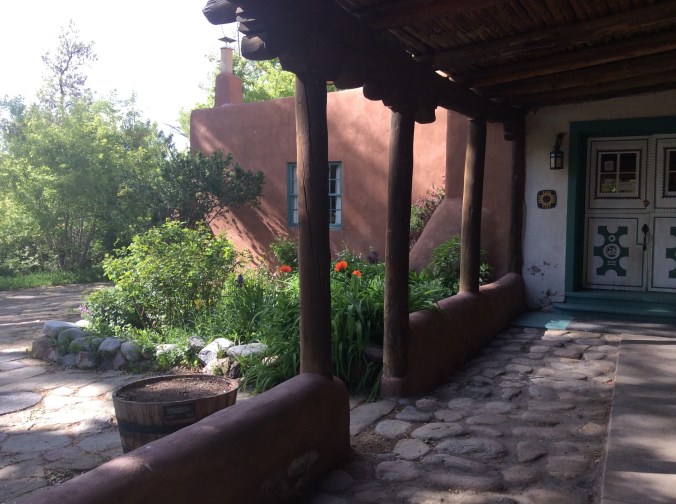
A close up view of the entrance.

IMG_2276

Look at all the bird houses.

IMG_2275

Beside the kitchen, out a side door–patio and horno (traditional clay oven) shaded from the afternoon sun.
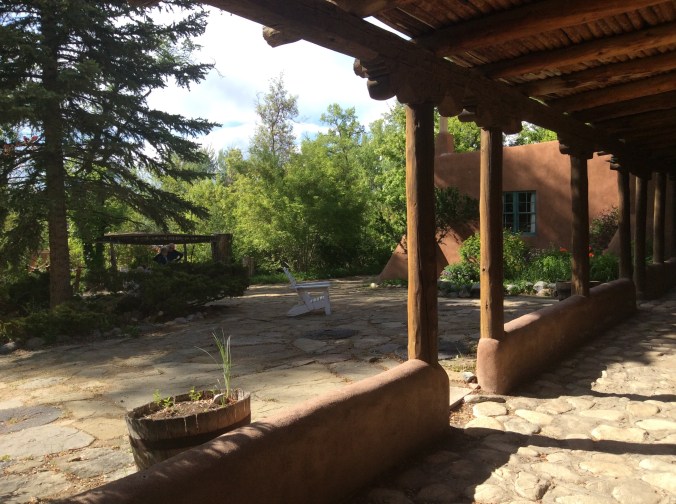
IMG_2277

IMG_2280

Friends chit chatting while I wander around taking photos.

For more details, go to:   http://www.mabeldodgeluhan.com.  This includes history, accommodations, workshops, etc.  The accommodations portion even tells the site visitor who slept in each room when visiting Mabel.


Saturday Night


Read two pages,

“Ghana Must Go”.

The wife’s Nigerian,

Yoruba, Igbo.

She sells flowers,

not in Nigeria.

The author’s name

Ethiopian?

Sip zinfandel

flowered glass.

Take a bite

chocolate filled

peppermint,

lick peppermint

fingers.

Read two pages:

“Africans…the indifference of the abundantly blessed…

who can’t accept, even with evidence, that anything native,

occurring in abundance, is exceptional without effort,

has value.”

Does anyone?


IMG_1584


Poem for Today


Inspired by a friend’s poem, I decided to take a look at some of my book stacks and write a poem from their titles–in honor of National Poetry Month.

IMG_2140

Now Is the Time to Open Your Hearts

the tongue’s blood does not run dry

The Mambo Kings Play Songs of Love

A Simple Havana Melody

Alejandro Blue

The Spirit of Indian Women

Still Life With Bread Crumbs

Ring of Fire

Gardens in the Dunes

Daughters of Fortune

The Way to Paradise

The Bingo Palace

Uppity Women

How We Became Human

Close Range

Native Guard

Things Fall Apart

Gone Home


Women Writers and the Story Circle Network


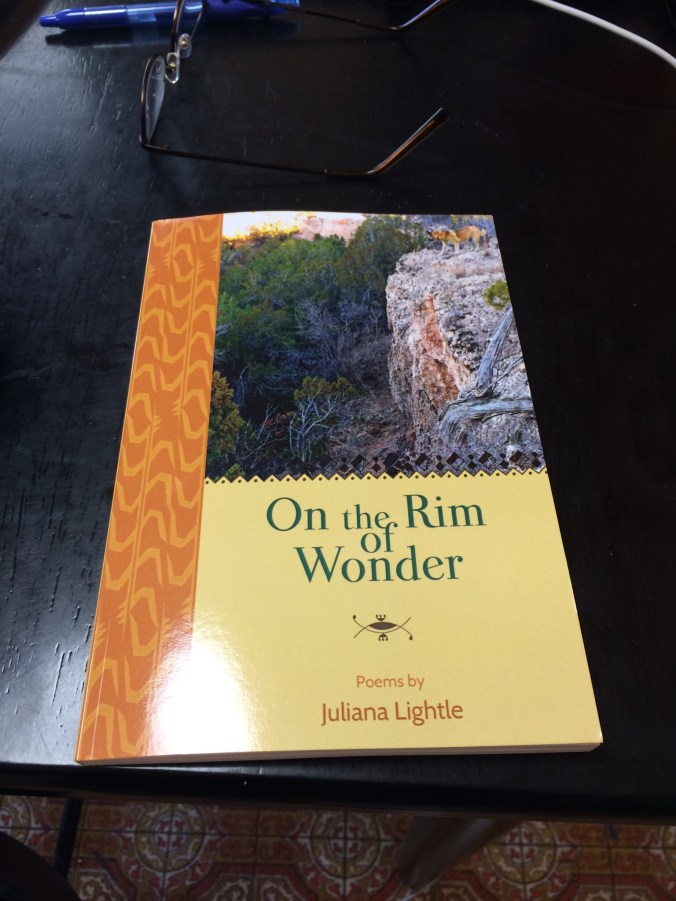
More than twenty years ago, I coauthored a book with an attorney.  Not only did it get published, it was also translated into Spanish.  The topic, the momentum for its topic, seems basically gone now.  Some technical and business magazines published a few articles I wrote.  I wrote some safety manuals, other technical stuff, rather boring, uninspiring.  Then I discovered the Story Circle Network.

The Story Circle Network inspired me to write creatively again–once upon a time in high school my poetry was published.  Then I quit writing for years.  When I started again, it was technical or business writing.  If you want to write your stories, read other women’s stories, just explore fiction, poetry, travel writing, you name it, join this organization.  It changed not only my writing life, but my life in a broader sense.  Through it I met not only other writers, I also became a board member, made new friends who write and share. This inspiring organization not only provides classes, publishes, but also hosts various writing contests and a biannual conference.  In the middle of April, I will head to Austin for the conference.  The keynote speaker is no other than Brooke Warner, the woman who founded She Writes Press.  Go to http://www.storycircle.org to learn more about the conference and the just announced winners of the Sarton Women’s Literary Awards, become inspired, create, publish, grow.  Without this organization, I seriously doubt I would have written my book of poetry, published by Uno Mundo Press in April 2014.

10285598_10201564553698114_927164360_o

Because of comments from readers of this book, inspiration from friends, and personal interests, I am now working on another book.

I offer thanks to the Story Circle Network for renewing my writing life.


Rewriting Religion: the radical poetry of Aemilia Bassano Lanier by Mary Sharratt


This illustrates how recently in history English speaking women have gained the right to openly display their talents, how hard won these gains have been. These rights can just be as easily be lost unless we remain vigilant.

Mary Sharratt's avatarFeminism and Religion

Sharratt_DarkLady-hi

Aemilia Bassano Lanier (also spelled Lanyer) is the heroine of my new novel The Dark Lady’s Mask.  Born in 1569, she was the highly educated daughter of an Italian court musician—a man thought to have been a Marrano, a secret Jew living under the guise of a Christian convert. She may have also been the mysterious, musical Dark Lady of Shakespeare’s sonnets, although most academic scholars dispute this. What we do know for a fact and what really matters is that she was the first woman in England to pursue a career as a published poet.

In Italy women such as Isabella Andreini published plays and poetry on a wide variety of secular subjects, but in England Lanier effectively had only one option—to write devotional Protestant verse. Her English literary predecessors, Anne Locke and Mary Sidney, wrote poetic meditations on the Psalms.

But Lanier turned this…

View original post 636 more words

2016 Africa Reading Challenge


Want something new to read, what to expand your knowledge of the wider world, read literature from Africa, Latin America, anywhere that is not your culture.

Kinna's avatarKinna Reads

Welcome to the Africa Reading Challenge.

This will be the fourth time that I’m hosting the Africa Reading Challenge.  Details and requirements are the same this year as for the 2012 Africa Reading Challenge, which started with: “I have absolutely no reason for hosting nor urging you to participate in this challenge save for the joy of discovering and reading African literature!” Here are the details:

Challenge Period

January 1, 2016 to December 31, 2016

Region

The entire African continent, including its island-states, which are often overlooked. Please refer to this Wikipedia “list of sovereign states and dependent territories in Africa”. Pre-colonial empires and regions are also included.

Reading Goal

5 books.  That’s it.  There will be no other levels.  Of course, participants are encouraged to read more than 5 books.  Eligible books include those which are written by African writers, or take place in Africa, or are…

View original post 473 more words

Hey poets, be good literary citizens. No more excuses.


This post reiterates advice I would give myself. Additionally, I would add something I wish I had known a year ago before my book of poetry was published. No one told me that most writing contests require unpublished work. If you want to enter poetry contests, enter before you publish. Many contests even include work published in blogs as previously published. I continue to hunt for contests that allow previously published work. It seems few exist. If any of you writers out there know about such a contest, please let me know.

bripike's avatarBrianna Pike

With AWP (Association of Writers & Writing Programs) and National Poetry Month just around the corner, I’ve been thinking a lot about what it means to be a working poet. I’ve got a couple of projects in the works for the month of April (updates to come soon) but I keep coming back to a piece of advice I’m always giving my students, which is that poetry doesn’t occur in a vacuum. Poetry is about the poet but it’s also about the community where the poet lives and works.

Admittedly, the idea of community is constantly evolving. Your community can be your workplace, the local bookstore or coffee shop you frequent or your local library. However, community can also mean something much bigger, especially in the wake  Facebook, Twitter and Instagram. I’ve blogged about my love affair with social media and the poetry world. This love centers around the fact that Facebook…

View original post 606 more words

Brilliant books by brilliant writers


In case you are looking for something new to read. I would add any book by Leslie Marmon Silko. My all time favorite book, “Storyteller”, written by her contains a story I must have read 50 times, “Yellow Woman”.

Samuel Snoek-Brown's avatarSamuel Snoek-Brown

And all these writers are women.

I spotted this list of 30 books by women in my Facebook newsfeed — the always-glorious Lidia Yuknavitch shared it — and I loved the first line of the intro:

“Let’s be real: You should be reading books, and books by women, every month of the year.”

Amen!

But yes, it’s Women’s History Month here in the states, and while Emily Temple, author of this listicle, claims, “That women have contributed just as much to our literary culture as men doesn’t even need to be said,” I think, sadly, it does. We need to say it again and again, not just this month but every month.

So read a bunch of books by women. And the ones you don’t finish? Well, there’s always next month, and the month after that, and the rest of the year.

Need a hint of where to start? There are a bunch…

View original post 352 more words

Haiku Adventure-Part Seven


This rather short adventure was an experiment soon to end.  Since my haiku posts generated so many positive responses, I may consider its continuance.  My most recent adventure, however, is to take Word Press’ Blogging 101 in spite of the fact that I have been blogging for more than three years.  I feel certain I can learn something new.  For now here is another haiku.

Three large purple onions

waiting

mother’s old stoneware bowl.