One Book a Week-3


While wandering around Barnes and Noble looking for something new to read, I read the blurb for An Imaginary Life by David Malouf, an Australian writer. I bought it. Of course, I had heard of Ovid, seen parts of Metamorphosis, his most famous work, but knew little about him. Emperor Augustus exiled him to the remote regions near the Black Sea for reasons not totally known but perhaps due to the nature of Ovid’s erotic poetry which was very popular. Written in the first person, this book relates Ovid’s experiences, thoughts, and feelings while in exile. The urbane and educated Ovid now has to learn to live with superstitious, illiterate, poverty stricken people whose language he does not know, who possess none of amenities to which he is accustomed, who live in a bare survival mode. They find a “wild child” and Ovid becomes determined to catch him and teach him. The Child has lived with the animals and speaks their language, seems immune to weather even though naked, knows nothing of humans. As Ovid lives with and teaches the Child, he begins to question what it means to be human, to be civilized, to be different. What is the true meaning of life?

Note: If you look up Ovid, you will find a birthdate but no date of death. No one knows exactly when or where he died or where he was buried.
One Book a Week-2


One book a week? To date this year it has been more like 3-4, depending on the book and week. I wrote reviews for four books today on Goodreads including The Sea of Tranquility, Little Fires Everywhere, An Imaginary Life, The Woman They Could Not Silence. I mentioned the first one in my last post.

I noticed that Little Fires Everywhere is now a series, streaming. I will not watch it because it is one of the few books that made me cry. I rarely cry. Is it worth reading? Yes. I view it as recommended reading for parents. How do you treat your child who is different, the child who is not how you want your child to be? Is conforming the best way to live? And at what cost? Is a poor minority child better off with wealthy parents from a different ethnicity who can provide everything?

Next I read a non-fiction book, The Woman They Could Not Silence, The Shocking Story Of A Woman Who Dared To Fight Back, by Kate Moore. Apparently I did not know as much about women’s history in the US as I had thought. This is the true story of the life of Elizabeth Packard. Here are some of the things I learned:

  1. In the mid 1800s if a woman was married, her husband could place her in a mental asylum as insane and she could do nothing about it even if she was sane. She could not get out even if relatives and friends tried to come to her rescue.
  2. Her husband could confiscate all her property and do with it whatever he pleased. She and everything she owned now belonged to him.
  3. People in mental asylums were terrorized and treated with methods now considered even illegal treatment for actual terrorists, e.g. water boarding.
  4. A common, accepted treatment for “difficult” and “emotional” women was clitoridectomies, female genital mutilation. Prominent psychiatrists viewed female genitalia as the cause of female insanity. Dr. Isaac Brown, a prominent London surgeon, stated that it was easy to cure female insanity, just cut off her clitoris. This was practiced in both the US and England.

Elizabeth Packard’s husband placed her in an asylum because she disagreed with his religious views and her outgoing nature. This book details her life in the decades she struggled to be released from the asylum and her struggles to make life better for those who were placed in asylums. It is a must read for anyone interested in the history of women in the 1800s and the treatment of those deemed insane.

One Book a Week-1


After finishing Tolstoy and the Purple Chair, by Nina Sankovitch, who sets out to read a book each day for a year in order to alleviate her grief over her sister’s death, I decided to commit to reading a minimum of one book a week for a year. As of today, I have already read three, the first of which was The Sea of Tranquility by Emily St. John Mandel. Previously I had read my last Octavia Butler novel, Parable of the Talents in which the main character creates a religion with the ultimate goal of establishing human colonies in “the stars”. Then I discover that the title of The Sea of Tranquility refers to a specific area of the Moon where in this book there are two human colonies. Additionally, there are other colonies, the Far Colonies. Their specific location is never cited.

What is the likelihood that I would pick up a book at the library where the goal of the main character in the last book I read is fulfilled in the second book? Coincidence? Serendipity?

And, by the way, a pandemic occurs in both novels. Butler’s book, written in the 1990s, contains a number of prophetic statements and events which sound like today’s news. More about that in the next post.

Reading Octavia Butler-1


In a recent post I mentioned walking in her footsteps. This is the rainy season so we have not been able to go on that walk yet.. However, this morning I finished reading the last novel of hers that I had not read–Parable of the Talents. It is the sequel to Parable of the Sower. Now I have read all of them. She is buried at Mountain View Cemetery in Altadena, CA, Eagles View Lot 4517. The inscription on her gravestone is the theme of both the books above:

All that you touch You Change.

All that you Change Changes you.

The only lasting truth is Change.

God

Is Change.

Octavia Butler’s Pasadena–Part One


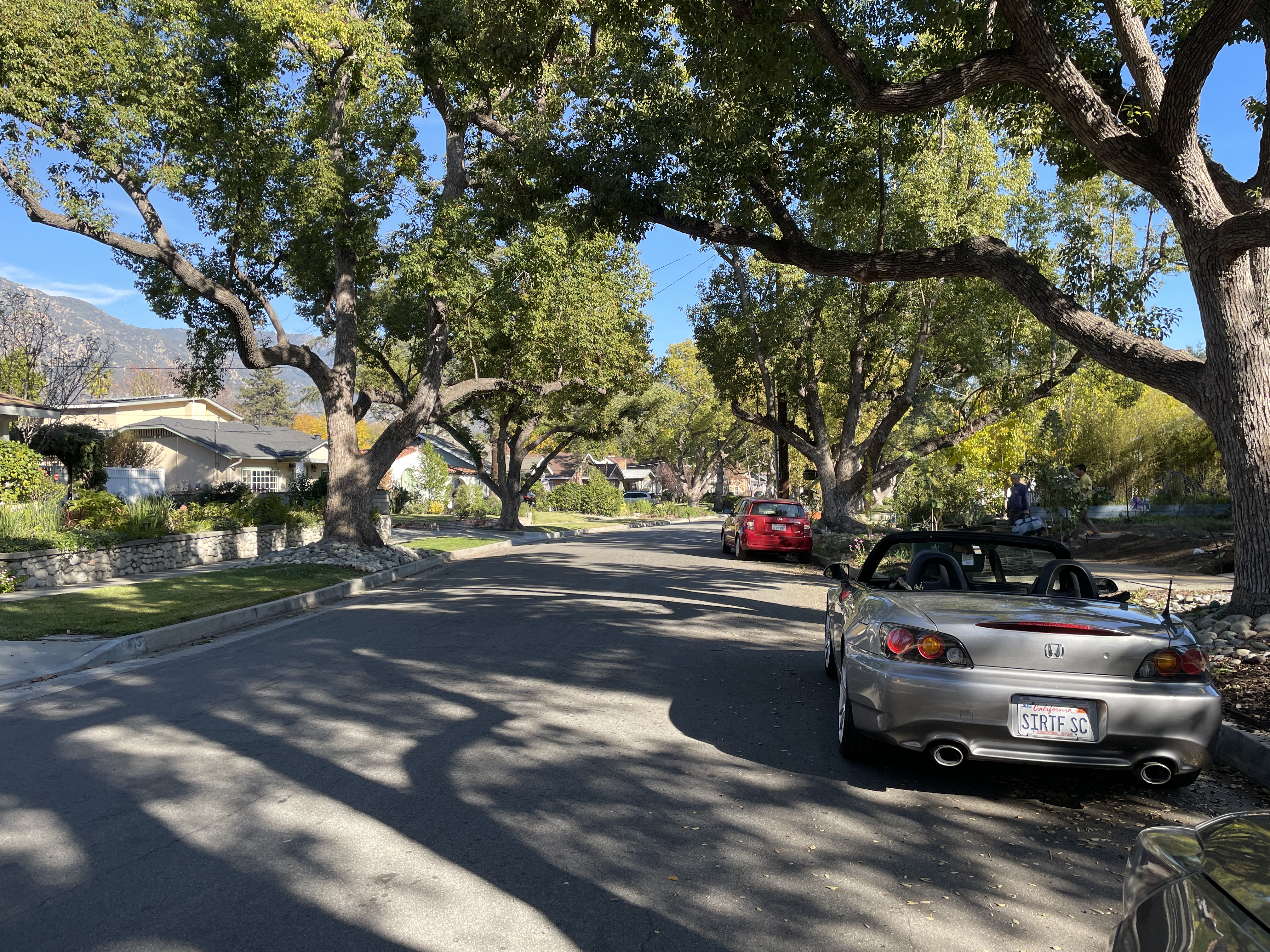
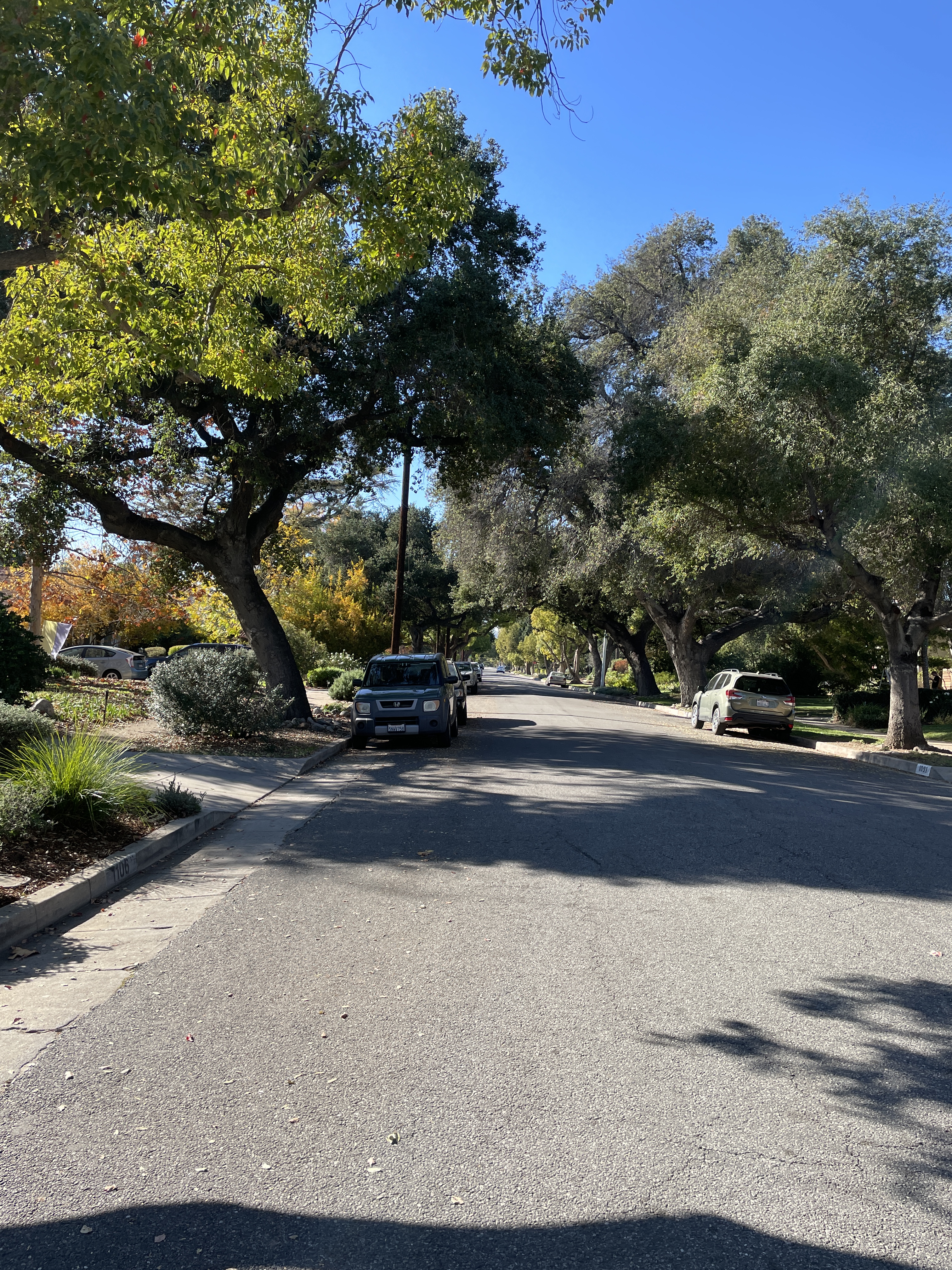
As part of a bookclub I co-host, we read Octavia Butler’s novel Kindred, a science fiction story which takes places in California and in the Old South. Since many of the bookclub members live in or near Pasadena, we decided we would do “Experience Butler’s Pasadena on Foot”, a walking loop of about 2.5 miles. We had planned to take the walk earlier in December but were rained out. We will reschedule early next year. I decided to do a dry run in November and took these photos along one of the streets where she often walked.

Butler lived most of her life in Pasadena but never owned a car. She either walked or took public transportation.

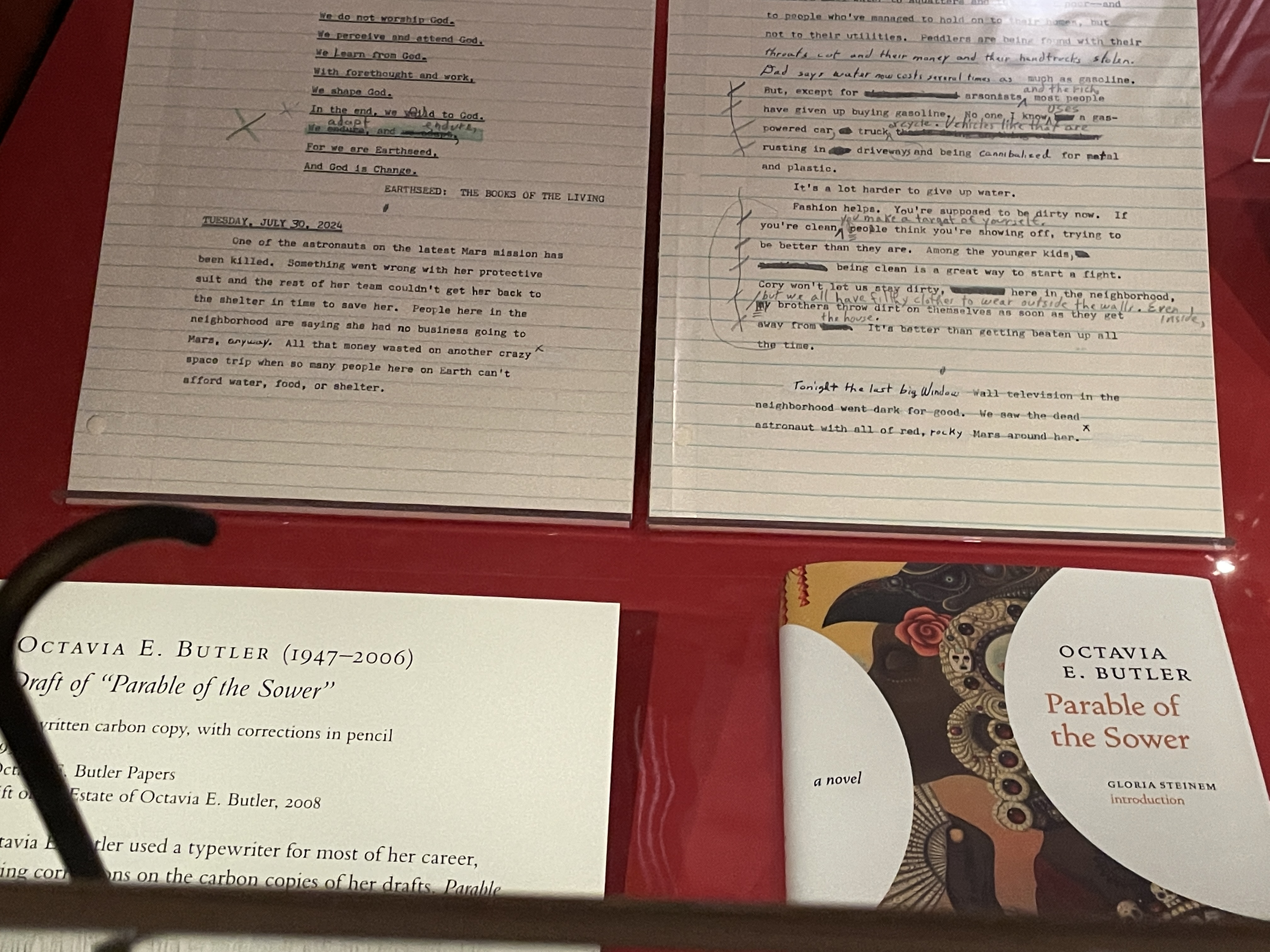
For those unfamiliar with her, she became famous as the first African American to win multiple Hugo and other science fiction awards. Born in 1947, she died in 2006, and is buried in a cemetery in Altadena, CA, just north of Pasadena. Many of her manuscripts are on display at The Huntington Library.

The last Octavia Butler book I read is the one illustrated in this photo taken at The Huntington Library. I am currently reading the sequel, Parable of the Talents. When I finish that one, I will have read all of her novels. She is one of my favorite authors.

Evening


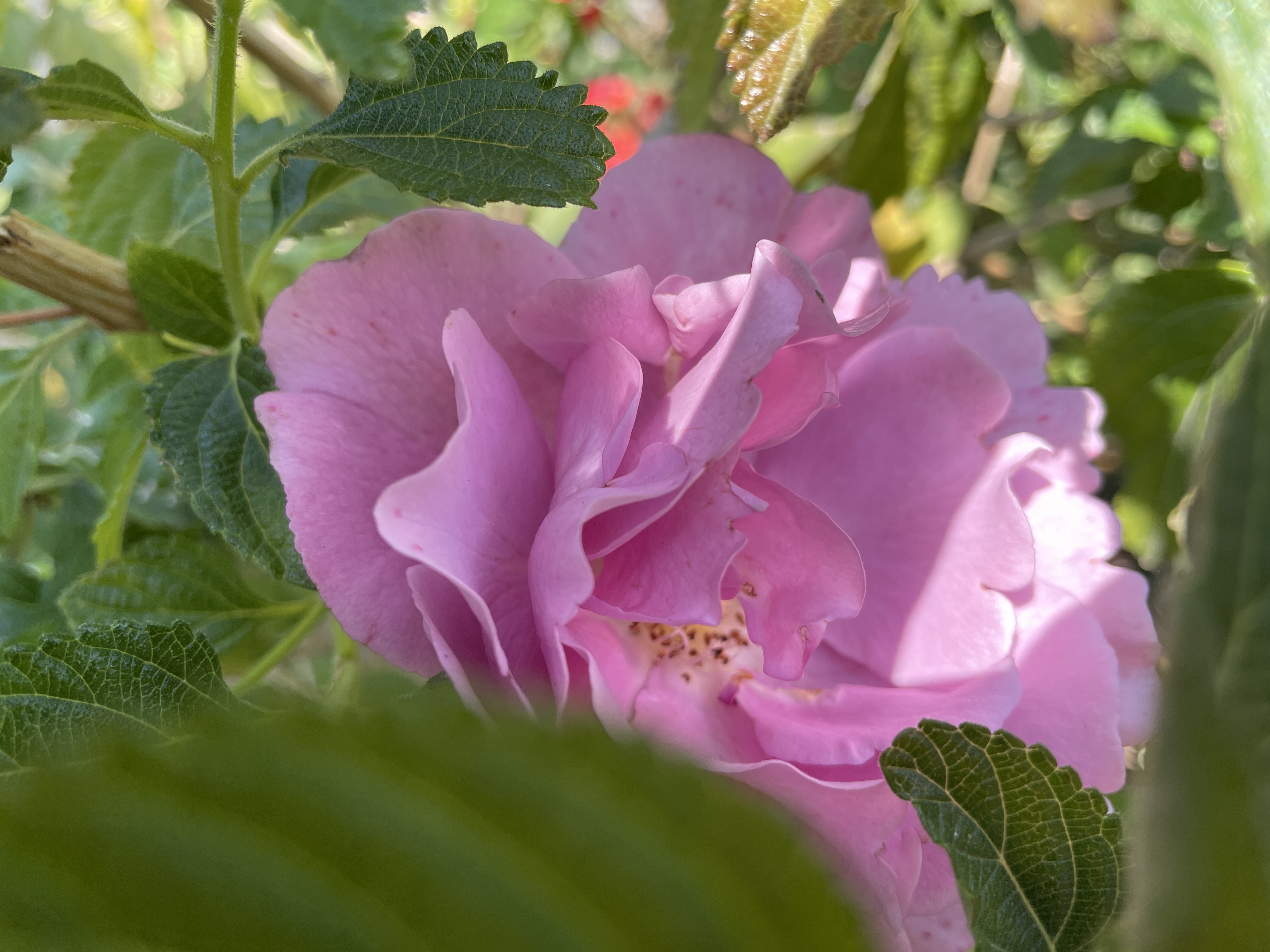
Rose remnants float in my palm

the color

of fresh blood

of sunsets

cerise, burnt orange, gold.


A pale blue dragon

thunders

across a salmon sky.


Slowly indigo night

descends,

only the coyotes sing.


Puma III


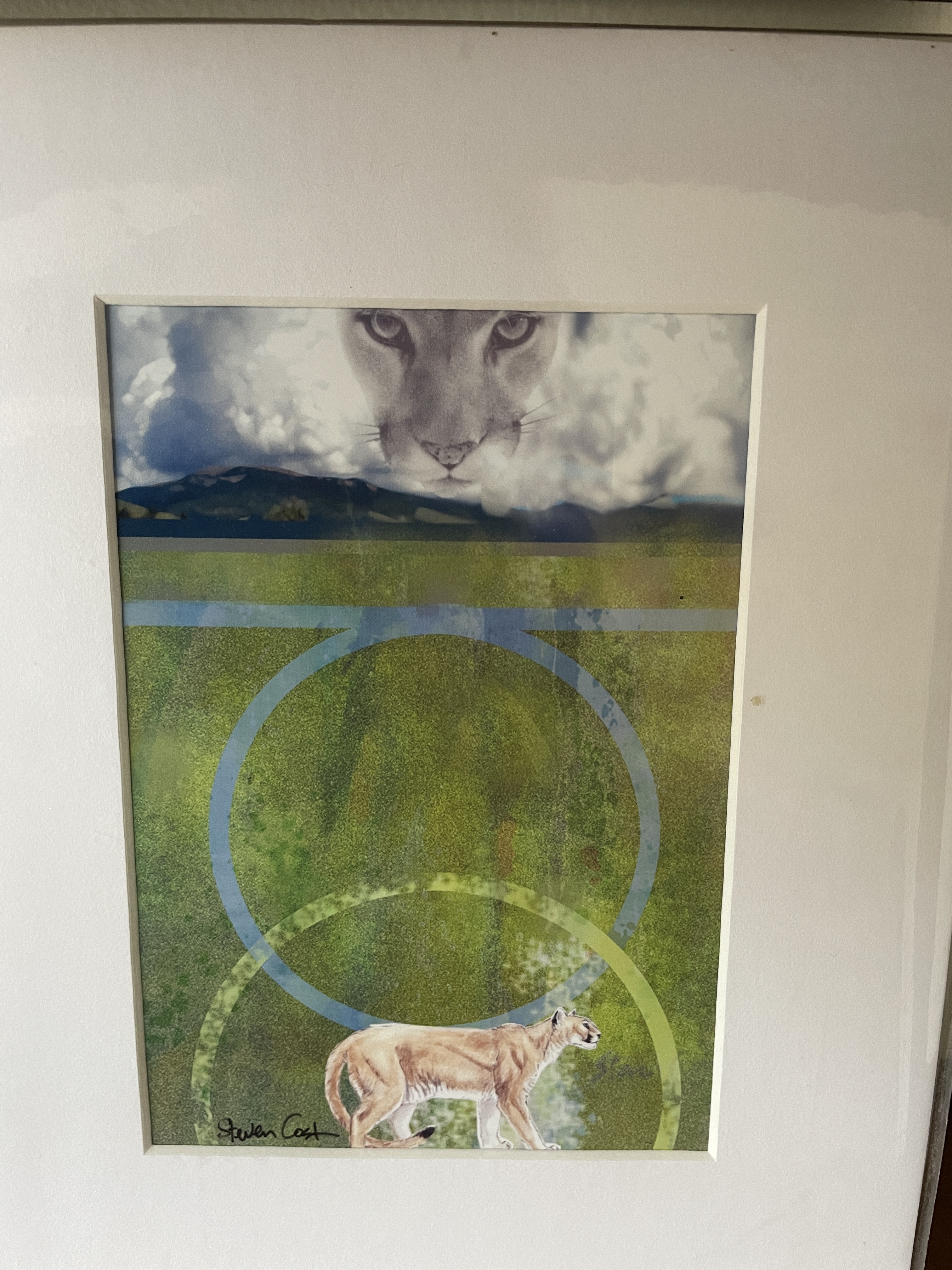
Two more puma paintings grace my house, one in my bedroom and one in my office. The one in my office was painted by Amarillo artist Steven Cost and needs framing.

The following poem is the last of the three puma poems published in “On the Rim of Wonder.”

I want

to walk

with you

in my dreams

scream your screams

feel your blood

rushing

your heartbeat

mine

soft golden fur

wound in my hair

your amber eyes

glowing

through my brown

death defying

together walking

moonlit

wild

free

Pumas — 1


Some people possess obsessions. For me only one really exists–pumas. I kept hoping I might see one when I lived at the edge of a canyon in the Panhandle of Texas even though I knew where I lived was probably too populated. Now, living in LA Country, I realize pumas can be anywhere. Have not seen one yet, but I keep hoping. I’ve considered driving 1/2 hour up into the Los Angeles National Forest to hike and hope. Since one of my walking partners refused to go any farther when the sign said “Watch for Bears”, I would have to take the hike alone. The bear sign did not deter me, but she could not go home since I drove so I went back to the car with her. People see bears in town all the time, but rarely pumas or if they are around, they hide. My puma obsession includes dreaming about them and writing poetry where they star. Here is one of the puma poems I wrote while I still lived in Texas.

I watch for eyes, blue changing to amber and back.

I put my palm, fingers stretched to measure, into the footprint.

Too small, bobcat

No puma.

My thin body squeezes between the rocks,

climbing quietly down the cliff.

Watching, listening, searching.

No puma,

Pale amber rushes across my vision line.

My hearth quakes.

I watch; I wait.

It is Isabella, a golden whir chasing rabbits.

No puma.

At sunrise, I walk the rim,

watching.

At sunset, I walk the rim,

waiting.

At night, I walk the rim,

dreaming.

No puma; not yet.

I’ve had this photo, taken by a famous wildlife photographer, for at least a decade. She, yes, it is a she, watches over me daily. In my bedroom is a puma Zuni fetish and a painting. I have a couple of others here and there in addition to books about pumas. Someday before I die, hopefully.

My First Published Poem


April is National Poetry Month. While emptying one of the boxes still stacked in the garage after the move, I found the book in which Missouri high school student’s poems were published. The following includes a photo of the book and my first published poem included in it.

Hot Pink Toenails


Since this is National Poetry Month, I have decided to post a few of my poems from my book “On the Rim of Wonder” which can be found on Amazon. This particular poem has been one of the more popular poems.

The day I met Tom

my toenails were pink.

A big mistake!

He called me the lady with the hot

pink toenails.

I am not a hot

pink person.

They should have been red

or orange.

I am orange person–

mixed with lot of red.

It took me two weeks

of looking at those hot

pink toe nails

to paint them red.

Am I happier now?

Not really

but I know

it is the real me,

my own toes when I

look down.

When she painted them pink

the woman said,

“Old ladies want red toenails.”

Will I be able to look

at my toenails and not

think “old lady”?

Will I have to find

a new color?

Probably.

Maybe orange marmalade or cinnamon spice or burnt sienna.