Fascinated since childhood by the lands surrounding the Mediterranean Sea, I accidentally discovered this book when I had to go to a new LA County library because the one near me is closed for renovations. The book describes in detail the life of Mohammed and the controversy that ensued after his death as to who should be in charge. This dispute ultimately caused the division into Sunni and Shia which continues today. It also covers other less well known groups such as Ismailis, a missionary sect of Shia Islam, and Sufiis, Muslim mystics.
I found the book extremely informative in describing how a small group of Arabs managed to conquer most of the land south of the Mediterranean and the lands to the east and eventually convert Central Asia and a substantial portion of West Africa. It also details the reign of many of the more famous caliphs, wars among various Muslim ruling families, and the building of Alhambra. While most of Europe was still feudal and in the Dark Ages, many Muslim cities such as Cairo and Damascus were centers of scientific research and learning as well as the arts and literature. Unlike what many continue to believe, Muslim women often held jobs and sometimes positions of considerable power and had legal guarantees to property and inheritance when women in Europe did not.
The daughter of a diplomat and historian explores books in her father’s library one evening and discovers an ancient book and a bunch of yellowing letters. These letters are those of one of her father’s advisors in graduate school, a man who suddenly disappeared. The center of the book contains a strange dragon drawing. This discovery leads her on a quest to find out more about her father’s past and the fate of a mother she has never known.
The letters involve the evil history of Vlad the Impaler who is the person behind the legend of Dracula. Vlad the Impaler was ruler of what is now part of Romania. In his efforts to retain power and fight off the Turks, whom he hated, his cruelty became legend. Often he impaled his enemies alive on stakes driven through their bodies and lined them up by the hundreds along the roadsides.
Combining reality and the legend of Dracula and vampires, this book’s main character, the daughter of the historian, leads the reader from London to Amsterdam to Istanbul to various parts of Romania and Bulgaria in search of the truth of her father’s past and the supposed death of her mother. Although it is a vampire story (I am not a vampire fan), it is much more; it is a fascinating trek through a part of history few know much about and about which little has been written.
Note: I doubted I would finish it by year’s end because this novel is 642 pages long. However, I found the story and history so compelling that I finished it before Christmas.
A young woman, Alexandra, travels to Sofia, Bulgaria, for a job as an English teacher in part to help her recover from the strange disappearance (and probably death) of her brother. She has barely arrived when she helps an elderly couple and the man with them. By accident she ends up with an urn of ashes in a bag when her luggage and theirs gets a bit mixed up. The ashes are inside an ornately and unusually carved box with the name Stoyan Lazarov engraved on it. She sets out to find them with the help of a young cab driver.
As they set out on this journey, they discover they are being followed but have no idea why. The cab driver whom she calls Bobby has keen observation skills which mystify her at first. They find part of the family and then unfortunate things occur to many they meet who are relatives or are connected to the man whose name is on the box. Without initially realizing it, they become involved in Bulgarian politics and political corruption as they try to unravel the story of the box and the man whose ashes it contains.
As I read this novel, which is both a lesson on the horrible Soviet occupation of Bulgaria and human determination and resilience, I became entranced with the history and culture of Bulgaria. If you want a glimpse into another culture and its history and the beauty of the Bulgarian landscape, I highly recommend this book. It is also a mystery story that keeps the reader going.
The author also wrote an earlier book called “The Historian” which is a novel about the history of Vlad the Impaler who is the real person behind the Dracula stories. I plan to read that novel as well.
Piketty is Professor of Economics at the Ecole des hautes etudes en sciences sociales and Paris School of Economics. Sandel is a Professor of Government at Harvard University. This small book (119 pages) is the discussion between the two on the value of equality. In this discussion they debate what citizens and governments should do to narrow the economic gaps that separate people. This includes looking at the dangers of political instability and environmental issues. Rather than summarize their discussions, I am going to quote various parts:
“Mainstream politicians…have faith in the market because of a belief that markets deliver rising prosperity and yield Wall Street campaign contributions. A deeper reason…is that markets seem to offer a way of sparing us as democratic citizens from engaging in messy , contentious, and controversial debates about how to value goods and how to value the various contributions that people make to the economy and to the common good.”
“We live in pluralist societies. We disagree about the nature of the good life. We disagree about how to value goods.”
Because of the above, it is just easier to use the market and avoid the discourse as to what is worth more, the work of a teacher or a laborer or a hedge fund manager.
“Those on the left and those on the right may may well disagree about what counts as the dignity of work and how to promote it…many working people and many without university degrees feel that elites look down on them, don’t value the work they do…individual upward mobility is not an adequate answer to inequality.”
They discuss credentialing and note that the government spends billions more on higher education than technical education. They note that this form of credentialism is something that many see as an acceptable form of prejudice. A survey was done of prejudices in both Europe and the US:
“The group most disfavored by the respondents were the poorly educated.”
They discuss corporate tax rates and world wide efforts to have a world tax on multinational corporations:
“So, really, it’s a game between tax administrations in Washington, Paris, and Berlin to split some of the tax revenues that are now in tax havens among them, leaving aside the countries in the South.” –referring to the Southern Hemisphere where most of the poorest countries in the world exist. “Don’t companies have a patriotic duty to pay taxes and contribute to the common good in the country that makes their success possible?”
They view the success of far right groups and the election of Trump as more due to job losses in manufacturing than due to the inflow of migrants. They note an anti-immigrant view in places where there are even few immigrants and see it as related to the destruction of jobs:
“It’s not about immigration, but it’s about feeling looked down upon. It’s about recognition. It’s about dignity. Throughout this conversation, we’ve discussed three aspects of equality. One is economy, about the distribution of income and wealth. A second is political, about voice and power and participation. Then there is a third category, about ‘dignity,’ ‘status,’ ‘respect,’ ‘recognition,’ ‘honor,’ and ‘esteem.’ My hunch is that the third is the most powerful politically and maybe also morally. Any hope we have of reducing inequality in the first two dimensions, economically and politically, will depend on creating conditions for greater equality of recognition, honor, dignity,. and respect.”
This novel details the lives of several immigrants fleeing violence in their own countries. One is a five year old boy in Austria whose father disappeared during the beginning of the Holocaust and whose mother put him on one of the Kindertransport trains from Nazi-occupied Austria to eventually reach England. He never sees her again. All he was allowed to take is one change of clothes and his violin.
Another is Leticia who is now a US citizen; she was carried on her father’s back across the Rio Grande after they escaped the El Mozote massacre in El Salvador, only because they were out of town when when paramilitary men came and killed everyone in their village.
The third is Anita, a blind, eight year old girl whose mother brought her to the US from El Salvador to escape threats on her life from a former military officer who was dismissed because of his behavior. She is separated from her mother by US officials and taken first to a detention center and then later to various “foster” shelters for such children.
Other characters include Selena, a woman working for a non-profit that helps such children and Frank, the high powered attorney she convinces to help her with Anita’s case. The novel illustrates how so many lives intersect and inter-relate in ways no one ever expected.
This book was not quite what I expected. It is somewhat memoir in that she talks about her career as a journalist accompanied by photographers and such which is not really on your own, about her marriage and divorce, the new guy, and actually traveling on her own. However, a large part of it, which is quite fascinating, is the history of the solo women travelers in history starting with the nun Egeria, who wrote about her own travels throughout the Middle East in the years AD 381-384. Centuries later the book, “Itinerarium Eerie”, provides the details of her journeys and her “boundless curiosity”.
The book provides details of the adventures of many women who traveled solo: Emily Hahn, Nellie Bly, Martha Gellhorn–once married to Hemingway, Annie Londenberry, Gertrude Bell–the first woman to ride by camel across the Empty Quarter in Saudi Arabia, Helena Swanwick, Ethel Smyth, Jean Baret–the first woman to circumvent the globe, Isabelle Eberhardt, Elspeth Beard. I realized in reading this I had actually read about one of these women, Sarah Hobson, who rode all over Persia (Iran) on horseback disguised as a man and have read several books about Gertrude Bell. In the 1700s, Jeanne Barat sailed around the world on a scientific expedition disguised as a man. In 1983, Elspeth Beard circumvented the globe on a motorcycle to heal the trauma she had suffered. Others rode bicycles, some used various forms of navigation, but all defied the norms of their time. Many encountered all sort of dangers and nearly died.
Yes, the book does give women advice on how to travel safely alone, what to pack, etc. And toward the end she tells the reader how to find adventures nearby in the countryside or streets where you live, how to open the eyes and ears, all the senses, and notice your surroundings in new ways.
Imagine a society where everyone has shelter and love.
My 15th book of the year was “Imagination, A Manifesto”, Ruha Benjamin. After going over the history of racism, poverty, and misogyny in the US, the author, a professor at Princeton, details various ways individuals and groups can imagine and act toward creating a better world for all. She delineates the endless obstacles to attaining this better world but claims through collectively imagining detailed ways the world can be better, people can work together to attain such a world. She admits individuals rarely have the power to do this alone but working with others, we can make dramatic differences, but first we have to imagine what this better world will look like. We now are prisoners of hierarchies, exploitation, and frequent violence, but it does not have to be this way. The Appendix includes Discussion Prompts, Project Based Prompts, and Speculative Prompts to help readers get started imagining differently. She quotes Toni Morrison–“Dream a little before you think.”
If you have ever felt enchanted by a trip to Rome, you will find this memoir delightful and informative. It made me want to return just to stay a while, wander around, visit the more obscure places Doerr describes, people watch, eat, and drink local wine.
In 2007, Anthony Doerr, the 2015 Pulitzer Price Winner, won the Rome Prize to become a fellow at the American Academy in Rome. He and his wife, Shauna, moved to Rome with their newborn twins, Owen and Henry. This memoir memorializes the four seasons they spent living there. They learn to care for babies; wander throughout Rome visiting tourist sites, local restaurants, the butcher, the baker, the toy store; learn enough Italian to acknowledge all the Italians who stop to admire the babies; and attend the vigil for the dying Pope John Paul II.
While there intending to write his later novel (the one that eventually won the Pulitzer) and failing to do so, he does manage to write a short story which I have read in one of his collections and to read everything by Pliny the Elder. His discussions about his readings makes me want to read some of Pliny the Elder myself. As in his short stories and novels, Doerr’s descriptions, language, and observations delight and enchant. This is a wondrous book about one of the world’s oldest and most fascinating cities which he calls, “a Metropolitan Museum of Art the size of Manhattan with no roof, no display cases…
Two young heroines dominate this fascinating novel which switches back and forth between the Syria of 2011 and the 12th century. The latter is a girl who disguises herself as a boy to join the quest of a famous mapmaker. Nour, the first girl, lost her father to cancer in NYC. Then her mother, a mapmaker, decides to move herself and the three daughters back to Homs, Syria. They barely settle into their new life when the civil war breaks out and a bomb destroys their house. They become refugees. This is the tale of their harrowing journey from Syria to Jordan to Egypt to Libya to Algeria, then Morocco and finally to Cuenta, the Spainish city on the north coast of Africa, where their uncle lives.
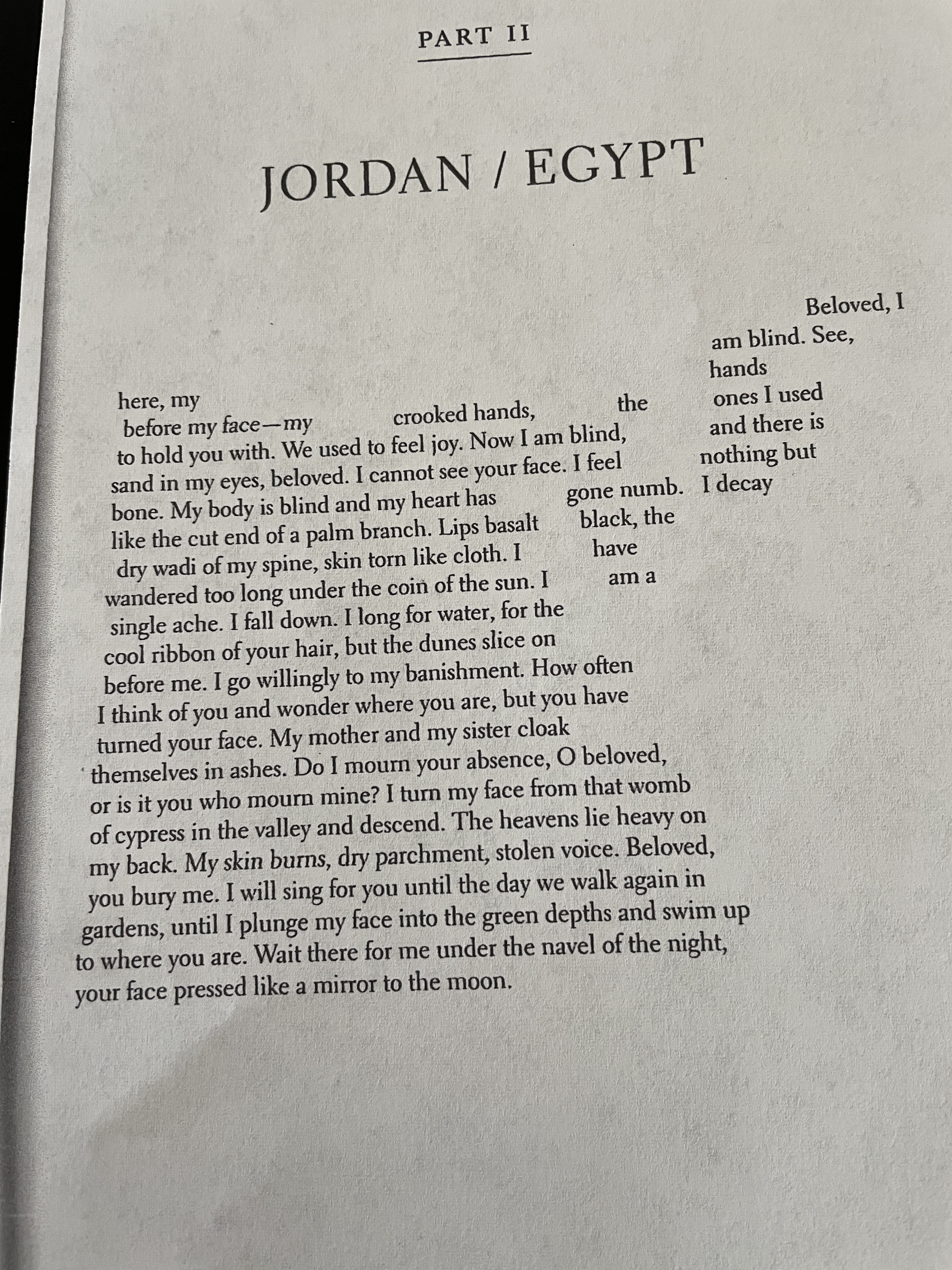
To keep sane, Nour repeatedly tells herself the story of Rawiya, the disguised girl who is an apprentice to the map maker. When he was alive, this was the favorite traditional story her father told her. The book alternates between what is really occurring to Nour and her refugee family and this ancient story. At the beginning of the section for each country through which they travel, there is a touching and beautifully written poem in the shape of the map of that country. The poem for Jordan/Egypt is printed below.
The subtitle of this book is “The War of Brothers That Shattered an Empire and Made Medieval Europe”.
The empire to which they are referring is the empire created by Charlemagne which was at the height of its power in the early 800s. He had managed to combine the territories of almost all of what we now consider Europe except for the far north and southern Italy and Spain and Greece. He managed to do this through cooperation among the nobles and the elite and it held throughout his life. He helped the spread of Christianity throughout what was previously pagan areas, e.g. the Saxons. Then not long afterward chaos ensued.
This history book details what occurs when fissures develop in what was once a stable social and political network and the bloody consequences of disagreeing on facts and reality. What happened?
For some time after Charlemagne’s death one of his son’s was able to hold the empire together by deftly giving bits of power to various sons and relatives. Once he died, a chaotic blood bath arose. Fathers and sons, brothers, uncles, nephews, everyone was killing or maiming each other for power. If they felt it was too unChristian to kill you, they just blinded you and sent you off to a monastery. If that did not work, then they would declare a female relative to be a witch and we all know what happened to witches. Meanwhile while jockeying for power, all these men declared they were doing what they were doing in the name of Christianity. If one brother won a battle, then he declared himself to be a better Christian than the one that lost. Even monks and bishops and the Pope became involved.
Then came the Battle of Fontenoy in what is now a part of France. Brothers against another brother with each leading more than 10,000 troops and in some cases as many total as 100,000. Watching was a noble who also commanded a huge army, but mostly he decided to just watch. The end result was a total bloodbath with one side violating the then current rules of battle. Normally, battles before this did not include a huge amount of killings in spite of what we now see in movies. This battle left thousands dead for the wolves, vultures, and other scavengers to eat, and the nearby streams ran red with blood. None of the warring brothers were killed so their fighting continued but no one ever really won and the great Frankish Empire created by Charlemagne fell totally apart. Some claim this battle was the beginning of the separation of a lot of Europe into what we now call France and Germany. Currently there is a marker at the place where the battle occurred. Regardless, Europe was never the same again for many centuries.
Note: Many find the world a very violent place today. Currently, wars and revolutions of one kind or another are occurring in many places in the world. Generally speaking, however, we do not find fathers and sons and brothers killing each other for power. We are seeing the consequences of what was once a relatively unified populace disagreeing on the facts and reality. Will we too fall into a dark ages like Europe did?



 writingontherim