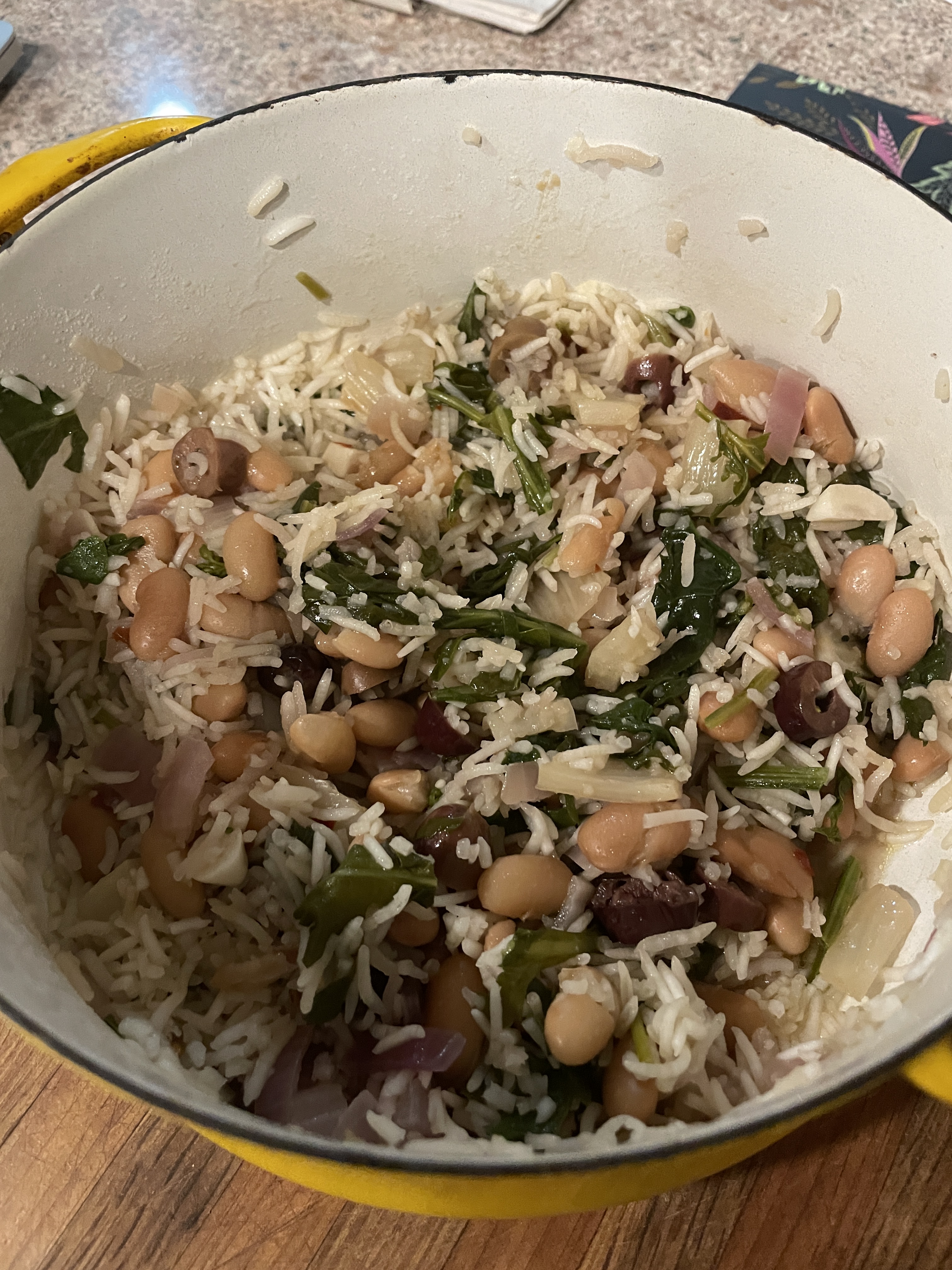
Vegetarian Plov with Greens


Plov is a common dish throughout Central Asia and is the national dish of Uzbekistan. All plov contains rice and usually meat like lamb or beef. Here is a vegetarian version. I found a vegetarian recipe and modified it using the ingredients I already had. The original recipe used chickpeas but I had already cooked Peruano beans so used them.

1/2 large purple onion, coarsely chopped

1/2 fennel bulb, coarsely chopped

3 cloves garlic, chopped

1/4 cup kalamata olives, chopped

1 drop coriander essential oil

1 drop cumin essential oil

1 drop cilantro essential oil

Chili flakes (optional and amount to taste)

1 cup cooked Peruano beans

2 cups greens (I used spinach and arugula), coarsely chopped

1 heaping half cup of basmati rice, rinsed

butter or olive oil for sautéing

Heat the oil or butter in a heavy casserole dish. Add onions, garlic, and fennel. Saute until tender. Stir in the spices. Scatter the beans and olives on top of the onion mixture. Do not stir! Add about 1/4 to 1/3 cup water. Layer the greens on top of the beans and olives. Flatten the greens with a spoon. Do not stir! Let greens wilt then layer the drained rice on top. Pour in enough boiling water to just cover the rice. Cook on high heat until the liquid has boiled off. Poke holes in the rice to allow steam to escape. Cover pan with lid and turn off heat but leave pan on the burner. Let the rice steam for 20-30 minutes.

To serve, stir the contents and serve in large bowls. You can add extra fresh herbs and lemon if desired. I just served as is and found it delicious. You do not have to use essential oil but can use ground herbs or fresh. If using essential oil, use a safe brand for cooking. I used Edens Garden but have used others, e.g. Doterra.

Book 34 for 2025: “Samarkand”, Caroline Eden and Eleanor Ford


I enjoyed the previous book by Caroline Eden so much I searched for this one. I doubt I will ever make it to Samarkand or Tashkent, places sort of on my bucket list, so what I do is read everything I find about these fabled cities on the Silk Road. The sub-title of this one is “Recipes and Stories From Central Asia and The Caucasus”. It starts with Samarkand and the story of Tamerlane, the legendary hero who conquered a lot of this area and a large portion of surrounding areas in 1370. He was a military genius who loved chess and made up his own chess game with twice the number of pieces.

What foods show up in both the stories and recipes? Beets, fruit–dried and fresh for which the area is famous, tomatoes, cucumber, pomegranates, cabbage, lentils, rice, lamb and mutton, and all sorts of kebabs and flatbreads. I learned there is a huge beach on Lake Issyk-Kul in Kyrgyzstan. It is one of the world’s largest alpine lakes and in summer people from Russia and all over Central Asia flock to its shores. People who own guest houses there make all their money for the entire year in the brief summer between mid-July and mid-August.

In the remote mountains of Azerbaijan lies the small town of Gyrmyzy Gasaba above the Qudiyaleay River, a town where all the people are Jewish. Even though Azerbaijan is a predominantly Shia Muslim country, the people in this town have peacefully lived here for hundreds of years. This town is considered the last surviving pre-Holocaust Jewish town untouched by WWII.

If you are a lover of apples, then consider this country, Kazakhstan, the place where apples originated. All apples in the world today come from the original apples here. The name of the largest city, Almaty, whose older name was Alma-Ata means fatherland of apples. In Ile-Altalan National Park on the northern slopes of the Tien Shan mountain chain thousands of acres of wild apples flourish.

Even though this book was published less than ten years ago in 2016, a lot of people must have been interested in reading the stories and recipes because the copy the library found for me is not in the best condition. Before I return it, I will copy some of the recipes to try.

Book 26 for 2025: “How the World Eats”, Julian Baggini


Although the subtitle says “A Global Food Philosophy”, most of it is an analysis of actually how the world does eat, including some rather remote tribal people, rarities in this contemporary world. This how also includes an analysis of how food affects health in different parts of the world, noting that although contemporary recommendations push vegetables and the Mediterranean diet, some people have no access to vegetables and eat mainly meat and fat and remain healthy. In other cases, like the Masai, cattle provide everything in their diet. The reader gets a broad based view of the best and the worse of diets and food practices worldwide.

A substantial portion of this tome–it is nearly 400 pages long with notes and index of more than 50 pages, looks at industrialized nations and world food supply, including the monopoly large food producing corporations maintain over what is available at grocery stores. Food is big business. The different definitions of food processing is covered as well as the good and bad. He debunks some common beliefs about food and health and notes that while people go hungry in some parts of the world, there is a surplus of food in others.

After all the analyzing and discussions, the last chapter covers “A Global Food Philosophy”. This includes recommendations for what we can do to create a healthier and more equitable worldwide food system while also saving the environment. He lists seven principles one of which is that our food management should be compassionate toward animals if we are going to eat them.

Book 11 for 2025: “The Serviceberry”, Robin Wall Kimmerer


A tiny book by the author of “Braiding Sweetgrass” envisions a totally different economy than the kind we have now. She uses a plant, the serviceberry, as a symbol for what she calls the “gift” economy. Instead of everything being focused on maximizing profit, it focuses on sharing and exchange and the idea that natural resources are gifts from Earth, from nature, rather than commodities to be exploited for profit.

She notes that capitalist economies hinge on the concept of scarcity and personal accumulation of wealth often at the expense of others. Gift economies, which occur in many indigenous cultures, focus on the mutual benefit of all which encourages gratitude and trust. Later in the book, she discusses how gift economies can be implemented and flourish alongside the current capitalist economy.

There must be considerable appeal for her concepts because this book has been on the non-fiction best seller list for weeks.

Book 31 for 2024: “Tender”, Sofia Samatar


This book contains 20 fantastical and dystopian short stories. I found them fascinating with topics ranging from selkies to ogres to ghouls to jinns to witches (in this case positive ones). The settings range from US to Africa to a settlement in outer space (the story “Fallow”). Divided into two sections, Tender Bodies, Tender Landscapes, these stories address human frailty, anger, greed, extreme religions and how humans treat each other (both good and bad) and what might occur in the future if people do not behave better. “Fallow” is a sort of handmaid’s tale where instead of being on Earth–which has been basically destroyed–a group of extreme religious folks have made a place for themselves on another planet after escaping Earth. If anyone from Earth accidentally shows up, they are in big trouble unless they become just like the people already there. Otherwise, they do not kill them–that is wrong–but just sort of let them slowly die. These stories, both brutal and lovely, display an incredible imagination.

An Abecedarian Poem for Sudan


While a lot of the world is focused on Ukraine and Israel/Gaza, since April 2023, two groups, the Sudanese Armed Forces and the Rapid Support Forces, have been fighting for control of Sudan. 11.1 million people are displaced and more than 17,000 killed, mostly civilians including children. Currently, for the second time since 2003, famine lurks at the door of Darfur state. Although I wrote the poem thinking about Sudan, a lot of the same conditions apply to Congo.

Amidst the denuded trees along a wide

boulevard walked a tall, dark-haired girl

carrying a large basket filled with a few

deep red pomegranates, two brown

eggs and three delicate pastries

filled with pineapple, cinnamon, and

guava, her favorite. She felt lucky.

Her mother sent her to the market, her mother

ill with ague, shivering, fevered,

jaundiced, too young to be dying, her father

killed in the endless wars which had

leveled so many cities and villages.

Men filled with the desire for revenge, for power,

never thinking how forgiveness and love could

overcome the endless devastation.

People plagued by angry men, men so

quick to condemn all not their tribe, their own,

retribution driving them week after week.

Some lay dying on the streets or dead as

the girl walked around their bodies

under the relentless, tropical sun.

Void of relief, fearful but determined, she

walked on toward the remains of her home.

Xenophobia once again stalked the streets,

young men brandishing assault rifles. Animals in the

zoo seem kinder, more caring.

Book Six for 2024: “Look At The Lights, My Love”, Annie Ernaux


Who would have thought a person could write an entire book about a hyper market? I never heard of Auchan until I read this book. For those not in the know, located in France, it is described as a hyper-market on search engines. From Ernaux’s description and those on the Internet, I think there is nothing like it in the US. The author refers to it as a Supermarket, but it is nothing like what we call a supermarket here. It is a superstore, somewhat like the big box stores here but much more. It sells food, clothes, books, you name it, but not like Target or Costco. The bookstore is a separate area, as are many other little shops within the giant store, e.g the fishmonger. It is three stories, open 24/7, and according to the Internet, works toward being something for everyone while caring about the environment and such. The employees wear a uniform so in that regard they all look the same. The store attends to the needs of all the various religions of the people of France, Muslims, Jews, Christians, everyone. This is especially true when it comes to food. During certain holidays, the preferred food for that religious holiday becomes available.

Ernaux decides to go shopping there in 2012 and 2013 over a span of a year. She deliberately goes at different times of day to see if there are differences. There are. Certain groups of people shop early in the morning–like older people. Young singles go later, mom’s with children at a different time. When there is a no school day, gangs of teen girls show up to hang out and shop. When the weather is bad, people go there to escape. Once in a while someone recognizes her, tells her they love her writing, and they have a conversation. At the first floor entry where there are places to sit, she notices that older North African men seem to like to hang out there and watch the passerby’s.

She notices that while a person can shop in a sort of anonymity that is impossible while standing in the checkout line. Here your eating habits, what method you choose to pay, whether you have elderly people at home or babies or children are all on full display laying there on the conveyor belt for all to see. If you have to ask for help with the money, it exposes you as a foreigner. Yet people pretend they do not notice or care–perhaps they do not.

I occasionally go to Target, never to Walmart or Costco. Nevertheless, reading this book has made me notice things I never noticed before, and normally I am quite observant. Now even when I go to smaller grocery stores, I notice who is there, what they are buying. Sometimes people will ask me a question about something in the store. At places near my house, I sometimes see people I know and chat.

Making a Difference: Kiva Loans


To honor the death of a best friend’s father, I did as she asked, made a Kiva loan.  After looking through dozens of potential individuals and groups, I loaned 100 dollars to a group of women in the Democratic Republic of Congo to help fund their poultry raising operation.  Even though it has been less than six months, they have paid back more than half, paid on time regularly.

Some loan opportunities require even less money.  People often think their efforts don’t count, they are too small to make a difference.  Everything each person does makes a difference for better or worse.  Make a difference, act, speak out, contribute however you can to make our world a better place for all of us.

Apocalyptic Planet-Part Seven: Species Vanish


We all know extinction occurs.  Nearly everyone knows different species of dinosaurs at varied times roamed the earth for millennia.  Bones of all sorts of animals and various hominids are dug up off and on.  Scientists study them, determine their age, where and how they lived.  Scientists and sometimes even average persons develop theories about why they went extinct.  Regardless of which theory a person decides is accurate, these ancient extinctions generally took thousands of years. Recent extinctions are different, e.g. carrier pigeons.  Millions existed a couple of hundreds of years ago; now they are gone.  Why?  Humans.

Various causes exist for the extinctions of ancient species.  A major cause is the climate change caused my the changing tilt of the earth’s axis.  These changes occur over thousands and thousands of years.  What is different now?  Let’s take corn.  Native Americans cultivated rainbow colors of corn in small, frequently irrigated fields.  Where is most corn grown now?  Giant fields of GMO corn grow from horizon to horizon in the Midwest.  And if Monsanto had its way, no other corn would continue to exist for long.   Iowa is a good example.  Wherever this corn is grown, native grasses and other native plants totally disappear, in part due to cultivation.  A bigger issue is herbicides–to have clean fields, nothing and I mean nothing but corn must grow there.  A farmer’s expertise as a farmer is measured my just how super clean his fields are.  The only way to get these totally weedless fields is to use herbicides.  Biodiversity is a key to environmental health.  Little biodiversity exists in giant fields of crops like corn and soybeans.  Fertilizers to obtain huge yields wash downstream and in the Midwest eventually end in the Gulf of Mexico and cause giant marine algae blooms which pulls oxygen from the water to create a dead zone where no marine animals or fish can live.

Perhaps readers have heard of the plight of monarch butterflies.  Compared to just ten years ago, the population has dropped dramatically.  What happened to them?  Roundup.  Over 100,000 tons of Roundup and other brands of glyphosate herbicides are annually applied to crops in the US.  What do monarchs eat?  Milkweed.  Since 1999, 58 per cent of the milkweed has disappeared.  Recently, monarchs experienced a 30 per cent reduction in their numbers in one year.  Are we headed toward a mass extinction?  Some scientists think so.  These scientists are not talking about tigers, elephants, and rhinos being killed at an ever increasing rate for their body parts, but rather about the less noticeable extinctions of various plants and less obvious animals like frogs.  And then there is the problem with bees.  Bees are disappearing at an ever increasing rate due to not only diseases but due to herbicides and pesticides.  Without bees to pollinate the giant fields of almonds and various fruits in California, for example, those foods won’t exist.  See a previous post for more discussion on the importance of bees.  So why care about frogs?  Scientists consider frogs and amphibians in general an indicator of the health of an ecosystem.  Certain more tropical species of frogs are especially subject to the effects of climate change and they are disappearing.

Where I live big bluestem, blue grama, buffalo grass, and other native species grew from horizon to horizon.  This is the high plains.  Root systems of some plants grow twelve feet deep.  It has not rained in over a month.  Where the native grass once grew, crops are now grown.  This time of year finds open fields. Without rain, with the recent endless high winds, dust fills the sky.  To safely return home from town Sunday, I had to turn on the car lights to see.  The dryness fuels wildfires.  Earlier this week, over one hundred homes burned down in a wildfire north of Amarillo.  Drought.

Many human inventions are wonderful and make many lives better, but for some of them, I cannot help but wonder at what cost.