These are easy to make and about as nutritious as a cake like treat can be. I used regular flour but might try almond flour next time.
3 cups lightly packed shredded carrots
1 heaping cup coarsely chopped walnuts
1 Tb. grated ginger or more to taste
2/3 cup light brown sugar
1 tsp BP
1 tsp baking soda
2 eggs
1 tsp vanilla extract
1 tsp ground cinnamon
1/2 tsp ground nutmeg
2/3 cup avocado oil
1 cup unbleached flour
Grease an 8 inch square pan ( I used glass). Put the oil, sugar, eggs, vanilla, and spices in mixing bowl and combine. Add ginger, BP, and baking soda. Add carrots and walnuts. Stir to combine. Finally, add the flour and stir. Pour into the baking pan. Use spatula to level because mixture will be thick. Bake at 335 for 45 minutes or until a toothpick inserted in middle comes out clean. Remove from oven and cool before cutting into bars.
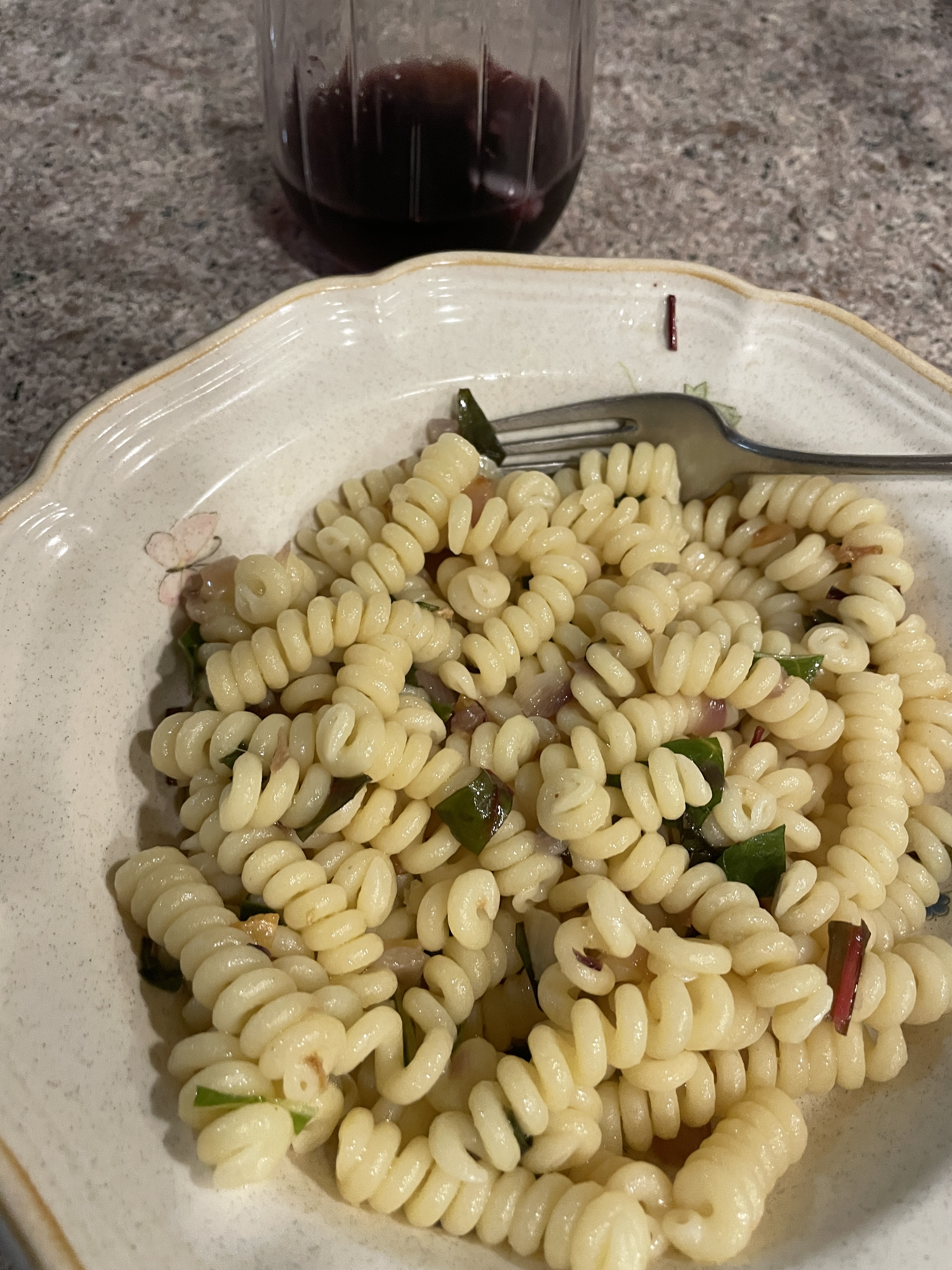
Cook pasta according to directions on the package. Remove the middle vein from the Swiss chard leaves and chop. Cut leaves into bite sized pieces. Sauté onion, garlic, ginger, and chard veins in olive oil. When translucent, add the leaves, and cook just long even for them to wilt. Add the drained pasta, stir, and serve in warm bowls or plates. This is nice with a green salad. However, if you want to make it a one dish meal, double or triple the amount of Swiss chard used. You can also use spinach or other greens.
Serves two. This recipe could be doubled, etc. to serve more people.
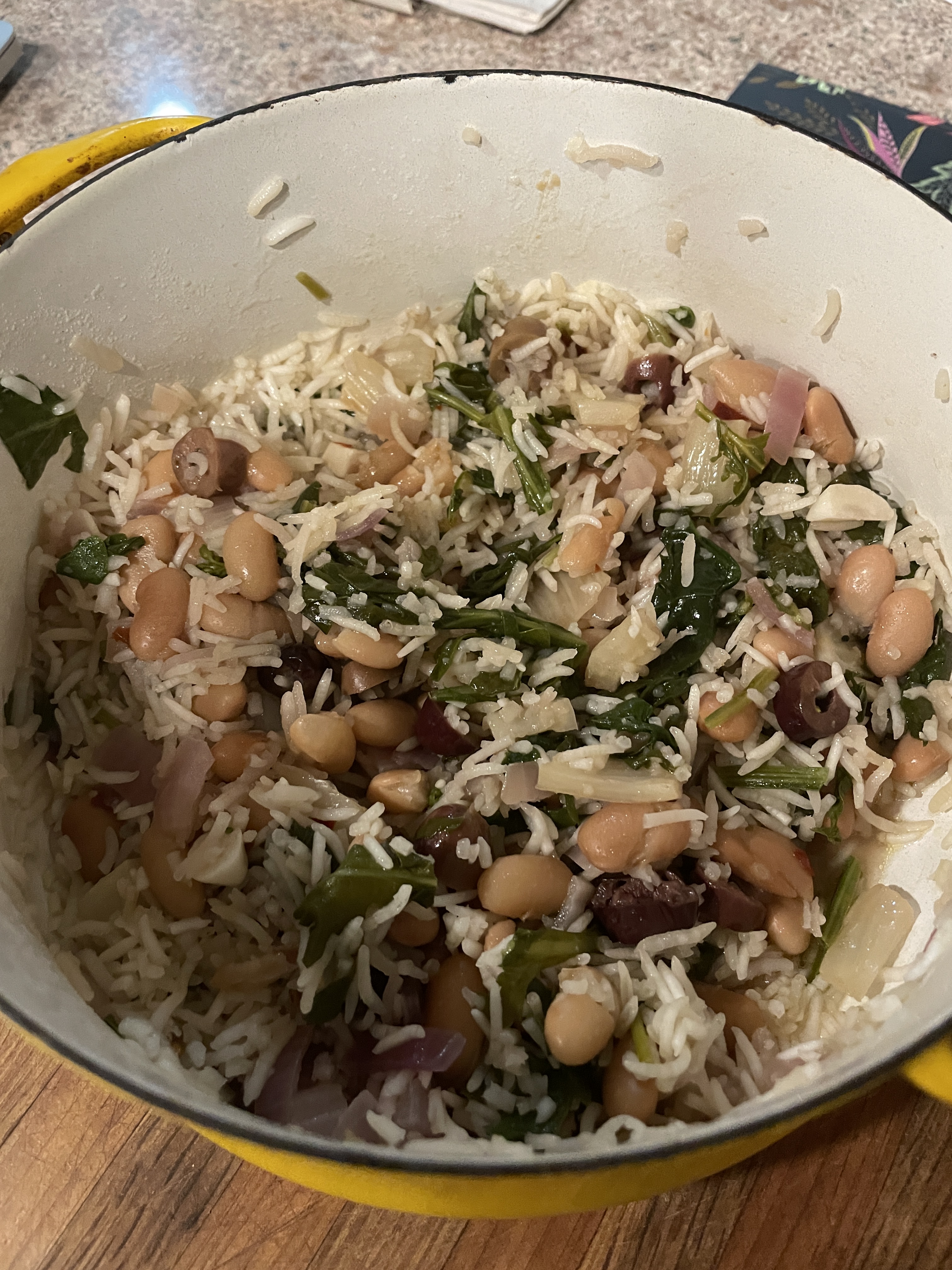
Plov is a common dish throughout Central Asia and is the national dish of Uzbekistan. All plov contains rice and usually meat like lamb or beef. Here is a vegetarian version. I found a vegetarian recipe and modified it using the ingredients I already had. The original recipe used chickpeas but I had already cooked Peruano beans so used them.
1/2 large purple onion, coarsely chopped
1/2 fennel bulb, coarsely chopped
3 cloves garlic, chopped
1/4 cup kalamata olives, chopped
1 drop coriander essential oil
1 drop cumin essential oil
1 drop cilantro essential oil
Chili flakes (optional and amount to taste)
1 cup cooked Peruano beans
2 cups greens (I used spinach and arugula), coarsely chopped
1 heaping half cup of basmati rice, rinsed
butter or olive oil for sautéing
Heat the oil or butter in a heavy casserole dish. Add onions, garlic, and fennel. Saute until tender. Stir in the spices. Scatter the beans and olives on top of the onion mixture. Do not stir! Add about 1/4 to 1/3 cup water. Layer the greens on top of the beans and olives. Flatten the greens with a spoon. Do not stir! Let greens wilt then layer the drained rice on top. Pour in enough boiling water to just cover the rice. Cook on high heat until the liquid has boiled off. Poke holes in the rice to allow steam to escape. Cover pan with lid and turn off heat but leave pan on the burner. Let the rice steam for 20-30 minutes.
To serve, stir the contents and serve in large bowls. You can add extra fresh herbs and lemon if desired. I just served as is and found it delicious. You do not have to use essential oil but can use ground herbs or fresh. If using essential oil, use a safe brand for cooking. I used Edens Garden but have used others, e.g. Doterra.
I enjoyed the previous book by Caroline Eden so much I searched for this one. I doubt I will ever make it to Samarkand or Tashkent, places sort of on my bucket list, so what I do is read everything I find about these fabled cities on the Silk Road. The sub-title of this one is “Recipes and Stories From Central Asia and The Caucasus”. It starts with Samarkand and the story of Tamerlane, the legendary hero who conquered a lot of this area and a large portion of surrounding areas in 1370. He was a military genius who loved chess and made up his own chess game with twice the number of pieces.
What foods show up in both the stories and recipes? Beets, fruit–dried and fresh for which the area is famous, tomatoes, cucumber, pomegranates, cabbage, lentils, rice, lamb and mutton, and all sorts of kebabs and flatbreads. I learned there is a huge beach on Lake Issyk-Kul in Kyrgyzstan. It is one of the world’s largest alpine lakes and in summer people from Russia and all over Central Asia flock to its shores. People who own guest houses there make all their money for the entire year in the brief summer between mid-July and mid-August.
In the remote mountains of Azerbaijan lies the small town of Gyrmyzy Gasaba above the Qudiyaleay River, a town where all the people are Jewish. Even though Azerbaijan is a predominantly Shia Muslim country, the people in this town have peacefully lived here for hundreds of years. This town is considered the last surviving pre-Holocaust Jewish town untouched by WWII.
If you are a lover of apples, then consider this country, Kazakhstan, the place where apples originated. All apples in the world today come from the original apples here. The name of the largest city, Almaty, whose older name was Alma-Ata means fatherland of apples. In Ile-Altalan National Park on the northern slopes of the Tien Shan mountain chain thousands of acres of wild apples flourish.
Even though this book was published less than ten years ago in 2016, a lot of people must have been interested in reading the stories and recipes because the copy the library found for me is not in the best condition. Before I return it, I will copy some of the recipes to try.
The novel fascinated me in so many ways, the style of writing, the subject matter, what I learned about some famous paintings and especially Turner. I will never see works by Turner in the same way as I previously did. Before mostly I noticed the colors, the translucence. I totally missed the details and the violence nearly hidden.
The novel takes place after an ecological collapse in England where first violent floods occurred followed by a devastating drought. Now it has not rained in three years and Penelope, the main character, spends most of her time working as an archivist for the notable collection at a soon to be demolished estate in the English countryside. She has lived here for two decades with her current partner, Aidan, who owns the estate. The disasters have nearly destroyed the once magnificent mansion. Now Penelope and Aidan allow refugees from the disasters to live there with them as they transition to new places and housing until the new buyers demolish the place.
Most of the novel is Penelope’s diary, what she writes about her life present and past. In the midst of this her archivist notes appear as well as descriptions of famous paintings, most of which show women being brutalized in one way or another, e.g. The Abduction of the Sabine Women, 1633-34, Nicholas Poussin. Later in the novel there are segments from the viewpoint of Aidan’s brother, Julian, who previously owned the estate and with whom Penelope experienced a violent and disastrous relationship.
This is a tale of survival, redemption, memory, and art as a means of renewal. I liked this novel so much that I spent time looking up the art the protagonist describes, researching Turner, writing down passages, etc.
In the late 1800s there is a photo of a group of Black babies lined up with the caption Alligator Bait. This trope goes back to the antebellum South but came into its own later. This photo, created in 1897 and popular with white Floridians, started an entire industry. There were even postcards of alligators chasing terrified Black children. Fishermen could buy lures that looked like a Black baby protruding from an alligator’s mouth. There was even a song called “Mammy’s Little Alligator Bait” and mechanical toys showing alligators swallowing Black babies. Thankfully, there is no evidence of Black babies actually being fed to alligators, but still…
Now we have Alligator Alcatraz and the president and his buddies even make jokes about why they put it in the middle of a swamp–anyone trying to escape will be alligator food. Who are the people there? Not any rich white people. They say it is to make the country safer. Data shows the place is not filled with criminals, even though some are there and maybe deserve to be there, but most are not criminals, just ordinary people who are darker–brown and black. It would seem that the trope of feeding certain sorts of people to the alligators never went away. How “sick” can we become.
While reading the novel “Landscapes” this afternoon, this passage struck me: a man, recently blind, explains, “I rely on my other senses. I get by. But in another way I’m not sure I ever knew where I was headed, not even when I had eyesight, you know what I mean? I doubt anyone really knows where they’re going. But you walk ahead anyways, no?”
This caused me to reflect on a video I saw earlier in the day at Mendez High School where I work for College Match LA. The purpose of the video was to help students address what they will write about in their college essays, how they will write about themselves. It’s called “Essence Objects”. The task is to think about various objects you would put in a box, objects that represent how you see certain things or people, how you think. Here are some examples:
What object reminds you of your mother?
What object represents your favorite piece of music?
What object reminds you of a fear you have?
What object would you choose to illustrate your favorite book?
What object would a friend associate with you?
The list goes on and on, thought provoking questions. I don’t have to write a college essay but I’m going to go over the whole list and think and think and think.
Note: I picked this photo because the objects that make me think of my mother are roses. She had a rose garden in front of the barn on our Missouri farm. All summer when the roses were blooming, she floated roses in a glass bowl on the kitchen table where we ate.
What a delightful, entertaining book! The title refers to her basement kitchen in Edinburgh, Scotland, where she lives when she is not wandering the globe. Each chapter highlights a certain place in her travels, in this case Ukraine, various countries in Central Asia, e.g. Uzbekistan, Russia, and the city of Istanbul, which she says is one of her favorite cities to visit especially in winter when tourists are gone. In one chapter, “Russian Railway Pies”, she and her husband ride the train from Moscow to the eastern shore of Russia–the Trans Siberian Railway journey. They did this in winter when the temperature in some places they stopped were as low as 50 below zero.
Each chapter contains her experiences in an individual country or city. She describes the places in detail, the people she meets, the food she eats. She also relates her feelings regarding these places, many of which she had previously visited, how they have changed over the years for better or worse–worse in the case of Russia, what they mean to her. In each chapter she always goes back to her kitchen, her dog, hiking the Scottish highlands, and her cooking, usually a recipe where she is trying to re-create a food she ate in one of these places she loves.
This is her most recent book, published in 2024. She also has a series of books about particular places where the entire book is dedicated to that particular place. Mostly, she has travelled in Central Asia, Russian, the Balkans, Turkey. I enjoyed this book so much, I plan to read another one about her other adventures. She is not just on these adventures for fun but also as a career so she knows many journalists, diplomats, officials in these places.
Piketty is Professor of Economics at the Ecole des hautes etudes en sciences sociales and Paris School of Economics. Sandel is a Professor of Government at Harvard University. This small book (119 pages) is the discussion between the two on the value of equality. In this discussion they debate what citizens and governments should do to narrow the economic gaps that separate people. This includes looking at the dangers of political instability and environmental issues. Rather than summarize their discussions, I am going to quote various parts:
“Mainstream politicians…have faith in the market because of a belief that markets deliver rising prosperity and yield Wall Street campaign contributions. A deeper reason…is that markets seem to offer a way of sparing us as democratic citizens from engaging in messy , contentious, and controversial debates about how to value goods and how to value the various contributions that people make to the economy and to the common good.”
“We live in pluralist societies. We disagree about the nature of the good life. We disagree about how to value goods.”
Because of the above, it is just easier to use the market and avoid the discourse as to what is worth more, the work of a teacher or a laborer or a hedge fund manager.
“Those on the left and those on the right may may well disagree about what counts as the dignity of work and how to promote it…many working people and many without university degrees feel that elites look down on them, don’t value the work they do…individual upward mobility is not an adequate answer to inequality.”
They discuss credentialing and note that the government spends billions more on higher education than technical education. They note that this form of credentialism is something that many see as an acceptable form of prejudice. A survey was done of prejudices in both Europe and the US:
“The group most disfavored by the respondents were the poorly educated.”
They discuss corporate tax rates and world wide efforts to have a world tax on multinational corporations:
“So, really, it’s a game between tax administrations in Washington, Paris, and Berlin to split some of the tax revenues that are now in tax havens among them, leaving aside the countries in the South.” –referring to the Southern Hemisphere where most of the poorest countries in the world exist. “Don’t companies have a patriotic duty to pay taxes and contribute to the common good in the country that makes their success possible?”
They view the success of far right groups and the election of Trump as more due to job losses in manufacturing than due to the inflow of migrants. They note an anti-immigrant view in places where there are even few immigrants and see it as related to the destruction of jobs:
“It’s not about immigration, but it’s about feeling looked down upon. It’s about recognition. It’s about dignity. Throughout this conversation, we’ve discussed three aspects of equality. One is economy, about the distribution of income and wealth. A second is political, about voice and power and participation. Then there is a third category, about ‘dignity,’ ‘status,’ ‘respect,’ ‘recognition,’ ‘honor,’ and ‘esteem.’ My hunch is that the third is the most powerful politically and maybe also morally. Any hope we have of reducing inequality in the first two dimensions, economically and politically, will depend on creating conditions for greater equality of recognition, honor, dignity,. and respect.”