The Motherhood of God by Mary Sharratt


The first woman to write a book in English–in the 1300s.

Mary Sharratt's avatarFeminism and Religion

Doing a recent talk on pioneering woman writers, I like to do the Before Jane Austen test with my audience. Who can name a single woman writer in the English language before Jane Austen? Alas, because woman have been written out of history to such a large extent, most people come up blank. Then we talk about pioneering Renaissance authors, such as Aemilia Bassano Lanier, the subject of my recent novel, THE DARK LADY’S MASK, or her mentor, Anne Locke, the first person of either sex to write a sonnet sequence in the English language.

But my next question takes us even further back into history. Who was the first woman to write a book in English?

The answer is Julian of Norwich, who wrote Revelations of Divine Love.

View original post 679 more words

Wickeder and Wickeder by Barbara Ardinger


A tale for our times.

Barbara Ardinger's avatarFeminism and Religion

The raven was standing on the little table in the wicked witch’s private room. Expecting a new kind of feast, he dipped his beak into a bowl of wiggly white worms. And spat them clear across the room. “Great Suffering Succotash!” he exclaimed. “What is this stuff?’

“It’s ramen noodles,” the witch replied calmly. ”They’re cheap. And you know we need to save money. El Presidente’s got men cruising around the country doing whatever they want to obstruct justice. We’re all trying to save money and build up the resistance.”

View original post 1,260 more words

Why Teachers Suck …


I was going to write a nice little poem for my blog post today but instead decided this was more important to post. As I teacher, I can verify the veracity of this post. In some ways it may be a little easier for me because I teach mostly seniors in high school who are somewhat self sufficient but many still get free or reduced lunches, some are homeless or drift from one friend to another since thrown out of their own house, some work so late they can barely stay awake in class, some self medicate because no one can afford the meds they need. Most graduate in spite of this. How? Because the school and teachers go to great lengths doing everything imaginable to help them succeed, e.g. online programs, extra time, alternative assignments. Why do I continue to teach? I love teenagers; I never have a boring day; I work hard to make a difference; I think public education is the foundation for a working republic, for this country to flourish and succeed.

Bert Fulks's avatarBert Fulks

A friend and I were grousing about ignorance run amok.

“Americans get their information from internet memes,” I laughed.  “And in the true spirit of democracy, dullards who have never cracked a book will cancel the votes of people who actually have a clue. What could go wrong?”

“You know what the problem is?” Tim challenged.  “Our country’s a mess because teachers suck.”

teacher2I bristled.

Although I’ve been out of the classroom for a number of years, once a teacher, always a teacher.  Plus, I have family and friends still slugging it out in the trenches.  I know their battles and the wounds they carry.

“Dude, do you know what teachers endure on a daily basis?” I asked Tim.  I found that, no, he didn’t.  I fear most Americans might be as clueless.

I emailed a former colleague (she’s two years from retirement) and asked one question:  “How has education…

View original post 1,411 more words

Is This How Patriarchy Began? by Carol P Christ


Is violence more likely when men spend a lot of time away from women and children?

Carol P. Christ's avatarFeminism and Religion

In my widely read blog and academic essay offering a new definition of patriarchy, I argued that patriarchy is a system of male dominance that arose at the intersection of the control of female sexuality, private property, and war. In it, bracketed the question of how patriarchy began. Today I want to share some thoughts provoked by a short paragraph in Harald Haarmann’s ground-breaking Roots of Ancient Greek Civilization. Haarmann briefly mentions (but does not discuss) the hypothesis that patriarchy arose among the steppe pastoralists as a result of conflicts over grazing lands. As these conflicts became increasingly violent, patriarchal warriors assumed clan leadership in order to protect animal herds, grazing lands, and the women and children of the clan.

View original post 808 more words

Weekend Adventure


This past weekend my family had to return to Tulsa, Oklahoma, to finish some family business.  While there, we decided to explore as well.  After completing what we needed to accomplish on Friday, we decided to check out the Tulsa Zoo located in Mohawk Park.  Tulsa Zoo contains lots of green, open spaces, and some extremely interesting architecture.  For example the Malayan tigers live in an area made to look like ancient, abandoned temples.

IMG_2682

Then there are animals I have never even heard of before like the siamangs.
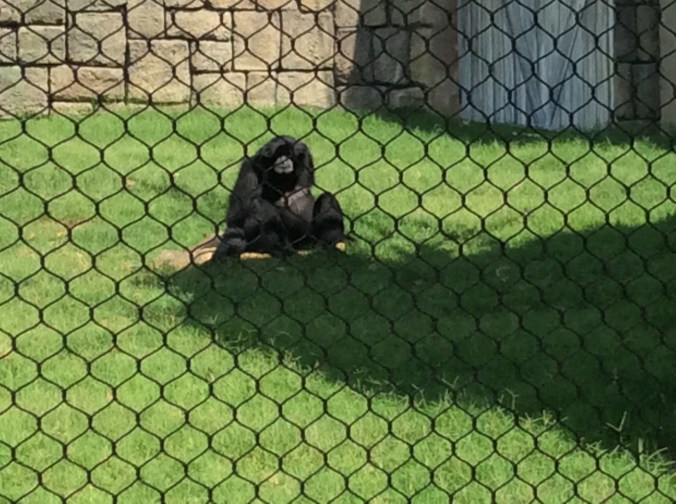
IMG_2686

I was surprised to see komodo dragons.

IMG_2681

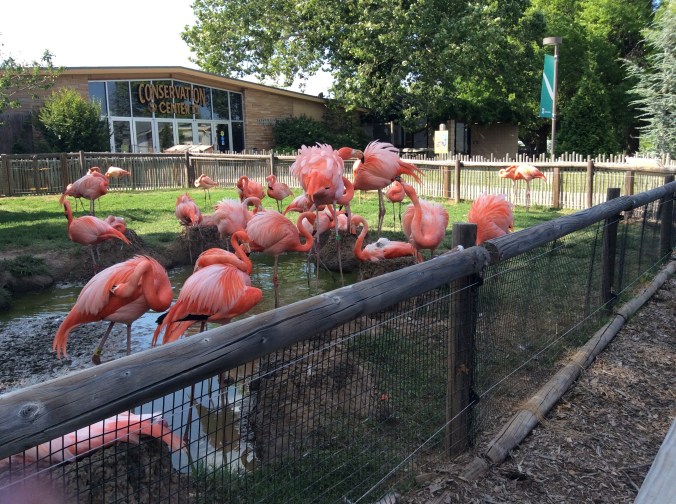
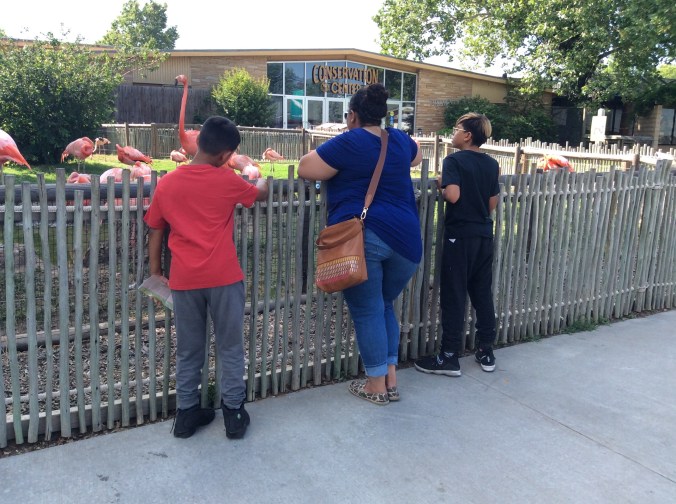
The intensity of the colors in the American flamingoes never cease to amaze.

IMG_2690

IMG_2691

Apparently, the rest of my family liked them as well.
IMG_2689

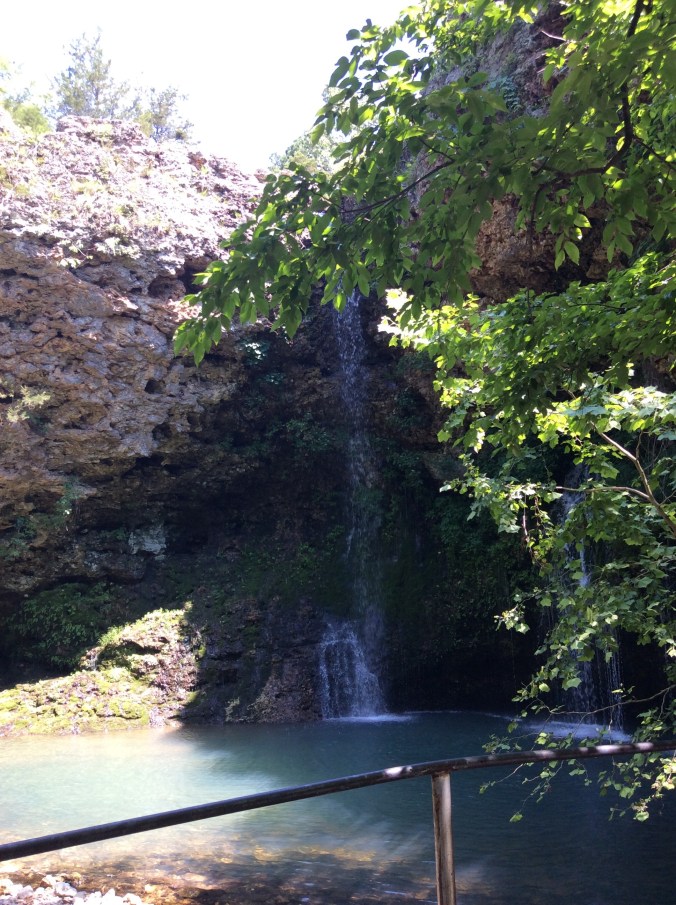
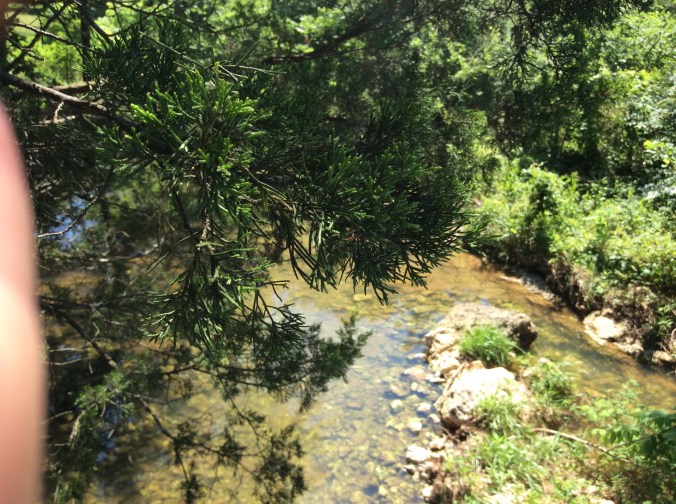
The next day, Saturday, we decided to head east through the Cheyenne Nation to visit Natural Falls State Park. If we had known what it is really like, we would have taken a picnic.
IMG_2693

The area above where the falls drop off.

IMG_2697

IMG_2698

Dripping Springs

IMG_2700

Just below the falls another stream enters and then flows down to a lake.

IMG_2709

The lake becomes larger as it flows farther.  It is a moderate to difficult hike getting to the lake.  Fishing is permitted here.  This park is also a good place to camp.

While gone, a giant thunderstorm arrived at my house with 8 inches of hail and three inches of rain in a short period.  Although the juniper trees look close to normal, most of the deciduous plants were denuded.  I have no idea whether they will recover.  A few of the small native flowers appear normal.  Luckily, my house was not damaged. However, this evening with my grandson’s help I will tackle the drive which is full of about 8 inches, in some places, of dirt, rocks, and gravel.  Luckily, after removing the larger rocks, I will get most of it with the tractor bucket and move it back to where it belongs.


Attitude


Where I teach high school, my grandson attended basketball camp the last three mornings.  While I watched and read, I heard the coach give them a little lecture.  Apparently, some of the campers were dragging along, not even jogging as they moved across the court.  They kept pulling on their shorts, looking down, not listening or paying any attention to the instructions.  Coach got fed up, stopped everything, and pointed out their self defeating behaviors.

Basically, he told them that their actions appeared defeatist.  Act tired, lag behind, ignore instructions, and you set yourself up to lose. Your actions become who you are.  It seems these are also good pointers for all aspects of life.  Ability alone will not lead to accomplishment or even happiness.  Even the most talented musician, athlete, writer attains little without practice and determination.  Being the best a person can be takes work and a positive outlook.

Respect


Because I teach high school, I am accustomed to teenagers, their loudness and capacity for rude behavior.  Nevertheless, because I live in ranching country with fences and gates, most know you do not go through another person’s fence or leave gates open.  The former is called trespassing.  The latter can thoughtlessly let out livestock and maybe get them killed.  If your neighbor’s dog keeps coming to your property and you call the sheriff’s office, they will simply tell you to shoot it.

Respect applies.  If you do not want people running over your property, obviously do not trespass on another’s.  Have respect for others as you would want them to respect you.

A big party full of teens started at my neighbor’s about five hours ago.  I watched them throwing rocks, running hither and yon,  like caged animals on the loose. A fence exists between my property and hers, a very obvious, country style fence with cedar and T-posts and five strands of wire.  It is not invisible.  I never installed no trespassing signs  because they would face her property and in some places exist at the edge of her back yard.  I would not be able to see them from my house or barn.  After this evening, I will reconsider.

Luckily, I was out feeding horses, doing chores, when several of the teens apparently decided to crawl through the fence and walk toward my house.  Because I was outside, I saw them and was able to tell them to get back across the fence.  If I had not been home, would they have kept walking, what might they have done?  Nothing, hopefully, but with 25 or perhaps more running around, who knows.  I kept thinking surely these young people know better.  Have they not been taught to respect others?  Where were the adults?  Did they even care?

This week I will go buy several no trespassing signs and install them at various places along the fence.  I feel sad to think I find this necessary.

Religion and Politics


The two things some of us were taught never to discuss in social situations.  Reading The Silk Roads, A New History of the World, simply reaffirms why those who wrote the United States Constitution insisted on separating religion and politics.  Mixing the two leads to tyranny, war, misunderstanding, and a host of other ills. When did this mixture start?  Prehistory or at least the early recorded history.

Constantine, the Roman emperor,  converted for political purposes.  The Persians tolerated a wide variety of religions until it was no longer politically expedient; then they decided to persecute Christians and declare Zoastrianism as official.  When the barbarian hoards from the steppes started to overrun both the Roman and Persian Empires, they decided to cooperate–a huge change–and actually built a wall between the Black and Caspian Seas to stop the uncivilized.  Roman soldiers guarded the wall.  This helped Rome little, however, because the Visigoths sacked Rome.  The barbarians won.

And then there was Constantine’s Counsel of Nicea, held in 410, 420, 424.  The “eastern” bishops were not invited.  Therefore, the results applied only to what later became known as Roman Catholicism. Infighting among bishops, arguments over who was right and wrong continued, and on and on.  Eastern bishops saw the western teachings as heresy. The arguments mainly centered on the divinity, or lack thereof, of Jesus.

The western church focused on rooting out unofficial religious views, while the east focused on missionary activity.  The king of Yemen even became a Christian. Rulers converted, shifted allegiances, persecuted or tolerated, according to political expediency.

Little seems to have changed in 1500 years.


Bedtime Reading


A habit I acquired years ago, perhaps even during my childhood, is reading just before I go to sleep.  Picking the right books remains key unless you want to stay up half the night either reading or thinking about something horrifying or depressing you’ve read. Lately, my reading has not been conducive to sweet dreams.  Earlier this week I finished Among the Ruins, an Iranian mystery of sorts, by Ausma Zehanat Khan.  It’s fiction but one of the characters writes letters from prison which are anything but cheery.  Now I am reading the Pulitzer Prize winner, The Return.  Since Hisham Matar never saw his father again after he was captured and hauled off to a Libyan prison, sleep inducing it is not.  Last night I decided perhaps for bedtime I needed to find something not exactly boring but somewhat less stimulating.  It may take me all summer given that The Silk Roads, A New History of the World by Peter Frankopan is 505 pages.  If I get bored with that, I can go back to two books I reread off and on and save for bedtime reading, When Women Were Birds by Terry Tempest Williams and Sor Juana Ines De La Cruz, Selected Works translated by Edith Grossman.  Both inspire reflection and contemplation.  For those who do not know Sor Juana Ines De La Cruz, she lived in Mexico in the 1600s.  She became famous for her intellectual capacity, her poetry, and was referred to as “the Phoenix of Mexico” when women rarely rose to such heights.

What are you reading this summer?