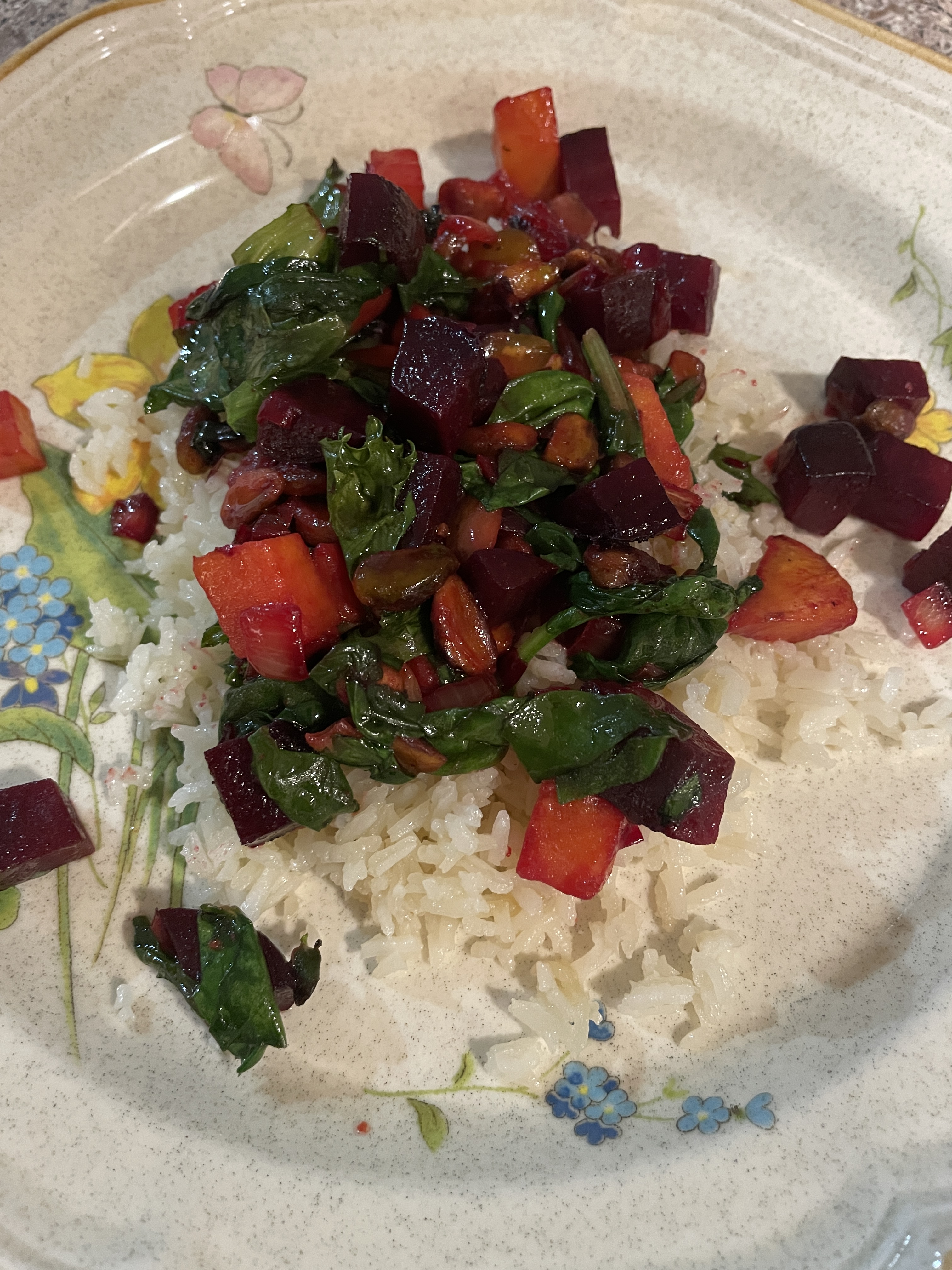
This recipe is vegan if you do not sprinkle grated cheese on top. It serves two. I used it as a main dish but it would also make an excellent side dish.
1/2 large beet, cut in small cubes
1/2 large sweet potato, peeled and cut into cubes
1/2 sweet onion, coarsely chopped
1/4 cup pistachios
2 cups greens
Sauté onion and beets in olive oil until tender. Add sweet potatoes and cook until soft. Stir in pistachios and 2 cups mixed greens. Stir until greens wilt. Serve over rice. Due to the flavors in the ingredients, I did not add any spices, but you could use your favorite spices.
After reading two intense, somewhat depressing novels, I decided to read a lighter non-fiction work. An article I read mentioned a tale of two guys, Tim Cahill and Garry Sowerby, who drove a GMC Sierra pickup truck from Tierra del Fuego, Argentina, to Prudhoe Bay, Alaska in less than 25 days. I like adventures and the best vehicle I ever owned was a Sierra 4 by 4 Off Road. I sold it to a former student when I moved. It was still going strong at over 300,000 miles.
In order to follow along on their adventure, I dug out my atlas and followed their trip through 13 countries, finding cities, little towns, rivers, mountains. When they traveled in 1987, the only place with no road was the Darien Gap on the border between Colombia and Panama–today still no road and now famous for all the migrants who labor through this dangerous, swampy, jungle area on foot on their way north. Since no road there, Tim and Garry had to load the truck onto a container ship in Cartagena and unload it in Panama. They also rode on the ship as passengers. This lead to their meeting some of the most colorful characters on their trip.
Along the way, they meet all sorts of people, e.g. sadistic police, kind employees of international GMC, a weird consulate employee, and helpful women, describe them and the landscape in detail. Procuring the right documents and proceeding across borders is sometimes easy and sometimes grueling, again described in detail. Of course, political leaders, ease of travel, etc. have changed in many places–I’ve been to or lived in five of the countries they traverse.
Want to explore new places, meet all sorts of folks?? Then this is the book for you and a fun read.
To say this novel is intense is an understatement. It begins with Toussaint, a 13 year old boy left to survive on his own then switches to Ava, his mother, who grew up on the road following her mother’s singing in Southern clubs until her mother settles down with Caro in a Black country Alabama town where all the Black people own acreage and are not only self sufficient but also sell their goods in many places. The nice life they have in this town changes suddenly when disaster occurs and her mom, Dutchess, goes into a prolonged mourning period. Eventually, Ava goes to college, obtains various jobs, wanders all over the country, and meets Cass, a doctor and Black Panther whose charisma draws people to him. He disappears, she and their son, Toussaint, wander from place to place as she goes from job to job. She marries, Cass reappears, and one bad event after another occurs.
This is a story of mother and son love, women who become ensnared with the wrong men, self sufficiency in spite of many obstacles, angry men, hope, and redemption. It is a story of this country.
This historical novel lead me to learn a lot about the history of the Denver area and nearby indigenous areas with regard to both Hispanic and other immigrants, e.g. Greek. I had no idea Denver was once such a racist place with the KKK marching in the streets and white men killing men of color over women and land.
The title comes from the nickname of the main character, Luz Lopez, luz being the Spanish word for light. The novel traces her family’s sad and unjust history from the indigenous areas of CO and NM where her family originated to their migration to Denver in search of work. Luz has special powers, reads tea leaves, initially works as a laundress, and lives with her aunt because her parents were both killed. Her brother, a snake charmer, has to leave town to save his life after white men beat him nearly to death because he dares to love a white woman. This is a book about survival, love, jealousy, hatred, joy, and the history of various indigenous and immigrant people in Colorado and New Mexico.
The author’s earlier book, “Sabrina and Corina”, a collection of stories, was a finalist for the National Book Award and won a number of other prizes.
I found this new non-fiction book both fascinating and disturbing. Like Funder, I’ve always considered George Orwell (not his real name) a great writer and appreciate his insights into the methods used to gain power and control people plus the clever ways those who wield power draw masses under their influence.
After reading several biographies of Orwell, Funder began to wonder about his wife whom these authors barely mention. What Funder discovers is both enlightening and dismaying. Did Orwell love her or just use her as an editor and fancy typist? Did he even like women or just use them? Would “Animal Farm” and “1984” even have been written without her help? The subtitle of Funder’s work is “Mrs. Orwell’s Invisible Life”. Her real name was Eileen O’Shaughnessy. She married him in 1936.
What does it mean to be a writer” What does it mean to be a writer’s wife?
In many ways this work is a tribute to the unrecognized contributions of women though out time and everywhere.
Note: While reading about Orwell and his wife and family, the reader also learns about what it was like to live in the middle of nowhere in the English countryside without adequate heat and even sometimes a lack of food. It also details Orwell’s stay in Spain during the Spanish Civil War and his travels to France as a journalist toward end of WWII. He also suffered from TB about which he continually lied to everyone.
“Mrs. Caliban”, once called “The Perfect Novel” by the New York Times, was a book ahead of its time. A sort of magical realism story, its message remains relevant over the decades. Mrs. Caliban’s husband just lives with her and only returns home to eat, and after going out for the evening, to sleep. He’s polite and indifferent. One day a green, sort of humanlike, highly intelligent monster shows up. He is hiding from the authorities who found him and experimented on him. She listens to his relating the horrible things done to him and hides him in the guest room where her husband never goes. He transforms her life. In the meantime, she goes to visit a close friend and listens to the friend’s stories of multiple simultaneous affairs she is having with multiple men friends. They give each other advice, exchange stories about various people they know. Mrs. Caliban tells no one about her house guest. Then a shocking accident and astonishing information she never guessed occur.
This short novel reveals so much about life, human behavior, and the status of men and women. I highly recommend it.
Note: The other three books I read for a project and cannot discuss them at this time.
Anyone who thinks slavery was useful to slaves needs to read this personal account. By the time Frederick Douglas was in his mid-20s, he had worked for several different people as a slave. Some of these people were decent given the circumstances and helped him learn to read. Others performed acts of abject cruelty. The latter far outnumbered the former. In the past I have read a number of slave narratives. However, he so eloquently describes the beatings, shootings, and other atrocities that it is horrifying to read. The fact that he endured so much at such an early age and became the famous abolitionist, orator, and writer later in life speaks to his remarkable intellectual abilities and emotional strength.
A 450 mile stretch of highway runs between two cities in British Columbia, Prince George and Prince Rupert. As part of the Trans-Canada Highway, it was completed in 1969. This event increased the disappearance and murder of First Nations (indigenous) women which began in the 1800s with the influx of miners near First Nations lands. More than 1200 First Nations women have disappeared or been found murdered in recent years. These women are 7 times more likely to be raped and/or murdered than any other group in Canada.
The United States fares no better. Approximately 7000 Native women have gone missing since 2016. If a non-Native person murders a Native person on tribal lands, tribal police cannot arrest the person; other law enforcement often fails to respond. In the US a Native women is 4.5 times more likely to be raped and/or murdered than any other group.
4 out of 5 First Nations, US Native, and Alaska Native women report experiencing violence.
For more information see “Hunted” on Al Jazeera English, powwow times.com, cnn.com, YouTube: Searching for America’s Missing Women. There are many other sources as well.




 writingontherim