Poverty


Proofs sent to the library at work–a high school–cannot legally be used on the shelves so they end up in various places.  Somehow I end up where they reside and read them.  My latest, The Boiling Season by Christopher Hebert provides abundant food for hard core thinking.  The setting, a Caribbean island, reeks of political turmoil and the legacy of slavery.  Unless you are totally ignorant of Caribbean history and the various cultures there, it does not take long to figure out the setting is Haiti.  In case you want to read the book, I will give you only a cursory introduction.  The main character grows up in basically what we call here a slum.  His mom dies of malaria when he is quite young and  his dad owns a small store.  He hates it and focuses most of his life on getting out of these circumstances.  He gets a job and a place to live with a senator, meets important people, and eventually discovers an abandoned estate out in the country.  He moves there after it is bought by a wealthy foreign white woman who hires him to restore it.  He absolutely loves the place.  It is an island of beauty and peace in the middle of squalor, poverty, and strife.

The details you can read for yourself.  It’s focus is the dilemma many who grow up poor and want to better themselves face:  if you progress, are you abandoning your roots, to whom do you owe loyalty.  And, indeed, what is progress?  Civil war breaks out and the main character is torn between his desire for peace and a more elegant lifestyle in this beautiful place and the needs of the poverty stricken people who surround it and who at one point work there.  Is he a free person or just a fancier slave for the rich who own the place?  Has he deluded himself into thinking because he worked hard to get where he is that he is better?

Although the book’s setting is a particular place, the theme remains universal.  I think of individuals I personally know who could not cope with success and riches, who felt they must “save” all their relatives and then were left with nothing themselves.  The thinking is this:  if you come into money, you must share it with everyone; to keep it for yourself is morally wrong.  If this is the case, how can the cycle ever break?  This sort of thinking is very difficult for those of use who work hard and save for the future to understand.  We question why we should help them when they hit the bottom.

Yesterday my hard working, single mom, going to graduate school daughter went on a rant about people she knows who get food stamps, Medicaid, etc. while she works and goes to school and gets nothing.  They have fancier cars, better TVs, etc. than she does.  I do understand both viewpoints although I admit I am the frugal without being austere.  I remember a time several years ago when several of my poorer students–I teach at a Title 1 school–wore jeans more expensive than I would ever buy–its jeans.  We got into a discussion about this.  I informed them that all the clothing I had on except for underwear and socks came from a thrift store.  When I take things to the thrift store, I actually shop.  Thrift stores are full of “finds”.  The response of one student was echoed by others, “I would never go into a thrift store.  Someone might see me go in there.”  Because they were poor, they wanted to avoid anyone seeing them do anything they thought might confirm this.

Although fraud exists in programs for the poor, it also exists in high end banking and just about everything.  The solution is to work hard to investigate and prevent it.  I keep wondering what is the solution for the people truly in need?  Do we punish everyone to prevent the fraudulent acts of the few?  And what about the children?  What happens to the dependent young?  Obviously, the world has not found answers.  I wonder if we ever will.

Amazon


His milk chocolate, heavy lidded eyes stare at me from the

front of the magazine.

His cheeks display charcoal tattoos, a criss cross

design, tiny Xs on top, stopping where his nostrils flare.

His straight hair barely touches his shoulders.

not the black I expected, but the color of mahogany.

His eyebrows grow thin and wide,

no visible eyelashes.

His skin, color of morning coffee with two teaspoons of milk,

looks clear, smooth.

His full lips only slightly darker than his skin

do not smile.

He, a Kayapo Indian, continues staring.

He lives in Kayapo Territory, Brazil, land the size of

Great Britain and Ireland.

He plans to save it from the rest of us.

He plans to save us from our own worst selves.


SAM_1502


The Kayapo and other indigenous Amerindians have lived in the rainforest for millennia.  They and most environmentalists view their rainforest as a priceless haven for biodiversity.  Their Amazon remains a major defense in the fight against global warming and habitat destruction.  Fifteen per cent of greenhouse emissions, more than all the trucks, cars, buses, and planes combined, come from deforestation.  Although Brazil has slowed the deforestation rate by 70 per cent in the last nine years, last year saw a reversal with an sudden increase of 30 per cent.  Brazil also began construction of a network of canals, dams, and a huge hydroelectric project on the Xingu River in the middle of Kayapo territory.  The Kayapo and other Amerindians defeated a larger project in the 1990s. They intend to defeat this one.

The chief of the Kayapo, Megaron, knows what is at stake, not only for his tribe, but also for the rest of us, long term survival.  One  National Geographic article noted, “It is one of the richest ironies of the Amazon that the supposedly civilized outsiders who spent five centuries evangelizing, exploiting, and exterminating aboriginal people are now turning to them to save ecosystems recognized as critical to the health of the planet–to defend essential tracts of land from the outside world’s insatiable appetite.”

Kayapo success can be attributed to their ability to embrace some of the best of the modern world while retaining a strong sense of identity, culture, and traditions, all of which come from the forest.  As Megaron notes, “Before the white man, we were always fighting other tribes.  Not anymore.  We stopped hitting each other over the head and united against a bigger threat.”  For our own long term health and success, we can support them and hope they succeed.


Apocalyptic Planet-Part Four: Seas Rise


As I write this title, it seems a bit counter intuitive that one of the first things I saw this morning was a newspaper discussing many small cities around the Texas Panhandle which are running out of water.  And on the TV news as I write this, the city of Amarillo announces measures being taken to curtail water use, followed by a detailed discussion, explaining how one of these smaller towns plans to address the lack of water.  Drought expands while ice melts and seas rise.

Childs explains sea behavior by comparing it to pouring water back and forth among a bunch of pans.  Ocean behavior varies from place to place.  Louisiana has been losing seacoast at the rate of twelve meters per year and large parts of the Nigerian coastline has lost as much as thirty meters per year, one of the fastest losses on earth–erosion.  The moon causes tides twice a day changing sea levels on the average of two meters each time.  Historically most sea level changes are long term changes.  A major cause of sea level change is temperature.  Half the current sea level rise can be attributed to thermal expansion.  Water warms and spreads out.  Not only does heat expand near the sea surface, but now also expands into depths not previously affected.  Findings by two oceanographers, Purkey and Johnson, indicate an increase in ocean heat 16 per cent greater than previously thought.  Oceans are the largest reservoirs of heat on earth.  Once heated, their size makes them slow to cool.

Purkey also notes that even in the depths of the seas, waves transfer heat.  However, because of the size of the Pacific, an event that occurred forty years ago in the southern Pacific will not reach the northern Pacific for approximately those forty years.  Thus, the warming and subsequent ice melt we see in the north Pacific started in the south Pacific forty years ago.  Another scientist, Carl Wunsch, notes that earth changes remarkably without human intervention.  Nevertheless, he recommends humans do something to reduce carbon dioxide emissions as a precautionary measure in addition to discouraging people from settling in low lying areas.  Unfortunately, rising seas do not bode well for much of the earth’s population who live in exactly these low lying areas:  all of Bangladesh, Venice, Shanghai, New Orleans, Bangkok, the Marshall Islands, and many US coastal cities to name just a few places.

St. Lawrence Island north of the Aleutians provides a perfect example of what is happening.  Sea ice breaks up too early, fish species they used to see are gone replaced by new ones they never saw before, and the population of seals and sea lions has altered.  Cancer rates in the villages there have risen dramatically caused in part by the toxic poisons concentrated in the meat of the seals, whales, and salmon they harvest from our polluted oceans.  In 2008, they brought a lawsuit against Exxon, Chevron, and Mobil, claiming that these companies are the world’s major contributors to global warming.  They want these companies to pay for moving their villages to higher ground.  Sea rise necessitates the move.  They lost in District Court, but the case is under appeal.  The court cited that the chain of events causing their predicament is too long to lay blame in one place.  Childs notes that we really need such places to endure, places where people know how to lead minimalist lives, places where people know how to survive.

Gypsies, Deserts, and Random Thoughts on a Cold Sunday Morning


In less than 15 hours, it has dropped from low 70s to 9 here on my canyon rim–one of the joys of living in the Panhandle of Texas where a mere change in wind direction can dictate the weather.  Yesterday afternoon, I was helping my daughter clean her back yard and ready the ground for planting some shrubs and a tree and now 60 degrees colder.  This type of drastic weather change has occurred repeatedly in the last few weeks.  Perhaps it has muddled my brain which keeps hopping back and forth from this to that.  First, the “this”.

Mostly, I read Latin American, American Indian, and Middle Eastern authors.  When I recently stopped by the library, I could find none of these that I had not already read so I picked up a book from a Dutch author of whom I had never previously heard, Margriet de Moor.  The book, a novel, The Duke of Egypt, tells the tale of a Gypsy man who meets this young Dutch woman.  They marry and lead a quite unusual life:  in the winter he lives with her on the family horse farm; in summer he leaves and lives with the Gypsies, wandering around Europe in their caravans.  When he is “home” with her, in the evenings he tells her tales of his Gypsy family and friends, centuries of history.  These tales shocked me:  centuries of discrimination, hangings–even Gypsy women hanged publicly for no other reason than they happened to be Gypsy in the wrong country at the wrong time, sick children whom no doctor would treat, starvation, driven from country to country.  Of course, like many people I have heard stories about Gypsies:  as a child my grandmother telling me that Gypsies stole other people’s children, a friend telling me the police said it was Gypsies when someone stole some silverware from her house, but I never really believed it.  Reading this book caused me to delve a bit more into Gypsy/Roma history only to learn even more tales of horror.  Hitler and his Nazis hated Gypsies almost as much as they hated Jews.  It is estimated that the Nazis sent at least ten per cent of the Gypsy population in Europe to the gas chamber.  On the positive side, I learned that many Gypsies were hired by people who raised horses to help them with their horse care because Gypsies were considered expert horse trainers and traders.  In addition, some hired them for their music to play for social events and festivals.

When several friends came over for dinner, I mentioned the book to them and my shock.  I wondered aloud as to why so many hated the Gypsies.  The general response was this:  Gypsies consistently live as they wish and refuse to follow the social norms of the rest of the population.  They refuse to settle down and live in one place, they enjoy life, dancing, drinking, roaming.  If you refuse to live like everyone else, the rest of the world will  punish you.

Then I moved on to the book I am reading now, Apocalyptic Planet:  Field Guide To The Future Of The Earth.  I am only on page 27 of 327, and already I have learned:  “Deserts generate most of the world’s airborne dust, contributing to a global migration of surface minerals.  Dust blowing from the southern Sahara is the single largest producer of iron for the mineral-poor soils of the Amazon in South America.  Half of this dust originates in the Bodele Depression north of Lake Chad, which produces about one hundred storms a year, each sending 40,000 tons of dust across the Atlantic to South America.”  And a bit further in the book:  much of the fertile High Plains here in the US (Kansas, eastern Colorado, Oklahoma, Nebraska, Texas, basically from Canada to Mexico) sit on top of a desert, e.g. the Sand Hills.  Currently, these sand hills remain stabilized by miles and miles of grass–our native short grass steppe.  It does not take much to imagine what would occur if drought continues and the grass disappears.  Once desertification occurs as it is now occurring in many places in the world, e.g. the Sahel, deserts consume.  Jonathan Overpeck, a leading climate researcher claims, “…we are significantly underestimating the severity of drought we could get in the future.”  He predicts many places now inhabited will become uninhabitable unless we initiate drastic changes in our water management.  People will be forced to move from places of little to no water to places “wherever there is no desert”.  He adds, “We are contributing enough change to the planet that we are moving toward more droughts instead of away from them.”  In the Sahel alone it is estimated that 500 million people will have to move to survive.  I think over this information and about the current drought here and look at the beautiful place where I write and live, wondering will it be habitable in one hundred years.

Now on to the “that”:  grateful I live here in the United States in spite of all our “problems”.  I could have been born in Ukraine, Syria, Central Aftican Republic, any of those places experiencing turmoil, fear, religious hatred, genocide, torture–the list goes on and on.  Instead here I am happy, relatively safe, warm in spite of the 9 degrees outside, well fed–you get the picture.

Much as Love and Murder, Freedom is a Many-Splendored Thing


danielwalldammit's avatarnorthierthanthou

17711-series-header Yapto Soerjosoemarno is a middle-aged man. He is the leader of Pankasila, an Indonesian youth group three million strong. The camera follows him out onto a golf course where he explains; “Gangsters are free men. They want to live life in their style. Relax and Rolex.” A moment later he tells his young caddy she has a mole on her pussy.

And she smiles.

Of course all of this comes after Yapto explains that Pankasila had killed all the communists in Indonesia. It comes after he has spoken at a Pankasila rally, one in which he calls himself the biggest gangster of all.

What else could the young girl do but smile?

KillingAs he and his friends try on colorful gangster outfits, Anwar Kongo waxes on about his inspirations; Al Pacino, John Wayne, and others like them. He goes on to relate the story of how he once placed the…

View original post 1,449 more words

Day Trip to Marvin Lake and Canadian, Texas–Part One


Two weeks ago, I joined the local Native Plant Society group for a trip to Lake Marvin east of Canadian, Texas, near the Oklahoma border.  Lake Marvin is located in the Black  Kettle National Grassland  which includes land in both Texas and Oklahoma. This national grassland’s name comes from the Southern Cheyenne Chief by the same name.  An aging chief, he had attempted to make peace with whites and had been guaranteed protection by the head officer at a nearby US Army Fort.  He, along with old men, children, and women was massacred by Lt. Colonel Armstrong Custer and his troops in Custer’s first great “success” as an Indian fighter.  It was an easy battle; the Indians had been assured their safety at this encampment.  They were totally unprepared.  Black Kettle attempted to meet the soldiers and flew a white peace flag as well as a US flag over his teepee. He and his wife were mowed down in a barrage of bullets.  The massacre is called the Battle of the Washita because the Indian encampment was on the Washita River which flows through the grassland.

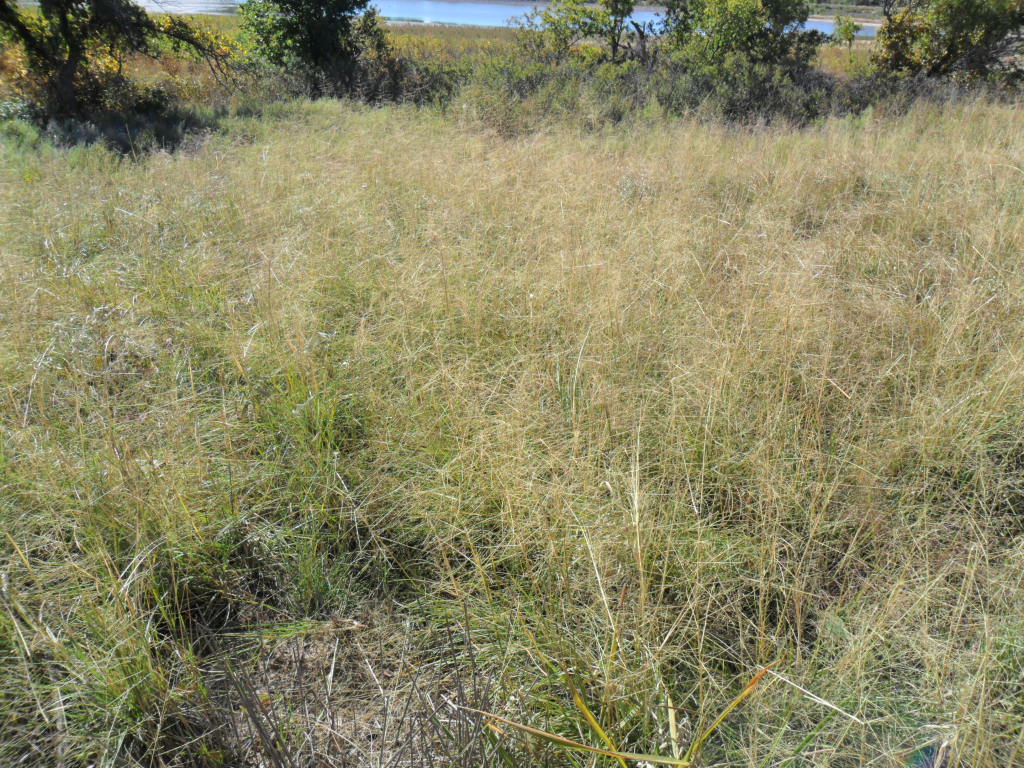
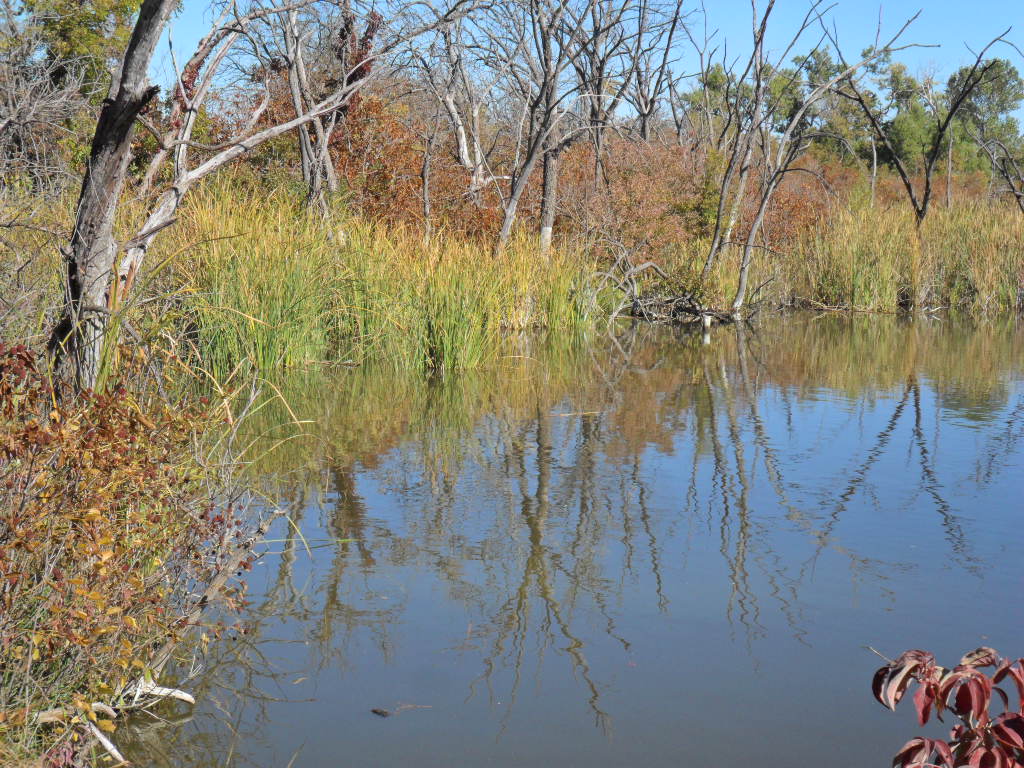
Those of us who live in the Panhandle of Texas become accustomed to the lack of trees and semi arid climate.  It is always a huge surprise to find those rare spots with numerous trees, water, and thick vegetation. Lake Marvin and much of the area near Canadian provide a total contrast to what we usually see.  JR  Bell, an expert on native grasses and plants, lead the hike around Lake Marvin, a manmade lake constructed for conservation purposes in the 1930’s on Boggy Creek.   Regretfully, I failed to carry a pen and pad to write down the name of all the grasses, some of which exist in the area where I live and others I had never seen before.  Perhaps some of you who read this will be able to identify the various grasses which include blue grama, side oats grama–the state grass of Texas, little blue stem, and two other species of blue stem, switch grass, buffalo grass, and wheat grass.  Unfortunately, Johnson grass, a non-native,  invasive species, also grows near the edges of the lake.

SAM_1321

The hike began near what was once the water’s edge before silt and drought made the lake half its original size.  Johnson grass, the outsider, is not too difficult to identify because of the bright maroony red on the leaves.  This enables an non-expert like me to differentiate among Johnson grass and a few other similar looking species.  While I tried to listen and watch grass identification, rather quickly I realized that without pen and paper remembering all of them would be impossible so I focused on photographing the natural beauty surrounding me.

SAM_1326

SAM_1323

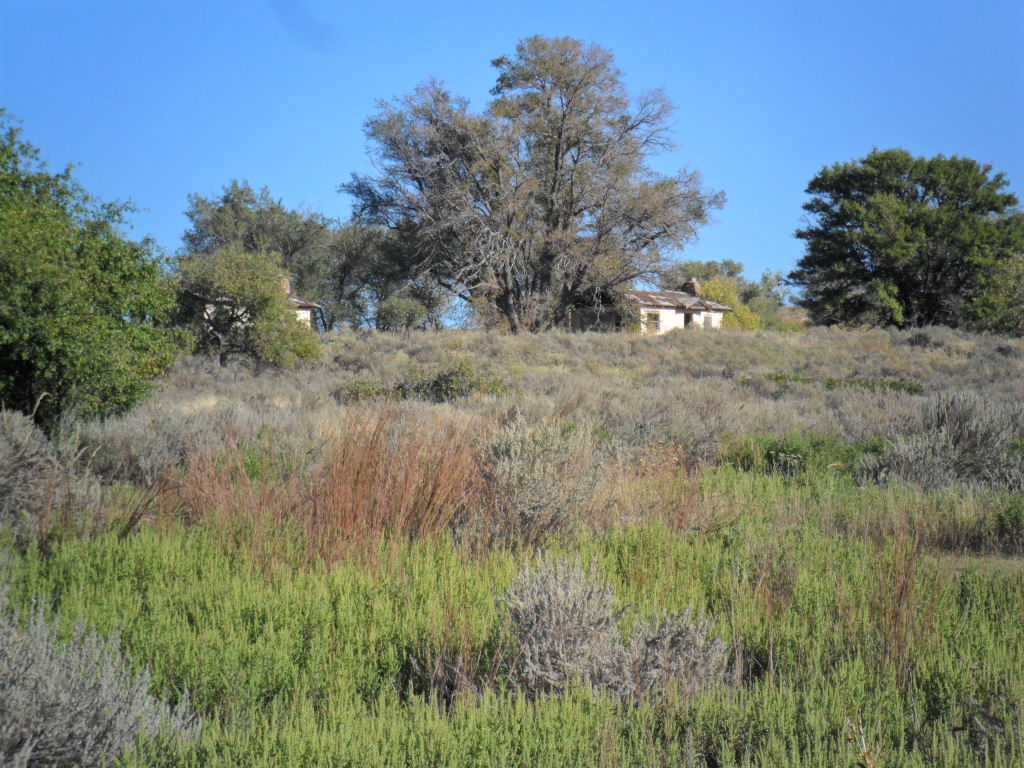
No one told me the origin or purpose of the abandoned buildings up the hill from the lake.  The change in flora one sees by facing the hill rather than toward the lake is amazing.  One could almost draw an imaginary line with certain grasses and shrubs on one side and totally different ones on the other.  The magic key, as always, is water.  Where I live, two hours away, no sage brush grows.  Here on the hillside, it grows everywhere with various grasses, some rather small and semi hidden, interspersed.

SAM_1328

I learned several keys to identifying grasses:  seed heads, texture of leaves and stems–some rough and others smooth, size of leaves and stems, some variations in color.  Height helps but does not necessarily determine differences because the same grass species can vary depending on amount of water and type of soil.  The amount and size of the trees continually astonished me, like this tunnel through the trees, something I never expected to see in the Panhandle.

SAM_1330

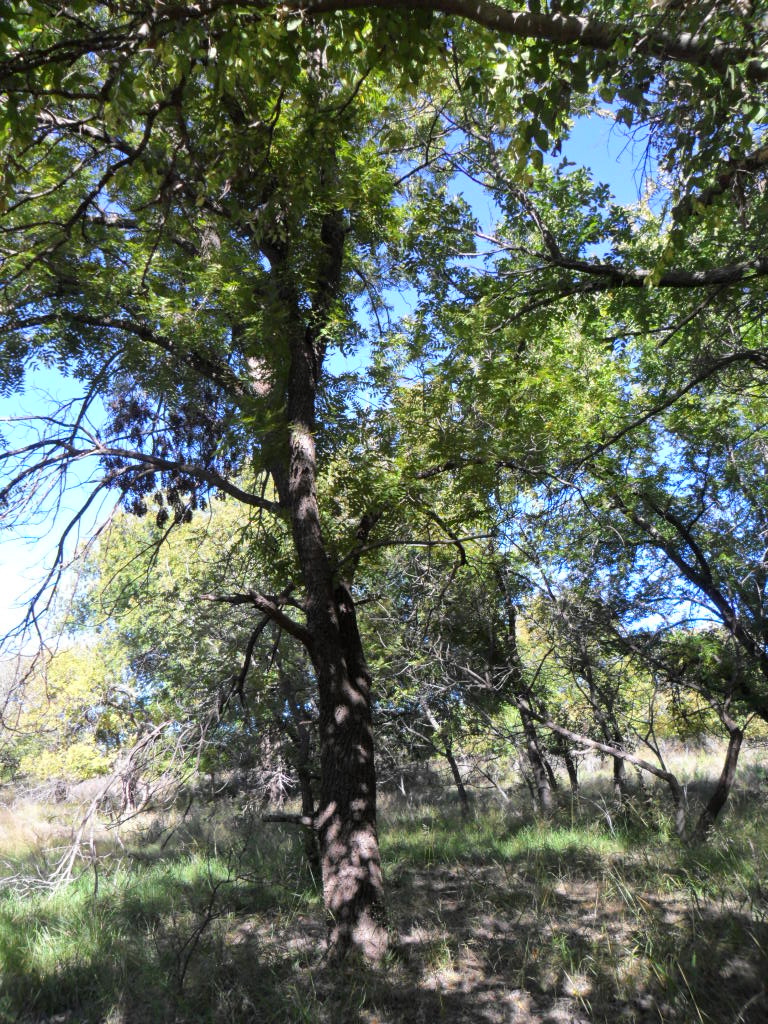
Where I grew up in northwestern Missouri, huge black walnut trees grow everywhere.  I recall exploring the walnut grove on the farm repeatedly as a child.  I certainly never expected to see them on this little trip.  Suddenly, astonished me stood there surrounded.

SAM_1334

While these trees never reach the size of the ones where I grew up and the nuts remain considerably smaller, here they stood, their distinctive leaves giving them away.  Before I went away to college, every autumn, we picked up the nuts, cleaned them–while the outside is a lovely lime green, the area between the seed and outside, is a sticky, dark brown mess which makes excellent natural dark brown dye, and cracked them to retrieve the meat inside.  Black walnut nuts are much harder than English walnuts and cracking them requires a hammer and something really hard on which to place the nut. After I left home, every year Mom spent hours working on these nuts and brought me at least a pound at Christmas, a true labor of love.  They are especially tasty with in recipes with chocolate or bananas.

SAM_1331

SAM_1332

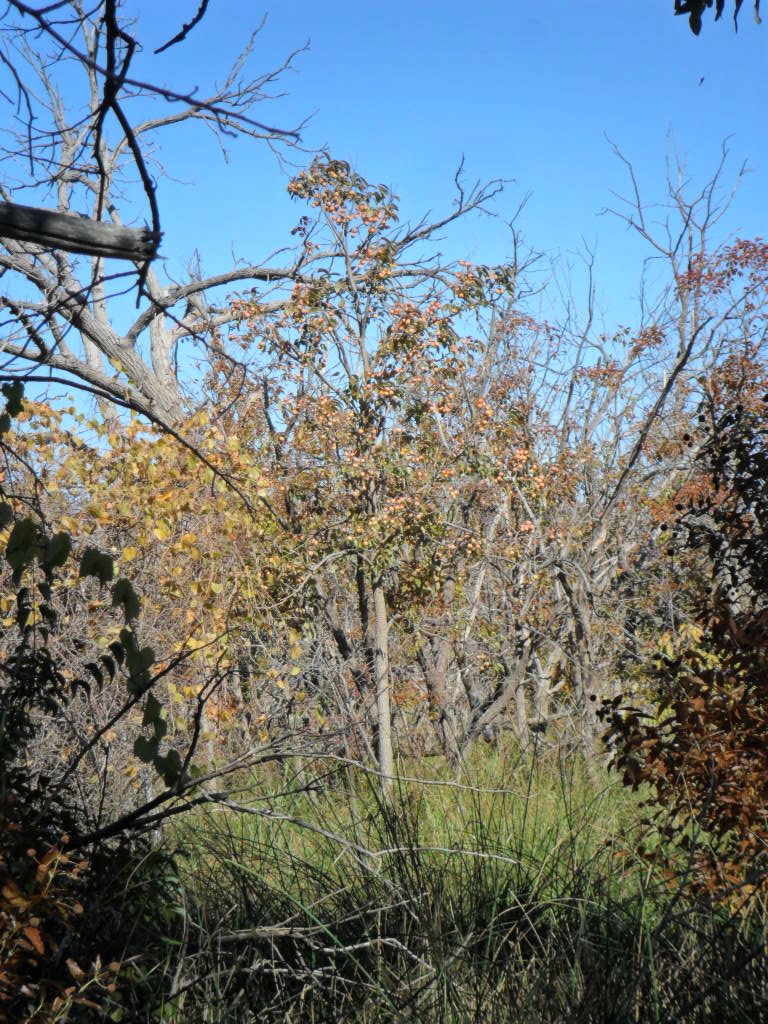
The hike provided continual surprises, a boggy pool, persimmon trees, a plant whose leaves resembled miniature spectacles, a grass so fine and thick in a glade between the trees that it looked like a tiny patch of fog on the ground, and poison ivy.

SAM_1336

Persimmons.

SAM_1343

This particular tree was loaded with persimmons.

SAM_1339

SAM_1340

Cattails in the background.

SAM_1341

SAM_1342

SAM_1344

When I first walked up to this spot, the fine grass toward the back of the photo looked exactly like a tiny patch of fog nestled in a miniature glade among the trees.

SAM_1346

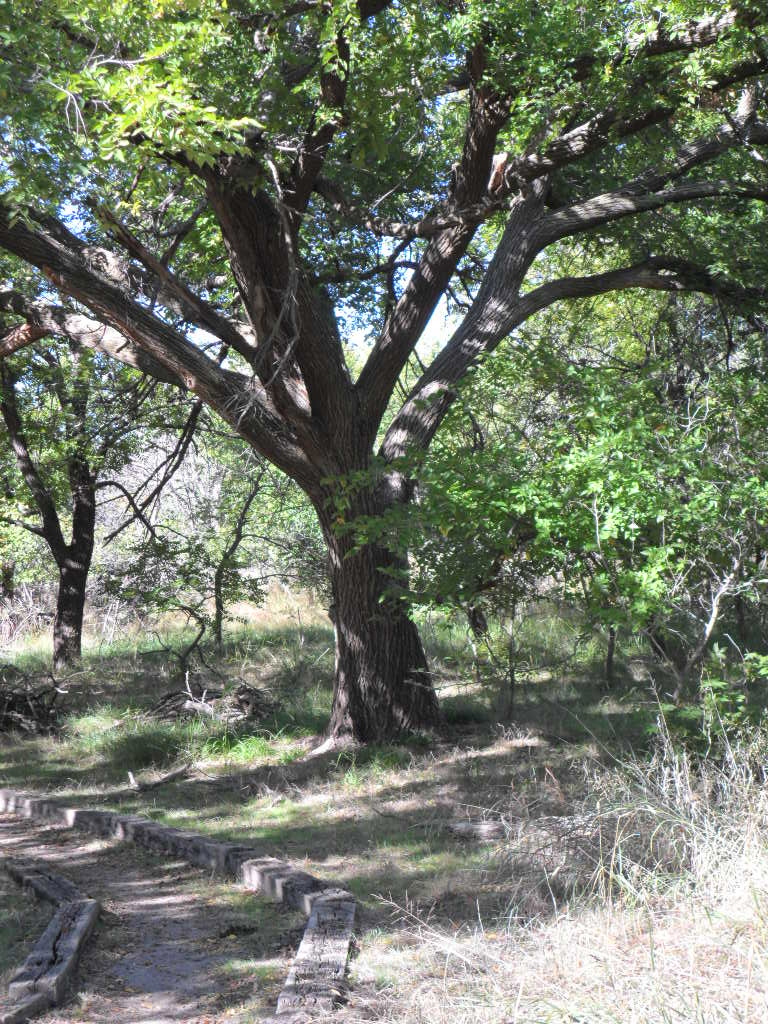
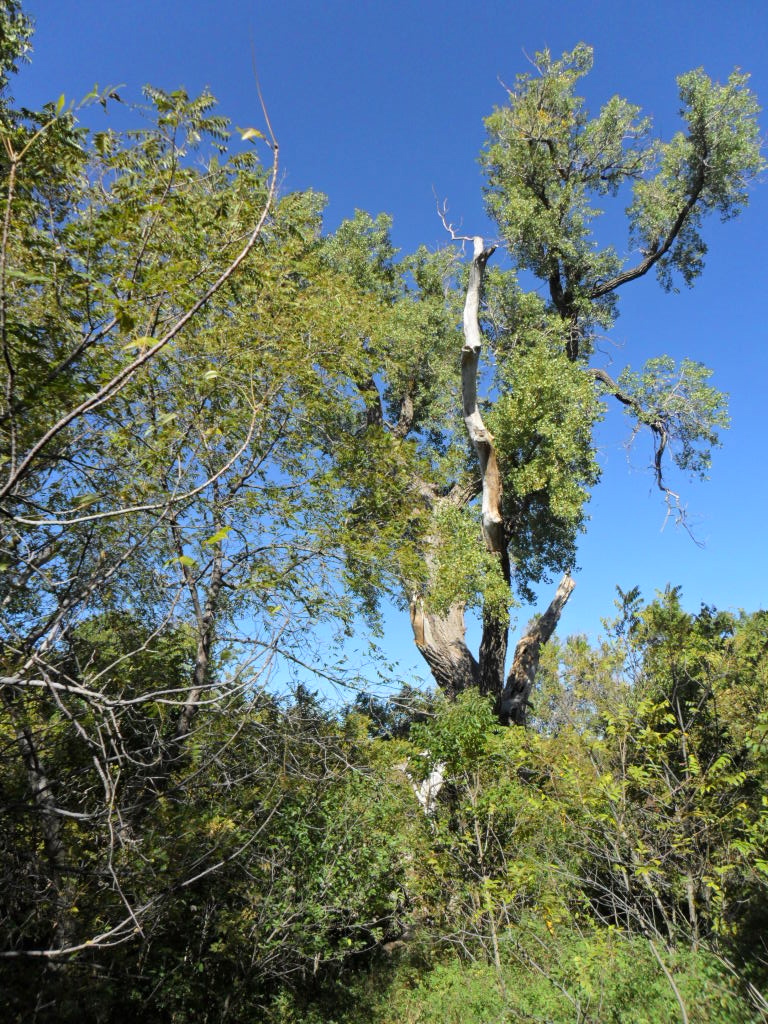
We took off from the main trail especially to come to this cottonwood tree, one of the oldest, if not the oldest, in the Panhandle. Over a hundred years ago this tree stood as the sentinel for the overland trail that went through this area.  The military, ranchers, and Native Americans all used the trail across this area of the plains.  The tree’s height enabled it to be seen for miles and helped travelers keep on their way with accuracy.  Once we reached the end of the main trail, some of the group took off in their vehicles while a few went on around the lake.  It saddened me to see so much of it dried up and old tires sticking out of the dried mud.  However, along the way, we saw numerous trees I could not identify.  The bark of this tree is particularly distinctive.

SAM_1347

This field trip coincided with the fall festival held annually in the small town of Canadian which gets its name from the Canadian River which flows beside the town.  The town is unique in the number of large, elaborate Victorian houses there.  Several of us ended the trip at the local elementary school with a big craft fair and a barbecue lunch.

For All the Lonely, Lost Young Men


At first, I planned to simply post a poem by this title, a response to the bombing in Boston and the young men who orchestrated it.  Then I decided that a few comments seemed more appropriate.  These comments come from a realization and conversations with a couple of colleagues at work noticing that all the perpetrators of the bombings and mass killings have been young males.  These young men cite various causes from the anger of being disenfranchised and bullied to religious fervor of a certain type to insanity.  All acknowledged anger over something, a rage so profound they felt driven to act, at least for those to whom authorities could talk.  Most appeared to be alienated from their culture, friends, or family, young men who failed to fit in.  Although we must condemn their horrific acts, perhaps it would also prove more productive to ask, “Why?” Unless we know why and address the causes, these events will be repeated somewhere at some totally unforeseen time.  And many innocents will die again and again.  Perhaps equally disturbing is the fact that we are not alone.  These types of events repeat themselves in one way or another in many other countries in the world.  Additionally, I realize that many people feel the solution lies in revenge, punishment, justice as they see it.  For those, many of the sentiments I express in this poem may seem too simplistic, too kind, too naive.  I teach high school.  I work with all types of young men daily.  I see their fear, anger, loneliness even if fleeting and only momentarily.  We can make a difference; we can reach out.

Look at yourselves

filled with

fear,

anger,

hatred.

This world may not embody

the perfect place

of which you dream;

do not despair.

We care.

Do not shoot me.

I care.

Do not throw bombs at the innocent;

They care.

Do not hate the different.

They care.

Do not despair.

The Land in Love with Guns


In the United States firearms kill approximately 15,000 individuals per year.  In Britain, Australia, and Canada, the average is 350 per year.  Spain’s rate is even lower.  In Germany, it is less than 800.  A young person here dies about every 4 ½ hours, shot dead.  The US murder rate is 19.5, nearly 20 times higher that the next 22 richest countries.  In the 23 richest countries combined, 80 percent of all gun related deaths are in the US; 87 percent of children killed are shot by guns here.  In the last 45 years, bullets killed more than one million people in the US.

Gun sales are big money.  More than a dozen hand guns are sold per minute.  One survey indicates that one out of every four US homes possess a gun; another survey says 39 percent.  However, most guns are owned by only a small proportion of the population, gun “collectors” who own an average of seven weapons per person.  Guns are cheap here and bullets even cheaper, about 50 cents each.  The Mexican government contends that our cheap guns help fuel the dreadful violence there which then overflows to here.

In spite of all this, the US murder rate is the lowest in more than 45 years.  The NRA claims more guns equal less violent crime.  The NRA contends that the lower crime rate is the result of less strict gun laws and more people owning guns.  Nevertheless, mass murder occurs on a regular basis.  We mourn, we lament, but nothing changes.

Eventually, another mass murder occurs and the cycle repeats itself.  Why?  Who or what is responsible?  What can be done?  Will more restrictive gun laws help or hinder?  Debates continue; opposing views and answers abound, but the cycle continues.  Will it ever change?

I wrote the above after the last mass murder event.  Nothing changed.  Now the conversation appears more strident, more active.  Apparently, the mass killing of children is more heinous, more scary than the mass murder of adults even if the adults are young.  The NRA advocates armed guards at schools.  How will that prevent mass killings at movie theaters, at malls, at churches, on the street, e.g. the three murders this week in Pennsylvania?

Australia was another country in love with guns, but after a mass killing there, they changed their collective mind.  They enacted strict gun control laws for assault weapons and ammunition.  Could that work here?  I think not.  This is a country in love with guns because the right to own a gun symbolizes  what is perceived as individual rights.  This is a country where personal liberty remains far more important than community safety and social justice.  Until that changes, mass murders will continue.