Book Two for 2026: “The Hounding”, Xenobe Purvis


This recently published book is one of the latest in a bookclub to which my grandson belongs. Although an historical novel based on the reporting of an actual event in 1701, much of it applies to today’s world. In 1701, Dr. John Friend reported to the the Royal Society of England about a “rumuor spread” which discussed a report that young girls in the Oxfordshire country side had “been seized with frequent barking in the manner of dogs.”

Five sisters live with their grandfather on an affluent farm in the country. Due to the recent death of their grandmother, they go around dressed in black as was the custom. Because they stay to themselves a lot, roam freer than most girls, they are often looked upon with suspicion by the villagers. One man, who ferries everyone to and fro over the nearby river, has issues with women and loathes these girls because he thinks they are too independent and views them as defiant and thinks they ridicule him because they do not chat with him when they use the ferry. He also has a severe drinking problem and spends all of his free time in the village pub. He is about to be married to a local woman but has severe anxiety over this because he thinks his new wife might try to boss him around.

Most of the men in the village spend their evenings drinking in the pub and often resort of fights and various forms of violence when issues arise. They see this as manly behavior. They view with suspicion any man who does not behave as they do. The woman, Temperance, who serves them hates alcohol and goes so far as to wear leather gloves so the alcohol will not touch her hands. She is one of few in the village who does not believe in rumors and supports rational behavior.

Everything goes awry when during a severe drought, the river dries up, the heat overcomes everyone, and Pete, the ferryman, insists he has seen the five sisters bark and turn into dogs and incites fear in many in the village. It seems to matter little that the two young men who work for the girls’ grandfather, proclaim that the girls are perfectly normal and none of this is true.

This novel raises various issues that continue as issues hundreds of years after the above incident:

-What does it take to make a man? What characteristics define real manhood? Is manhood defined by violence or kindness and compassion?

-How much freedom is okay for women? How much independence and who determines this?

-When is drinking ok and how much? Should people stop people who become violent when drunk?

-What happens to a neighborhood, a society, when people start to believe all sorts of stuff that is not true? Can it be stopped and how?

Book 45 for 2025: “Atmosphere”, Taylor Jenkins Reid


Joan, the main character, is an astronomer obsessed with the stars since childhood. She is content with her life as a physics professor until she sees an ad seeking the first women scientists to join NASA’s space program. While her initial attempt fails, she applies again and succeeds.

In the summer of 1980, she begins her astronaut training at Houston’s Johnson Space Center, along with other trainees, including some from the military and others chosen because of their specialist expertise. She is one of those. Some of the top military pilots are nice and some like to make jokes at the expense of women. The women know they won’t all be chosen to go to space. As a consequence one woman in particular becomes excessively competitive. Others help each other and hang out together.

The novel details the rigor of astronaut training both mentally and physically, how trainees behave under stress, and how all the stress makes some people nicer and others increasingly rude. In the midst of all this Joan continues to care for her beloved niece and discovers a love she never dreamed of in her wildest dreams.

Book 43 for 2025: “Salt Bones”, Jennifer Givhan


This novel surprised me by being a page turner. Once I read through the first couple of chapters, I had to keep going. In Southern California the Salton Sea, once much larger and the home of a thriving resort, now has shrunk and only a few people live there. Not far away lies the Imperial Valley, one of the largest agricultural regions in the US which is close to the Mexican border. This is the setting of the story of the little town of El Valle, the surrounding areas, and the tale of two families, one rich, white landowners, the other Mexican-indigenous. Mal, one of the main characters, has always lived on El Valle, worked hard, tried to forget the disappearance of her sister, and raised two daughters alone. Another local girl goes missing, then a week later her youngest daughter also goes missing. Frantic, she searches for answers, wonders if there is a link, and keeps dreaming of the local, indigenous legend of the horse headed woman, El Siguanaba. Meanwhile readers learn about the long friendship and affair between Mal’s oldest daughter, Griselda, and the son of the valley’s largest, white landowner, Mal’s difficult, disabled mother, her father, and brother’s, one of whom is running for office after going to Stanford, and the youngest brother, Benny, who is now a detective. Not only does this work of fiction combine Latinx and indigenous cultures, it also addresses environmental collapse, family secrets, and the complex relationships between mothers and daughters.

Book 29 for 2025: “Hang the Moon”, Jeannette Walls


I had only read her memoir, “The Glass Castle”, previously and remember thinking, wow, even some intelligent, educated people can have very different ideas about how to live. I was looking for a book to read and found this novel, her most recent book published in 2023, at the local library.

The main character, Sallie Kincaid, is the daughter of the wealthiest man in a small town, well even the county, and he runs everyone and everything there. Sallie remembers little of her mother and knows little about what happened to her except she died after a violent argument with her father. He remarries and has a son. Sallie tries to teach him to be bold like she and her father are. This results in a horrible accident and her stepmother demands she leave. Her dad sends her to live with the poor sister of her mother where she remains until she is seventeen. Her dad sends an old friend from her childhood to bring her back to his place, the biggest, grandest house in the county.

It is Prohibition and ways of making a living that have always existed in this area of the mountain Southeast is now illegal. Slavery is over and women can vote but for most life has changed very little. Her stepmom dies, unforeseen tragedies occur, people are not who she thinks they are, and one awful thing after another ensues. This is one of those novels you keep reading because you want to know what happens. It is the story of Sallie Kincaid, a very strong, determined woman who survives and even thrives no matter what.

Book 19 for 2025: “Tell Me Everything”, Elizabeth Strout


This latest Strout novel takes the reader back to Crosby, Maine, the site of most of her other novels. The same cast of characters appear, Olive, the Burgess boys, Lucy, William, Margaret, and all the others. This one, however, has a new twist, a heinous murder occurs. The most obvious suspect is the victim’s reclusive son who lived with her. Bob Burgess is hired as his lawyer. Lucy starts visiting Olive and they tell each other stories about people they have known , what Lucy calls “unrecorded lives”. Meanwhile, Lucy keeps asking, “What does anyone’s life mean?” Lucy and Bob take walks every week, spending the time talking about all the things they feel they cannot talk about with anyone else. William becomes more obsessed with the parasites he is studying and never quits talking about them.

This, like all of Strout’s novels, focuses on relationships, the good and the bad, and how they sustain us, sometimes transform our lives, sometimes nearly ruin us. Although, readers do not have to read her novels in sequence and this one could be read alone, I think it would make more sense to the reader to at least read three others first: “Olive Kitteridge”, “The Burgess Boys”, and “Oh, William”.

Strout has a unique, easy to read style, that is both simple and profound. She talks about people as they are with empathy and concern. She talks about the many forms of love–“…it is always love. If it is love, then it is love.”

Book 12 for 2025: “Girls of Riyadh”, Rajaa Alsanea


I was not looking for this, but rather accidentally found it while strolling through the stacks at the local library. What an informative and entertaining book. When it was first published in Lebanon in 2005, it sort of shocked the Arab world causing public debates about the subject matter and story both pro and con. The novel centers on the lives of four upper class Saudi young women who have known each other for years and are friends. Because the book openly discusses the difficulties young educated Saudi women have pursuing education and careers while also trying to find suitable men to marry, the religious conservatives found the novel blasphemous and wanted it banned. Others said it disrespected Saudi women. Black market copies showed up everywhere and the author became an overnight sensation.

The book focuses on the difficulties these women experience as they navigate the modern world while still living in a society founded in very conservative patriarchal cultural conditions. They want to believe in love and hope they will find someone to marry they also love. However, traditions get in the way of this goal more often than not. Some of them find someone they love and who loves them but families forbid it–the person is not high enough status or has been divorced, or…the barriers seem endless, focused on family connections. Love is considered a frivolous, unhealthy distraction.

Contrary to what I believed before reading this, most of these higher class Saudi young women are going to college, often in subjects like medicine and dentistry, and plan to pursue careers in their fields. Many have travelled to Europe where they are freer to roam, not dress conservatively, etc. Yet they return home because of close family ties and love of country. Several of the fathers in this novel are considerably more liberal than the girls’ mothers. Like any society the view of progress and tradition vary greatly by family and individual.

Because as a reader you get to “know” these young women, I found myself reading nonstop because I really wanted to know what was going to happen, whether any of them would be allowed to marry someone they loved or would be heartbroken and forced into unwanted situations. The latter never occurred thankfully. None were forced to marry someone they disliked. It is a great read for those who are curious about other cultures and how women navigate their lives in a place dramatically different from what is more common in Europe and the US.

Book Seven for 2025: “The Map of Salt and Stars”, Zeynab Joukhadar


Two young heroines dominate this fascinating novel which switches back and forth between the Syria of 2011 and the 12th century. The latter is a girl who disguises herself as a boy to join the quest of a famous mapmaker. Nour, the first girl, lost her father to cancer in NYC. Then her mother, a mapmaker, decides to move herself and the three daughters back to Homs, Syria. They barely settle into their new life when the civil war breaks out and a bomb destroys their house. They become refugees. This is the tale of their harrowing journey from Syria to Jordan to Egypt to Libya to Algeria, then Morocco and finally to Cuenta, the Spainish city on the north coast of Africa, where their uncle lives.

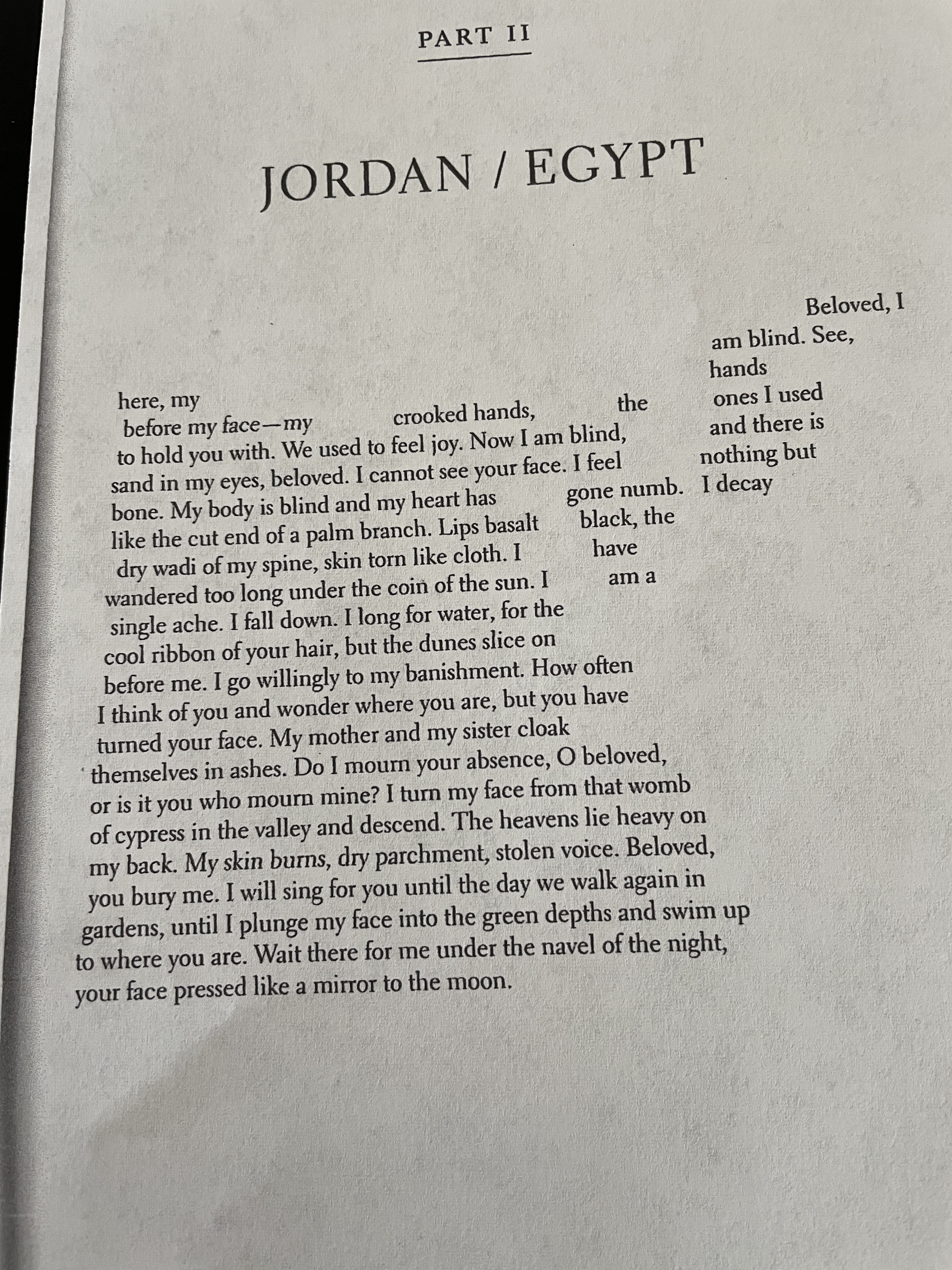
To keep sane, Nour repeatedly tells herself the story of Rawiya, the disguised girl who is an apprentice to the map maker. When he was alive, this was the favorite traditional story her father told her. The book alternates between what is really occurring to Nour and her refugee family and this ancient story. At the beginning of the section for each country through which they travel, there is a touching and beautifully written poem in the shape of the map of that country. The poem for Jordan/Egypt is printed below.

Book 46 for 2024: “What Happened to Ruthy Ramirez”, Claire Jiménez


The Puerto Rican Ramirez family lives on Staten Island. The book begins years after one of the three daughters, Ruthy, disappears at the age of 13 while on her way home after her school track practice. Twelve years later while watching TV, Jessica, the oldest daughter, sees someone on a reality show who looks like Ruthy. The woman on the TV has red hair like Ruthy and the same birthmark mole. Jessica tells her younger sister, Nina. They concoct a plot to go to the reality show site and bring Ruthy (if she is really Ruthy) home. They avoid telling their mother, Delores, who has never ceased struggling over Ruthy’s disappearance. Delores discovers their plot and insists on not only joining them, but also bringing her older Pentecostal friend who frequently falls into spiritual spells on the floor at church. Eventually, they all head to Boston where the show is located and all kinds of turmoil occurs.

The novel is told from the viewpoint of each sister and their mother, providing endless details about their Puerto Rican culture, their jobs, their views, and how they feel about each other, all done with dialogue. Sometimes it is loving, sometimes snarky as it deals with their experiences with racism, sexism, family secrets, and violence. As a reader, I, too, wanted to know what happened to Ruthy. Definitely worth the read.

Book 42 for 2024: “These Is My Words: The Diary of Sarah Agnes Prine, 1881-1901, Arizona Territories


This fictional work is based on the life of the author’s great grandmother. Written as a diary with specific dates, the narrator is not yet a teen when the novel starts. Her parents are wanderers, always looking for a better, new place. Sarah’s character is that of a tough, pioneer girl and then a woman. She can ride horses, shoot to kill, manage a ranch, do whatever it takes to survive. Much of it includes a rather accurate portrayal of life in Arizonan territories as well as Texas at the time including the prejudices of many of the white inhabitants toward the Spanish speaking people already there, fights with Apaches, and the hunt for Geronimo. It is not just the story of her own life, including her relationship with the Army Captain whose job initially is to protect a wagon train, but also portrays other people living in the Southwest during that time period.

I read this as part of a book club. Reactions to the book varied widely from those of us who thoroughly enjoyed the book to at least one person who insisted it is poorly written and viewed it as a romance novel. The rest of us did not. She used an audio book edition. After her descriptions, it appears the audio book does not correctly follow the book itself and is poorly done which may have contributed to her view of this work. I borrowed this novel from the public library and it was obviously well read because it was not in the best condition.

Book 31 for 2024: “Tender”, Sofia Samatar


This book contains 20 fantastical and dystopian short stories. I found them fascinating with topics ranging from selkies to ogres to ghouls to jinns to witches (in this case positive ones). The settings range from US to Africa to a settlement in outer space (the story “Fallow”). Divided into two sections, Tender Bodies, Tender Landscapes, these stories address human frailty, anger, greed, extreme religions and how humans treat each other (both good and bad) and what might occur in the future if people do not behave better. “Fallow” is a sort of handmaid’s tale where instead of being on Earth–which has been basically destroyed–a group of extreme religious folks have made a place for themselves on another planet after escaping Earth. If anyone from Earth accidentally shows up, they are in big trouble unless they become just like the people already there. Otherwise, they do not kill them–that is wrong–but just sort of let them slowly die. These stories, both brutal and lovely, display an incredible imagination.