Visiting Chaco Canyon


Several weeks ago, I spent a day wandering around the ancient sites where native peoples gathered over a thousand years ago.

This explains the extensive influence this place, located in the northwestern New Mexico desert, held for people from as far away as Central America. To reach this park, you have to drive on a dirt/gravel, rough road for more than 25 miles north of Crownpoint, NM. It is definitely worth the effort. However, it is impassable in rainy or snowy weather. The rangers who care for the park live there.

One of the first things you see as you get closer to the park is this rock tower, Fajada Butte.

Archeologists climbed to the top and discovered petroglyphs, “Sun Daggers”. Created between rock slabs, they align with each solstice and equinox and at these events the light projects to other sites, e.g. Pueblo Bonito. Other petroglyphs on a section of the canyon wall represent a supernova that occurred in 1054 CE.

The following depicts an overview of the site as it would have been in the past. In the 1940s part of the wall of rock behind the site collapsed onto it and destroyed some of the buildings.
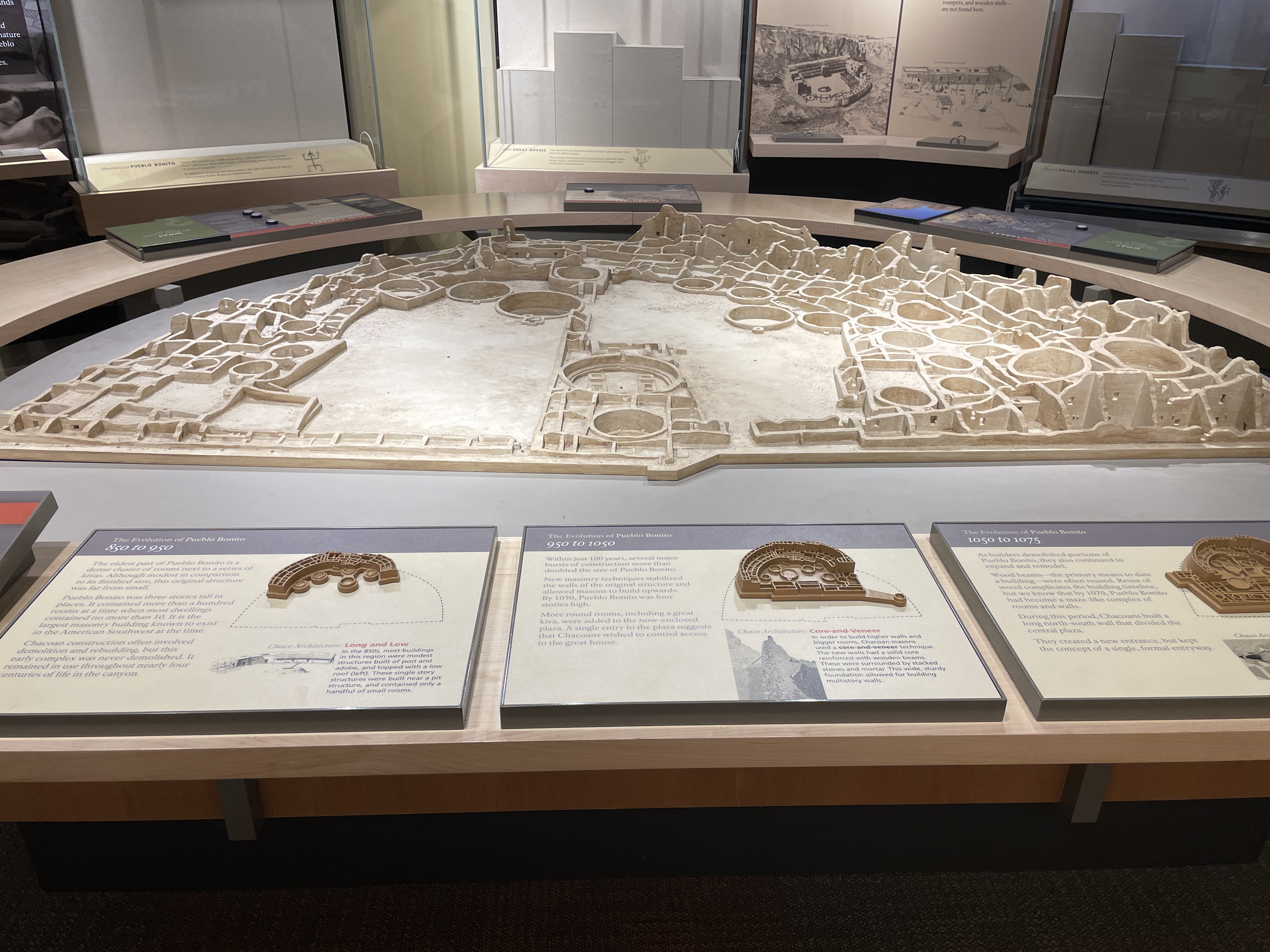
Here is how it looks today. Many of the doors and windows align with astronomical events, e.g. solstices, the two equinox, and astronomical events that occur only every 17 years.
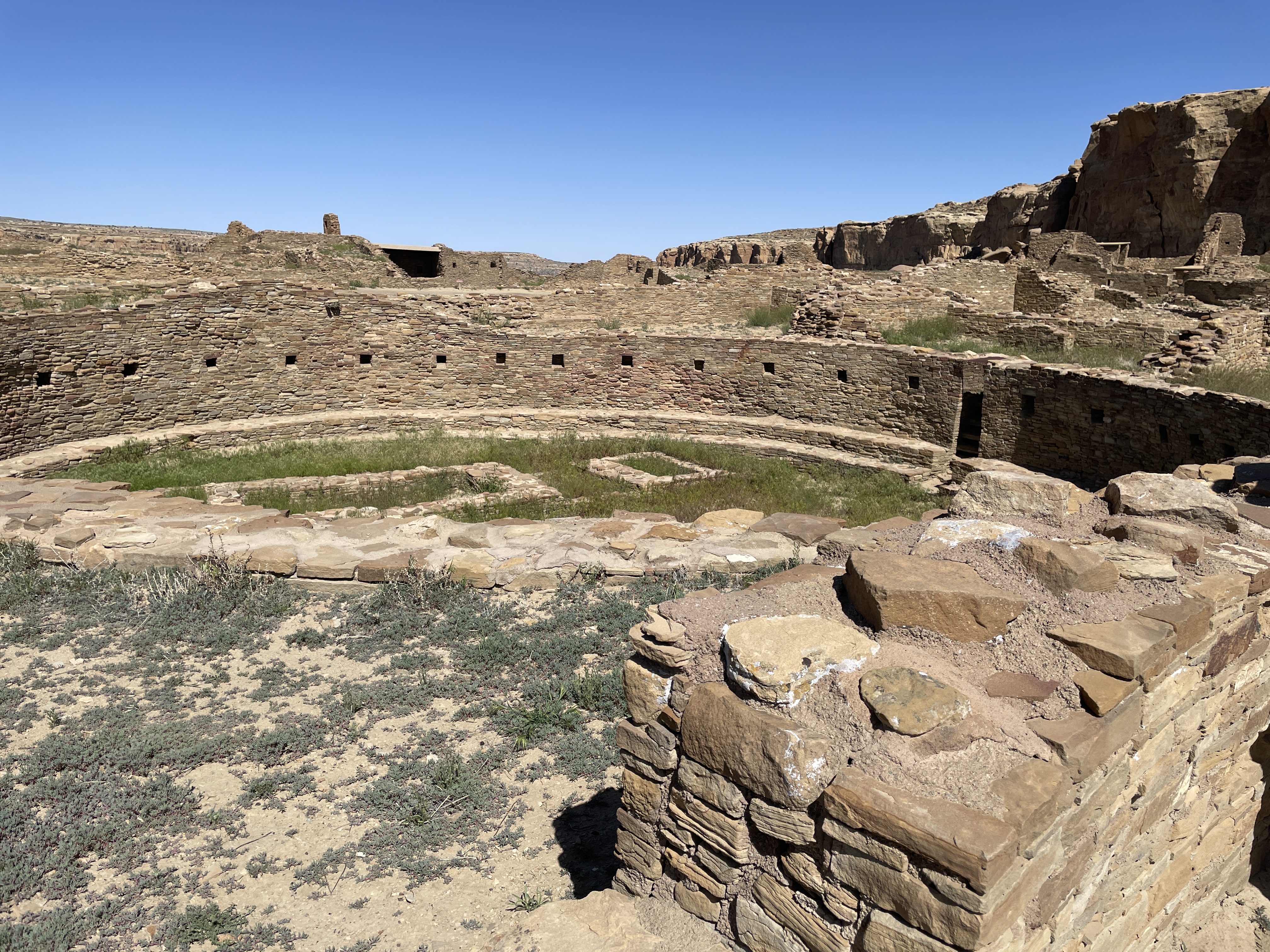
All sites here contain many kivas, many of which are very large. It is speculated that these were used for various sorts of ceremonies, including religious events.

In this view you can see how the rocks that fell from the cliff have destroyed parts of the structures.

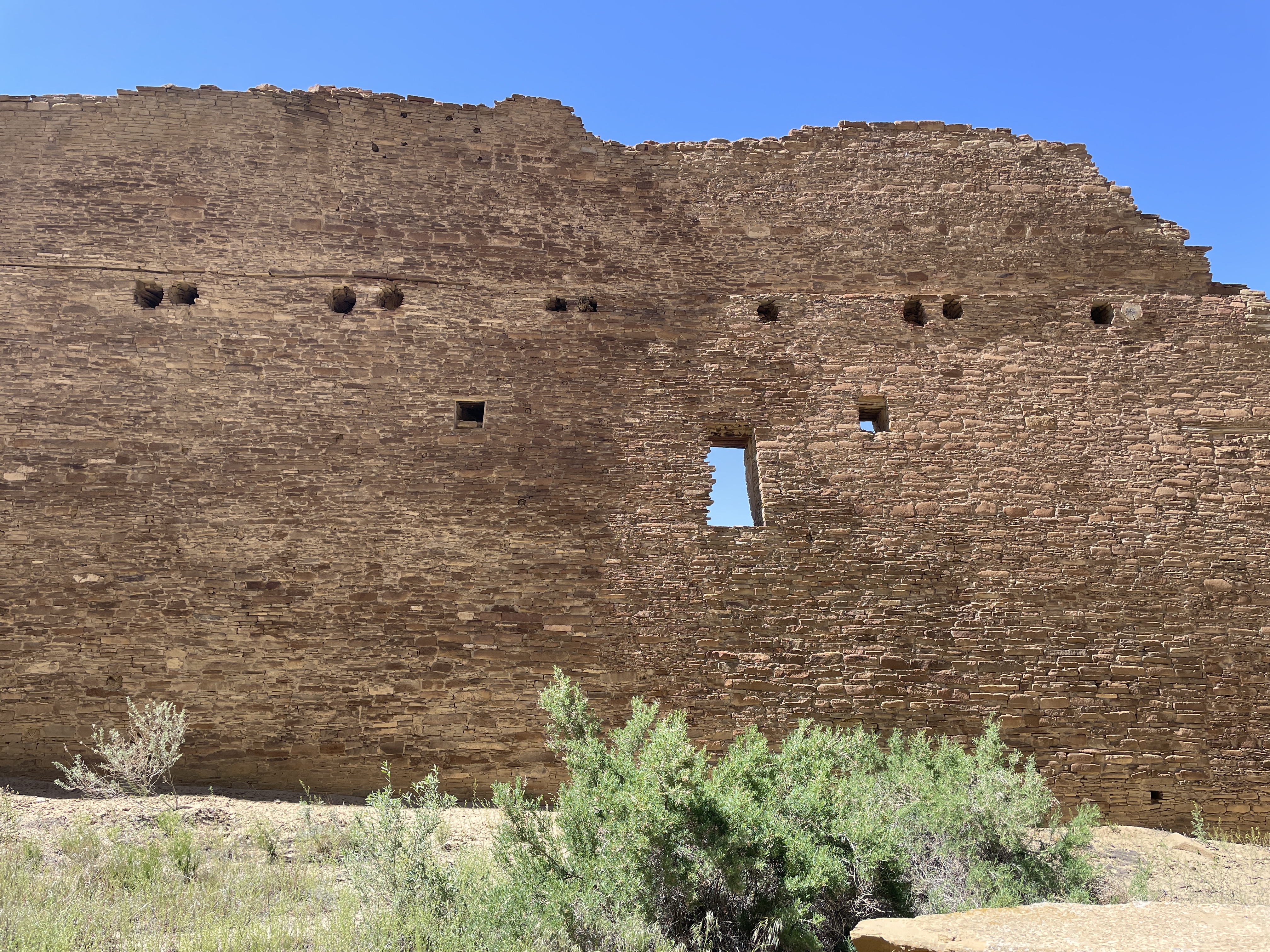
Many of the buildings were several stories high. In their heyday, they did not look like this. They were covered with something like stucco and painted white. What an impressive site they must have been–large white structures in the middle of the brown desert. Archeologists think few people lived here. It was a place for gathering, for ceremonies, for trade, for people from long distances to meet.
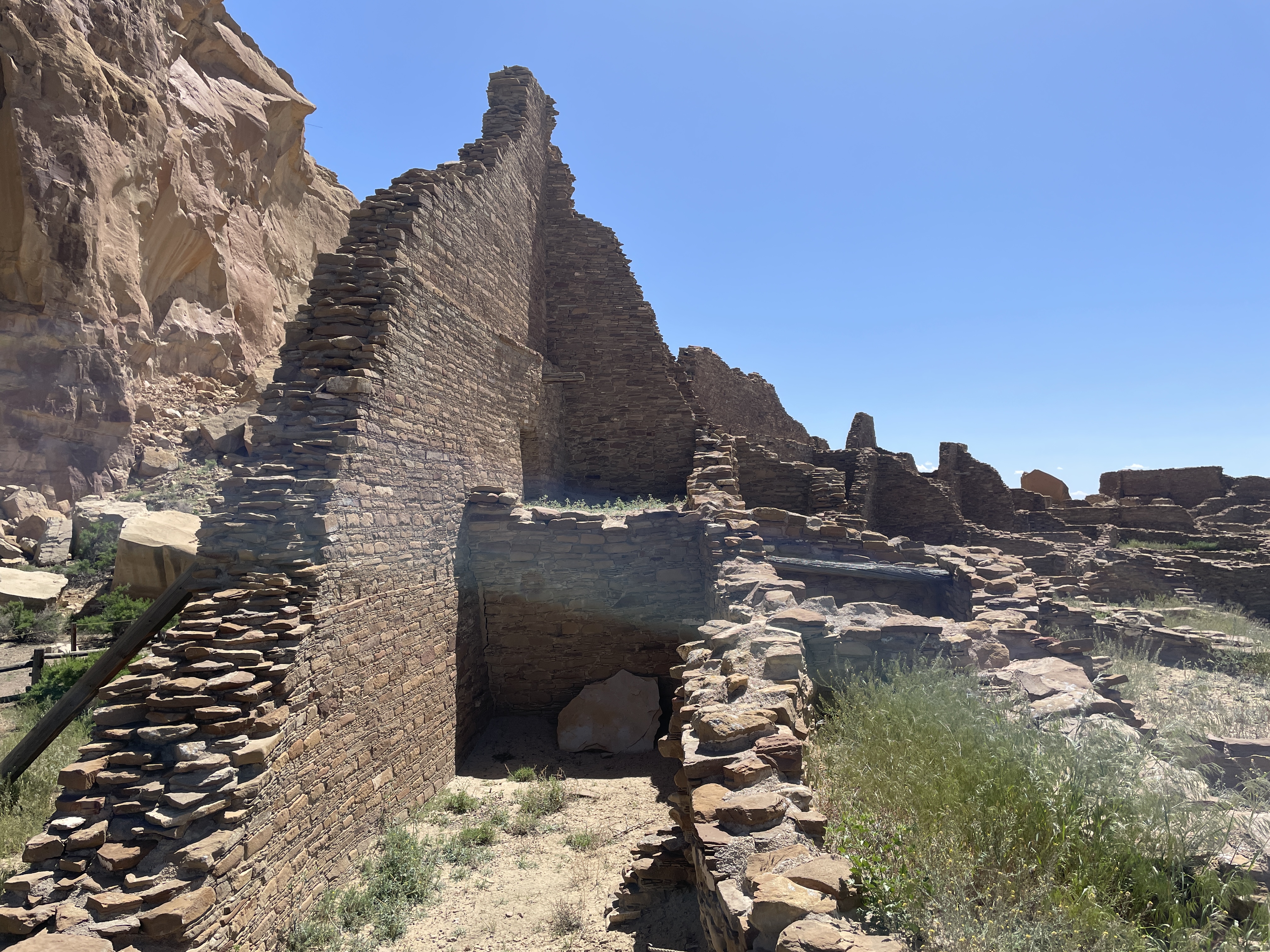
Across from Pueblo Bonito is the largest kiva found in the area.

Behind the bars on the far side of the photo is an area that was used for ceremonial dancers to don their costumes. At the bottom you can see a depression with a small door. Before centuries of sand filled it in, this place would have be large enough for the ceremonial dancers to enter through it.

If you follow a trail along the cliff from Pueblo Bonito, you will find another area built at different times hundreds of years ago.

Another large kiva and many smaller ones are located at this site, including this famous long wall built at two different times.

The following shows where at some point the wall stopped, then later it was continued using somewhat different building material and techniques.

The top photo is considered the newer part of the wall.

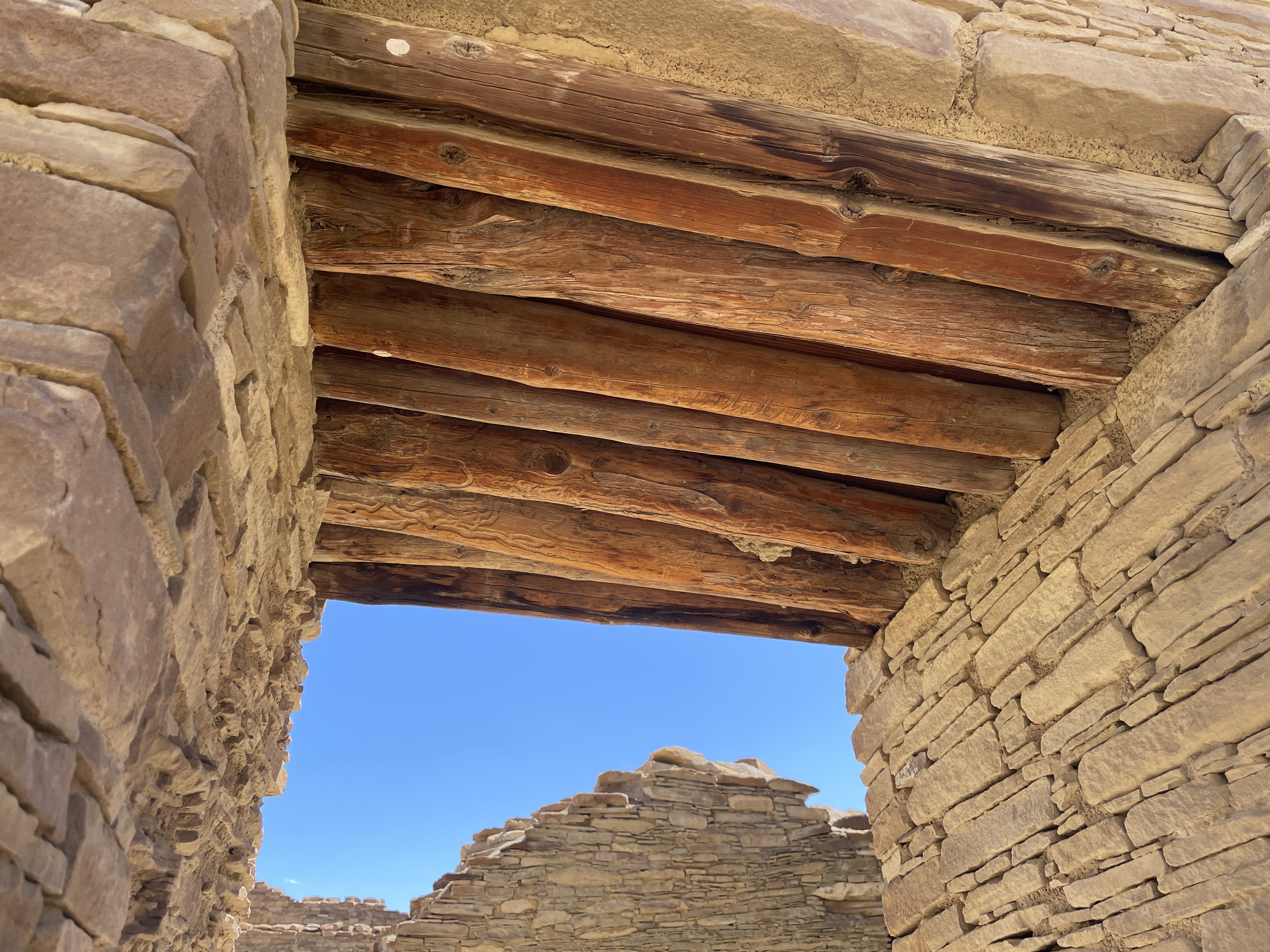
The wood used for tops of windows and doors was brought from forests hundreds of miles away. The desert air has enable it to be preserved.
When you walk the trails, you see wild flowers and native plants. This is desert rhubarb and it is edible.

While these are photos of the more impressive structures at Chaco Canyon, more than two hundred ceremonial and meeting sites can be found in this area of NM and AZ.

Book 14 for 2024: “The Invisible Hour”, Alice Hoffman


This is a book for those who believe in the power of books to transform life, who are fans of Alice Hoffman, and who like time travel. It also about how a charismatic man can ruin the lives of many, especially women, by controlling everything around him through fear and coercion. In his Community books and contact with the rest of the world are banned. Mia is a young woman who sneaks into a local library and finds Hawthorne’s “The Scarlet Letter”. She realizes the life she is living in the Community is like the lives in the book. Through this book she manages to attain the courage to escape such a man, the man who destroyed her mother, Ivy. She makes her way back in time to the period in the book, has a love affair with Hawthorne, and finally escapes the horrible man who tracks her everywhere she goes.

Book 10 for 2024: “The Furies: Women, Vengeance, and Justice”, Elizabeth Flock


This book raises these questions: Can women gain true safety and equality without violence? Can we end misogyny without fighting back?

The book details the stories of three women, one from Alabama, a woman from northern India, and a Kurdish fighter in northern Syria. All use a form of violence to overcome abuse and mistreatment they have experienced and see other women experiencing. The author personally interviewed all of these women and others close to them and visited them repeatedly.

The first is Brittany Smith, who shot the man who had raped her and was trying to kill her brother. Her story details how Stand Your Ground laws work for men, but often fail for women, especially in areas of the US South where men are protected by their beliefs in a male Code of Honor.

The second is the story of Angoori Dahariya, a Dalit woman, from Uttar Pradesh, India. Fed up, she creates a group called the Green Gang (they wear green saris) dedicated to defending poor, under caste, female victims of abuse. Note: Dalit refers to the lowest caste.

The third is the story of Cicek Mustafa Zibo, a Kurdish fighter in the female militia that fought ISIS in northern Syria. She and many others follow the teachings of Ocalan, a Kurdish leader imprisoned by the Turks for leading the Kurdish militia who for years have fought the Turks for independence. He teaches equality between men and women and women’s rights, which is anti the general cultural beliefs in this area of the world. Note: Ocalan is labeled a terrorist by many.

Eye Drama


Kohl

Kajal

Sormeh

Mebari

Ancient names for eyeliner

still in use today.

Kohl-Arabic

Kajal-South Asian

Ithmid-the purest kohl

made from galena

Surma-powered kohl in Urdu, Bengali

Sormeh-loose power preferred by Persians

Tiro-Nigerian

Mebari-red eyeliner, Japanese

Nefertiti used it.

Today the Worso and Wodaabe

African men use it.

Where women must veil themselves

the eyes are everything.

Bedouins use it for protection

from the desert sun.

In defiance find Cat Eyes

in Chola culture.

In Kerala Kathakali

dancers use it.

Geishas in Kyoto use red.

Find influencers on TikTok

Instragram, they will

teach you how.

Note: The above poem was inspired by my most recent read:

“Eyeliner A Cultural History”, Zahra Hankir. Hankir is a Lebanese journalist whose history of eyeliner throughout the world informs the reader about places and people and customs many never heard of or know about.

Book Seven for 2024: “After Eden, A Short History of the World”, John Charles Chasteen


Want to learn a lot in less than 400 pages? Read this book. Published this year, it is the most recent book by a prominent Latin American scholar and historian. After humans learned agriculture and built cities, most of the population of the world became increasingly patriarchal and warlike. The divide between rich and poor increased. Egalitarian foragers and wandering hunters existed only in more remote areas. A few still exist in those remote and less modern corners of the world, often places where few others want to even go. This quote says a lot about the current state of affairs:

“Our civilization has thousands of years practice making war. We have almost NO practice making global peace, but without it we are doomed. Today’s pervasive nationalism and rearmament is unlikely to help us make global peace.”

And a page later:

“Only a true unanimous global effort has any chance to preserve our common home.”

He notes that saving Earth will take huge social transformations, including curbing the excessive consumer capitalism that currently pervades plus overcoming a world wide history where half of humanity mistreated the other half, a practice that still continues.

Chinese New Year at the Tzu Chi Campus


Today I traveled a bit south of where I live to the campus of the Tzu Chi school which I have visited numerous times. First we had a vegetarian lunch–they are Taiwanese Buddhists who advocate a vegetarian, plant based diet as better for the environmental future of Earth. Then all the visitors, who were mostly parents of the children, went to the gym for the program. Various ages wore headdresses to represent the various signs. Some of the youngest children wore dragon headdresses. This is the year of the dragon.

The children sang and danced.

Parents were very enthusiastic about taking photos.

Then after all the students of varying ages finished all their performances, including older students who made a circle around the room and sang plus danced with perfect synchrony, out came the dragon.

It was so much fun to see all the children performing; it was obvious they had worked very hard to accomplish this. It was also enjoyable to see so many happy, enthusiastic parents.

Note: I work with this Buddhist Center teaching character education at local public schools.

Book Two of 2024: “Jezebel”, Megan Barnard


As a woman whose view of most women in the Bible remains nuanced, I could not resist a purchase when I saw this on the shelf at a bookstore. For centuries, she’s been vilified as a harlot, a temptress, both descriptors seen as negative by many societies even in these freer, modern times.

This novel by Megan Barnard is first person Jezebel, beginning with what she has been told about her birth and family. Then she describes her luxurious upbringing in Tyre, her forced marriage to Ahab while Ahab’s father is still alive and king of Israel. She begs her father not to force her to marry Ahab. Her father wants an alliance with Israel, which at that time was considerably less wealthy, quite backward, and more warlike than Tyre. She and Ahab have never even met when she arrives as a teenager to be his wife. To make it more difficult initially Ahab mostly ignores her, preferring other women in the harem. One issue is their differences in religion, she being a follower of Astarte while he and Israel are followers of Yaweh. She is used to religious tolerance, thinks people should be free to follow whatever religion works for them. The Israelis go to war over religion, demand adherence to their god.

Throughout she laments the plight of women, their lack of power and self determination. She notes that only prominent men are remembered, written about, not women regardless of their status, intellect, and influence. She remains steadfast in her determination to be remembered, to be written about even to the point where she engages in devious and sometimes cruel behavior to accomplish her goals. I find it noteworthy how effective this turned out to be; she is remembered, immortal, whereas kinder, gentler women are mostly forgotten.

Book One for 2024: “Rain of Gold”, Victor Villaseñor


The lady in charge of the College Center at Mendez Learning Center told me about this book, one of her favorites. I received it for Christmas from my grandson. It is the first book I read this year.

Although it reads like an epic novel, it is non-fiction, the story of Victor Villaseñor’s family tracing back to his four grandparents in Mexico, one set from Jalisco and the other from the rugged mountains closer to the US border. All left Mexico to escape the violence of the Mexican Revolution and eventually settled in Southern California.

Some of the events in this story are heart wrenching incidents of violence, even death, blatant prejudice, and economic poverty. On the other hand, I often found myself laughing out loud, it was so funny. The author’s parents remain perfect examples of strong people who never give up, whose persistence and determination lead to prosperous lives as successful business owners. The author continues to live on the ranch where he grew up in northern San Diego County. Now 83, he has authored many books including a sequel to this one. His website not only talks about his life and writing, but also struggles with dyslexia.

One Book a Week-55: “The Scribe of Siena”, Melodie Winawer


At the beginning of 2023, my main resolution was to read at least one book a week on average. I exceeded the goal. Now I have to decide whether to continue. I discovered a lot of authors I had never read before and learned many new things.

This last book of the year is perfect for those who love Italy, the Italy of today and medieval Italy because it takes place in both time periods–mostly in the Siena of the 14th century but some in modern Siena as well. It begins in current day New York where Beatrice, the main character, works as a neurosurgeon. Years before, her older brother, a medieval scholar, moved to Siena to investigate the ancient rivalry between Florence and Siena. When her brother suddenly dies, Beatrice discovers she has inherited his house in Siena. When she goes there to settle his estate, she not only discovers his wonderful, centuries old house, but also a manuscript from a fresco artist, Gabriele Accorsi, and one of his paintings where there is an image of a woman who looks exactly like Beatrice herself. This magically leads her to 1347 Siena, a conspiracy over the rivalry between Florence and Siena, the Plague, romance, and so much more. This is a page turner sort of book where the reader also learns a lot about the Plague, medieval Italian customs and life, and Tuscan history.

I find it interesting that the author is a professor of neurology, fluent in several languages, and literate in Latin. This novel has also lead me to explore the actual medieval relationship between the cities of Florence and Siena.

One Book a Week-52: “Small Things Like These”, Claire Keegan


This book was short listed for the Booker Prize in 2022. It is short (116 pages) and simply written. It illustrates the life of a small businessman in Ireland who delivers coal for heating to both homes and businesses. One of his customers is the local convent which houses young, unwed, pregnant women and their babies. To make money for the convent these young women are forced to do laundry under dire circumstances. While delivering coal one day, he discovers something that disturbs him so much, it changes his life.

The book is dedicated to the women and children who suffered in these Magdalen laundries. The last of these horrible places was not shut down until 1996. Estimates as to the number of young women subjugated to forced labor varies between 10,000 to 30,000. The number of women and babies who died in these places is unknown.

Note: At the beginning of 2023, I created a goal of reading at least one book per week. I am slightly ahead since the above is no. 52. I probably will get to at least 54 because nearly finished with another book. Now I have to decide whether to continues this goal into 2024.