Books 12 and 13 for 2026: “The Women of Troy” and “The Voyage Home”, Pat Barker


After getting started with the first one, I realized the other was a sequel. Later, I learned this is a trilogy but the library did not have the first book of it. This British author won the Booker Prize for another historical trilogy, “The Regeneration Trilogy.” These two books are obviously about the Trojan War. Although “The Women of Troy” begins with Achilles’ son stuck in the Trojan horse, young (16), scared and concerned about how he will live up to his father’s name, most of the book occurs after the Greeks have won the war, Troy is destroyed, most of the Trojan men and boys, including infants, have been killed and the Greeks have built a village below what is left of Troy because they cannot go home. The constant gale winds make it impossible for their fleet of ships to travel. They have been stuck there for years, have become restive, often violent, bored. The women of Troy, even the princesses and other noble women are now slaves to Greek leaders. Most of the book is told from the viewpoint of several women including, Briseis, who once belonged to Achilles and is pregnant with his child but now married to the leader Acinus. Cassandra, the murdered Trojan king’s daughter, has been forced to live with Agamemnon, She has vowed revenge and has prophesied than both of them will die once they reach his Greek kingdom. This novel centers on what life is like for these Trojan women who are the spoils of war, living as slaves in the Greek camp.

“The Voyage Home” centers on the trip from Troy back to Mycenae and the immediate aftermath of their arrival home. It is mostly told from the viewpoint of Ritsa, a healer who has been assigned to watch over Cassandra even though she belongs as a slave to another person, a doctor. Because of her assignment to Cassandra and healing abilities, she has higher status than many others. Part of the story is also told from the viewpoint of Clytemnestra, Agamemnon’s wife, the queen who has been in charge of Mycenae during his ten year absence. For readers who know many of the different myths surrounding her, this novel has a totally different take. It is from the viewpoint of a woman still devastated by the death of her daughter with Agamemnon whom he killed because he was told the gods would give him and his soldiers a good wind to get to Troy if he sacrificed her. He deceived Clytemnestra to achieve this sacrifice and she has never recovered from this loss.

If you enjoy Greek mythes and the different retellings of them and want to experience a different perspective, mostly told from the viewpoint of female characters, you will enjoy these books. I read both in just a few day; I became so interested.

Book 11 for 2026: “How literature saved my life”: David Shields


I only acquired this book because the author of “Delights”, Ross Gay, recommended it as one of his favorite books. I almost quit reading it but kept going because I wondered why he loved this book. Perhaps if you watch a lot of movies (I am not a movie person), it would be better because Shields critiques a lot of movies, almost none of which I had ever even heard of. He also seems to prefer non-fiction and critiques a lot of non-fiction essay writers. To be honest even though I read hundreds of books, most of the books he mentions I have never read. His taste apparently differs greatly from mine. I have read Joan Didion, John Cheever, Gertrude Stein, Yeats, as he has and I do agree with him about the essay, “Killing an Elephant”. In this essay George Orwell describes a horrible event he experienced as a young man while working for the British in Burma (now Myanmar). I agree with Shields that this essay describes better the horrors of colonialism and racism better than most books written on those subjects.

What bothers me about this work by Shields is the relentless negativity. I consider myself to be a rather realistic person, often perhaps too blunt for my own good. Nevertheless, I do not view my life or that of others as nearly as hopeless and lonely as Shields seems to view it. Here is a quote from near the end of the book:

“I believe in art as pathology lab, landfill, recycling station, death sentence, aborted suicide note, lunge at redemption. Your art is most alive and dangerous when you use it against yourself. That’s why I pick at my scabs” and four pages later at the end: “I wanted literature to assuage human loneliness, but nothing can assuage human loneliness. Literature doesn’t lie about this–which is what makes it essential.” I know lots of folks talk about the plague of loneliness permeating society these days. He focuses on this relentlessly for 207 pages. Do most people feel this awful a lot of the time? Am I naive? How did I escape it?

Books 9 and 10 for 2026: “Hear the Wind Sing” and “Pinball, 1973”, Haruki Murakami


These are the first two books of his long career as a writer. Although the cover calls them novels, they are short and what I would call novellas. The most fascinating thing in this publication of the two novels together is his introduction which he wrote in 2014 and where he explains how he unexpectedly became a writer. He begins by explaining that most people in Japanese society follow a certain path–“graduate from school, then find work, then, after sometime has passed, get married.” He did not follow that path: he married, then found work, and finally graduated. He did not want to work for a company; the idea turned him off completely so he decided to open a business, a coffee shop where people could come, hangout, drink coffee, and listen to jazz. He and his wife did not have much money but did manage to put enough together and opened a small coffee shop in 1974. He brought his old piano from his parents’ house to the coffee shop and convinced young jazz musicians to play there for small amounts of money. Some went on to become famous musicians. He and his wife came across some money lying in the street and instead of turning it in to the police used it to pay debts. He spent his twenties running this shop, listening to the music there, making sandwiches, mixing cocktails, typical small restaurant stuff.

He also liked baseball and often went to see his favorite team which he admits was usually not very good and rarely won. Just when the team had a turn of events and seemed to be winning, he suddenly had this thought rush through his mind: “I think I can write a novel.” He claims he still can recall that exact moment and sensation. After the end of the game, he took the train to a store and bought a “sheaf of writing paper and a fountain pen.” Each night after he arrived home from the coffee shop, he went to work writing. It took him six months and a lot of work to write “Hear the Wind Sing”. He admits he had no clue how to write a novel, especially since his favorite novels were 19th century Russian novels and US detective stories. He struggled and almost gave up. He decided to try a new tactic and wrote it in English then translated it into Japanese. He says his English was very simple so that is how he wrote. He decided to submit it to a literary journal, not expecting much. He was shocked when he received a call that his novel had been short-listed for a new writers’ prize. This was a year after his attendance at the baseball game and he had just turned thirty. He had almost forgotten about even submitting the novel. An incident with an injured bird suddenly caused him to think that he was going to win the prize and go on to become a novelist. He wrote “Pinball, 1973” as a sequel. Shortly after, he decided to become a full-time writer and sold the business.

Reading this introduction enlightened me about some of his other works and certain repeating themes and especially settings. In all his novels I have read, music and coffee shops play a role. His novels have characters who know a lot about music; now I know how and why.

Delights–Three


There is nothing like meeting a goal while enjoying it to bring a sense of delight as well as accomplishment. I walk daily–today I arrived at day 707 without ever missing a day–looking at the flowers, visiting with all the other walkers. I live in a walking neighborhood with friendly walkers who at a minimum wave. Some stop to chat and some check on me if they have not seen me out walking in a while because of the different routes we take or different times we walk. One particular person who checks on me taught me how to make some of her native food–India. Another lady several blocks away prefers to walk with others, not alone, so if she sees me out, we join together in the company of her little dog, June, whom I have never seen actually walking. June rides in a baby carriage.

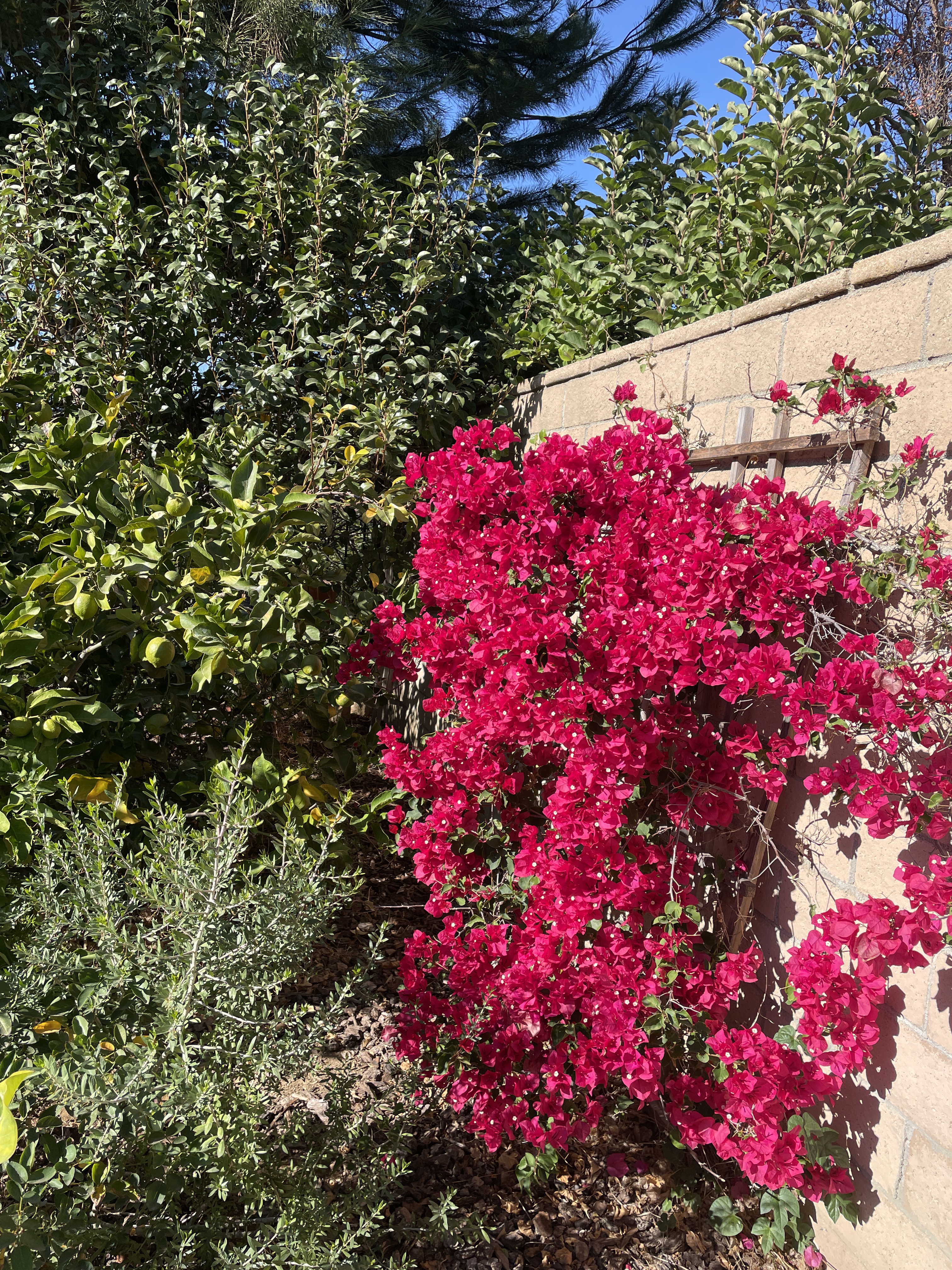
Now, as I write this, I’m enjoying another late afternoon of delight in my backyard. The hibiscus is full of ruby flowers. Freeway daisies, bright white and purple, pop up everywhere. Four different colors of bougainvillea sport their joy. One nasturtium–they are popping in places I never even planted–is sporting the same color of ruby as the hibiscus. The lemon tree is full of almost ripe lemons some of which I have promised to friends and neighbors. One woman cannot eat all these lemons. Meanwhile, I listen to different birds singing their varied songs and to the gurgle of the water fountain by the Nile Blue French doors and watch the hummingbird who is watching me.

I feel grateful to be surrounded in beauty and quiet joy.

Book 7 for 2026: “Never Let Me Go”, Kazuo Ishiguro


Categorized as science fiction, this novel relates a story so possible, it no longer seems like science fiction. Because it is so possible, I found it one of the most disturbing stories I have ever read. The first person narrator relates her personal story, the story of two of her best friends, and that of several other students at the boarding school where they have lived all their lives until they turn 16. Her feelings, her relationships with the other students and with the guardians who run the school are described in great detail and always from her point of view. At the age of 16, they are all sent to various places called Cottages where they experience their first interactions with anything beyond the perimeter of the boarding school where they have always lived and begin the training for the rest of their lives.

As I read this novel, I kept thinking of Epstein and his international ring which seemed to be out of the public eye until recently. If he could do this for decades without the general public knowing, I kept wondering if something like what occurs in this novel is actually occurring internationally and we just do not know it. I do know there is a black market for what occurs in the novel and that little to nothing is done about it. And given how little reaction officially overall has occurred regarding the Epstein files, would the general public accept what occurs in this novel if they felt it would benefit them personally. I do not want to say too much because it might ruin the novel for those who might want to read it and find out.

Book Six for 2026: “THE BOOK OF (MORE) DELIGHTS,” Ross Gay


As I mentioned in a previous post, his books on delights were mentioned to me by two different people in two totally different settings so I decided to stay sane in all the seriousness of my life, reading something lighter might be a good thing to do. I guess I was thinking delights like flowers, food, etc. but this is more like a series of short essays about life all written in the span of one year–his gardening, experiences strolling around his neighborhood and favorite coffee shops, food, his parents, his wife, some personal history, his experience as a college professor, children. However, he also addresses serious issues–his meeting a homeless veteran just out from a stint in a mental facility and how he was compelled to help out after first driving off, racism he has experienced, his issues with the government and social media, family death, and life in general. And above all, what it means to him to identify as a poet.

Delights–2


As a person who works with high school students mostly non-white, many of whom have family members who are undocumented, I worry and need to find daily delights to stay sane. I decided to make a list of some of the past week’s delights:

-afternoons 70 degrees, sunny, no wind

-hummingbirds sipping nectar from both flowers and the two feeders

-singing a song the lyrics of which come from a poem by Langston Hughes where he dreams a world with no racism

-sitting on the back patio, listening to birdsong while I read a book about delights

-learning that all the rains have eliminated drought in California

-appreciating all the colors of the flowers blooming in my yard

Delight 1- A Testosterone Story


After reading two intense, serious books, one fiction and one non-fiction, I needed a break. Several friends and acquaintances recently told me about Ross Gay’s delight books so I went to the local library and asked them to request his latest, “The Book of (More) Delights”. I had my doubts after reading the first few entries, but kept going and then #10 “Alright Baby” made me laugh out loud as well as recall an incident in a high school class I taught years ago.

Gay’s 2.5 page entry is about testicles, yes, testicles. He tells about a couple of young guys who think they are not stuff challenging him and his friend (they are in their 40s) to basketball. The two 20 somethings were doing their best to prove what Gay calls their manhood. As Gay relates the incident, he jokes about maleness and testicles and how testicles control a lot of what men do. I had to laugh. The two old guys won by the way.

This mere 2.5 page story made me remember a class of teenagers I taught from years ago. I do not even recall what caused whatever was going on in class, but one male student suddenly shouted, “There’s too much testosterone in this room!” Everyone laughed. Thereafter every time any sort of commotion, even if piddly, occurred, everyone shouted, “There’s too much testosterone in this room!”

Book Four for 2026: “Playground”, Richard Powers


Another intriguing novel by an author who has won both the Pulitzer and the National Book Award. Initially the four main characters do not seem to have any interactions with each other. 12 year old Evie’s life is changed forever when her father, the inventor of the first aqualung, makes her submerge in a pool to prove it works. She becomes one of the world’s most famous divers and oceanographers. Ina, an artist, grew up in US naval bases all over the South Pacific and eventually finds herself at a university in Illinois. Rafi, a genius black child, is pushed by his dad to apply to a private Jesuit high school where he meets Todd, a rich kid whose whose family provides scholarships to the school. The two become best friends in spite of different interests. Rafi loves literature and Todd loves computers. They bond over a thousands of years old Chinese game with which they become obsessed. They become roommates at the same university where Ina is a student. The three become best friends.

Decades later all these lives become intertwined on an island in the South Pacific–Makatea in French Polynesia, an island where the harvesting of giant phosphorus deposits nearly ruined it while furnishing the rest of the world with fuel to make planets grows faster and better and feed the world. Because of Evie’s obsession with the sea, I learned enormous amounts about the ocean and the varied animals that live there, some of which I had never heard of before. Because of Todd’s obsession with computers and his invention of an AI game, I learned a lot about how gaming works and how people become addicted. For Rafi, the agony and anger of often being the one left out, the one seen as the smart Black kid, and the only one in many circumstances affect how he views the world and himself and where life eventually takes him. From his character I learned new things about literature and how books and writing affect people and their relationships.

I could not stop reading this book. Years ago, when it first came out, I read the author’s novel, “The Overstay”. While the topics and characters are totally different, in some ways this novel reminded me of that story, of how our lives are often intertwined in all sorts of ways we never expected.

Book Three for 2026: “Memoirs: Confieso que he vivido”, Pablo Neruda


Neftali Ricardo Reyes Basoalto, a country boy who grew up in a remote, rainy, forested area in southern Chile, an area called Araucania, an indigenous name, became Pablo Neruda, a name he created so he could publish poetry without his father’s knowledge. His father and mother, who died less than a month after his birth, originally came from the wine country of central Chile. His father became a conductor for a ballast train in this southern region. His descriptions of his childhood are of a shy boy who loved nature in all its forms and books. Later, he wrote letters to girls for his friends. Yet, he says he wrote his first poem when he had barely learned to read. Overcome with emotion, he wrote a poem to his stepmother, the only mother he knew. When he showed it to his father, his father asked to know what he had copied it from.

Later, he moves to Santiago to attend university, always poor, always wearing black, always carrying books. He joins a Student Federation and becomes acquainted with other young poets. He writes, “I saw a refuge in poetry with the intensity of someone timid.” After he struggled paying for the printing of his first book, he wrote, “…the writer’s task…must be a personal effort for the benefit of all.”

He wins a literary prize at school, his books are popular, and he finds himself acquiring a job at a Chilean consul in Rangoon but to get there he and a friend end up in France and Portugal, then Japan, then Singapore, before finally arriving at his destination. Thus, began his life as a consul official in places all over the world, including Spain just before and at the beginning of Franco’s rise to power.

After witnessing so much poverty, so many conflicts benefiting the rich, he becomes an avid supporter of the Chilean Communist Party–a form of communism unlike what most think of when they think of communism. The communism he and his friends support includes working on behalf of the poor, the common laborer, the disenfranchised against the wealthy elite who controlled most Latin American countries during his lifetime and in many cases still do.

He states, “I want to live in a world where beings are only human with no other title but that, without worrying their heads about rules, a word, a label…I want the great majority, the only majority, everyone, to be able to speak out, read, listen, thrive…I have taken a road because I believe that road leads us all to a lasting brotherhood…an inexhaustible goodness…”

Later, he chose to live at Isla Negra, a sort of hideout especially in winter where he could write. Then he returned to Chile. He helped his friend Salvatore Allende campaign for the presidency of Chile. After Allende became president, he appointed Neruda to be ambassador to France. In 1971, Neruda won the Nobel Prize. In 1972, the US blockaded Chile and Neruda returned and completed the final edit of his memoirs. He was welcomed back with a ceremony at the National Stadium in Santiago with a huge crowd in attendance. In 1973, a military coup, supported by the US, overturned the government and assassinated Allende. Less than one month later, Neruda died. Shortly thereafter, news spread worldwide that his two houses in different parts of Chile had been ransacked and vandalized by the new government and its forces.