I wrote this poem several years ago. It was republished today on One Woman’s Day by the Story Circle Network.
ranching
Costa Rica Adventure, Day Four–Part One
People love food. One of the fun things about travel is exploring the food. My two favorite, traditional Costa Rican foods are gallo pinto and platanos fritos. Fruit shows up everywhere too.

Breakfast at El Establo just before heading down the mountain to the Pan American Highway on the way to Rio Tenorio. The plate in the background contains gallo pinto and platanos fritos. I have made gallo pinto three times since I returned. See recipe at end of post.
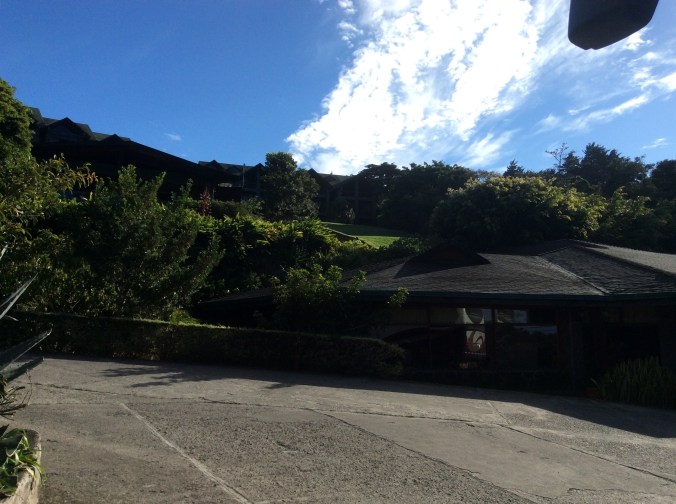
The final view of El Establo as we drove away.
The following photos were all taken riding along the highway, dropping altitude dramatically all the way from Monteverde to the Pan American Highway. The beauty one passes going to and from Monteverde remains unrivaled anywhere–miles of green vistas, colorful mountain homes, cattle grazing.
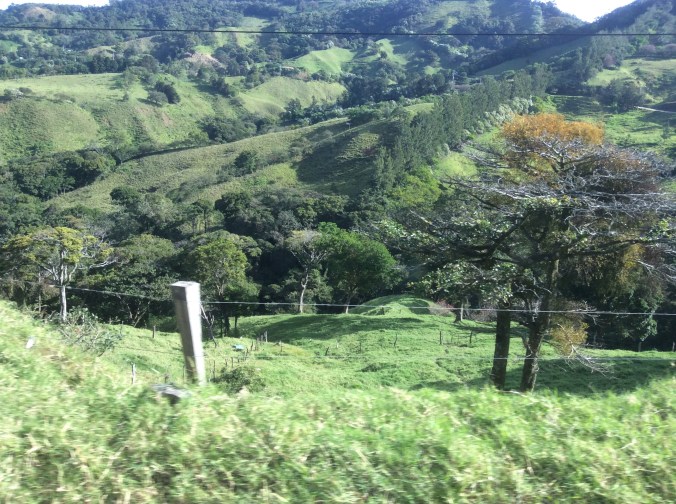
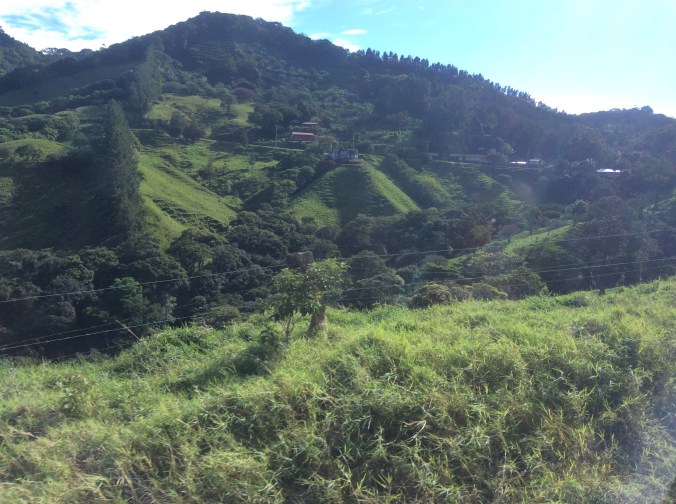

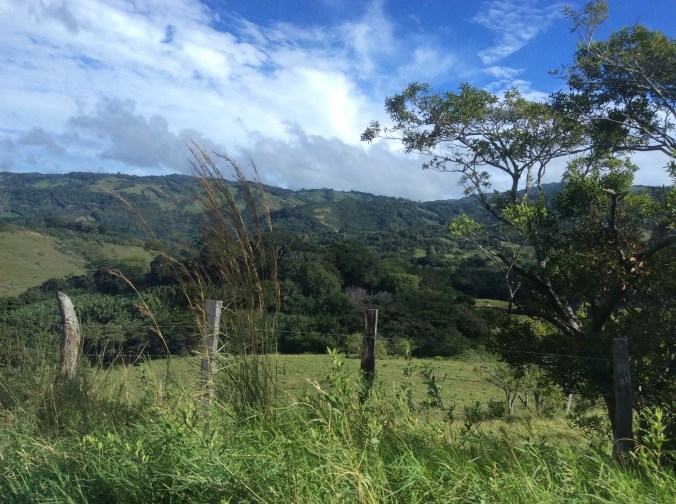

Typical country houses along the side of the road painted colorful hues. Even here the houses have electricity and running water. Most of the way the road was gravel. In spite of all the green in these photos, this is the dry side of the mountains, the Pacific side.


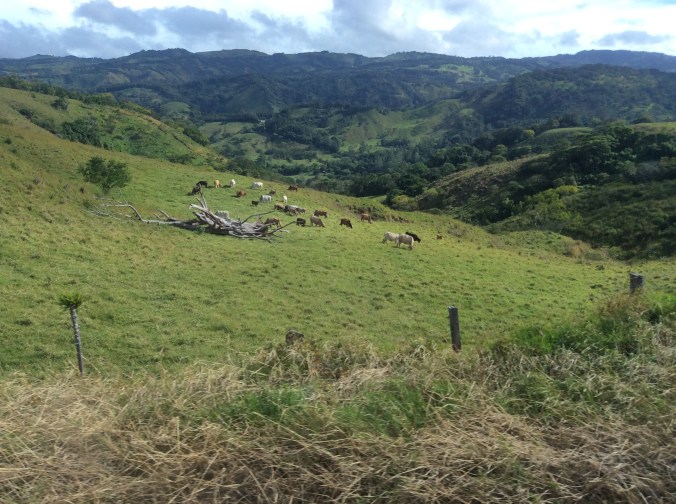
A lot of Costa Rica is cattle country. In the lowlands all the cattle have Brahma blood in evidence. In the high country it varies. Frequently, they look exactly like the common dairy cattle in the United States.


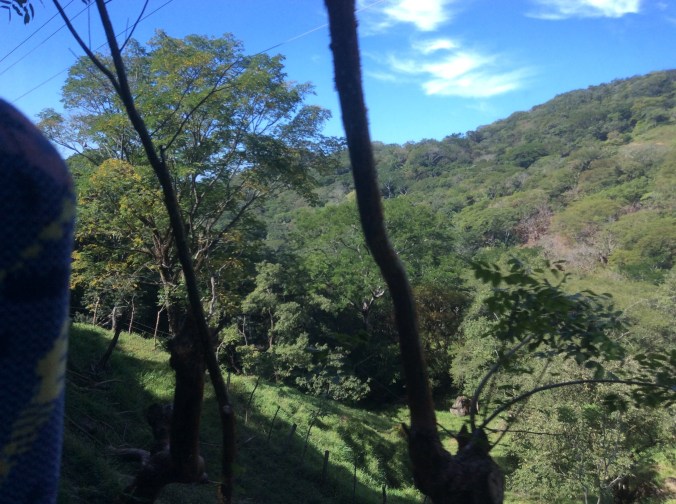
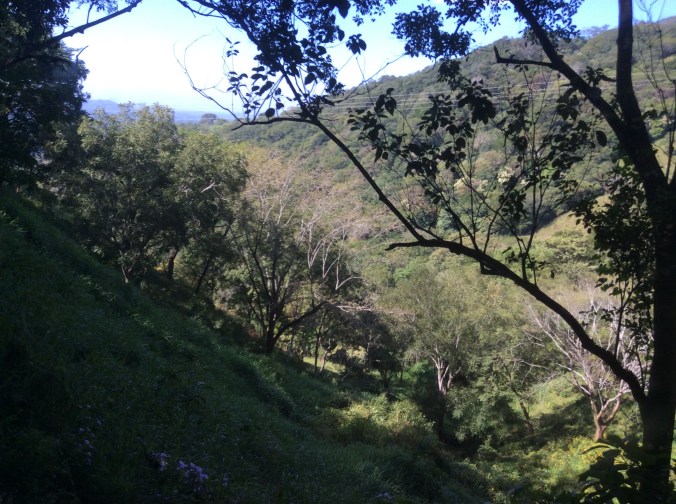
The farther we drove down the mountain, the drier the foliage and grasses became. Finally, we arrived at a paved road and a town.


Most places, even small towns, in Costa Rica are clean. People take pride in the appearance of their houses no matter how small. Flowers bloom brilliantly throughout the country.

Streams run everywhere even through towns.

Finally, we headed north on the Pan American Highway. In all of Costa Rica living fences surround fields. In this area it appeared the major commercial endeavor is cattle, all distinctively Brahma or at least part Brahma.

Looking at these photos it seems hard to believe this is the dry season. We saw large irrigation ditches bringing water all the way from Arenal, a huge lake on the other side of the mountains, a place I visited on my previous trip.
Recipe for gallo pinto:
Enough vegetable oil to lightly cover bottom of a skillet
1 1/2 cups day old, cooked rice
1 cup day old, cooked, black beans
1 medium onion, finely diced
1 small, sweet red pepper, finely diced
2 Tbls. chopped cilantro (optional)
2 Tbls. salsa (optional)
Add chopped vegetables to the skillet. Saute until onions are clear. Then add the beans and salsa. Finally, add the rice and heat through while stirring constantly. The mixture should be moist but not wet. There should be enough juice from the beans to color the rice. Experiment to see what you prefer. I use garlic instead of onion and poblano peppers instead of the red.
Water, Water, Where?
Today, I drove about fifty miles to watch a play especially produced by my friend, King Hill, for the Gem Theatre in Claude. I almost did not go because of high winds and blowing dust. Between 8 and 10 this morning visibility was so low it was impossible to see the horizon. High wind and blowing dust warnings started yesterday. Now, as I write this, these warnings have continued for more than 24 hours. Red flag warnings flash across the TV screen. Thankfully, not quite the dust bowl extremes, not yet anyway.
Originally, a green sea of grass covered all the land where I live in the Panhandle of Texas, the Llano Estacado. Immense herds of buffalo roamed free. This prairie grass protected the land from erosion. Rivers and an occasional canyon interrupted this endless sea, including the Canadian River, Palo Duro Canyon and the network of canyons running into it. Once the Spanish brought horses, Kiowa and Comanche ruled this sea for more than a hundred years. Under a full moon, the Comanche reigned by night raids from Nebraska to Mexico.
What happened? Plows brought by people from the East dug up the grass. These people planted the crops they knew, wheat, corn. They settled in towns and homesteaded the country. They brought cattle and in some areas developed gigantic ranches. Hunters killed all the buffalo except a few the famous rancher Charlie Goodnight and his wife managed to save. Remnants of this southern herd now live at Caprock Canyons State Park near the tiny town of Quitaque, Texas. Those who farmed dry land farmed. In a normal year crops grew, the people prospered. In dry years dust blew because there was no grass to hold the dirt.
Today, giant pumps pull water from the aquifers, the Ogallala, the Santa Rosa. My well is 400 feet deep, some are nearly 900. More and more people move here from other parts of the United States. They want lawns like the ones they had where it rains forty inches a year. It does not rain much here, twenty in a good year, ten in a bad year. These aquifers lose much more water to irrigation in a year than are replenished by rain. Farmers grow corn,wheat, cotton, and milo, all irrigated. In some places where the water became to saline for crops, the pumps sit abandoned.
Today, I drove by miles and miles of dry, thirsty grass, perfect fuel for the wind driven wildfires which sometimes start this time of year. In other places irrigation pivots rained water on immense emerald fields of wheat. I could not help but wonder how much of this water evaporated in the sixty mile an hour wind. As I finish writing this with the TV on weather watching, I see Fire Weather Watch, High Wind Warning, Red Flag Warning flash across the screen. I hear the wind roar and heavy outdoor furniture slide across the patio. I’ve seen wildfires, had a half mile of cedar post fence burned down. All it takes is a tiny piece of cigarette thrown from a truck or car, a flash of dry lightning. They predict three more days of this.
I love the space, the vermillion sunsets, the intense blue of the sky. I watch my neighbors water, water, water their new houses in the country. I think about those pivots irrigating in the wind, and I wonder what will happen when all the water’s gone.

Apocalyptic Planet–Part One
Usually I read only one book at a time. Lately, I am reading several, one of which is Apocalyptic Planet: Field Guide to the Future of the Earth by Craig Childs. Childs is a sort of combined explorer/adventurer/scientist. He goes to places few go to see what occurs there, the wind, the flora and fauna, the weather, the climate. The next couple of days I intend to share some of his most pithy observations and ruminations. We will start with the desert. He and a friend literally wandered around the most arid and hostile portion of the Sonoran Desert in northwestern Mexico. This desert has enlarged and become more arid due to an extended drought.
Deserts come and go. If you live in a lovely lush green landscape, wait long enough and it, too, may become a desert. Six thousand years ago lakes, marshes, and grassland lay where the Sahara is today. A slight orbital change in earth’s relation to the sun caused nearby oceans to heat up, changing atmospheric conditions. Humans living there had no choice but to move. Forty per cent of the earth’s population lives in semiarid regions. Even a small drought changes survival chances for the people who live there. The Sahara, the Gobi, and the Taklimakan are growing, arable farmland decreasing. Vulnerable areas include southern Spain, Greece, Bolivia, Australia, central Asia, and our own West. The entire American High Plains (I live in the southern part) sits on top a giant desert. Without pivot irrigation, only grass grows here. In the last decade many irrigation wells have dried up or gone too saline. The giant bulges you see in places like the sand hills of Nebraska are really a sand dune sea covered with grass. Take away a little rain and here comes the desert.
Childs and his friend carried water with them and buried them with markers in the sand so they could find them later. As the desert grows in parts of India, women carry water farther and farther, an average of six miles a day, four gallons at a time. In the Sahel just south of the Sahara a difference in rainfall of just an inch or two can mean the difference between survival and starvation. Without water, there is no civilization.
What causes these changes? Human behavior and the increase in greenhouse gases are part of the reason. Humans are creating enough changes that we are moving toward more deserts, not fewer. One climate expert, Jonathan Overpeck, thinks we are seriously underestimating the severity of drought we will face in the not so distant future. Forget five and seven year droughts and think fifty years. Hadley cells also affect climate change. Tomorrow I will explain Hadley cells and how they affect our weather.

Northern Arizona
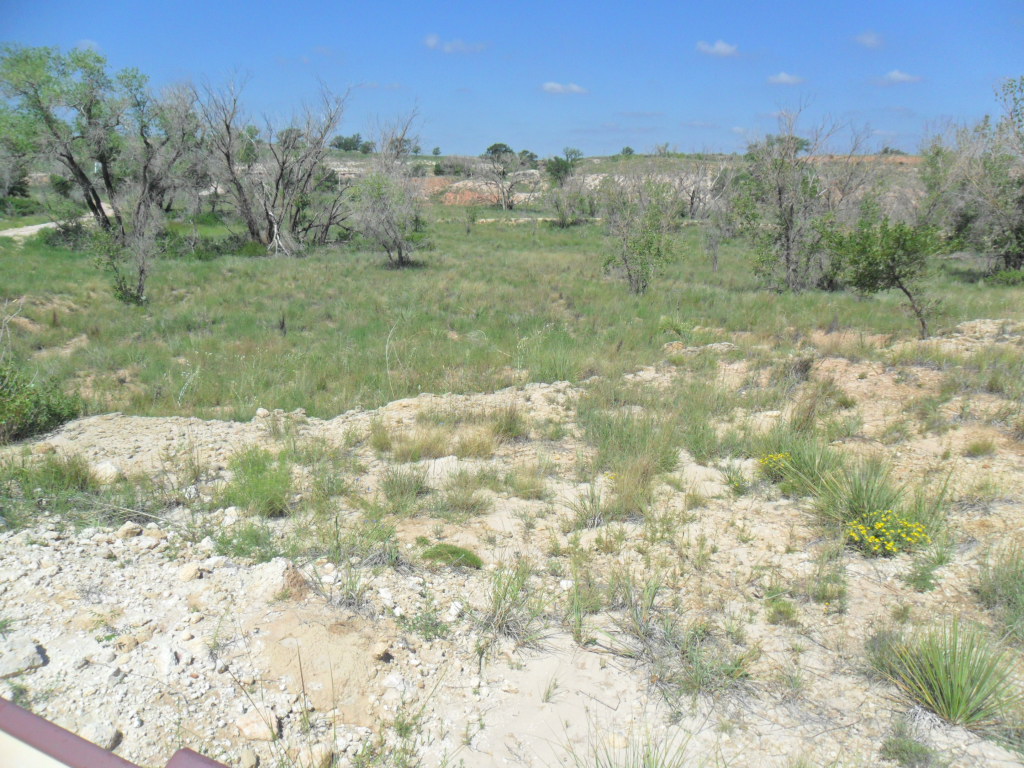
Eastern New Mexico
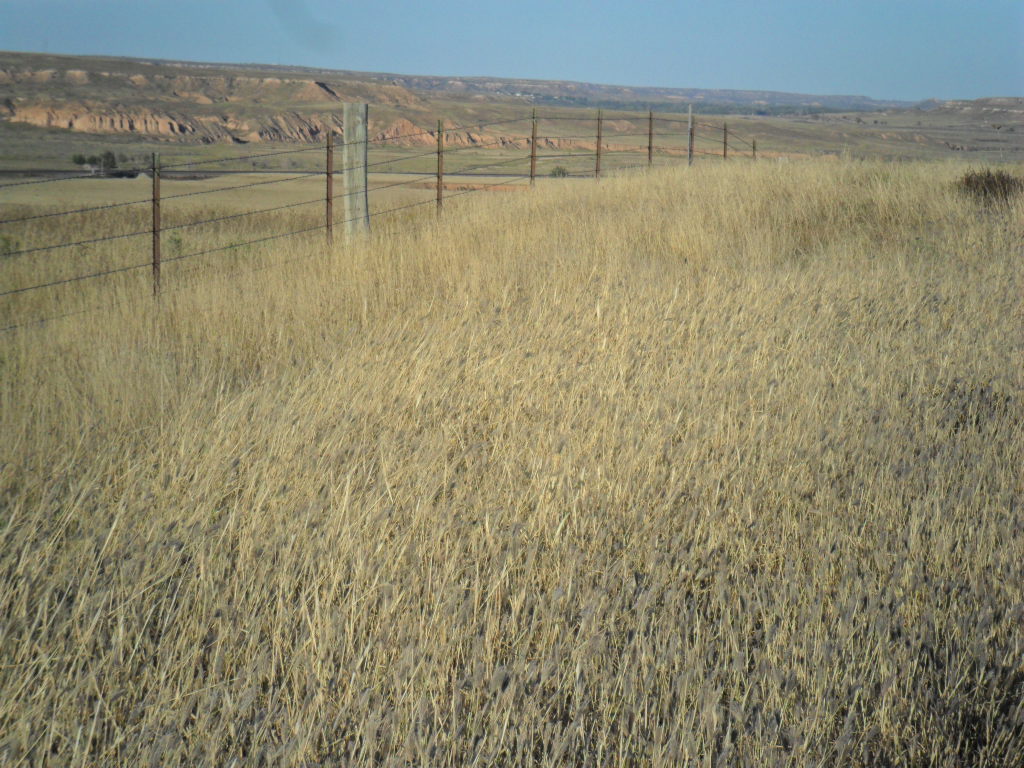
Texas Panhandle
Cool Surf
Wednesday, I topped the little rise down the
long drive to my house.
Cool’s down, lying down,
not like a happy horse,
soaking up the afternoon sun.
Down!!
Still dressed for work, I
rush, make him get up.
Instantly, I know, colic,
sadly go to the house,
change into jeans,
call the vet–he’s an
hour a way,
quirt banamine down Cool’s throat-
can’t hit his neck vein.
We walk and walk and walk,
waiting for the vet.
Cool’s hurting, distressed,
kicks my arm.
Vet and I load him in the
borrowed trailer as he
wobbles, half drugged.
Two giant bags drain into
his neck vein.
Vet listens, takes tests.
Result should read 2;
it reads 10.
In spite of hopeless odds,
the vet and staff work and
watch all night.
At 2:30 in the afternoon
a message on my cell phone:
Cool’s buried in the pasture with Miracle.
They’ve taken care of everything.
Stunned, trying not to cry at work.
Cool was fine when I left
Wednesday morning,
running the night before.
Stunned, remembering him as a baby,
the picture perfect paint.
Stunned, remembering how I
loved to watch him run,
head and tail up,
floating fast, joyous.
It’s Sunday now.
I walk out on my bedroom patio,
look up to his corral.
He always called to me, always.
Today, all I hear is the sound of silence.
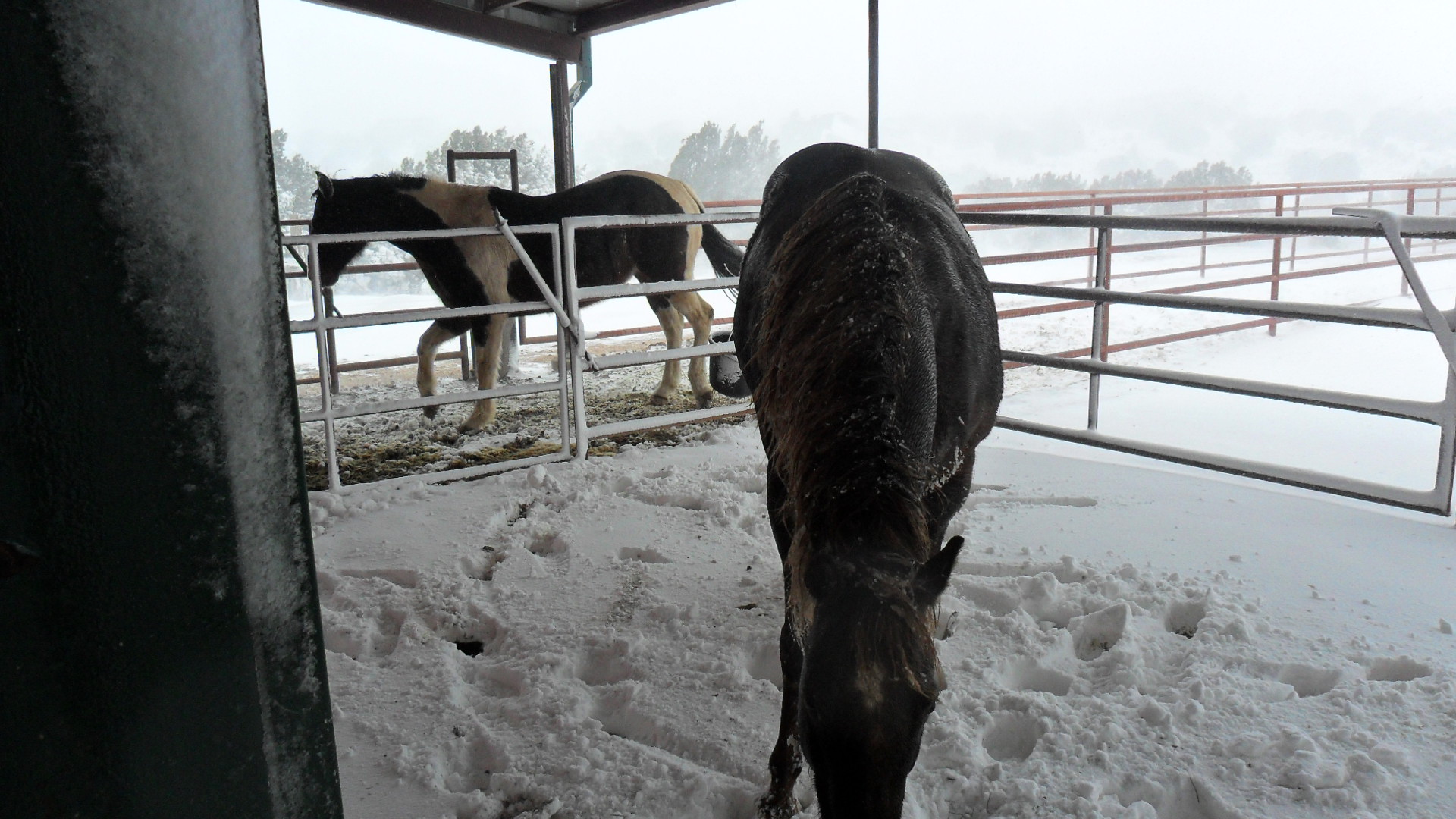

Snowbound
This prose poem recently appeared in the latest “Story Circle Journal”.

They’re young; they’re handsome; they’re mine for six months.
Two seventeen year old South Americans. The Brazilian has never
seen snow. It snows two feet in less than twenty-four hours, wind
shrieking along the canyon rim, drifts piling four feet high, roads
closed. Even the snow plows give up. We’re house and barn bound.
Horses need food. We all pitch in, climb through drifts, shovel.
Schools never closed are closed; offices closed. No lights on the road.
Two days later it takes us an hour rocking back and forth in the green
Off Road 4X4 truck to go the one eighth mile to the main road. After school
and work we leave the truck near the road and trudge down the long hill
to the house. By flashlight we struggle back up the next morning, trying
not to fall. Even boots fill with snow. That evening, the boys insist
we drive all the way down to the barn. I start to fix dinner. They tell me,
“We’ll be back in an hour. We aren’t going through that again!”
They shovel tracks for the truck all the way from the barn to the main road.
I miss them, especially in winter.
The Farrier
He looks like the typical cowboy
with no cowboy hat.
A cowboy hat would get in the way
up against a horse.
Pale blue eyes,
grey, handlebar mustache,
pack of Camels
he chain smokes,
Australian shepherd, Chili, by his side.
After the trimming
he sits and talks to me
for two hours.
He tells me a story
he told me the last time.
I listen as if it were the first time.
People call him from Oklahoma City.
They want a shoer.
He tells them,
“Too far unless
there’s ten head at 85 a head.”
They agree.
He gets there with Chili,
a pup then.
He starts to tie her up.
“No need;
let her play with our puppy.”
He does.
They invite him out.
It is New Year’s Eve.
“The dive they took me to
was real rough, real rough,
so rough I’d worry about
my safety even with two 45s.
They had a friend singing there
somewhere in Southeast Oklahoma City.
Real rough.
Next morning I’m ready
for the other six horses.
There’s none.”
He packs up,
comes home.
Chili won’t eat,
won’t play.
He sits and waits at the vet.
It’s parvo.
She’s had the vaccine
but not enough time.
“The people in Oklahoma City
lied about the horses
about the parvo.
Chili stayed on IVs for five days.”
Today, Chili’s a dog dynamo,
no longer a puppy but
with puppy energy.
She and Isabella play
constantly for the two hours.
He says,
“You must be rich to build this place.”
I laugh.
“Rich, I’m not rick.
Lucky maybe,
no, not lucky.
I don’t believe in luck.”
A person makes her own luck.
Smart helps, sometimes.
Star
The phone rings.
“Star’s dead. There’s blood everywhere.
He’s hanging from the gate.
Blood is all over Rosie’s face.
It’s dreadful.”
A tear choked voice.
“You can’t bring D’mitri home.”
D’mitri’s nine. Star belongs to him.
Shock, tears, disbelief.
Last night he ran, bucked, reared,
chased around, playing.
How?
The pen’s all pipe, no sharp edges,
nothing harmful, consistently inspected.
D’mitri goes home with me. He says,
“Nana, I have to see him;
I have to know what happened.”
Slowly, in dread, we walk behind the barn.
Star’s hanging by one hoof in the three inch
space between the gate and fence,
ankle broken.
The blood covered fence, gate, and ground
stare at me.
It’s hot, his body’s stiff.
He must be moved.
The coyotes will come in the night,
drawn by the smell of blood, of death.
The neighbor brings his big, red tractor;
a wench pulls Star’s young body free,
and gently lays him on the cold, grey, barn floor.
His shining copper coat no longer shines.
D’mitri and I remember bottle feeding him
after Miracle died, teaching him to lead.
We stare at Star’s body in disbelief.
Kindly, the neighbor says,
“He died quick, femoral artery cut by bone,
bled out.”
For hours Rosie and Cool stand at the spot
where Star died.
They do not even leave to eat alfalfa.
It takes me hours to wash away the blood.
It took D’mitri ten months to go back to the barn,
to ride Rosie again.

Note: This is a photo of Star and Miracle in July 2010 shortly after Star’s birth. Miracle died of colic three days later. Star died last May.
Variety is the Spice of Life
Here I go again taking classes. This one is Part III of the series on modern women poets taught by Lorraine Mejia-Green through the Story Circle Network. We read poems by a variety of women and use their works and related assignments for inspiration. This week features Julia Alvarez and even though I have already read all her novels, etc. and a book of prose poetry, the selected poems are new to me. It seems I always take a different route from a lot of the others enrolled in the class. The following show cases draft two of my first assignment:
I keep coming to this part
where I’m happy
95 per cent of the time.
It’s my story
dictated by
ME.
“Variety is the Spice of Life.”
Cliche?
Yes, but true.
Four marriages
Lovers-I lost count
Activist in “love” with
Che and other South American
Revolutionaries.
Feminist for forty years
Up to maybe four careers.
Big city apartments
Ranches
Old houses by the bay
Bricks with arched windows
A tree lined street.
Can I settle?
For what, with whom, where?
Variety is the Spice of Life.
The Blizzard
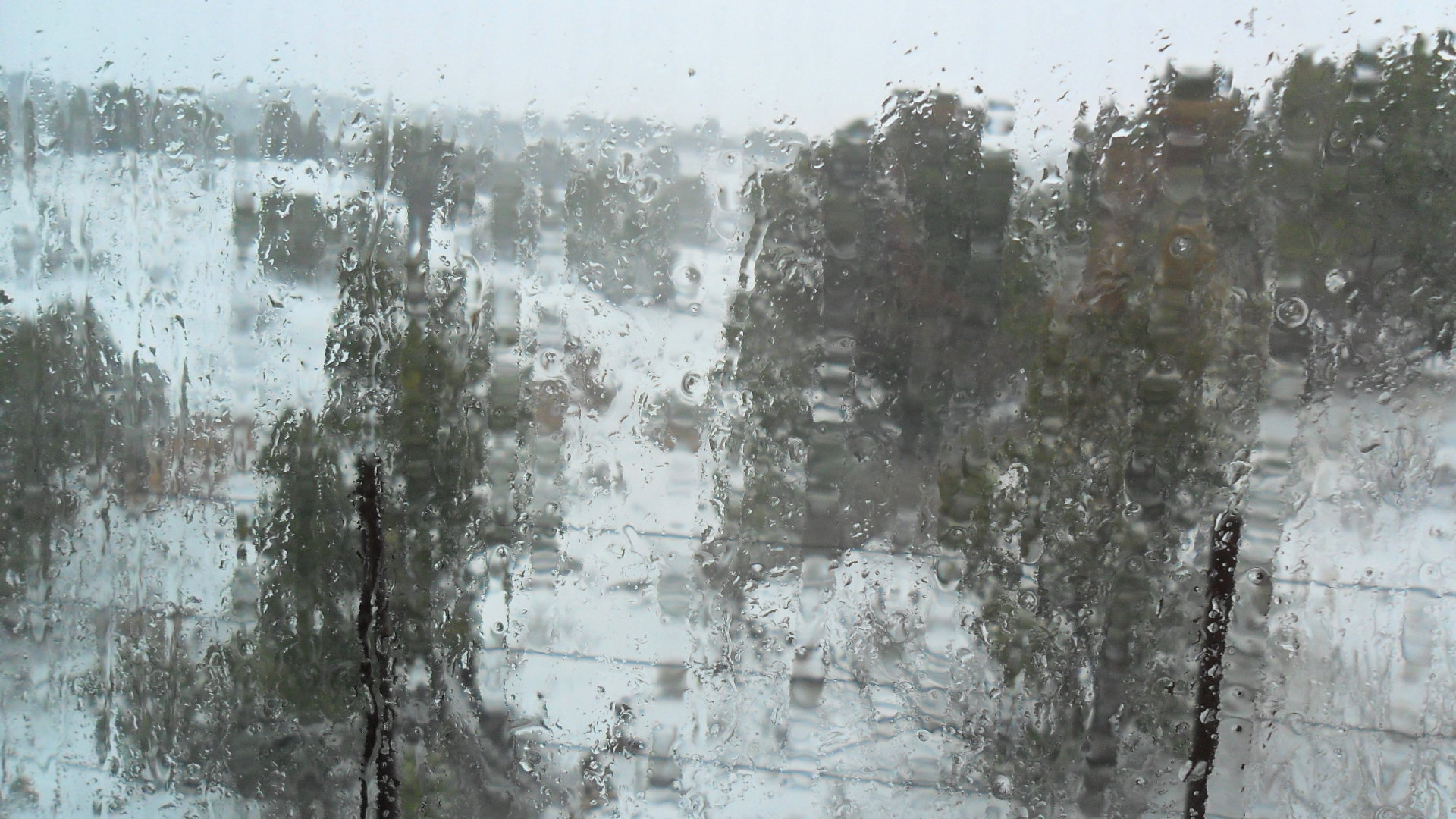
Looking through the window.
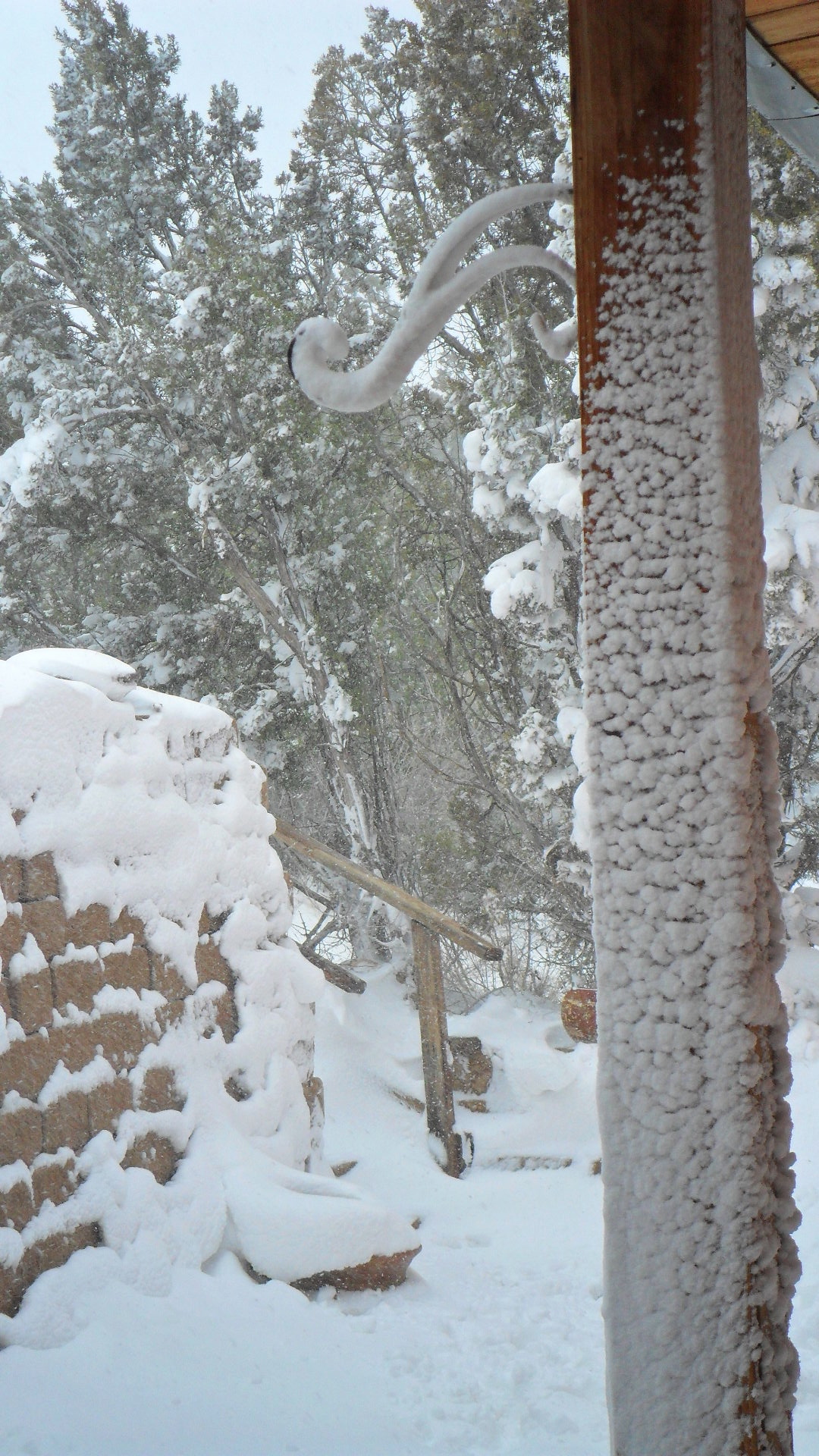
The steps climbing up the hill to the barn.

Outside the office window.

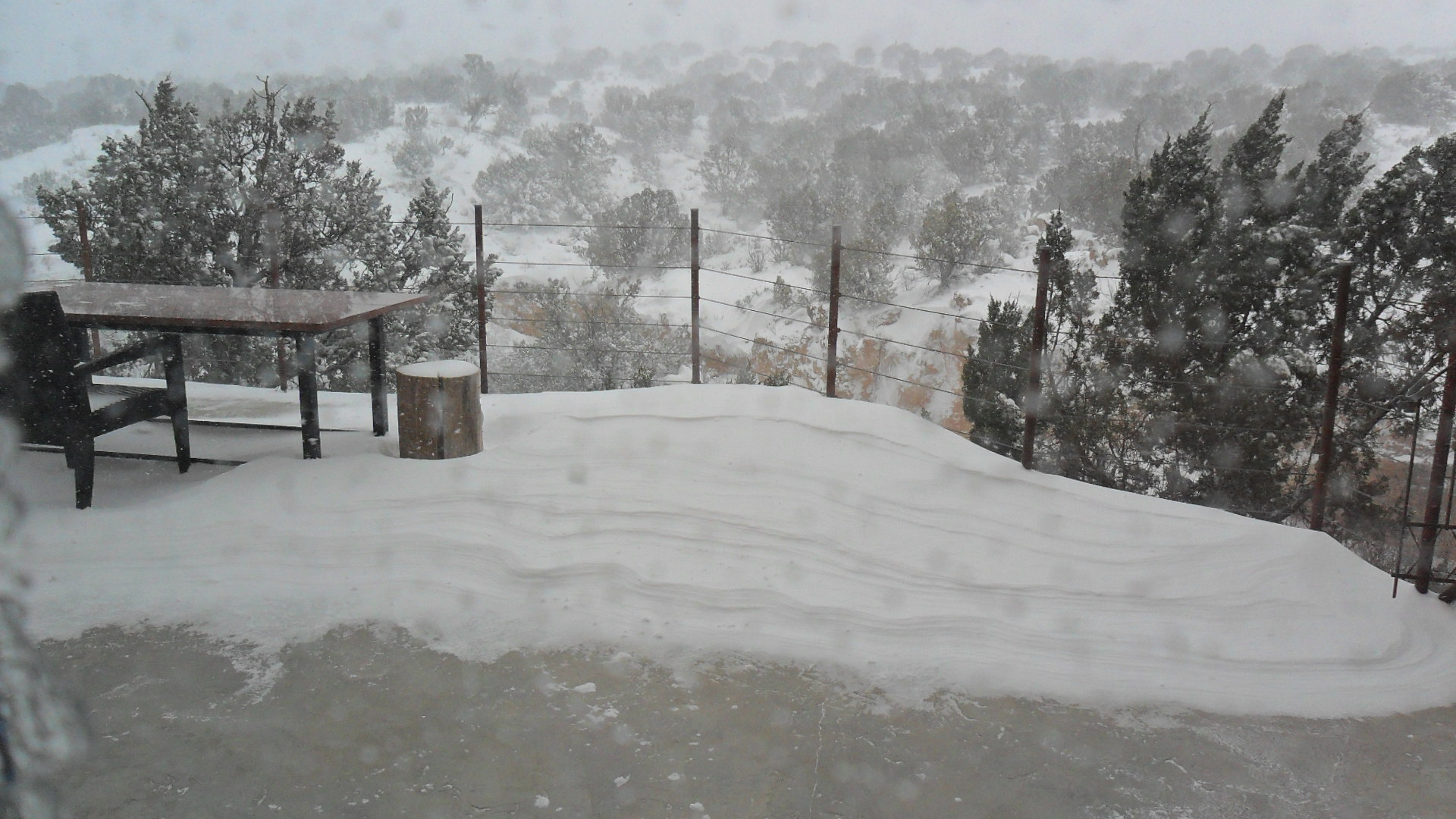
My patio which I will have to eventually shovel–afraid to do so today because the wind is so strong.

The barn door before I shoveled my way in.

The view out the double barn door. All this is actually under a roof. The wind is blowing the snow everywhere.

The view from the front door after digging it out twice from reoccurring drifts.
The new assignment arrived for my prose poetry class. In the last couple of hours I have read poems by Baudelaire and Rimbaud as examples of some of the first prose poems. While I read them, I listened to “The Unicorn, the Gorgan, and the Manticore” by Menotti, a piece I am supposed to be singing in 1 1/2 months. Work shut down today because of a massive blizzard. The wind literally shrieks down the canyon where I live–gusts they say to 70 mph. It piles up drifts four to six feet high. Twice today I have donned my boots, gloves, heavy coat, and gone shoveling and to feed the horses. For the first time since the barn has been there, snow is actually inside, driven by the wind, and the horses are standing in snow drifts that blew under the overhanging roof of the outside runs. Even getting to the barn door necessitated shoveling through drifts taller than I. The snow continues, predicted for another twelve hours or so, maybe as much as twenty inches. Living alone fails to daunt me, but I cannot concentrate well today. My drive is long and climbs up a steep hill. Even my four wheel drive truck may not make it. I keep thinking it may take days for me to shovel out even if, when the snow and wind cease, my neighbor brings over his tractor to help. A friend, several miles away, remains without electricity. I filled my wood burning stove with wood and started a fire just in case. It seems a perfect day to write and cook and practice music. And here I sit unable to concentrate long enough. The wind keeps rushing through my brain.
 writingontherim