Book a Week-21: “Boy, Snow, Bird”, Helen Oyeyemi


A unique and sometimes frightening story with a surprising ending, this is another tale of the lengths to which people of color will go to pass for white to gain the benefits of whiteness. For one New England family this has succeeded quite well by sending a too dark daughter back South to live with relatives and never allowing her to come to the town where the rest of the family lives. It fails when a too dark child is born and the parents keep her with them. It is also a tale of gender identity and how rape and abuse can destroy and deform and of resilience in the face of endless obstacles. This is not an ordinary novel.

One Book a Week-16, “The Promise”, Damon Galgut


Winner of the 2021 Booker Prize, this novel illustrates the dismal consequences of colonialism and racism. South Africa before and after apartheid comes alive in this story about an Afrikaner family whose matriarch dies young enough to leave her husband with three children, only one of whom is old enough to be on his own. In her dying, she returns to her Jewish roots much to the horror of her husband and many others. Her youngest daughter overhears her dying wish which her husband promises to fulfill even though he has no intention of doing so. This remains an underlying thread, the promise which this daughter never forgets.

The difficult, often prejudiced and unequal, relations between the races underpins the actions of most of the characters, leading a few to greater humanity and kindness, but most into lives of loss, disappointment, and anger.

One Book a Week-12: The Sweetness of Water, Nathan Harris


The immeasurable horrors of slavery and the immediate years after come excruciatingly alive in this novel. Decent white people help recently freed brothers but at a terrible price. A “forbidden” romance between two Confederate soldiers highlights the destructiveness of class and hatred. Yet, in spite of the despair and cruelty, resilience, decency, and tenderness prevail in the end. Long listed for the Booker Prize, this detailed and beautifully written novel remains true to some of the most painful parts of US history.

One Book a Week-11: The Vanishing Half, Brit Bennett


This unusual novel features identical twin sisters, inseparable as children, living in a small town in rural Louisiana. The town’s founder, a light skinned Black man, insisted on maintaining a certain character for the town–only light skinned Black people should live there. At sixteen the sisters run away to New Orleans where they ultimately choose diametrically opposed lives, one passing as white, marrying a wealthy white man who knows nothing of her true past. In spite of the deception and lies, years later their lives become intertwined in unexpected ways. The novel not only addresses themes of race but also sexual identity and who we are as individuals and a country.

One Book a Week-7: “Memorial Drive, A Daughter’s Memoir” by Natasha Trethewey


Published in 2020, and a must read for anyone who cares about abused women, their rights, and how law enforcement often fails them, this book by Trethewey, 2007 Pulitzer Poetry Price winner for “Native Guard”, voices her struggle to deal with her mother’s untimely death. When Trethewey was nineteen and in college, her mother was shot and killed by her step-father after the police officer assigned to protect her mother left his post early. Additionally, the memoir details the effects of the racism she experienced as the child of a white father and black mother (married when it was illegal where they lived) in Mississippi and later in Atlanta in the 1970s and 80s before her mother’s murder in 1985. The book gets its title from the street on which her mother lived when she was murdered. Through this memoir Trethewey discusses how her parent’s divorce, her mother’s remarriage to an angry, abusive man, and her mother’s murder has informed her life and affected the enduring love she holds for her mother.

Prophetic Passages from Octavia Butler


In my last blog post about reading, I promised to address the prophecies of Octavia Butler in my next post. The best way is to quote some passages from Parable of the Talents which was published in 1998. This book is the sequel to Parable of the Sowers. In that book the main character creates a new religion with CHANGE as a major focus. In fact, one of the main tenants of that religion forms the words on Octavia Butler’s tombstone which I quoted in an earlier post. Here are some passages from Parable of the Talents:

I couldn’t help wondering, though, whether these people with their crosses, had some connection with my current least favorite presidential candidate, Texas Senator Andrew Steele Jarrett. It sounds like the sort of thing his people might do—a revival of some nasty out of the past….So now we have another group that uses crosses and slaughters people. Jarrett’s people could be behind it. He insists on being a throwback to some earlier ‘simpler’ time. Now does not suit him. Religious tolerance does not suit him. He wants to take us back to some magical time when everyone believed in the same God, worshipped Him in the same way, and understood that their safety in the universe depended on completing the same religious rituals and stomping anyone who is different.

Jarrett’s supporters have been known to burn people at the stake for being witches….a Moslem, a Jew, a Hindu, a Buddhist, or in some parts of the country, a Mormon, a Jehovah’s Witness, or even a Catholic. A witch may also be an atheist or an eccentric…anyone who does not fit into Jarrett’s version of Christianity. He condemns the burnings but in very mild language.

He has a simple answer: ‘Join us! Our doors are open to every nationality, every race.! Leave your sinful past behind, and become one of us. Help us make American great again.”

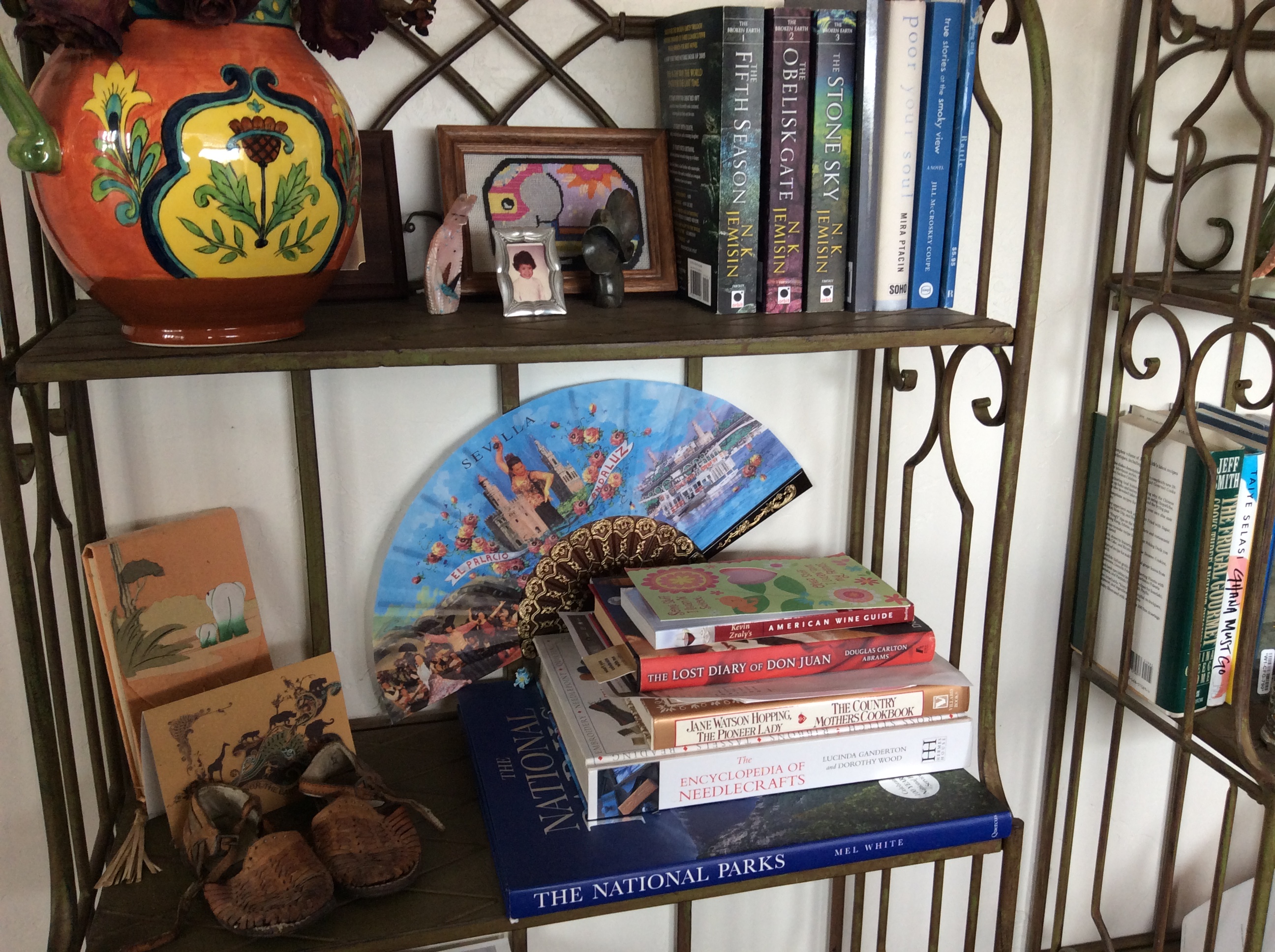
Note: If you are interested in Octavia Butler books, the stack at the right bottom of the photo are mostly her books. Some are series and need to be read in a certain order.

Summer Reading


IMG_3957Last year I joined Now Read This, the online bookclub sponsored by PBS and The New York Times.  Why did I join?  To expand my exposure to books I might not otherwise read, to learn, to explore, to interact with others reading the same books.

I rarely read fantasy or science fiction.  This summer has become an exception.  The June choice, The Fifth Season by Jemisin, won the Hugo in 2016.  The other two books in the trilogy won in 2017 and 2018.  I wanted to know what happened to the characters so I read them all.  The spine says Fantasy.  I think they are more science fiction.  Even people who claimed they did not like either fantasy or science fiction became like me and read them all.  This series tells a futuristic tale extremely applicable to events, both social and political, in the world today, how prejudice kills both overtly and covertly,  how fear of those who are different affect everyone, what it costs to live in a world where certain attitudes exist.

It took me two days to finish the July title even with chores, touchup house painting, all the things teachers attempt to do during summer break.  Although I had previously read at least three books by Luis Alberto Urrea, I had not read this one, The House of Broken Angels about a family who lives back and forth across the border–San Diego and Tijuana.  It is a tragic-comedy about the endurance, hopes, dreams, cooking, living of several generations.  His non-fiction book, The Devil’s Highway, is a must read for those who want to understand what occurs along the US-Mexico borderlands.

In the midst of all this, I went back and reread Ursula LeGuin’s The Left Hand of Darkness.  Wow, no wonder it caused a stir when it was published in the 1960s: a whole country where everyone switches back and forth between male and female and those who cannot do this are considered perverts.  Additionally, the main character is described as having very dark brown skin and those who do not behave exactly as they should or politically protest are sent off to a stark camp where they work in excessive cold and eventually die.

Then I read an article about Toni Morrison and authors who do not write for people based on a certain audience, e.g. black, white.  They write about what they know, what they feel, for a different purpose. One book listed was Children of Blood and Bone by Tomi Adeyemi, a fantasy, all of which takes place in what we now think of as Nigeria. It has not one single white character in it.  I kept thinking, wow.  I read a lot of literature from Africa, Middle East, and Latin America.  Most of the time, for better or worse, characters from other cultures show up, usually European and usually for the worse.  Not in this one.  If you go to a book store looking for it, look in Young Adult.  Jemisin’s can be found in Adult Science Fiction/Fantasy.  When I mentioned to someone I could not tell why some are categorized one way and some another, I was told there is less graphic sex in YA.  Really?  I cannot tell the difference.

Next on my list?  I annually act as a judge in a literary contest.  Three novels arrived in yesterday’s mail.  Guess I need to get busy.


Taking a Knee?


When I read this post, I kept think the other times in life when people as he puts it, “take the knee”: when men propose, when people pray. No one see those as signs of disrespect or do they? For all those who think it is disrespectful, try reading every verse of the national anthem. Hint: the author was a pro-slavery slave owner.

danielwalldammit's avatarnorthierthanthou

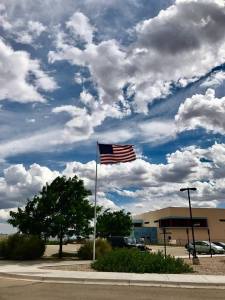
Institute of American Indian Arts (Photo compliments of Moni)

Not everyone really appreciates just how powerful the ritual of standing for the National Anthem really can be. I got a real sense of this when I was 14. My Jr. rifle team won the Wyoming-state BB-Gun finals, which earned our way to the International BB-Gun Championship in Bowling Green, Kentucky. …on July 4th. As the child of a career military officer, I was always happy to stand for the Star-Spangled Banner or to recite the Pledge of Allegiance, but standing there during the final ceremonies, the whole thing took on a whole new layer of meaning for me. That time, I had my heart in my throat. That time, the whole ritual moved me nearly to tears. I loved my country so much, and at that moment, putting my hand over my heart for that beautiful song was absolutely the…

View original post 1,498 more words

Quote for the day


Sadly, this quote seems appropriate given the events in Virginia.  I had hoped we were beyond this but apparently not.


“If you can convince the lowest white man he’s better than the best colored man, he won’t notice you picking his pockets.  Hell, give him somebody to look down on, and he’ll empty his pockets for you”.  Lyndon Johnson, 1970.

Whitney Plantation Visit


Whitney Plantation resides on the River Road about one hours drive from New Orleans.  A recent visit there provided much enlightening information about the slave trade, crops grown near New Orleans, and the history of this area. Tours can be scheduled all days of the week except Tuesday.  It is unique in that many different types of plantation buildings still exist there, including old slave cabins, a foundry,  and the outside kitchen.

A German immigrant started the plantation in the late 1700s.  At Habitation Haydel, its original name, he grew indigo.  After his death, his youngest son converted the main crop grown to sugar cane, which is still grown there today.  Both indigo and sugar cane required intensive labor for profitability.

Although, according to population data, only ten blacks lived in Louisiana in 1712, by the end of the century slavery was the main source of labor.  In 1795, there were 19,926 slaves in Louisiana.  Under Spanish rule the slave population steadily increased.  Although many were imported from Haiti, those from Africa came from what are now the countries of Senegal, Bissau, and Guinea.  After the initial importation of slaves, the United States imported few compared to islands in the West Indies and Latin America, e.g. Brazil.  The preferred method in the United States to obtain slaves was breeding.  Women and men were forced to breed.  Their owners specifically chose certain people to produce certain types of progeny just like in breeding livestock.  One woman complained of having 16 children by 16 different men.
IMG_2729

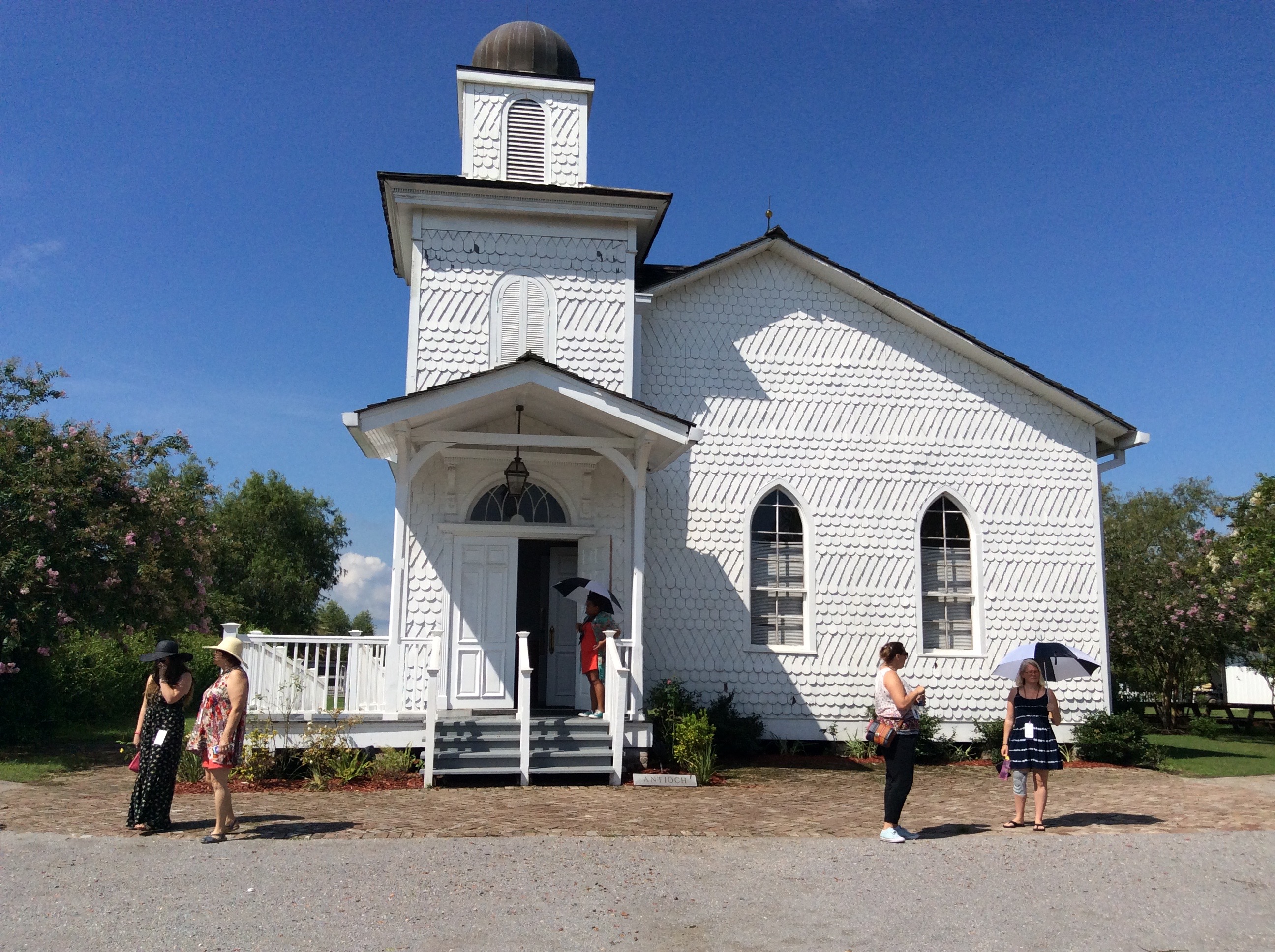
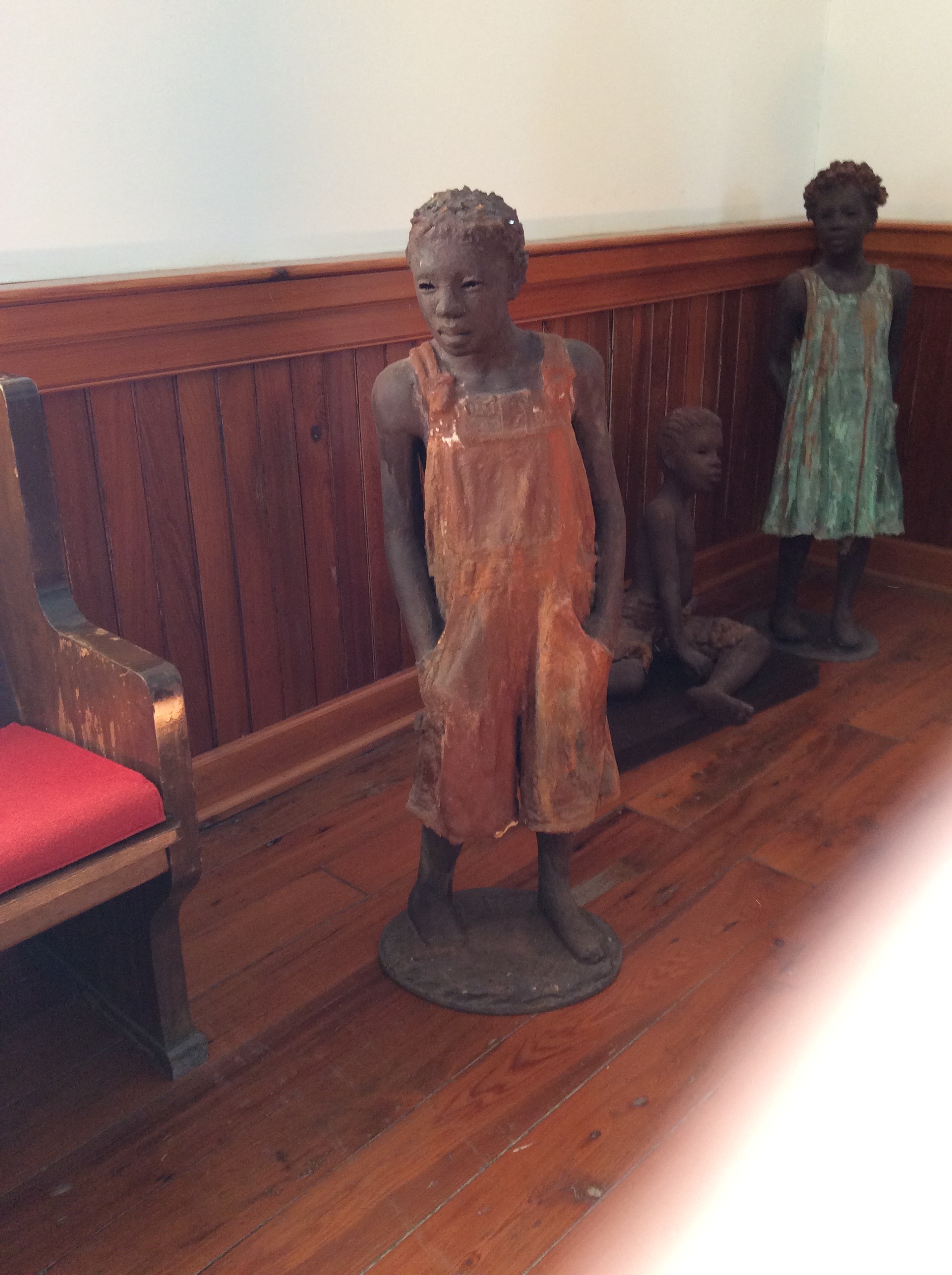
After leaving the visitor center, the first building on the tour is the church.  Inside the church are statues of various children who were the products of the breeding program at the plantation.
IMG_2728

The artist created these statues from specific information about the children.  The plantation owners maintained detailed inventories of all slaves and their value.  This particular plantation often owned as many as 100 slaves.
IMG_2731

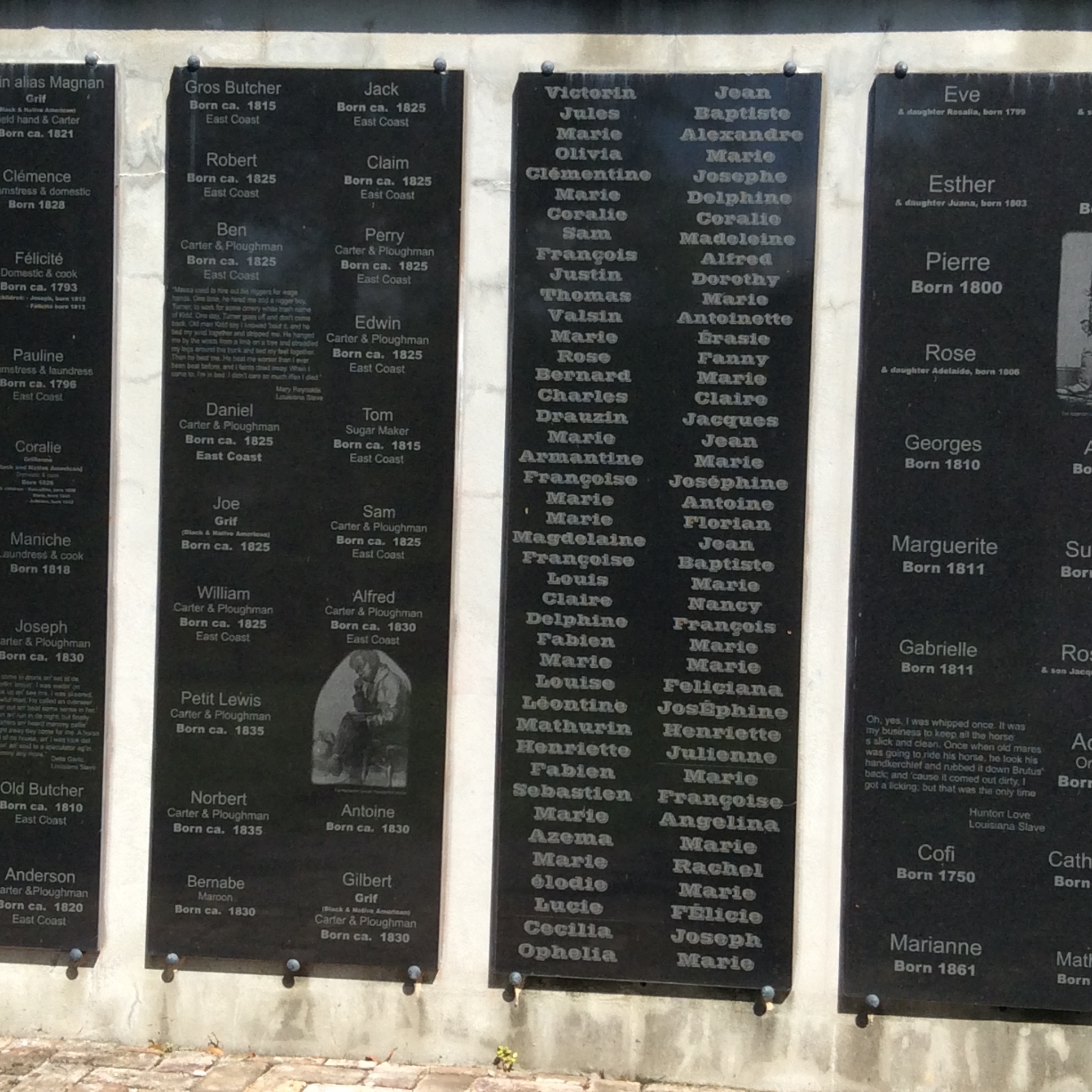
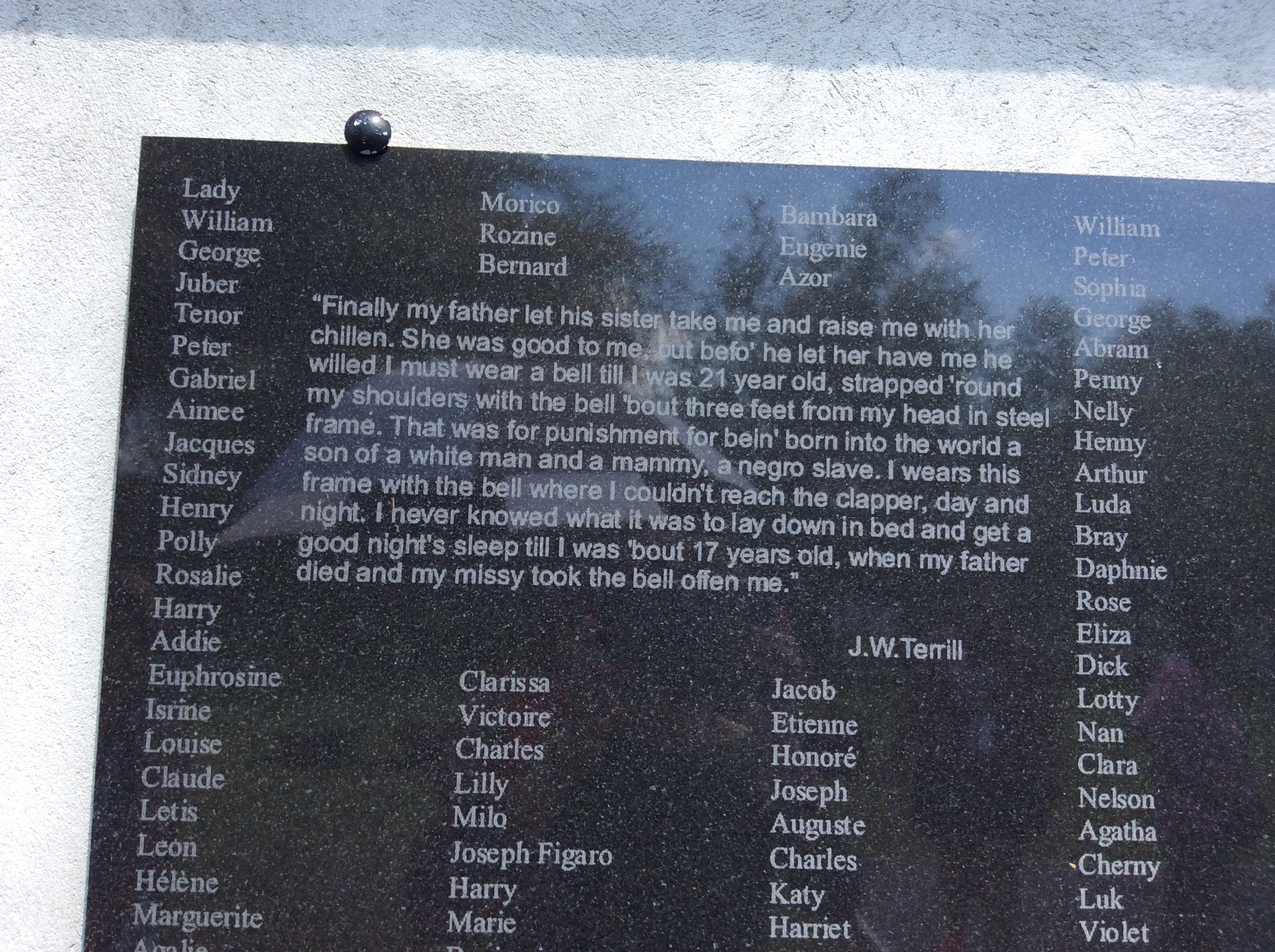
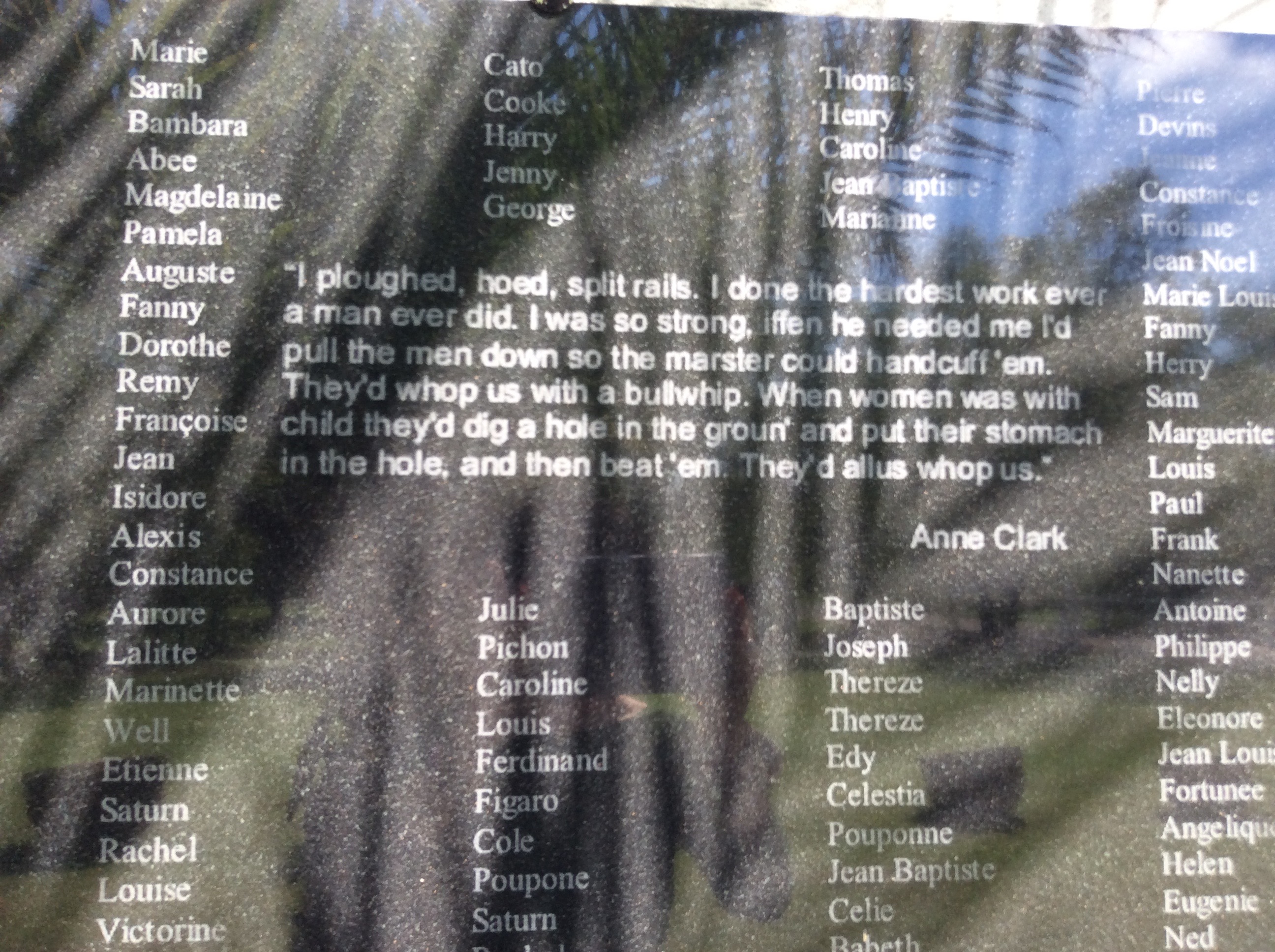
From this inventory a memorial has been created with the names of the slaves.  Included are various statements made by the slaves themselves as recorded in slave narratives.
IMG_2733

The above tells the story of a child fathered by his owner and one of the slave women and how his father treated him.
IMG_2734

Even pregnant women could not escape beatings.
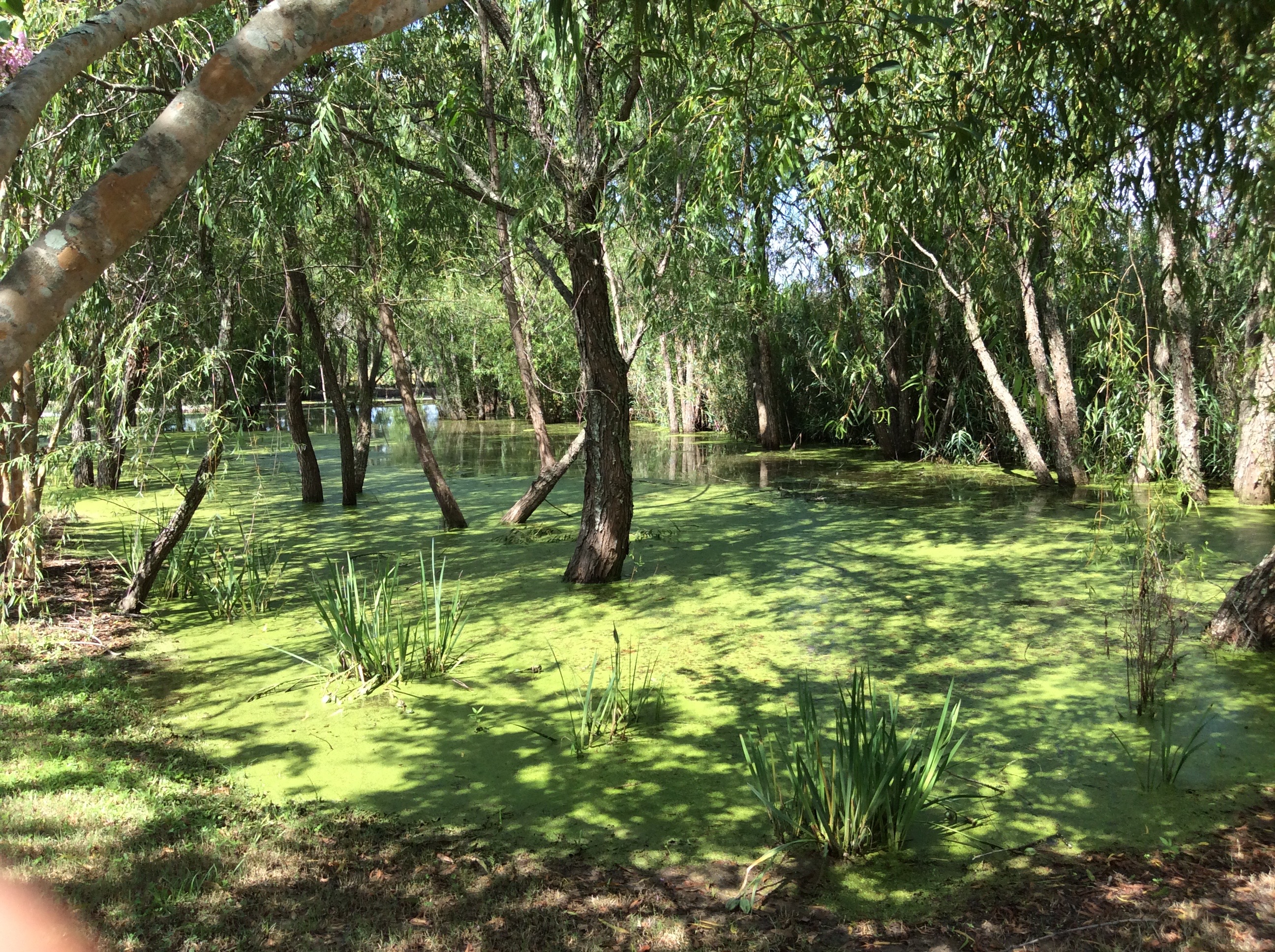
IMG_2735Because the area around New Orleans receives 60 inches of rain a year, the landscape everywhere is lush.  This is one of several pools at the plantation.
IMG_2736

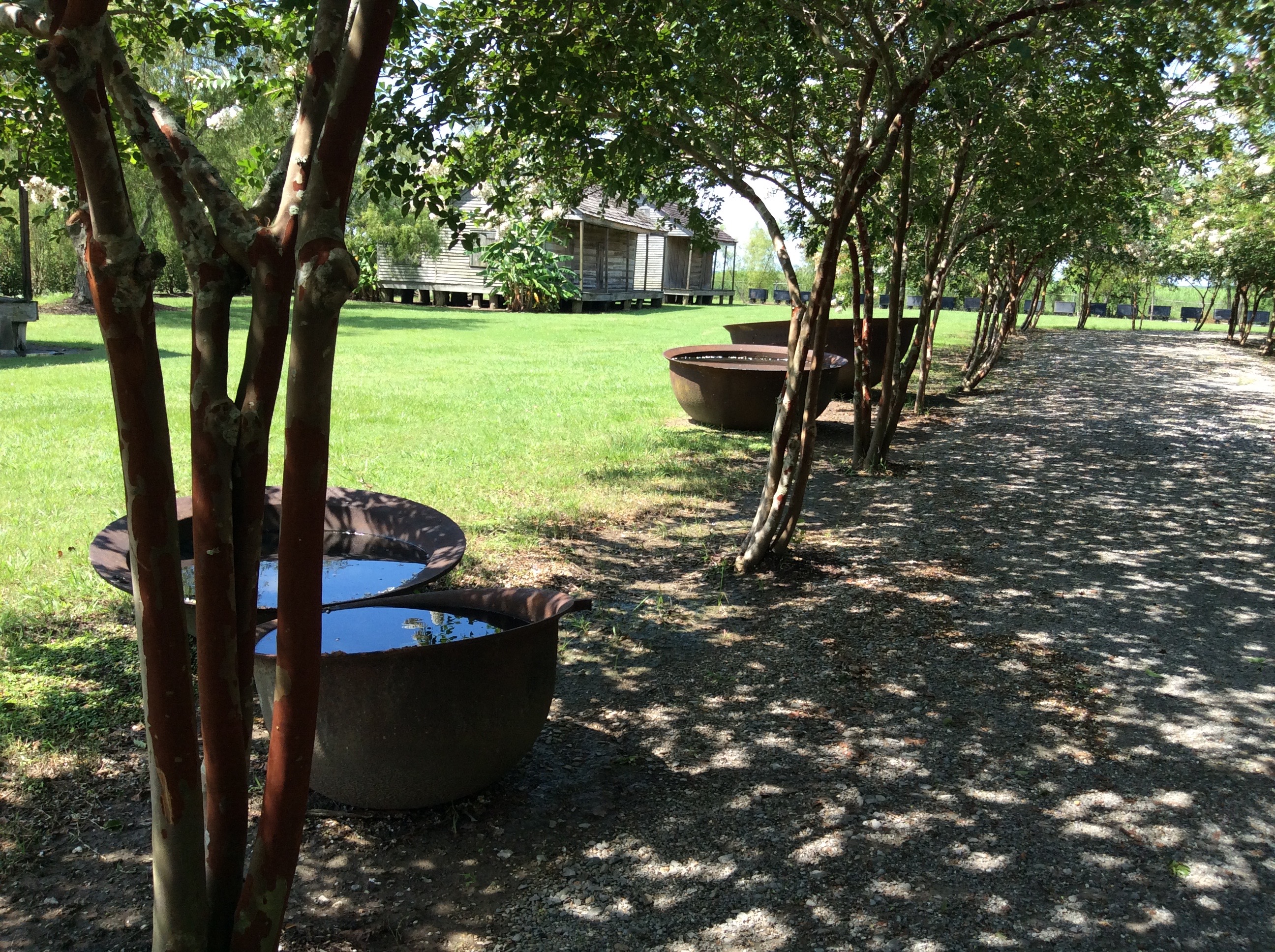
These containers cooked the sugar cane.  Starting with the largest, the cane was boiled repeatedly until it cooked down and poured into increasingly smaller containers.  This was especially dangerous work due to the fires, the heat, and the boiling sugar cane. Sugar cane production was much more dangerous than cotton which was grown farther north in Louisiana.  The cane itself was cut with large machetes and the edges of the cane are also sharp.  Many people were severely injured.  The life expectancy of a sugar cane slave who worked in the fields or cooking the cane was approximately ten years from the time he or she went to work, often as young as ten. Although field slaves had a much harder life in terms of labor, they had less exposure to their owners and their families and therefore, in some ways, more freedom to talk and interact. House slaves were constantly watched and the women especially subject to sexual abuse.
IMG_2737

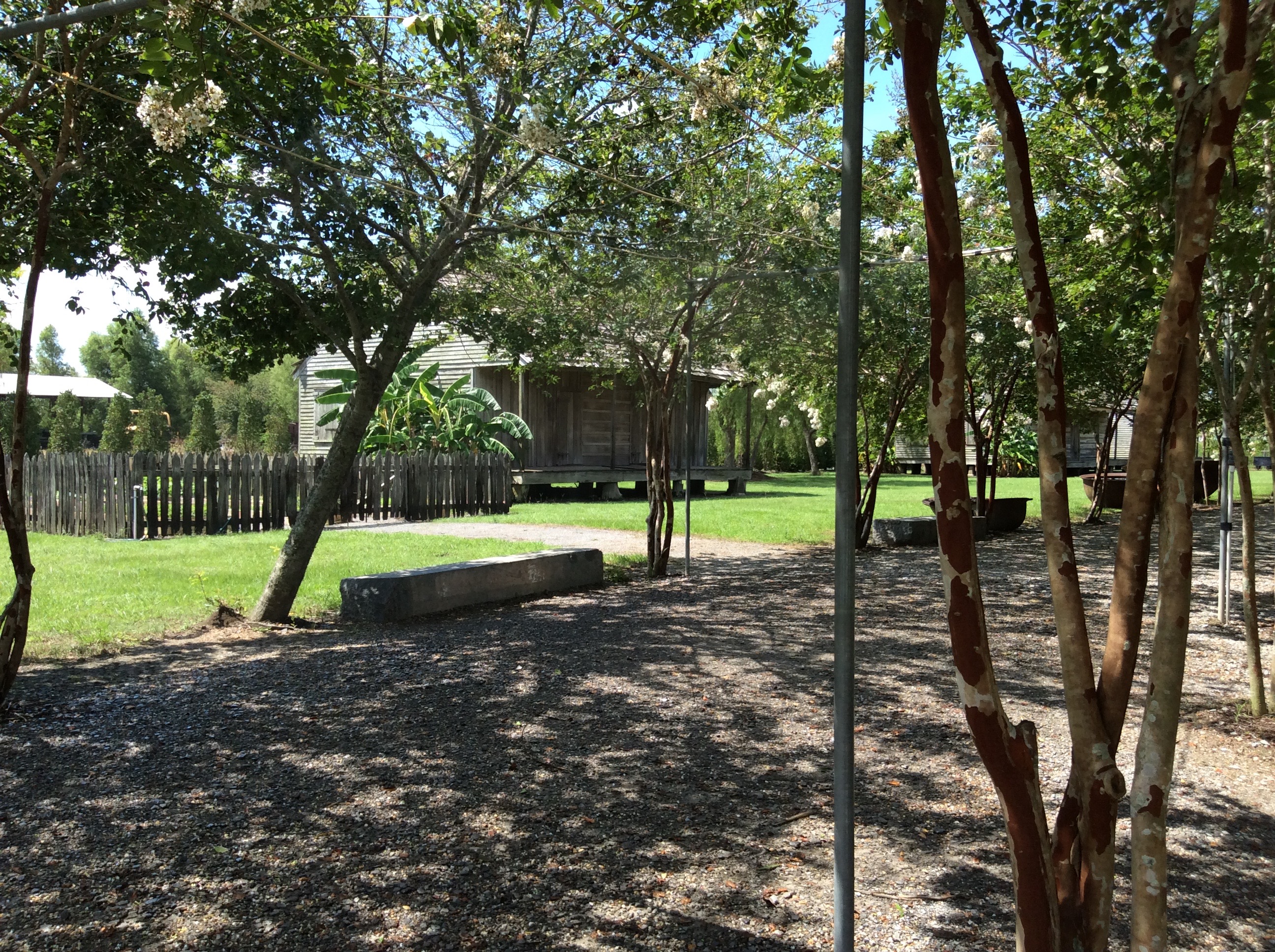
Slave cabins like this one contained four rooms.  Like the main plantation house, most buildings were built off the ground.  No levees existed then and the largest plantations were often built within sight of the Mississippi River and thus prone to flooding.
IMG_2738

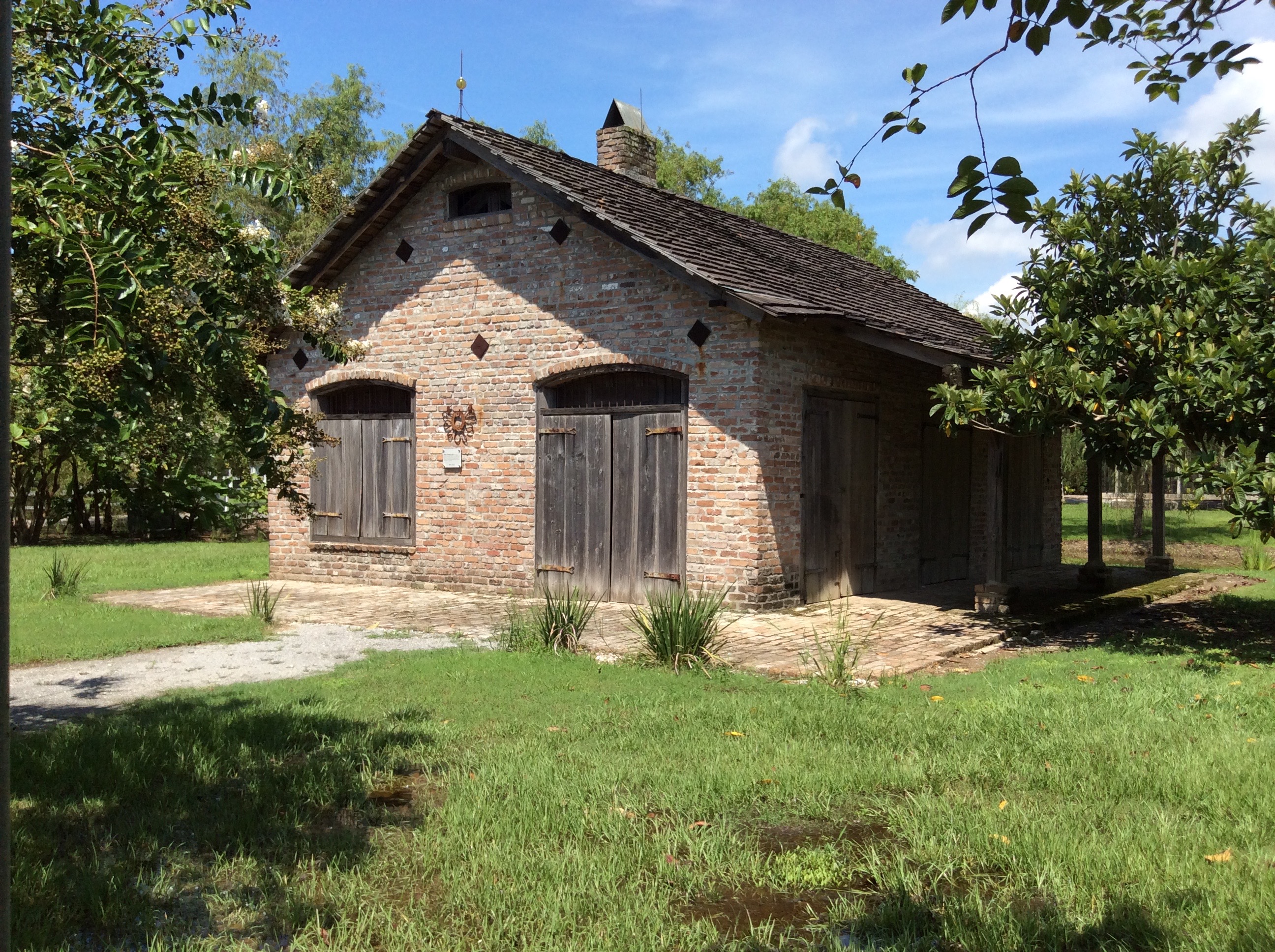
This building housed the foundry.  Skilled slaves, like blacksmiths, were very valuable and received better treatment, e.g. enough food.  When the movie, “Django Unchained” was filmed, part of the movie was filmed here because the adjoining plantation did not have a blacksmith shop.  The branding portion was filmed at Whitney Plantation.
IMG_2741

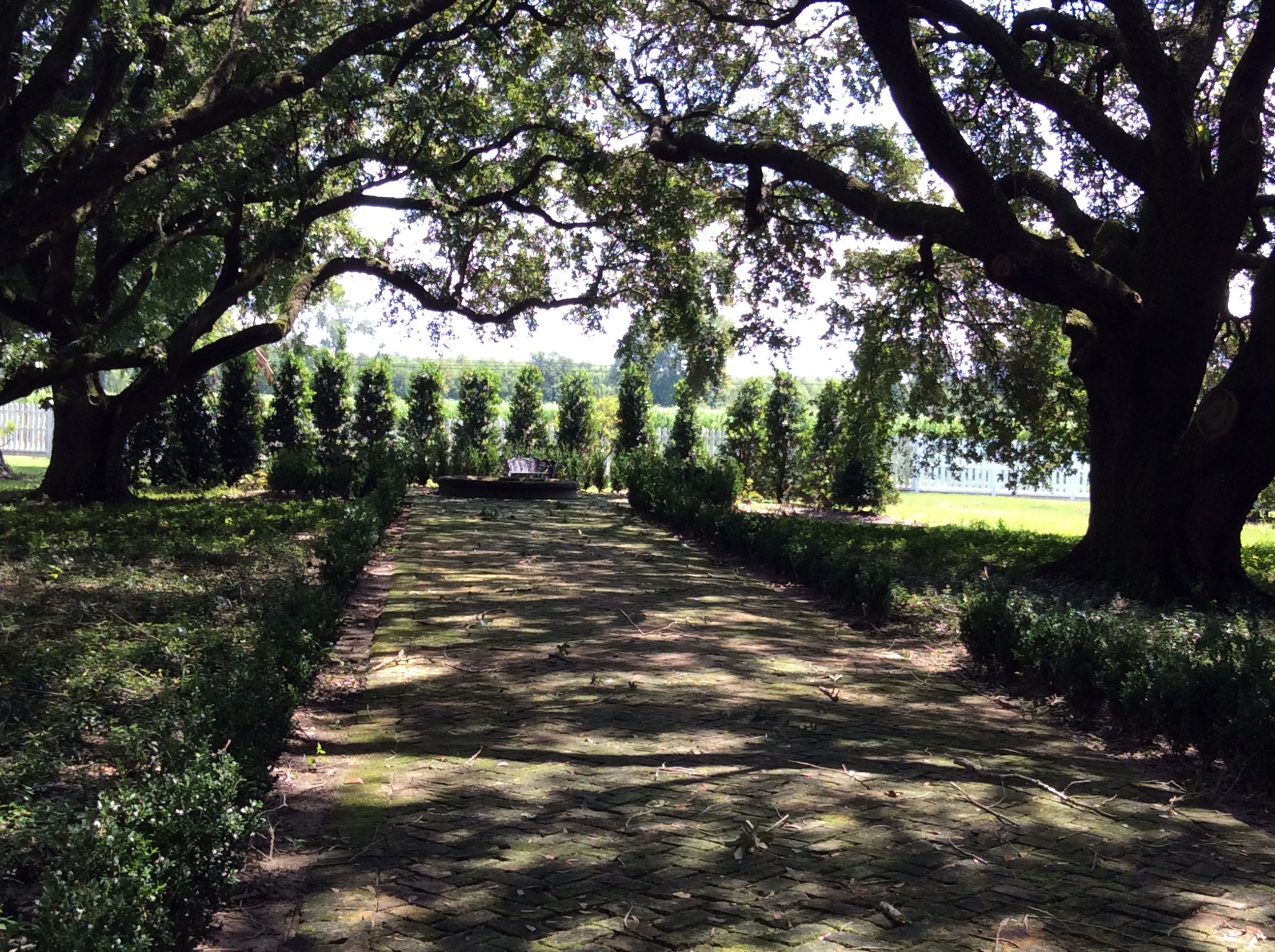
The walkway, looking from the front of the main plantation house, is lined with giant oak trees.  Before the levees were built, the Mississippi River could be seen from the house.

IMG_2742

Originally, there was no first floor due to the flooding.  Later, after it will built and used for dining, an office, and a living area, whenever the floods came, the slaves were required to carry everything to the second floor until the water subsided. Then they would clean the first floor of mud and debris and return the furniture there.  Whitney Plantation possesses some unique characteristics, e.g. finely painted European style ceilings.

Cooking was not done inside the main house at any of the plantations due to the heat and fire danger. The cook, another skilled and valuable slave, was required to know how to cook various popular cuisines typical of the area, e.g. creole, European–French, Spanish.

IMG_2743

The various ferns and mosses growing from the limb of this large oak trees demonstrates the lushness and humidity typical of this area and why it is still used for sugar cane production.
IMG_2744

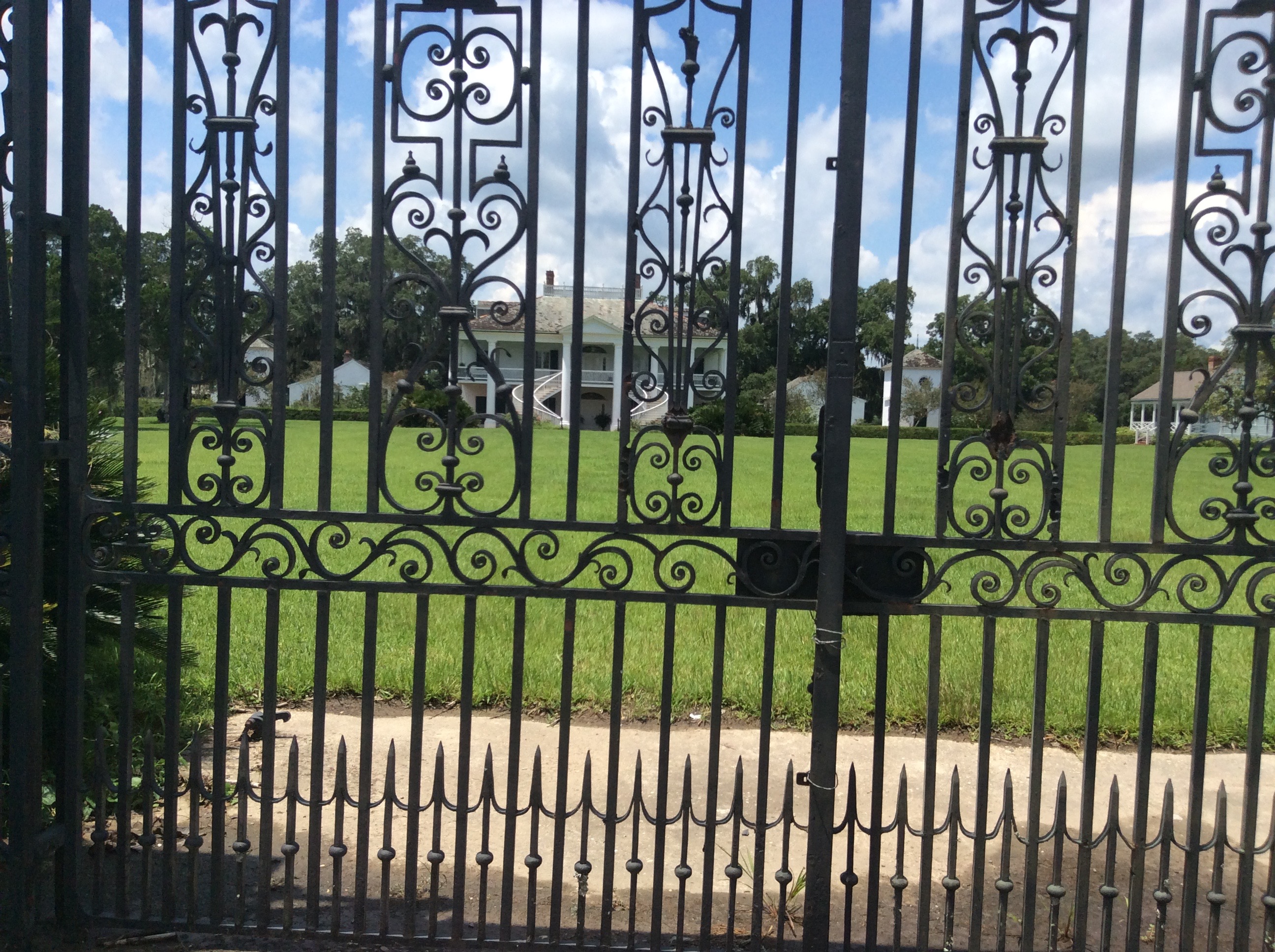
A short distance down the road is Evergreen Plantation where the main portion of “Django Unchained” was filmed.  It, too, still produces sugar cane and a family lives here.  Tours are available as well.