The first half annoyed me. I kept asking, “What? Why? What is wrong with these greedy, despicable people?” I almost quit reading it (I never quit reading a book) but plunged on. Then, about halfway through “A Memoir, Remembered” section entranced me. Aha. Now I “get” it. I became so engaged I read the last half almost straight through without stopping.
The title should be Truth. This novel deftly explores these questions:
-What is true?
-Whose truth is true?
It does this via competing narratives involved with financial markets, how investors have and can manipulate the stock market, and relationships. It also quietly addresses the issue of how men take credit for the acumen of the women with whom they are involved and the destructive power of wealth and influence.
As an ardent reader who prefers what are usually referred to as literary novels and serious non-fiction, few books impact me deeply and emotionally like this one has. As soon as I finished it, I reread parts of it several times, then sat silently stunned.
After her family moves to North Africa for her father’s work, an 18 year old British girl, rescued by a Taureg leader, is believed dead by her family until she resurfaces years later at a Catholic “home” run by nuns in North Africa. She re-enters British society, marries, leads a relatively “normal” life while keeping a secret for decades. When she receives a telegram, “Abu is dead”, everything changes. Her past comes rushing back in unexpected ways.
The Booker (previously Mann-Booker) Prize winner in 2022, this book is filled with gruesome events and dark, graveyard humor. Since if takes place in Sri Lanka, if you know little about Sri Lanka history in the last 50 years, you might want to do a quick review so you know about the civil unrest and the various Sri Lankan ethnicities, e.g. Tamil, Sinhalese, Burgher. Written from the viewpoint of the title character, a war photographer, after being murdered, he resides in a sort of celestial purgatory while he tries to save his two best friends and male lover who are still alive and discover the identity of his murderer. He is given seven moons in which to accomplish this task. Not a book for the faint of heart, it contains gruesome war and torture details but frequently is also quite funny and filled with “truths”. In an interview the author explained, “Sri Lankans specialize in gallows humor; it is our coping mechanism.” As I read, I underlined passages I found especially meaningful, profound, or fascinating. Here are some of them:
“-There are only two gods worth worshipping. Chance and electricity.
-Hell is all around us and it is in session as we speak.
-Evil is not what we should fear. Creatures with power acting in their own best interests; that is what should make us shudder.
-There has never been an era of peace in all recorded history.
-Interest in fair play and democracy are not always the same thing.
-I have a superb name for God. Whoever.
-Laws are needed because made-up religions are not enough.
-The universe is nothing but mathematics and probabilities…we are nothing more than accidents of our births.
-They say the only thing worse than being talked about is not being talked about.
-Your race, your school, your family will dictate how the dice of life will fall for you.
-All religions keep the poor docile and the rich in their castles.
-People are ok if bad things happen to people who are not them.
-Do not be afraid of demons; it is the living we should fear.
-I have thought long and there are no answers. There is only this. There is only now.
-We must all find a pointless cause to fight for, or why bother with breath?
-The kindest thing you can say about life. It’s not for nothing.
-I cannot understand why humans destroy when they can create. Such a waste.”
This memoir take place when the author decides to move to Paris in order to address certain “issues” related to her childhood and young adult years. She grew up in Saudi Arabia before the oil boom and went to high school and lived in Beirut when it was considered one of the best cities in the world. She had to leave when Lebanon became war torn, her dad was kidnapped, and her sister shot. Her return to the US proved traumatizing even though she is not genetically of Middle Eastern descent. Paris was filled with Lebanese refugees so she moves there in an attempt to understand what happened to her beloved Lebanon and why.
This is not an ordinary memoir. I could not stop reading it; I wanted to know what happens next and why. It includes a graphic honesty not found in most memoirs I’ve read. In addition, it contains political and historical explanations for the events that transpired during the time period of the book.
Want to learn more about the background to current events in the Middle East? Want to read about a remarkable life? Then read this memoir.
One book a week? To date this year it has been more like 3-4, depending on the book and week. I wrote reviews for four books today on Goodreads including The Sea of Tranquility, Little Fires Everywhere, An Imaginary Life, The Woman They Could Not Silence. I mentioned the first one in my last post.
I noticed that Little Fires Everywhere is now a series, streaming. I will not watch it because it is one of the few books that made me cry. I rarely cry. Is it worth reading? Yes. I view it as recommended reading for parents. How do you treat your child who is different, the child who is not how you want your child to be? Is conforming the best way to live? And at what cost? Is a poor minority child better off with wealthy parents from a different ethnicity who can provide everything?
Next I read a non-fiction book, The Woman They CouldNot Silence, The Shocking Story Of A Woman Who Dared To Fight Back, by Kate Moore. Apparently I did not know as much about women’s history in the US as I had thought. This is the true story of the life of Elizabeth Packard. Here are some of the things I learned:
In the mid 1800s if a woman was married, her husband could place her in a mental asylum as insane and she could do nothing about it even if she was sane. She could not get out even if relatives and friends tried to come to her rescue.
Her husband could confiscate all her property and do with it whatever he pleased. She and everything she owned now belonged to him.
People in mental asylums were terrorized and treated with methods now considered even illegal treatment for actual terrorists, e.g. water boarding.
A common, accepted treatment for “difficult” and “emotional” women was clitoridectomies, female genital mutilation. Prominent psychiatrists viewed female genitalia as the cause of female insanity. Dr. Isaac Brown, a prominent London surgeon, stated that it was easy to cure female insanity, just cut off her clitoris. This was practiced in both the US and England.
Elizabeth Packard’s husband placed her in an asylum because she disagreed with his religious views and her outgoing nature. This book details her life in the decades she struggled to be released from the asylum and her struggles to make life better for those who were placed in asylums. It is a must read for anyone interested in the history of women in the 1800s and the treatment of those deemed insane.
In my last blog post about reading, I promised to address the prophecies of Octavia Butler in my next post. The best way is to quote some passages from Parable of the Talents which was published in 1998. This book is the sequel to Parable of the Sowers. In that book the main character creates a new religion with CHANGE as a major focus. In fact, one of the main tenants of that religion forms the words on Octavia Butler’s tombstone which I quoted in an earlier post. Here are some passages from Parable of the Talents:
I couldn’t help wondering, though, whether these people with their crosses, had some connection with my current least favorite presidential candidate, Texas Senator Andrew Steele Jarrett. It sounds like the sort of thing his people might do—a revival of some nasty out of the past….So now we have another group that uses crosses and slaughters people. Jarrett’s people could be behind it. He insists on being a throwback to some earlier ‘simpler’ time. Now does not suit him. Religious tolerance does not suit him. He wants to take us back to some magical time when everyone believed in the same God, worshipped Him in the same way, and understood that their safety in the universe depended on completing the same religious rituals and stomping anyone who is different.
Jarrett’s supporters have been known to burn people at the stake for being witches….a Moslem, a Jew, a Hindu, a Buddhist, or in some parts of the country, a Mormon, a Jehovah’s Witness, or even a Catholic. A witch may also be an atheist or an eccentric…anyone who does not fit into Jarrett’s version of Christianity. He condemns the burnings but in very mild language.
He has a simple answer: ‘Join us! Our doors are open to every nationality, every race.! Leave your sinful past behind, and become one of us. Help us make American great again.”
Note: If you are interested in Octavia Butler books, the stack at the right bottom of the photo are mostly her books. Some are series and need to be read in a certain order.
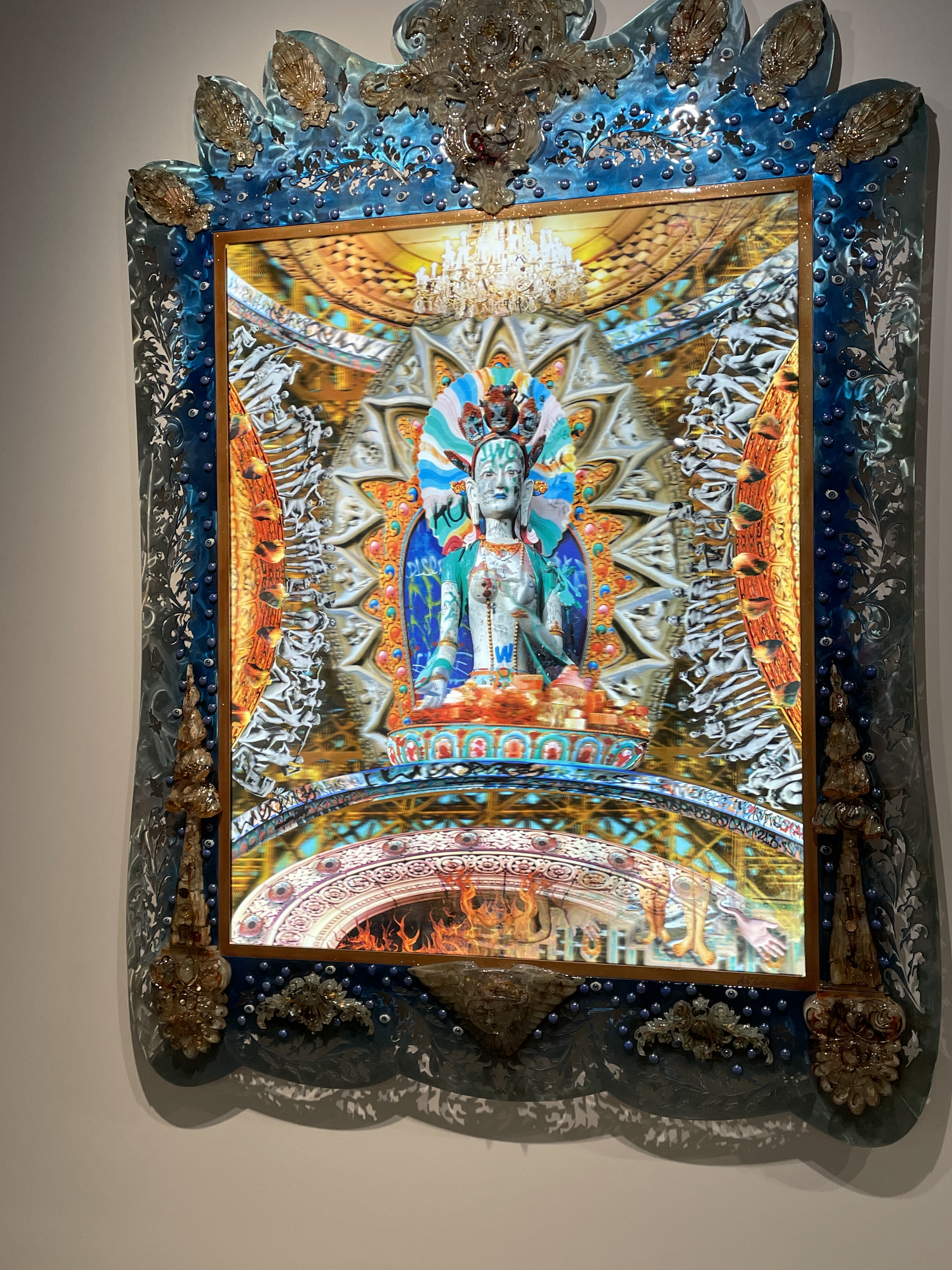
The second floor of the Cheech contains even more astonishing art including more multidimensional pieces except smaller than the giant one you see when you enter the building.
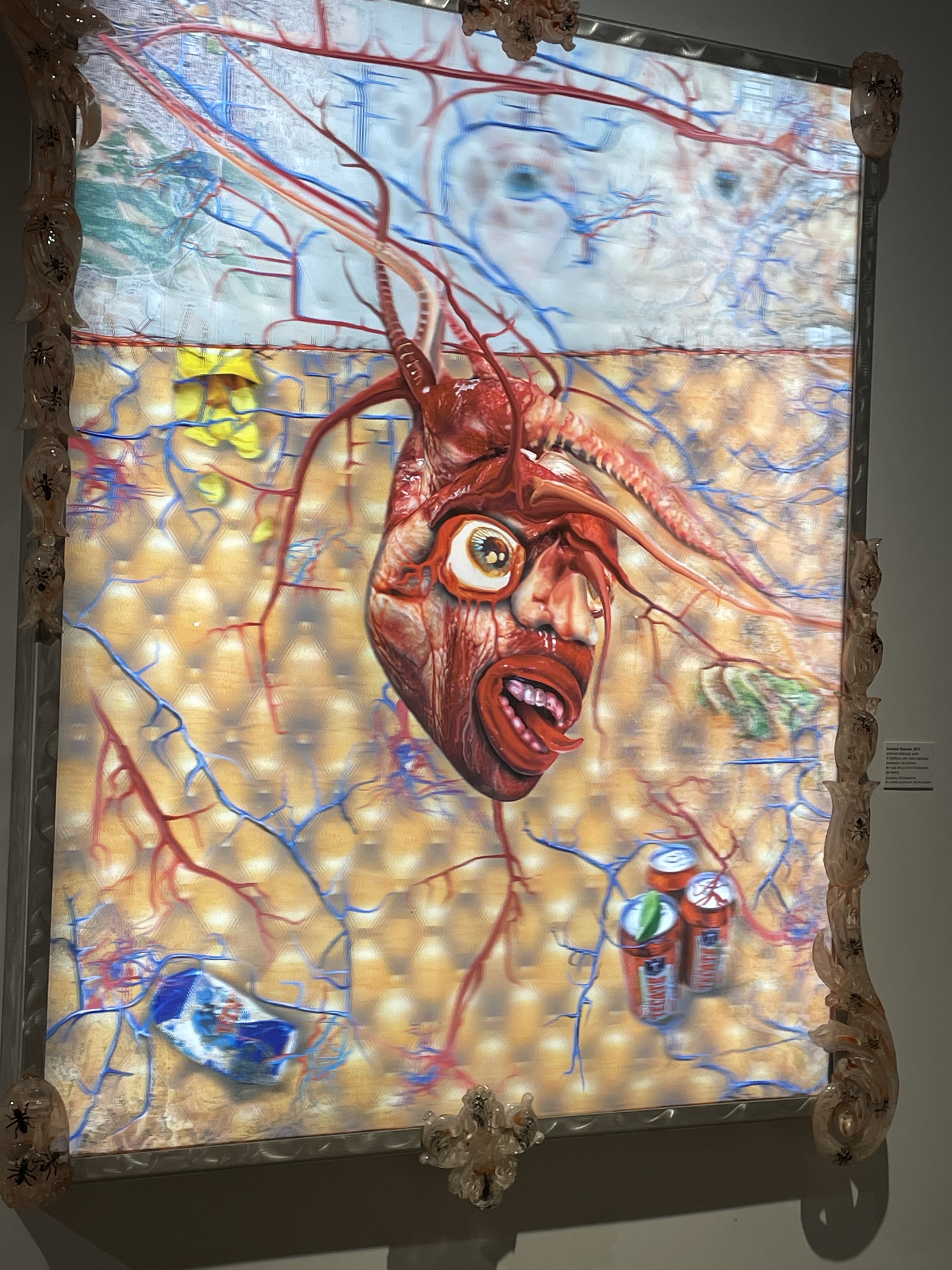
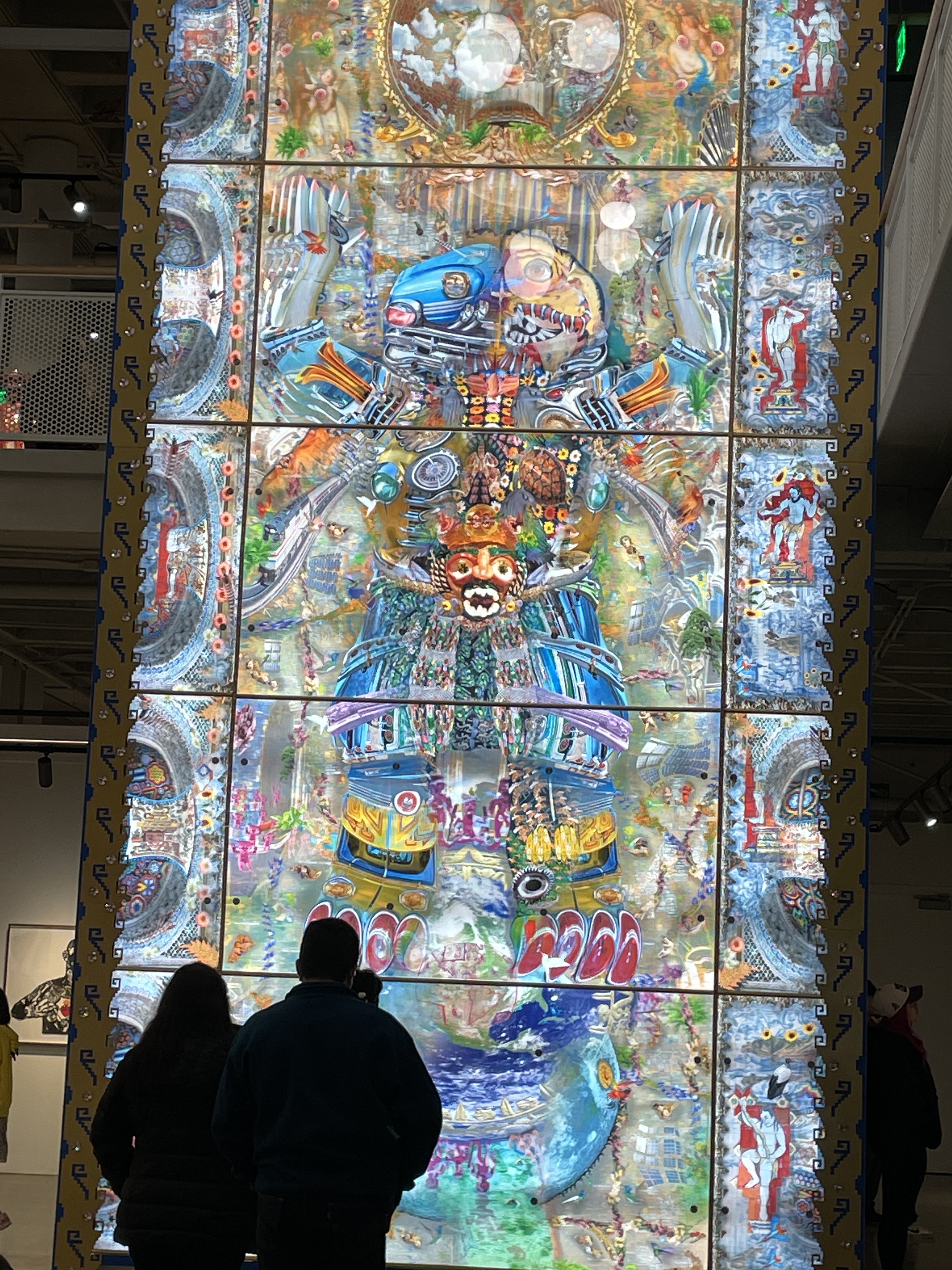
Depending where you stand in front, to either side, what you see is quite different. I kept thinking some old Flemish art or Hieronymus Bosch meets modern technology.
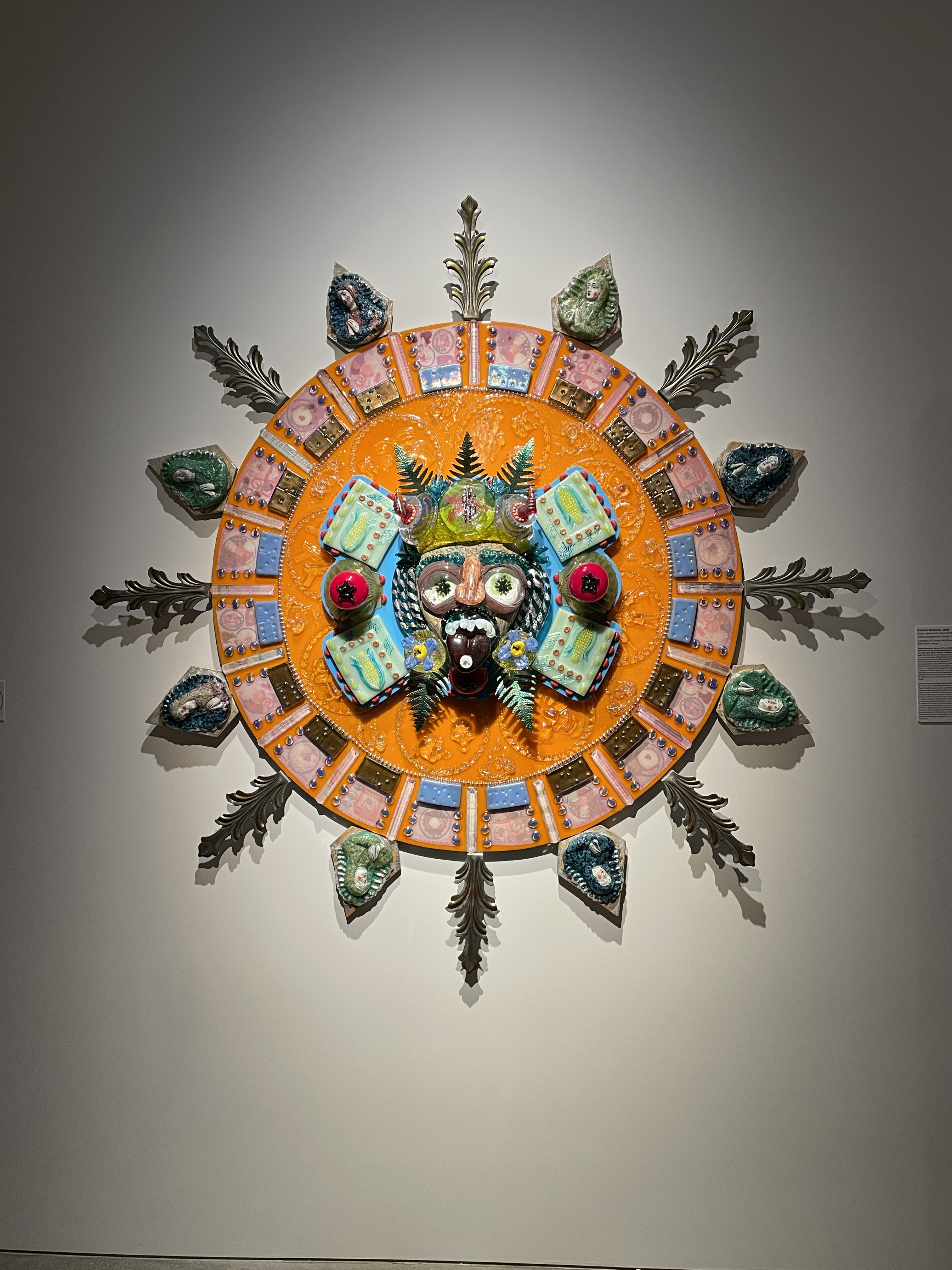
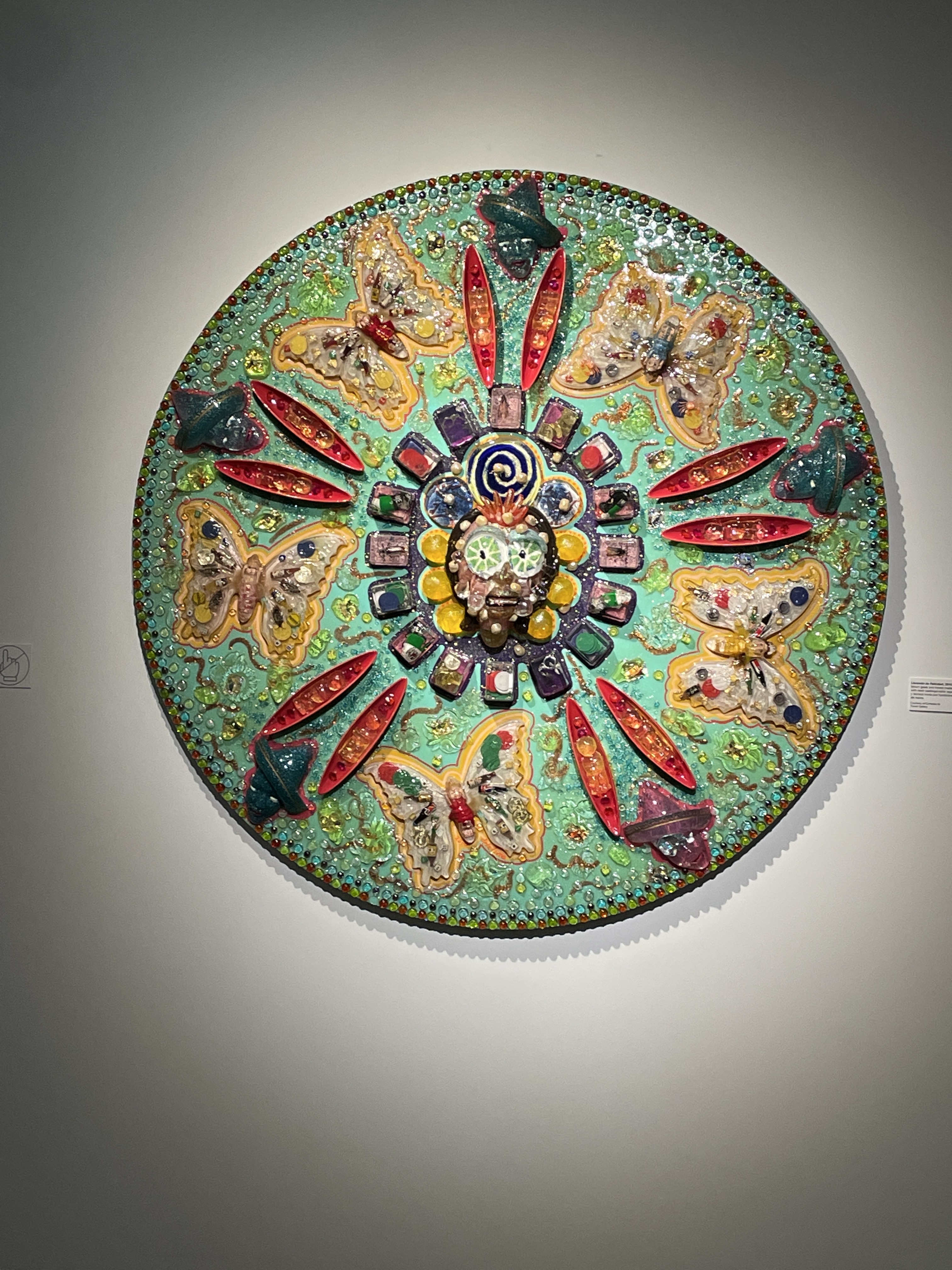
Much of the art makes a social or political statement especially about colonization, culture, poverty.
Some of the art is reminiscent of Mayan and Aztec calendars.
Hearts appear in many of the paintings.
And of course Frida.
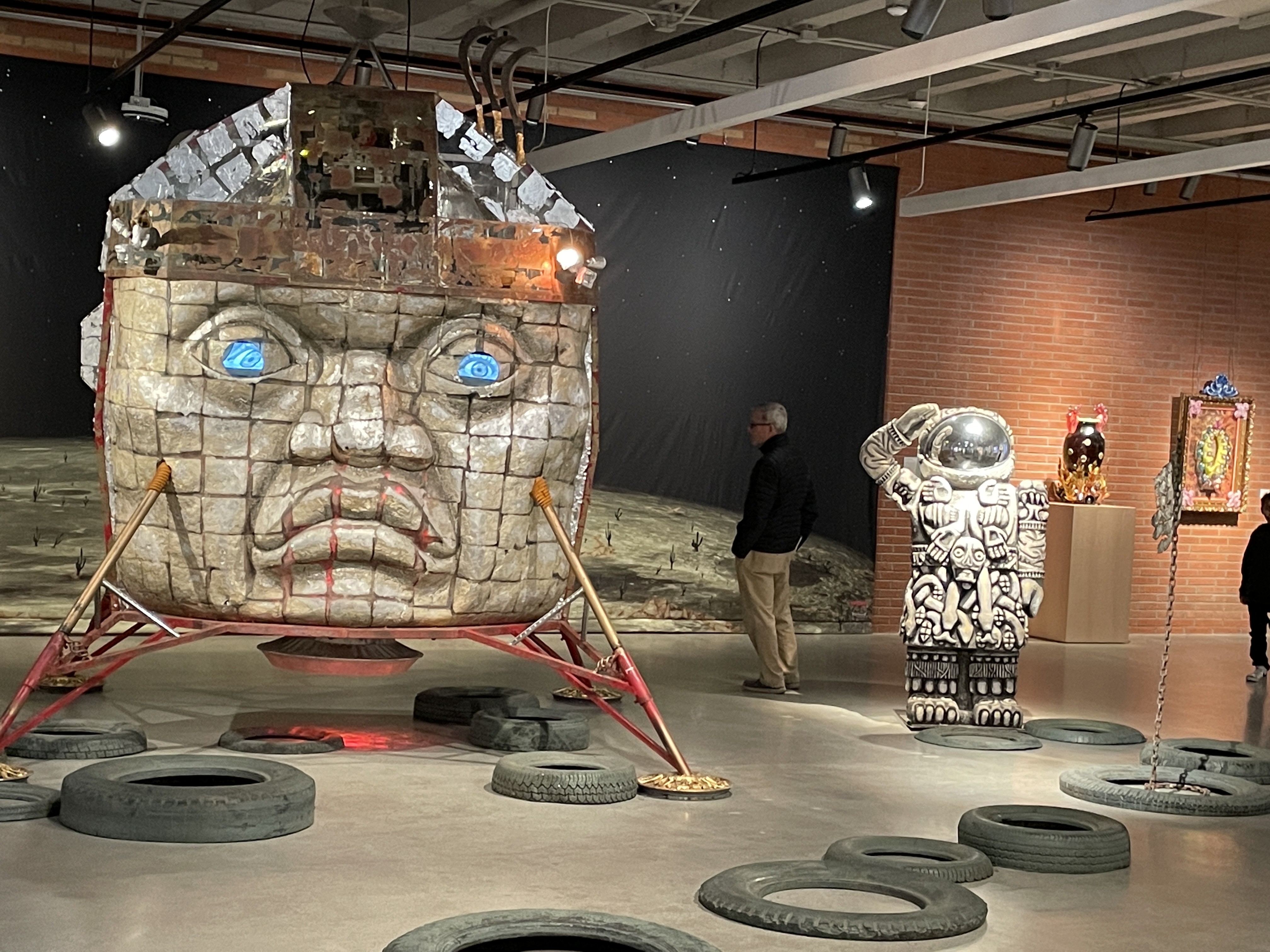
This is a space ship with changing eyes. If you walk around the back there is a creature inside watching everything with monitors.
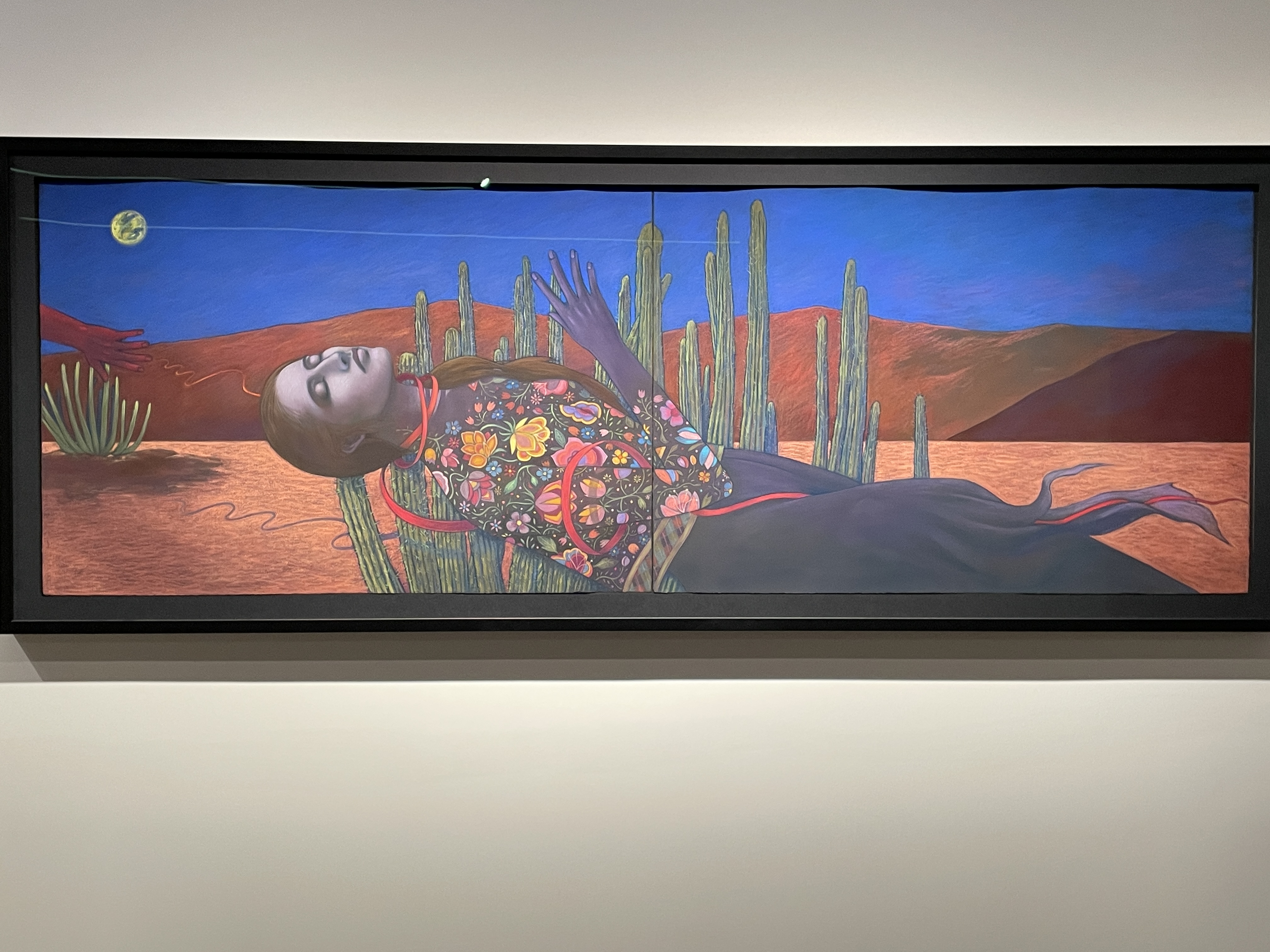
Some of you may remember the comedy duo Cheech and Chong way back in the day. Cheech has spent his life collecting Chicano and Chicana art. This year he gave a lot of his art collection to open a new museum in Riverside, California. Earlier this week my grandson, his girlfriend and I went to visit the museum. Photos and videos are allowed without flash. The following is the first set of photos I took. Please note that you need to see this art for yourself. Photos do not do it justice. Much of it is multidimensional and looks very different depending on where the viewer stands.
This is what you see when you enter the door; it is two stories high and multidimensional. Look how different the next photo of it looks from this one.
Walk farther to the side and it looks totally different again.
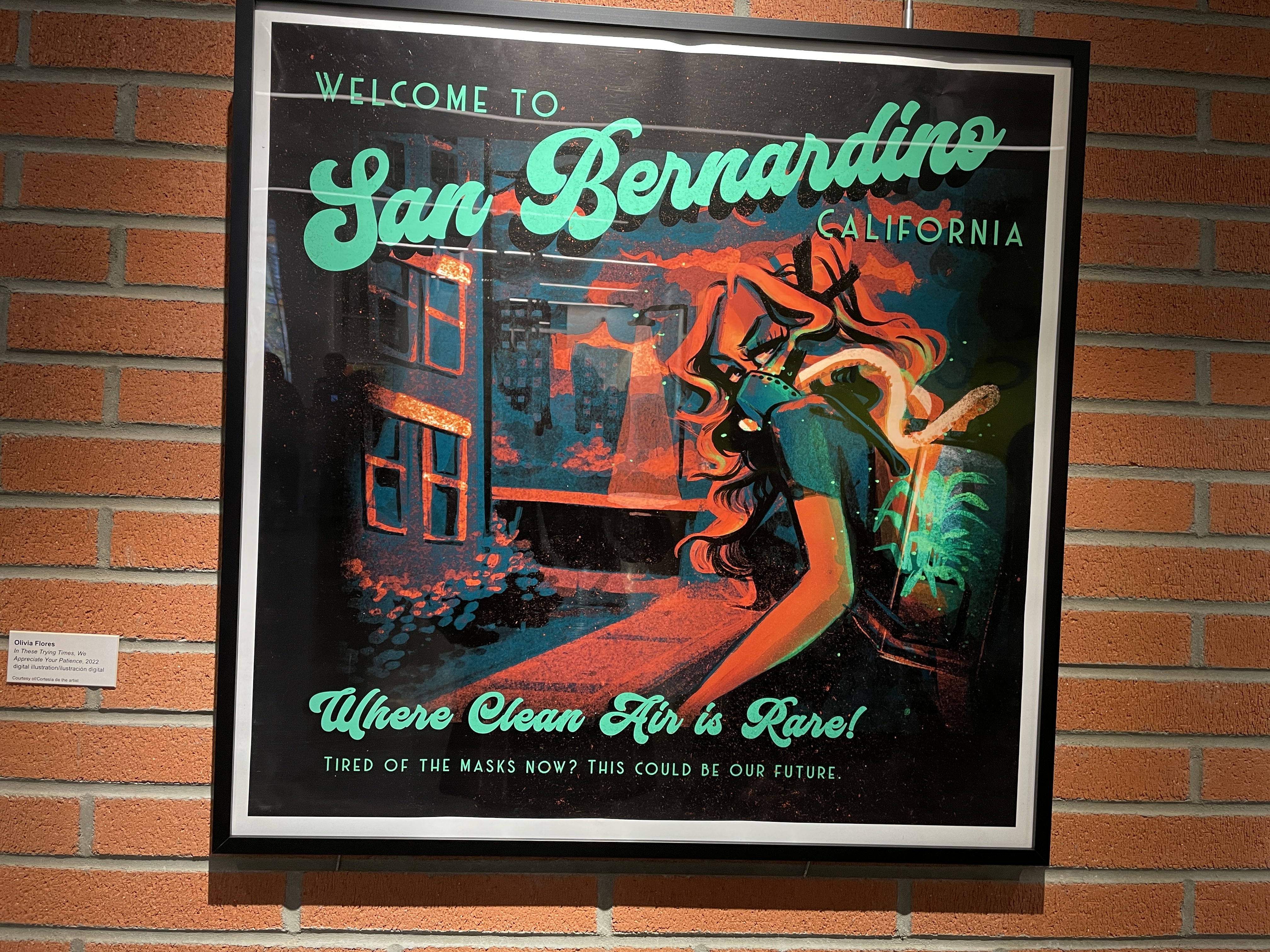
This speaks for itself. Right now where I live the air is clean enough that unless it is foggy, I can see all the way to downtown LA 30 plus miles away.
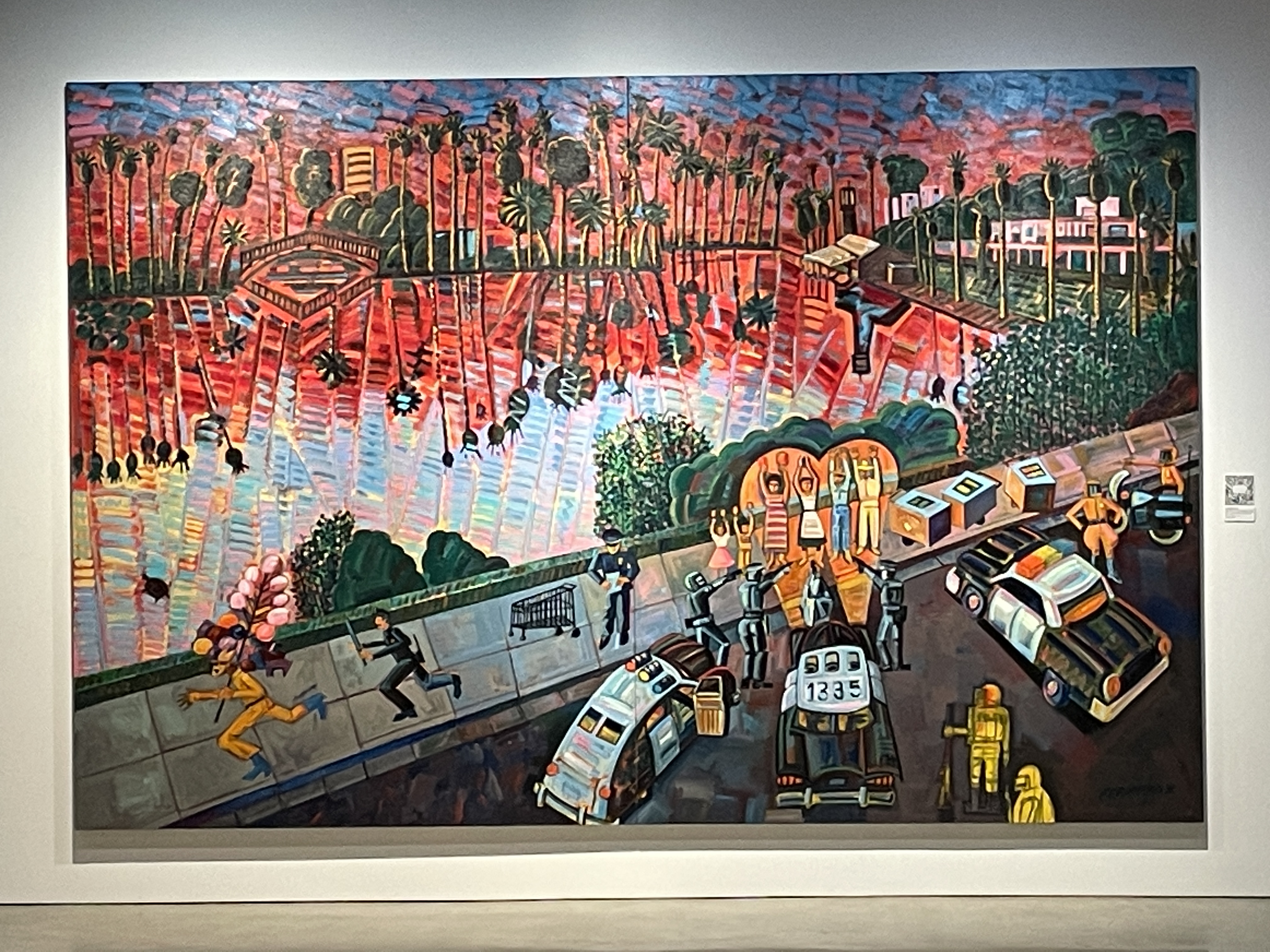
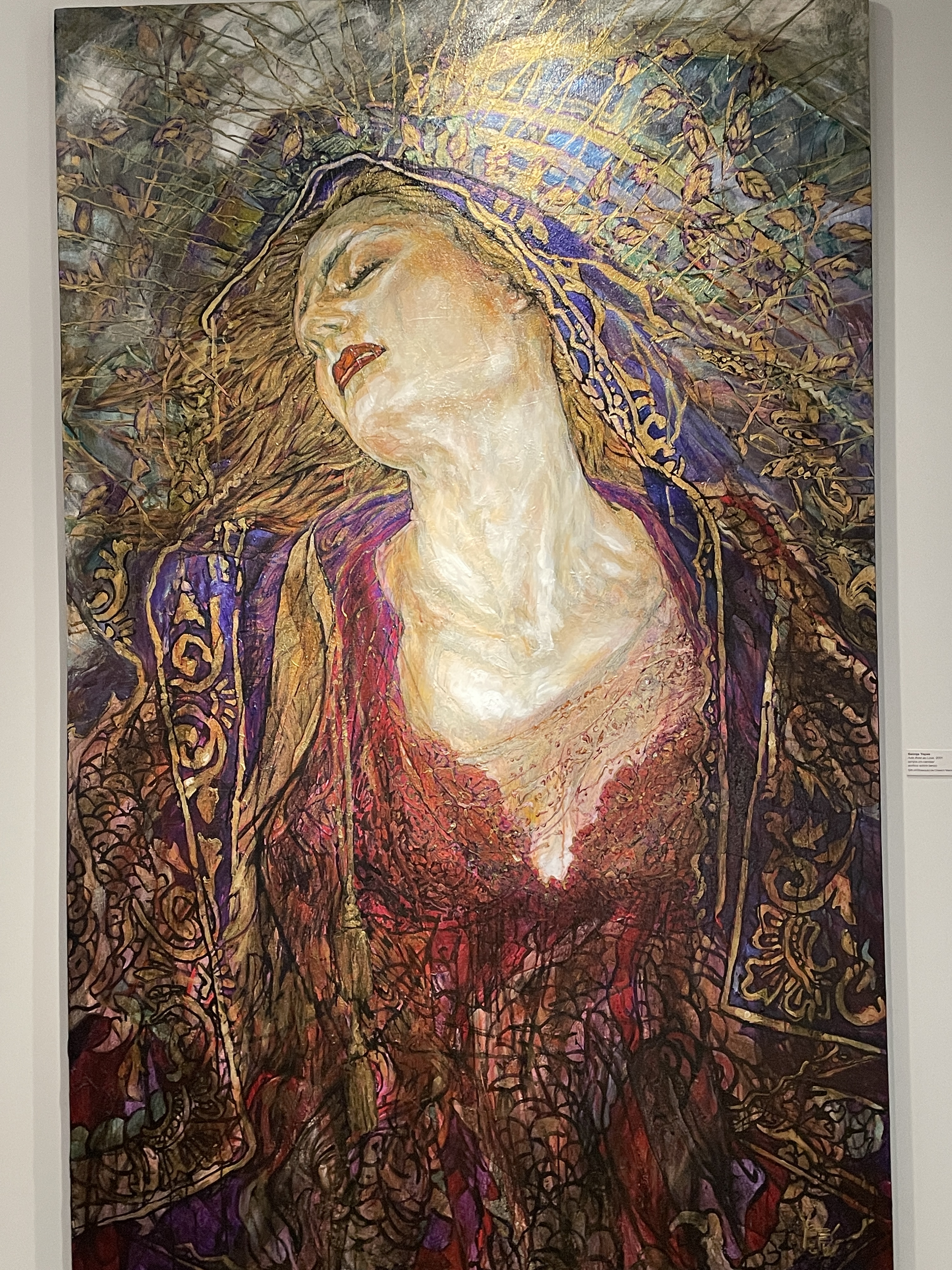
All the art at this museum has a message; much of it illustrates the ills of society.
The influence of indigenous art, e.g. Aztec, Mayan, can be seem in much of the art and the statements the art makes.
The woman above and the woman below hang next to each other.
One hundred years ago, a racist US General, Amos Fries, transformed tear gas from a wartime chemical into use against protestors. He loved war gases and saw them as the ultimate in US technology. He advocated the use of tear gas against any form of civil disorder. As head of US Chemical Warfare Services, he pedaled his favorite gas to private security firms, police departments, and the National Guard. According to him, tear gas in the hands of the “White man can quell any uprising.” He went on to talk about how White men are set apart from the Negro, Gurkha, and the Moroccan. In his effects were letters from the women of the Ku Klux Klan praising his efforts.
Today the tear gas he loved is used all over the world by tyrannical governments to control their people.
This is for those who are mystified, upset, angry, or whatever else about Citizens United. Without doubt I learned more from this book by Adam Winkler than I have learned from any book in months and some of it shocked me. It is this month’s assignment if one is a member of the PBS/New York Times online book club.
The first English settlement, Jamestown, was a corporation. The people who first lived there were all employees of that corporation and could not own anything themselves. Massachusetts Bay Colony was founded as a corporation as were several other colonies and Dartmouth, Harvard, and Yale. In the first business related case before the Supreme Court in 1809, Bank of the United States vs. Derveaux, the bank won. It was the first Supreme Court case which dealt with the constitutional rights of corporations. With occasional exceptions, since that first case, the Supreme Court has generally sided with businesses.
Corporate and business donations to presidential campaigns began over a hundred years ago with the election cycle of McKinley vs. William Jennings Bryan. Marcus Alonzo Hanna realized just how much money could matter and transformed the campaign process. He created the first national advertising campaign. This new strategy required money, lots more than the traditional campaigning methods. Where did he acquire this money? Corporations. He coined the phrase, “There are two things important in politics. The first is money, and I can’t remember what the second one is.”
In a case in 1916, Dodge Brothers vs. Ford Motor Company, Ford lost because of his testimony when he said he had the right to make business decisions in the interests of the general public even if stockholders had to sacrifice. The Michigan Supreme Court ruled against him, stating that they could not commit to the concept that “a general purpose and plan to benefit mankind at the expense of stockholders” is acceptable.
Although there have been periods of time when the Supreme Court of the US has been prone to limit the rights of corporations, they have been brief in comparison to periods where corporate rights were increased by Supreme Court decisions. The extension of corporate rights to free speech began long ago in Britain. However, in the US, the Fourteenth Amendment was used in the case of Grosjean vs. American Press Company to guarantee free speech rights to corporations. This case decades ago is, along with many other cases, a precursor to Citizens United.
If you want to understand how corporations have increasingly attained rights, I highly recommend this book. It will give you new insights into where we are now and how we got to this point regarding the rights of corporations in the United States.

















 This is for those who are mystified, upset, angry, or whatever else about Citizens United. Without doubt I learned more from this book by Adam Winkler than I have learned from any book in months and some of it shocked me. It is this month’s assignment if one is a member of the PBS/New York Times online book club.
 writingontherim