Book 21 for 2026: “Hurricane Season”, Fernanda Melchor


The inside of the front cover informs the potential reader that this is a novel about a world steeped in mythology and violence, set in a small town in rural southeastern Mexico. The violence part is extreme, the kind of violence that only sometimes pervades a lot of small, rural, poverty ridden towns everywhere in the world. Written in a style reminiscent of Faulkner (I read a translation from the Spanish), each chapter tells the main story from a different perspective, the story leading up to and the death of the Witch who is found floating in the water of a canal. She is called the Witch but no one for sure seems to know her gender, where she attained the money to build such a huge house, and how she manages to entertain with lavish abandon. People both avoid her and are drawn to her.

There is the grandmother who thinks her wayward grandson can do no wrong while blaming her daughter ( the child’s mother) for everything and anything, there is his friend whom he both loves and hates, their is the poor girl he aids and loves who has been groomed and impregnated by her stepfather and has run away because of it, the engineer who loves boys and men, the woman who makes her living as a fancy prostitute to support her disabled husband and on and on it goes–people harming each other out of anger and frustration with their dire circumstances. For some of the characters, the writing is first person so the reader learns the interworkings of those mentally harmed by their life’s poverty and environment from which there appears to be no escape.

This is not a novel for the faint of heart.

Books 12 and 13 for 2026: “The Women of Troy” and “The Voyage Home”, Pat Barker


After getting started with the first one, I realized the other was a sequel. Later, I learned this is a trilogy but the library did not have the first book of it. This British author won the Booker Prize for another historical trilogy, “The Regeneration Trilogy.” These two books are obviously about the Trojan War. Although “The Women of Troy” begins with Achilles’ son stuck in the Trojan horse, young (16), scared and concerned about how he will live up to his father’s name, most of the book occurs after the Greeks have won the war, Troy is destroyed, most of the Trojan men and boys, including infants, have been killed and the Greeks have built a village below what is left of Troy because they cannot go home. The constant gale winds make it impossible for their fleet of ships to travel. They have been stuck there for years, have become restive, often violent, bored. The women of Troy, even the princesses and other noble women are now slaves to Greek leaders. Most of the book is told from the viewpoint of several women including, Briseis, who once belonged to Achilles and is pregnant with his child but now married to the leader Acinus. Cassandra, the murdered Trojan king’s daughter, has been forced to live with Agamemnon, She has vowed revenge and has prophesied than both of them will die once they reach his Greek kingdom. This novel centers on what life is like for these Trojan women who are the spoils of war, living as slaves in the Greek camp.

“The Voyage Home” centers on the trip from Troy back to Mycenae and the immediate aftermath of their arrival home. It is mostly told from the viewpoint of Ritsa, a healer who has been assigned to watch over Cassandra even though she belongs as a slave to another person, a doctor. Because of her assignment to Cassandra and healing abilities, she has higher status than many others. Part of the story is also told from the viewpoint of Clytemnestra, Agamemnon’s wife, the queen who has been in charge of Mycenae during his ten year absence. For readers who know many of the different myths surrounding her, this novel has a totally different take. It is from the viewpoint of a woman still devastated by the death of her daughter with Agamemnon whom he killed because he was told the gods would give him and his soldiers a good wind to get to Troy if he sacrificed her. He deceived Clytemnestra to achieve this sacrifice and she has never recovered from this loss.

If you enjoy Greek mythes and the different retellings of them and want to experience a different perspective, mostly told from the viewpoint of female characters, you will enjoy these books. I read both in just a few day; I became so interested.

Book Four for 2025: “The Shell Collector”, Anthony Doerr


After reading his other collection of short stories, I ordered this one which is an earlier collection. Once again, he does not disappoint. One of the stories, “The Hunter’s Wife” won the O’Henry Award and has to be one of those most touching and unusual stories I have ever read. One main character, the man who makes his living guiding hunting parties in Montana, becomes obsessed with a young woman he sees in a magic show and follows her everywhere. When he first meets her, she is underage and he does nothing. Later when she is older he relentlessly pursues and marries her. After years of enduring the hardships of living in a remote cabin in the mountains, she leaves. She has always possessed the ability to feel the emotions of both other humans and animals and begins to make her living using this ability to help people. After never seeing her for twenty years, the hunter comes to one of her events. The story details the years between their first meeting and what happens when the hunter attends this event.

The title story, “The Shell Collector”, details the life of a blind expert on certain kinds of sea shells and the marine life that inhabit them, some of which are poisonous. He moves to a remote Pacific island, becomes familiar to those who live there. After a local child becomes ill and her father thinks the shell collector saves her, his peaceful life as he has known it becomes totally upended.


All the stories are notable but another one I found fascinating is “Mkondo”. The main character, Ward Beach, works for a natural history museum and goes to Tanzania to study and collect specimens. While there, he becomes fascinated with a young woman he sees rapidly running through the forest. The rest of the story details his pursuit, their life together, their separate lives, and questions the meaning of what is considered success in life.

I generally am not a short story reader but Doerr’s stories are unique, insightful, touching, and carry a sort of magic not found in many novels or stories.

Book Three for 2025: “”A Psalm for the Wild-Built”, Becky Chambers


This book is part of a group read at the church where I sing. Classified as science fiction because it occurs in a society on the moon of a different planet far into the future, it is the cheeriest science fiction I have ever read. One of the main characters, Sibling Dex, is a tea monk who travels from town to town, village to village, dispensing the right herbal tea and “advice” to the people who come to see him. He becomes frustrated and bored with this life and decides to head out into the countryside, out into the untouched nature where all the old roads are overgrown or now non-existent.

Due to past experiences, these humans have freed all the robots after they became sentient, and they have an agreement as to where each lives. In addition, humans have decided to live very differently, leave a lot of nature to nature and so live only in certain areas, in bigger towns and small villages with some nature here and there, but most of nature is now untouched and left to do whatever nature does.

Dex heads out in his tea house wagon which he pedals to generate electricity. It is self containing and he has everything he needs for at least two weeks. At one campsite not too far into the wilderness, a robot named Mosscap appears. Mosscap has volunteered to go into human territory per the ancient agreement between humans and robots and learn about humans. Dex finds this a mixture of frightening, intriguing, and confusing. Yet he agrees to allow Mosscap to accompany him on his adventure. The rest of the book is about what they discover, what they learn from each other, and the future they plan.

Ovid


This is poem two for National Poetry Month. A friend wrote a poem following the prompt to write a poem about a book the writer has not read for a long time. She wrote about The Scarlet Letter. My poem is about the book, An Imaginary Life.

The Roman Emperor Augustus saw Ovid’s poetry as subversive,

a power threat. He exiled Ovid to a remote corner of the Empire,

somewhere over by the Black Sea, the Carpathian Mountains,

among the destitute, the superstitious, people who did even know

how to read or write. They believed in witches, feared ghosts, saw

evil in everything and everyone different. Different equaled

death.

Paid to host Ovid, the village leader teaches him to ride horses

bareback, hunt, become stronger. Ovid transforms from a weak

revolutionary who hates this place to one who sees the barren

beauty, wanders in the forests, plants a wildflower garden,

survives.

While hunting, they see barefoot tracks in snow, tracks

of a feral child, a boy. Ovid fears for him, finds him,

rescues him. An accident occurs. The villagers blame

the boy, want to kill him. He and Ovid escape,

wander far into the northern wilds, into

infinity.

Book Two of 2024: “Jezebel”, Megan Barnard


As a woman whose view of most women in the Bible remains nuanced, I could not resist a purchase when I saw this on the shelf at a bookstore. For centuries, she’s been vilified as a harlot, a temptress, both descriptors seen as negative by many societies even in these freer, modern times.

This novel by Megan Barnard is first person Jezebel, beginning with what she has been told about her birth and family. Then she describes her luxurious upbringing in Tyre, her forced marriage to Ahab while Ahab’s father is still alive and king of Israel. She begs her father not to force her to marry Ahab. Her father wants an alliance with Israel, which at that time was considerably less wealthy, quite backward, and more warlike than Tyre. She and Ahab have never even met when she arrives as a teenager to be his wife. To make it more difficult initially Ahab mostly ignores her, preferring other women in the harem. One issue is their differences in religion, she being a follower of Astarte while he and Israel are followers of Yaweh. She is used to religious tolerance, thinks people should be free to follow whatever religion works for them. The Israelis go to war over religion, demand adherence to their god.

Throughout she laments the plight of women, their lack of power and self determination. She notes that only prominent men are remembered, written about, not women regardless of their status, intellect, and influence. She remains steadfast in her determination to be remembered, to be written about even to the point where she engages in devious and sometimes cruel behavior to accomplish her goals. I find it noteworthy how effective this turned out to be; she is remembered, immortal, whereas kinder, gentler women are mostly forgotten.

An Afternoon at the Cheech Museum – 2


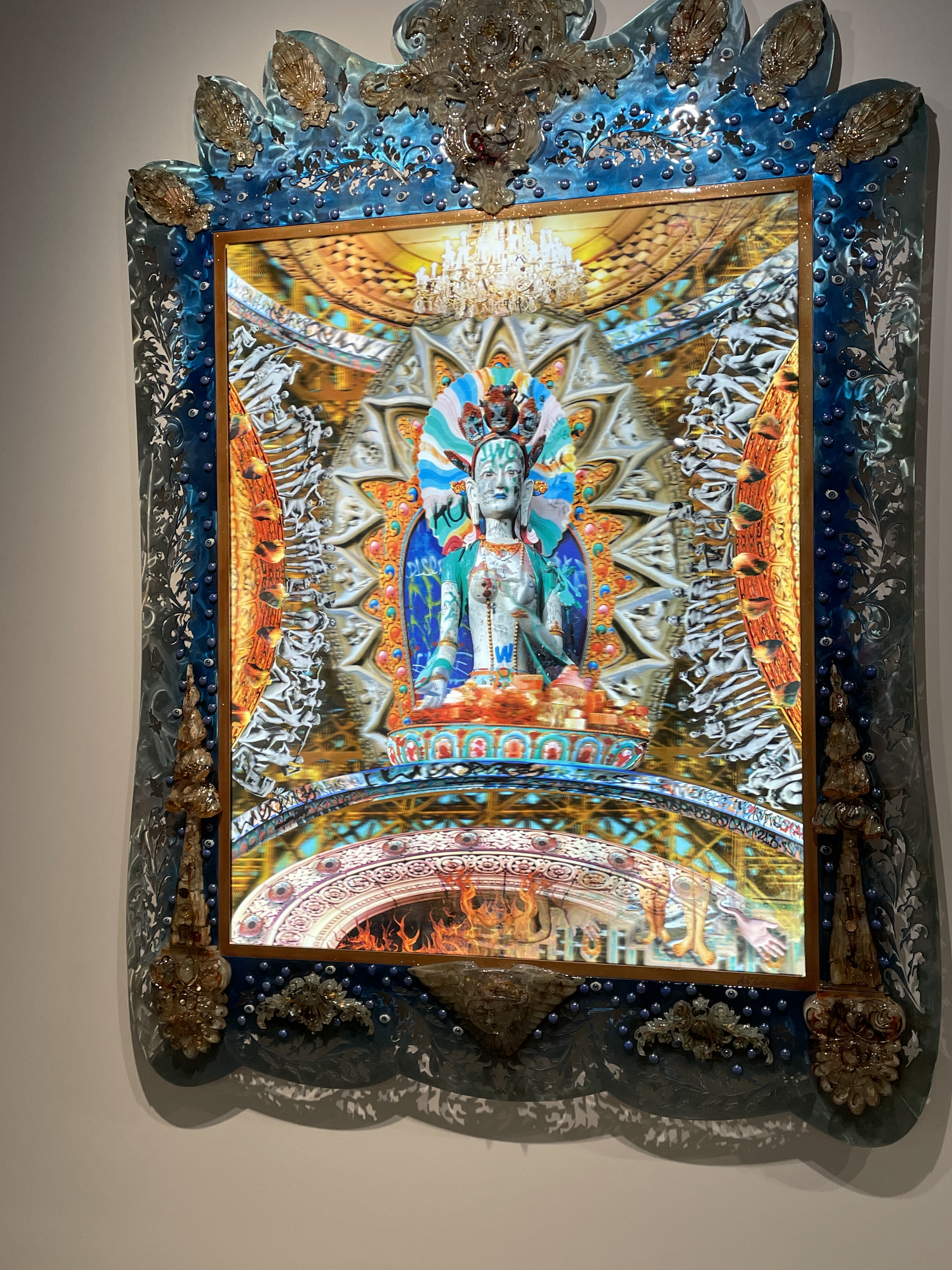
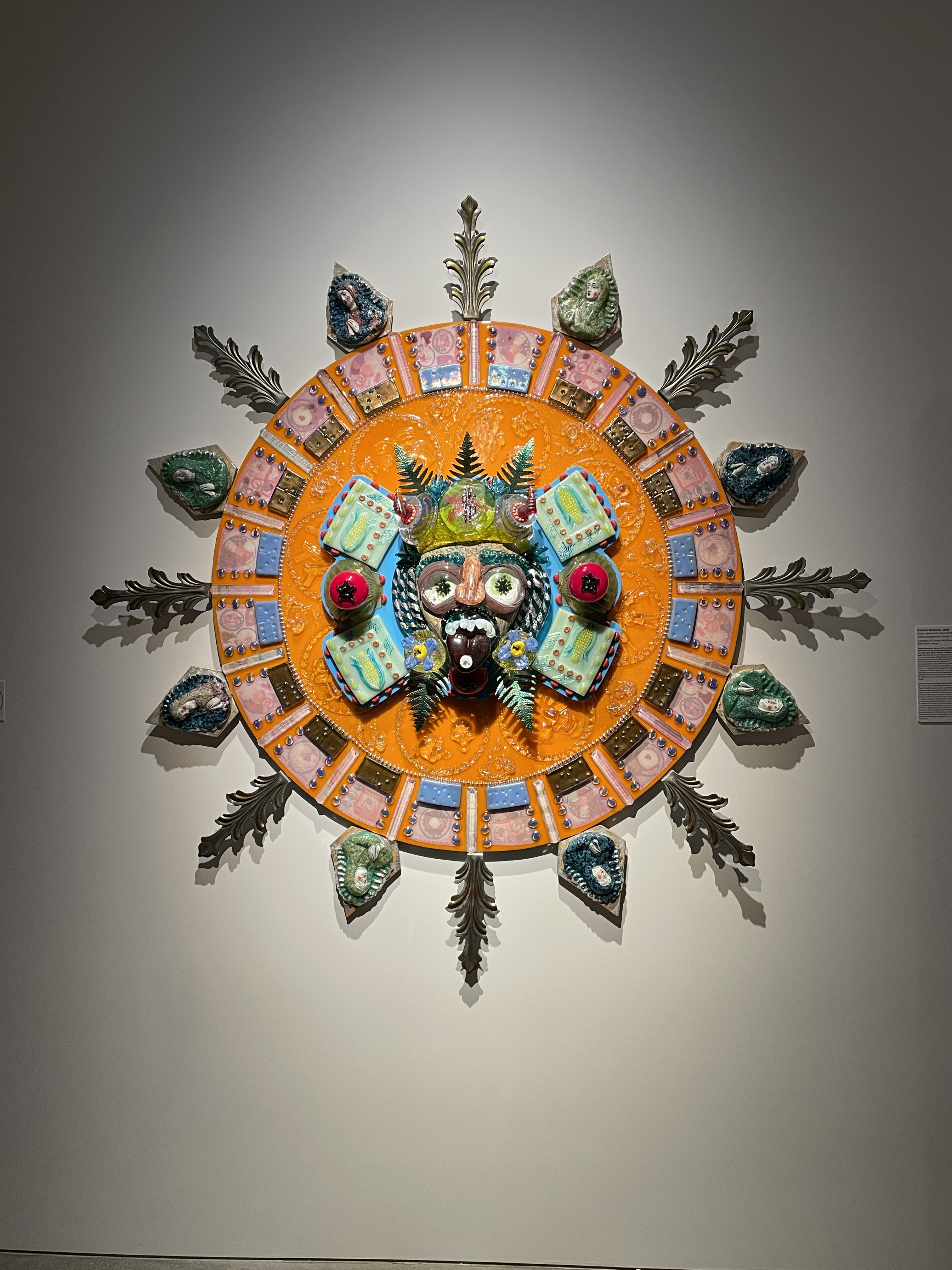
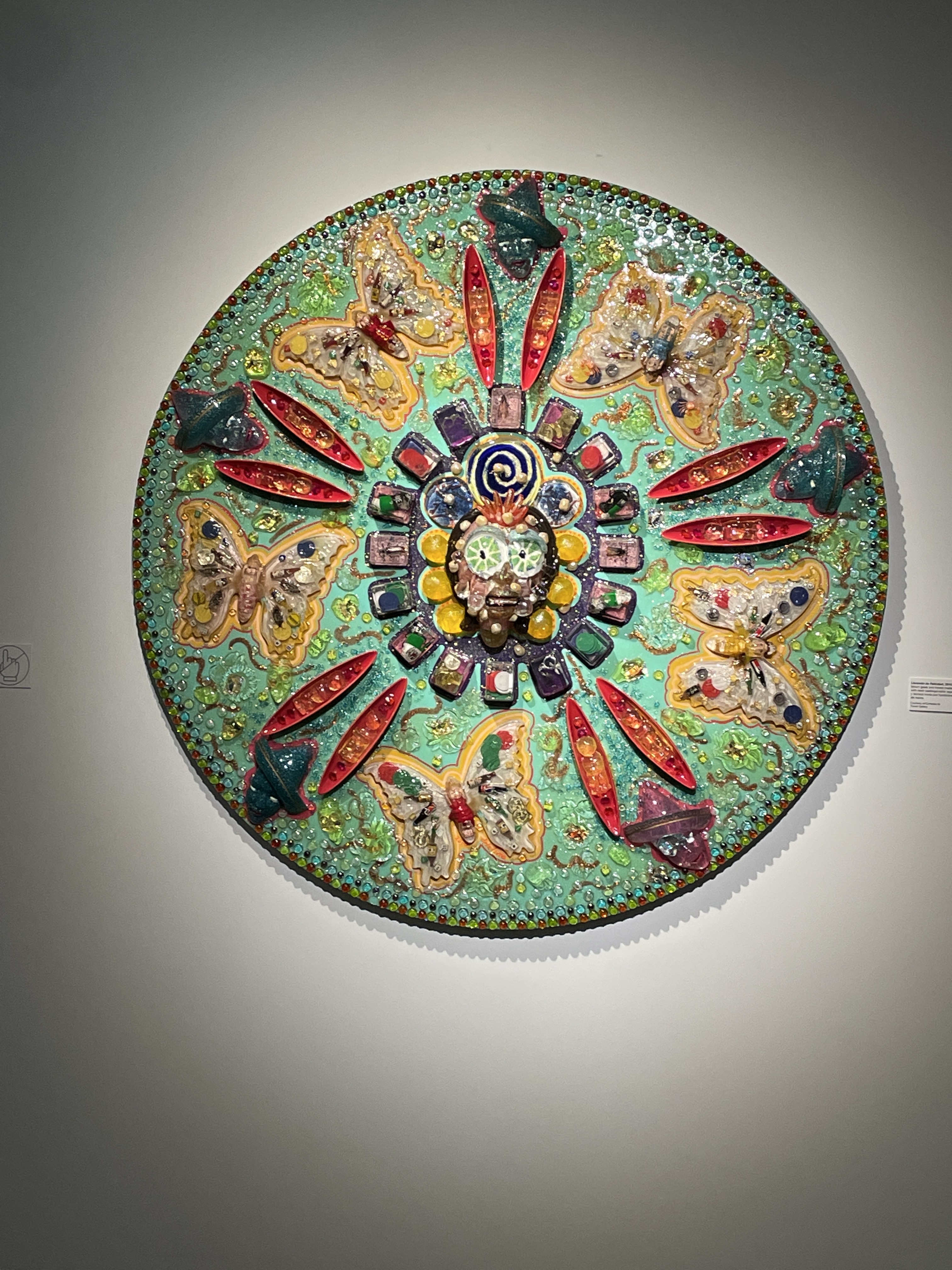
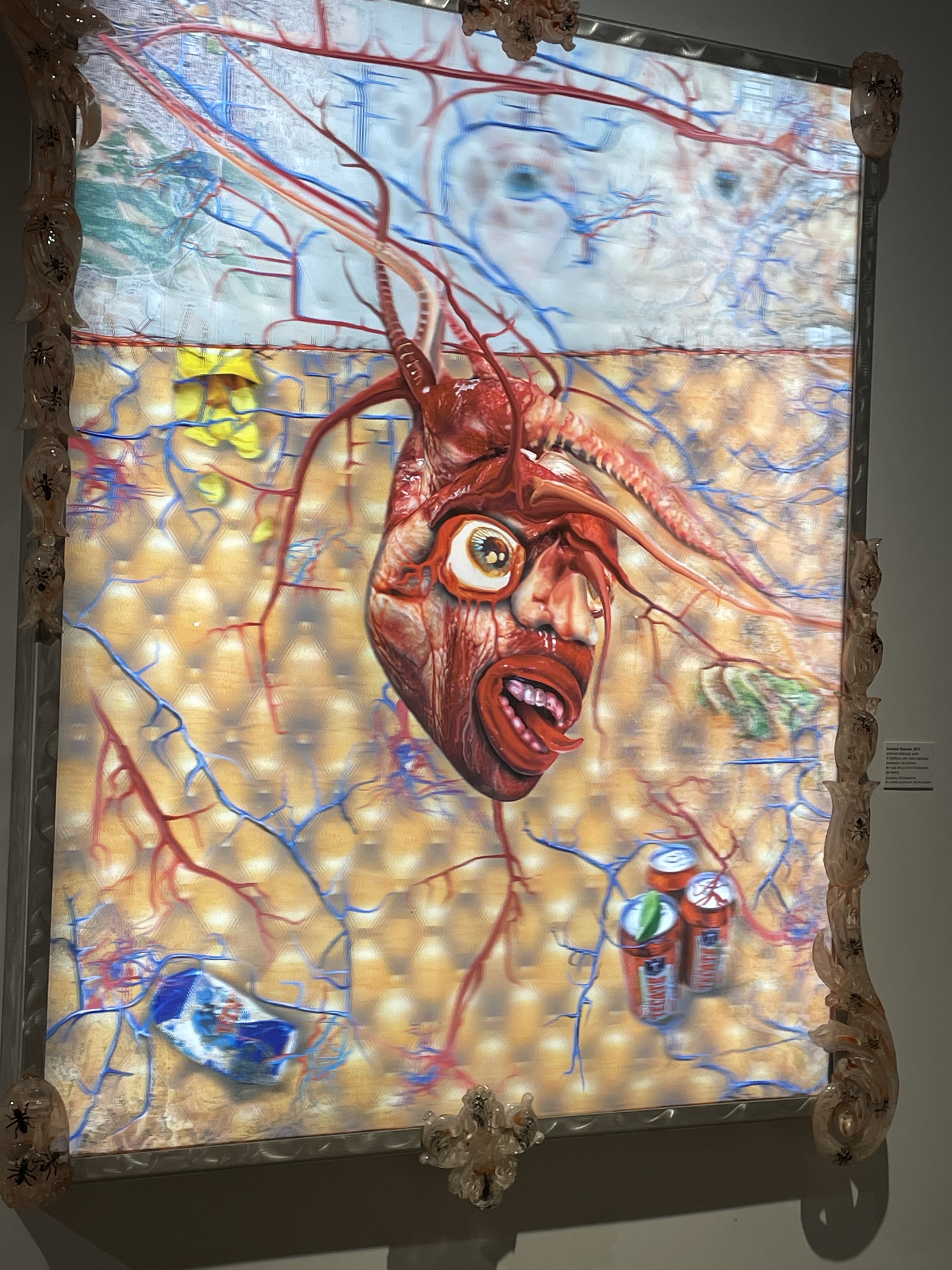
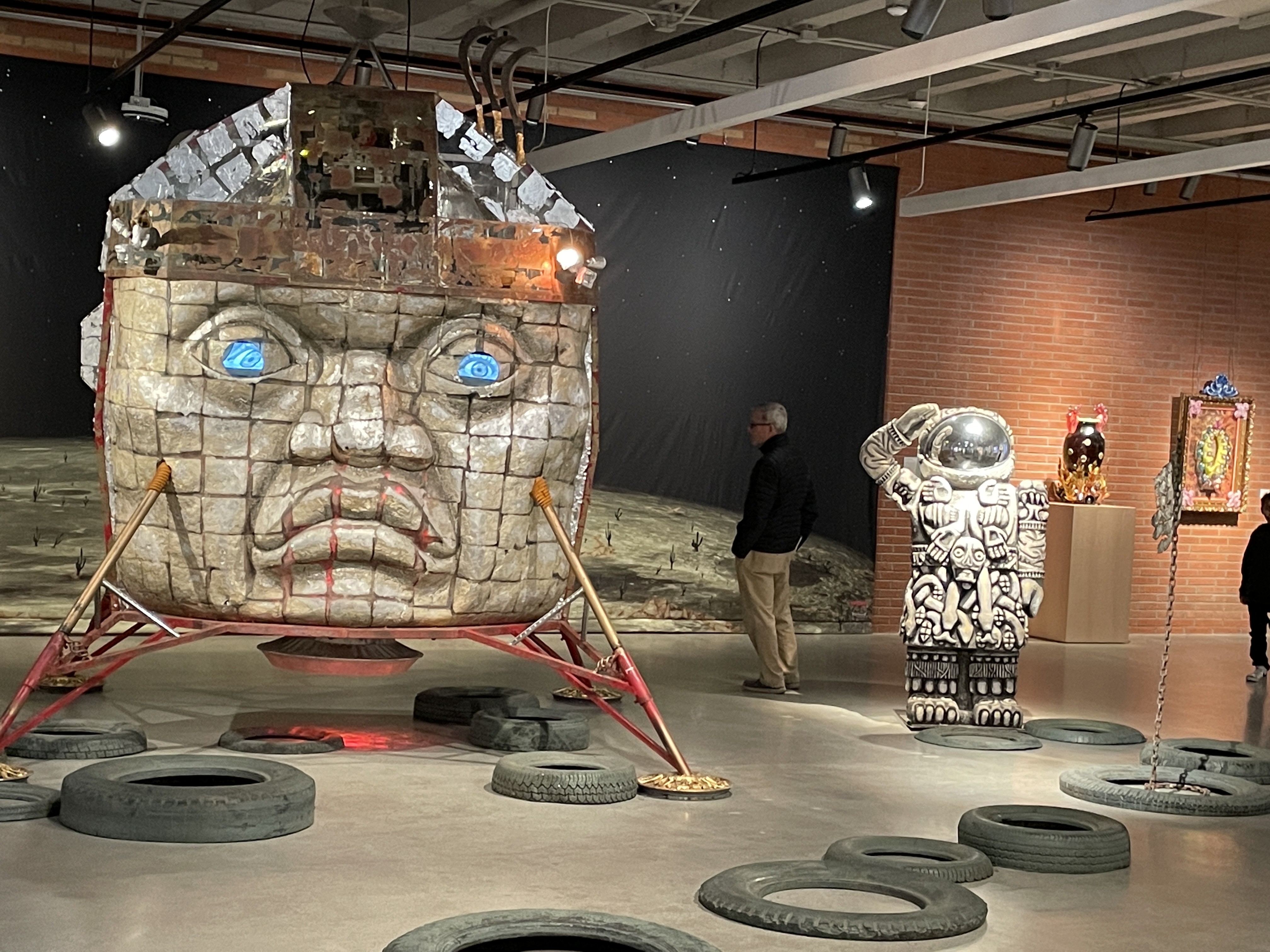
The second floor of the Cheech contains even more astonishing art including more multidimensional pieces except smaller than the giant one you see when you enter the building.

Depending where you stand in front, to either side, what you see is quite different. I kept thinking some old Flemish art or Hieronymus Bosch meets modern technology.

Much of the art makes a social or political statement especially about colonization, culture, poverty.

Some of the art is reminiscent of Mayan and Aztec calendars.

Hearts appear in many of the paintings.

And of course Frida.

This is a space ship with changing eyes. If you walk around the back there is a creature inside watching everything with monitors.

Fuerte


An “exercise” to write a poem about ones origins with the words I am from… inspired me to write this poem.

I am from the dark side of the moon, blood born, secretly shining.

Fuerte

I am from puma, stalking your memories, invading your minds,.

Fuerte

I am from Gottlieb, who left Swiss mountains 150 years ago at 18 to avoid

becoming a mercenary, moved to Missouri, created a farm. His cultivator

sets in my front garden.

Fuerte

I am from persons Gujarati, Bengali, Punjabi, who sailed seas, met strangers, loved.

Fuerte

I am from Esan, a Nigerian tribe about which I knew nothing until a DNA test revealed,

ancient, black, beautiful.

Fuerte

I am from Latin America, Colombian, Peruvian, Puerto Rican–wanderers, explorers.

Fuerte

I am from Slavic peoples. Byzantine, Macedonian, Alexander the Great.

Fuerte

I am from brave wandering ancestors–Asian, Latin, Toscani Italian, French, German, Swiss, Slavic, Iberian.

Fuerte

I am from J haploid group, people who left the northern Middle East 7000 years ago,

wandered, explored, populated Western Europe.

Fuerte

I am from farmers, Doyle and Barbara, who grew corn, wheat, soybeans, Hereford and Charolaise cattle

to whom I carried salt blocks as a child.

Fuerte

I am from Sacred Corn, the nourisher, singing on hot summers, growing.

Fuerte

I am from the sweet smell of Jasmine, Roses, Honeysuckle, winding up walls, overgrowing gardens,

giving people hope.

Fuerte

I am from lemons, figs, dates, pomegranates, golden, dark, red, tropical, lingering.

Fuerte

I am from Stars, universal child, born on sacred ground, singing infinite songs.

Fuerte

Italy–Sirens’ Song


As we drove along the Amalfi Coast, the guide told us the mythological story of the Sirens.  My daughter took a photo out the window of the Sirens’ islands.

IMG_2866

Later I wrote this poem remembering the travails of Odysseus.


The melodious Sirens’ song

lured Odysseus

begging to be untied from

the mast.

Even the roaring sea’s

voice whispered in

comparison.

They sang honeyed

love songs to starving

sailors, longing for a woman’s

touch, a kiss, ecstasy.

With knife claws, they

ripped them asunder,

crunching bones, blood

erupting.

Satiated, they sang,

eternal, etherial, deceptive.


Several days later at a shop in Sorrento, while my daughter was looking for a medusa cameo, the owner, a cameo artist, brought out Siren cameos.  He insisted the Siren’s have been terribly misunderstood.  I wanted clarification but unfortunately other customers appeared and I remain mystified.

Omnipotence: The Ultimate Homage to Male Dominance as Control by Carol P. Christ


I follow Carol Christ for a variety of reasons including her words often make me think about ideas, concepts, controversies in new ways.

Carol P. Christ's avatarFeminism and Religion

The concept of divine omnipotence is the ultimate expression of male dominance as control.  Divine omnipotence is the view that everything that happens in the world happens according to the will of a divinity, who is in control of everything that happens in the world. When someone dies or great suffering occurs, we are told, “everything happens for a purpose,” “it was meant to be,” or “everything happens according to the will of God—or Goddess.” In our recent book Goddess and God in the World, Judith Plaskow and I criticize and reject this view on both rational and moral grounds.

The doctrine of divine omnipotence is widely assumed, not only in Christian theologies, but in Islam and to a lesser extent in Judaism. Moreover, it is also to be found in western metaphysical and mystery traditions and in the many New Age and Goddess theologies based upon them. Thus…

View original post 931 more words