One Book A Week-28: “The Tea Girl of Hummingbird Lane”, Lisa See


My view of this book remains somewhat mixed. I know it was a best seller, but some parts of the storyline seem extremely contrived rags to riches stories without evidence to back them up. Nevertheless, it is a powerful novel about the ritualistic Akha tribal people of the southern Chinese region of Yunnan who were viewed as backward and remained mostly unknown until their superior Pu’er tea was discovered. Additionally, the novel explores Chinese adoptions, issues Chinese children experience when adopted by white people, and how so-called primitive practices, e.g. killing twins and banishing their parents, can change over time even in remote areas.

I prefer to read books that provide me the opportunity to learn something new. This book definitely provided that. Before reading this novel, I knew nothing about the Akha people, even though I have visited tribal areas not too distant, nothing about Pu’er tea or tea processing and how tea can be as valuable a commodity as gold. Pu’er tea is different from other teas because of the types of trees from which it is harvested and its unique fermentation process which makes it a probiotic.

One Book A Week-27: “Lucy By The Sea”, Elizabeth Strout


A short, honest, realistic view of life, this book by Strout, written from the viewpoint of Lucy
Barton, continues the story started in her book, “Oh, William”, where Lucy and her ex, William, go to Maine to seek out his long lost sister whom he did not know existed until he took a DNA test. Once again they head to Maine, but for a much more stressful reason, the Covid pandemic. They both live separately in NYC where Covid hit early and hard. After accurately assessing the danger, William finds a large, old house to rent on the Maine coast and convinces Lucy to go with him there to save their lives. He convinces one daughter to leave NYC but the other insists on staying.

The book addresses the issues of isolation brought on by the pandemic and how people deal with stress and isolation differently and with the difficulties which arise when once close families can no longer see each other. It also shows that isolation can bring the positives that can be found in a more quiet life. Strout’s uniquely simple style emphasizes the emotions and stresses as well as the joys life can bring to all of us.

One Book a Week-26: “Holding Fire: A Reckoning With The American West”, Bryce Andrews


If you LOVE the West, but sometimes struggle with its violent history, this is the memoir for you. Here is a quote from page 178: “I’m embarrassed at how long it has taken me to notice that a rancher’s view of the natural world is blindered in comparison to the hunter’s perspective; that driving livestock from one field to another is nothing like stalking free-ranging herds; that finding, gathering, and preparing a hundred different wild plants bears no resemblance to growing alfalfa or oats…”

Andrews also discusses the difference between sustainability and reciprocity. Before reading the book, I had never thought about this. He notes that sustainability is taking without damaging. Reciprocity entails giving back, e.g. nature, asking, “What can I give back? What can I do to take care of this place that feeds and shelters me?” This is quite different from “How much can I sustainably take?”

Andrews grew up in the West. However, after cowboying on several ranches in Montana, hunting annually, and later inheriting his grandfather’s Smith and Wesson revolver, he begins to question the gun violence and destructiveness of Western culture. This book details his journey. He continues to live on a farm in the Montana mountains, slowly transforming the land to make it profitable but also a place for nature, for wildlife to prosper.

An Afternoon Stroll at The Huntington


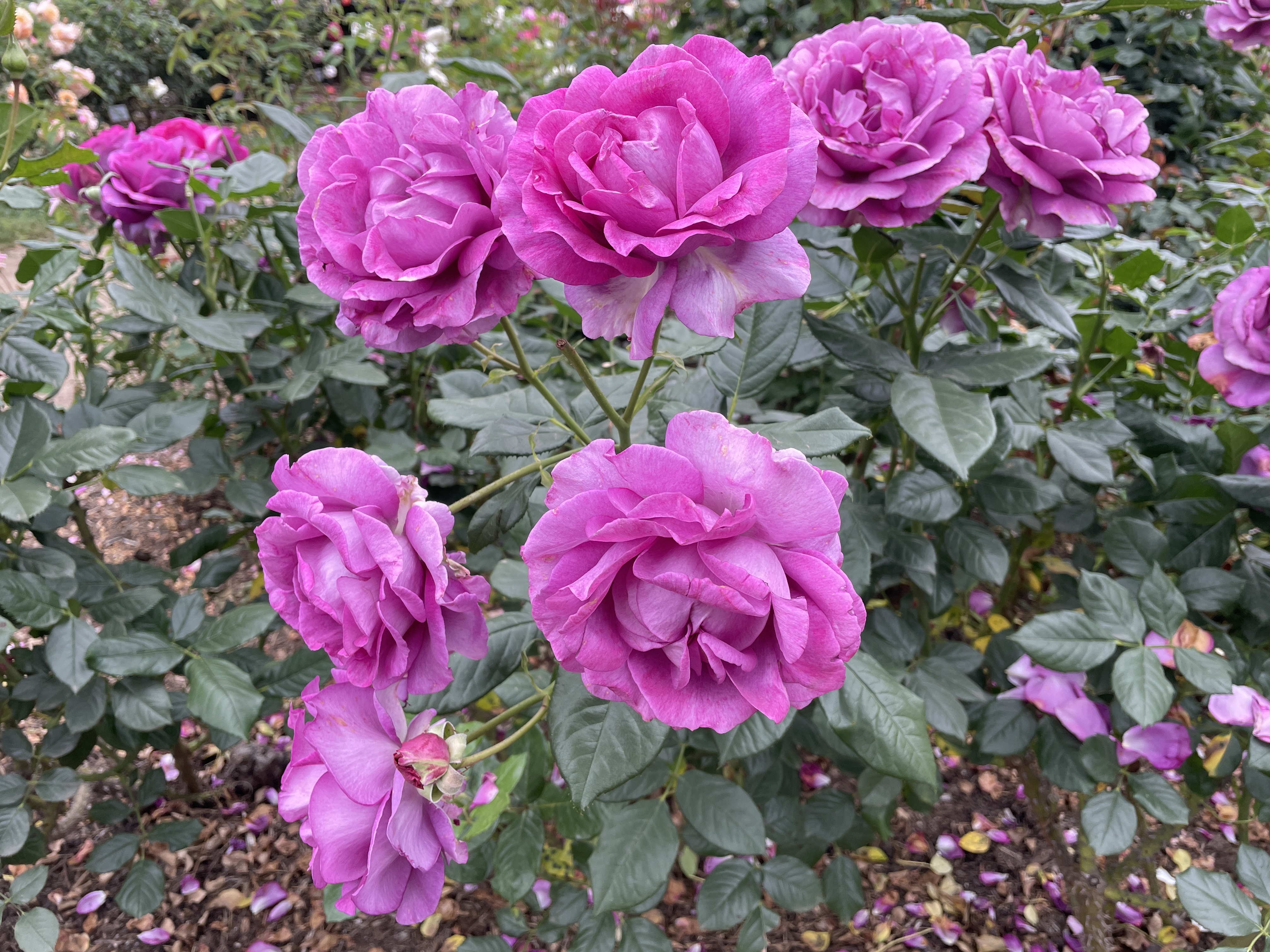
Friday, I decided to look around at parts of The Huntington since I had not been there in a while. For one thing, I knew the roses would be in full bloom, and even though I had been there a number of times, I had never looked around the rose garden. They did not disappoint.

Find the bird among the roses.

The building is the newly reopened Tea Room.

This rose has perfume as part of its name and smells divine.

I left the rose area and strolled in the herb garden seen above. Then I found a new kind of artichoke, Opera Artichoke. See below.

Facing away from the rose garden I could see all the way to downtown Los Angeles.

This tree is labeled Naked Coral.

Then I strolled through the tropical garden area.

Fig trees.

After leaving the tropical area, I wandered around cactus and succulent gardens.

Trip to Lucky 5 Ranch, near Julian, CA


Yesterday I drove to this place about six miles south of Julian, CA, a small, touristy, mountain town east of San Diego. Owned by the Nature Conservancy, the ranch abuts Anza-Borrega Desert Park, but this area is not desert. On the way, I drove through at least four Indian Reservations on Highway 76. California has more Native American residents than any other state.

This is Lake Henshaw on Highway 76 on the way to Julian. It is so full now that tops of trees stick out of the water. People told me that last year it was more like a big puddle.

The three mile hike was not long but quite strenuous as we climbed approximately 800 – 1000 ft. in altitude on the hike.

Lots of wild flowers everywhere due to abundant rain this year. We had to find parts of the trail because it had not been used since before Covid and was overgrown.

Views of Lake Cuyamaca which we could see in the distance as we climbed up and down.

The manzanita are in full bloom and luxurious this year. There were other flower the names none of us knew.

Lupine.

We kept climbing up steep slopes higher and higher. The climb was more difficult because lots of loose, little rocks and gravel in many places.

Where we ate lunch at the top which is slightly over a mile high. There are these dead, bleached out branches everywhere, the result of a big fire in 2003 which killed a lot of plants and some of it has never recovered.

Lunch up high among the rocks.

A different type of yucca than grows everywhere in the many other places where I have previously lived.

On the way down from the top. Everything is still quite green here and there were storm clouds in the distance.

Some people call this California lilac. It grows everywhere here and is in full bloom glory.

Baja Trip-7: Tres Mujeres Winery


Originally started by three women–see the name, this woman is the only one of the three left as owner. She said she has been doing this for 20 years. The vineyards keep healthy without the use of toxic herbicides or pesticides. She says the breezes from the ocean help with keeping the vines healthy. She also has olive trees and gardens and a small restaurant–outside. The vegetables, flowers, etc. used in the restaurant are grown there. Below is the salad we had for lunch.

Lunch under the trees.

Wine tasting underground. What you notice when you drink all natural wines is that at the bottom of the bottle there is usually a residue.

The path in and out of the tasting room.

Buildings and fences made of local stone and flowers everywhere.

Stones, some quite large, show up everywhere in this part of Valle de Guadalupe. Some buildings, restaurants, other wineries, houses are build around the rocks with rocks as part of the architecture. I took the following photos from Tres Mujeres.

A lot of Valle de Guadalupe reminded me of parts of New Mexico and also the rocky hills around Temecula, California.

Not only are there over 100 vineyards in this valley but also endless olive groves. Locally pressed olive oil can also be purchased at many of the wineries. The other specialty is cheese. We stopped at one shop, the Cremeria Los Globos where they specialized in many cheeses filled with chipotle, black pepper, you name it. Honey is also produced locally and for sale at many wineries. For the most part, everything is all natural.

Baja Trip-4


Off to another winery, Santo Tomas, after visiting the fish market where I glanced at all the fish and saw fish I could not begin to identify. This winery is in a different valley, Santo Tomas Valley, and the second oldest winery in Mexico. Although their official sign says it is 130 years old, it is actually older and originated years before that to produce wine for communion and the Catholic Church.

Rather than have the wine tasting in a building or patio, here they put us on a wagon pulled by an old tractor and transported us to the vineyards where they drove around then stopped to give us various wines to try while we sat on the wagon. Our guides brought along cheese and other goodies for snacks as we tasted the wine.

The main building for production.

Vineyards for miles. They have 800 acres of vineyards mostly in this valley but a few in another area we did not visit.

Baja Trip-3


After visiting the winery in the previous trip post, we headed to another winery, Las Nubes (The Clouds), for more tasting and lunch. We did not visit the cellars here but the lunch view was spectacular as were the sandwiches. Like many other buildings at other wineries, a lot of the building material is local stone.

Taken from below the winery and restaurant area. Then off we went to winery three for the day, Clos de Tres Cantos. This winery is created with a philosophy dedicated to making natural wine, caring for Earth, and blending into nature. They also have deliberately grown varietals that can best withstand climate change. All the buildings are made from local materials and designed by a local architect.

A wall made from wine bottles.

A shrine to the Virgen de Guadalupe with wine aging to the side.

A natural roof of soil and flowers.

From here we drove through the countryside to La Laja restaurant for dinner. It is located way out in the country where they grow what they serve except for the fish which is locally caught in Ensenada area. It is rated as one of the top 50 restaurants in Latin America. We experienced a six course meal including two desserts, one of which was a slice of mango steeped in mescal.

Baja Trip-2


Day Two we visited several wineries and went to dinner at one of the top 50 restaurants in Latin America, La Laja. The following photos are from the first winery where we not only tasted various wines but also took a tour of their remarkable wine cellar dug deep into solid rock.

This is the name of the winery and each barrel is marked with varietal, date, etc.

The hills in some part of Valle de Guadalupe reminded me of the hills near Temecula, CA.

Here you can see how the cellar is dug out of the rock. The rock was oozing moisture due to the unusual amount of rain they received this winter.

I loved this message so much I had to take a photo of it.

I wish I could find a duplicate to hang outside on one of the empty sides of my house.

The wines here are all natural. Many of the wineries we visited do not use pesticides or herbicides.The sophistication of many of the wineries in Baja is very impressive.

National Poetry Month: 1: The Kingdom of Trees


An essence within the heart of trees

allows them to communicate

with other trees to

-aid each other when disturbed

-send secret signals, warnings to other trees

-express pain, sympathy.

The kingdom of trees now cries

worldwide in pain,

watching each other’s murders.

land laid naked, nature destroyed.

Note: I wrote this poem last year. It is published in the anthology, “Writing Through The Apocalypse, Pandemic Poetry and Prose”,

Editor: Marcia Meier