Like Tequila, Love Bats


Tequila is made from a specific species of agave plants that grow in certain areas of Mexico and Southwestern United States.  Did you know:  no bats, no tequila?

The Mexican long-nosed bat (Leptonycteris nivalis) remains crucial for tequila production because they pollinate tall, column-like cactuses and the blue agave from which tequila is made.  No bats, no agave, no tequila.

Every year these bats migrate from Central and Northern Mexico into the southern areas of Texas, Arizona, and New Mexico and they are endangered.  These bats have been listed as an endangered species since 1988 in the US and since 1991 in Mexico.  Researchers at New Mexico State in Las Cruces are part of a conservation network working with Mexican counterparts to save these bats.  And tequila.


ACoE Invades South Texas


No regard for precious wildlife, no regard for property rights, no regard for anything.

Jude Lieber's avatarJude Lieber

Photo caption: Snapshot from one of my trips to the Rio Grande — Big Bend National Park hot springs with with wild mustangs on the Mexican bank.

We knew this was coming, but it doesn’t make it any easier. Trespassing on private soil, our own Army Corps of Engineers (ACoE) have begun clearing areas for the border wall. Rather than steal land legally through eminent domain, they have arrived without permission or notification. Instead of cutting through ranchland, they have begun where it will hurt the most — nature preserves. The first location to fall beneath the saw, machete, and blade is a strip through the National Butterfly Center. Scientists had purchased the area from farmers and restored it with plant species vital to the survival of the threatened monarch butterfly. Now, only brown stubble remains. The wall will block the migration of thousands of land-based animals, cutting their territory…

View original post 369 more words

Trip to Honey Island Swamp


On our third day in New Orleans, we headed to Slidell, LA, to visit the swamp.  Many swamp tours exist in the area and some in Lafayette as well.  After reading extensively online about the various tours, I decided to take Dr. Wagner’s Honey Island tour early in the morning.  Depending on traffic, it is about a 3/4 to one hour drive from downtown New Orleans.  For at least half this time, you are driving on a bridge across Lake Pontchartrain.

IMG_2773

This little swampy area is right next to the small cabin where they sell alligator souvenirs and you pick up your ticket.  This place requires cash.

IMG_2747

After boarding the boat which holds about 20 passengers, we headed down the Pearl River.  This view looks upriver.

IMG_2748

Many expensive houses rise above the river banks.  You can see the for sale sign.  According to the boat captain, the fancier ones cost about one million.  However, for all the elegant houses, there are more just the opposite and close by.

IMG_2750

Like this one which appears boarded up.  Some appeared abandoned, some in decent repair, some recently used.  When we asked how high the water rose during Katrina, we were told that it would be above the roof of a house like this.  The tours were abandoned for over a year after the hurricane except for the occasional hurricane cleanup crew who wanted a tour.

IMG_2749

This is one of the nice houses along the river, modern, large, well kept.

IMG_2751

We saw a large blue heron, wings outstretched, sunning itself on a large tree stump.  When the captain tried to get closer, it slowly lifted off and flew away before I could get a photo.

IMG_2757

We turned to the right off the river and began to see alligators of all sizes.  Because of harvesting for skins, meat, etc., few really large ones remain.  More common is 8-10 footers.

IMG_2762

Even the boat captain was astonished at the number of alligators we saw.  They seemed to be everywhere and one exceedingly large male followed us deeper into the swamp.

IMG_2764

Although the water flows rather rapidly on the river, once in the swamp, the water is very quiet.  Many different types of trees live here including cypress.  Most of the trees are deciduous and lose their leaves in the winter.  I was extremely surprised to learn how cold it can get here, below freezing, sometimes even down in the teens.  However, the captain said it always rises above freezing during the day.

IMG_2765

IMG_2766

Most of the really large cypress have been cut down in the past for lumber.  Now this is a reserve.  The tree on the left is really large and a lot of moss hangs from it.

IMG_2767

Hogs, like these, are not native anywhere in the Western Hemisphere.  It seems feral hogs can live anywhere.  We also saw raccoons.  The trees and other vegetation are so dense during the summer, wildlife could be a few feet away and remain unseen.

IMG_2769

IMG_2772

The swamp possesses a wild, magical beauty.


Star Tree – Star Goddess by Judith Shaw


See the paintings. With deforestation affecting so much of the world, the idea of trees as sacred is especially appealing and meaningful.

Judith Shaw's avatarFeminism and Religion

judith shaw photo

In a world where humans were small and nature was big, surrounded by forests of trees of immense size and stature, it’s not surprising that the ancient Celts came to hold trees as sacred. Like many others, the Celts revered the World Tree or the Tree of Life as the mythic bridge between heaven and earth. The roots reach down and ground with the Earth while the branches spread their canopy up to the heavens.

View original post 745 more words

Rita Blanca National Grassland


Today, three of us drove up into the northwest corner of the Panhandle of Texas to visit this national grassland which adjoins the Kiowa National Grassland in New Mexico.  The two grasslands together equal more than 200,000 acres.  Originally, created after the Dust Bowl in an attempt by the government to mediate the destruction caused by the giant Dust Bowl storms, the grasslands are now managed by the US Forest Service.  The US acquired much of the land when its owners gave up and left the land owing money to banks.  As a consequence these national grasslands are interspersed with privately owned grassland.  Ranchers, some of whom refer to themselves as grass farmers, can lease this land and graze it along with their adjoining property.  Moderately grazed land often supports a more diverse wildlife and plant population than overgrazed or ungrazed land.

To reach the Rita Blanca we drove past Dalhart, Texas, and turned on a Farm to Market road which led to an area with camping and picnic tables plus restrooms.  Campers and picnickers must bring their own water.  The only trees are those deliberately planted in days long past.  We saw or heard many birds there, including orioles.  Below is the entrance to the Thompson Grove camping and picnic area.

IMG_2719

After a comprehensive briefing from the park ranger, a wildlife biologist, and a range specialist, we took a hike across the grassland.

IMG_2721

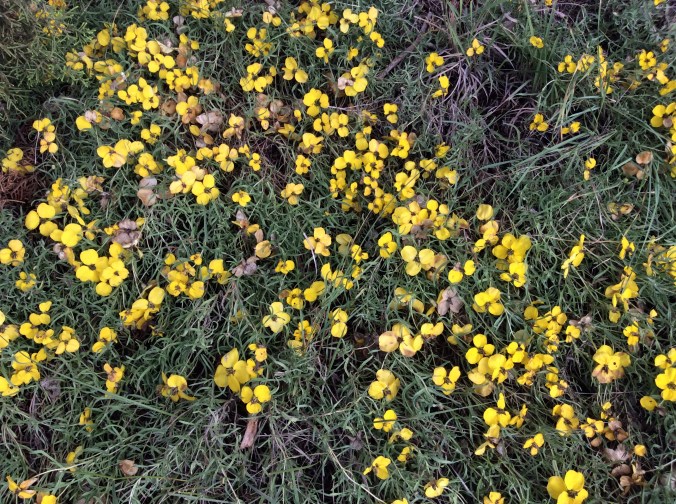
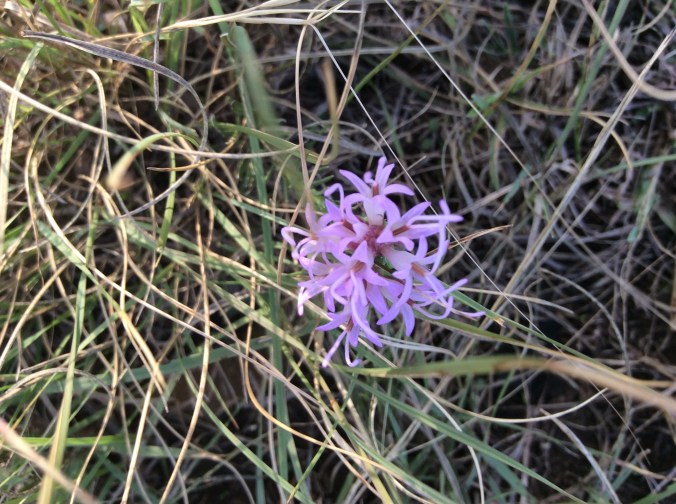
While this may look like a boring green sea to some, upon close inspection, this land teams with many species of grasses and flowers.  Flowers I saw today include Fineleaf Woolly-White, which is not white but bright yellow, Prairie Zinnia, Broomweed, Sundrops, Engelmann Daisy, Mexican Hat, Winecup, Tansey Aster, all of which I have at my own place an hour and 1/2 away.  However, I saw two flowers I have never seen before, White Pricklepoppy and a native Morning Glory which has huge hot pink flowers. While the Pricklepoppy has spectacular, large white flowers with gold centers, the plant looks like a very prickly grayish thistle.

Although I knew some of the species of grasses there, I could not identify the others.  However, the park ranger knew them all.  I might remember some with the help of a book.  Many I have around my land but still cannot identify all of them.  I do know blue grama, side oats grama, buffalo grass, and a few others.

Many grassland and wildlife research projects done there produce useful information.  One current project deals with seismic activity.

If you are driving cross country anywhere near Dalhart, Texas, or Clayton, New Mexico, take a short break and head to these grasslands.

IMG_2720


Grateful


Six days ago a huge storm struck, including eight inches of hail, a rain deluge, and high winds.  While the hail denuded many plants and bushes, the deluge made my drive a mess.

IMG_2711

Although it may be hard to determine the depth of the gravel and dirt and rocks from this photo, many of the rocks are bigger than the size of the fists of both my hands together, large enough to not want car tires to drive over them.  The gravel and dirt on the far side of the photo were at least eight inches deep.  Luckily I have a small tractor with a bucket and a helpful grandson.  He picked up the larger rocks and hauled all of them to the ditch created either side of the steep incline above the cement.  The rain had created a trench a foot deep in some places and exposed a pipe to the septic system. He filled parts of these trenches with the bigger rocks.

The next morning I used the tractor bucket to scoop up dirt and rocks and haul them to washed out places in the upper drive.  It was impossible to get it all with the bucket given some of the space is not very big or where it was possible to maneuver the tractor.  Therefore, I had to scoop it up and remove it with a shovel.  It took several tractor buckets full to get rid of what I had to shovel.  Finally, this morning I finished sweeping the rest of the fine sandstone off the cement.

After all this, why am I grateful?  There was no damage to my house.  The hail broke windows in some houses not far away, the wind blew light weight buildings into neighbors’ yards, and some people nearby had roof damage. I only have some tiny damage to the barn roof.  It could have been a lot worse.  I feel grateful to have escaped with just a messed up driveway.

Why do I feel even more grateful?  It occurred to me that I was able to clean up most of this except for my grandson’s help with the rocks–which I could have done but it was helpful.  I can still shovel gravel and dirt, a lot of it, lift and carry 50 pounds of horse feed from the vehicle across the barn–about 40 ft or more–and dump it in the container. I can work for hours doing this sort of stuff and feel fine afterwards. Yes, I feel grateful that I can continue to do all these things myself and what is more, usually enjoy doing them, feeling productive and independent.

When people ask me how I do all this, I usually tell them two things, yoga (as well as lots of other exercise mandatory if you live in the country and have animals) and heathy food.  My yoga practice began decades ago; I never stopped.  I practice it at least three times a week, sometimes more.  I stand on my head in the middle of the room several times a week.  My favorite foods are mostly vegetables.  The only carb I really like is rice. One of my dad’s sayings was, “You are what you eat.”  He still ran a farm at 90.  Yes, I admit, genes probably help, but without the exercise and self discipline, it probably is not enough.  I also meditate daily which does not require lots of time unless you want to spend lots of time doing it.  Even 15-30 minutes a day matter.  Exercise, yoga, healthy eating, meditating will all make for a happier person.  I promise.


Weekend Adventure


This past weekend my family had to return to Tulsa, Oklahoma, to finish some family business.  While there, we decided to explore as well.  After completing what we needed to accomplish on Friday, we decided to check out the Tulsa Zoo located in Mohawk Park.  Tulsa Zoo contains lots of green, open spaces, and some extremely interesting architecture.  For example the Malayan tigers live in an area made to look like ancient, abandoned temples.

IMG_2682

Then there are animals I have never even heard of before like the siamangs.

IMG_2686

I was surprised to see komodo dragons.

IMG_2681

The intensity of the colors in the American flamingoes never cease to amaze.

IMG_2690

IMG_2691

Apparently, the rest of my family liked them as well.

IMG_2689

The next day, Saturday, we decided to head east through the Cheyenne Nation to visit Natural Falls State Park. If we had known what it is really like, we would have taken a picnic.

IMG_2693

The area above where the falls drop off.

IMG_2697

IMG_2698

Dripping Springs

IMG_2700

Just below the falls another stream enters and then flows down to a lake.

IMG_2709

The lake becomes larger as it flows farther.  It is a moderate to difficult hike getting to the lake.  Fishing is permitted here.  This park is also a good place to camp.

While gone, a giant thunderstorm arrived at my house with 8 inches of hail and three inches of rain in a short period.  Although the juniper trees look close to normal, most of the deciduous plants were denuded.  I have no idea whether they will recover.  A few of the small native flowers appear normal.  Luckily, my house was not damaged. However, this evening with my grandson’s help I will tackle the drive which is full of about 8 inches, in some places, of dirt, rocks, and gravel.  Luckily, after removing the larger rocks, I will get most of it with the tractor bucket and move it back to where it belongs.

Hazy, Lazy Days


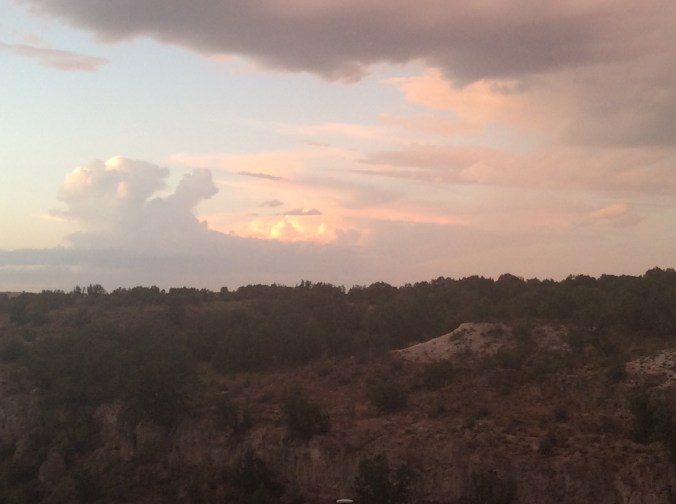
The words and tune to this old song float through my brain.  Summer.  Early morning yoga, coffee, horses fed, flowers watered, a lazy lunch:  salad with feta, black beans with caramelized onions.  Slouched, reading a book (The Return, Hasham Matar) on the sofa, feet crossed on edge of coffee table, patio doors open, I hear birdsong, the whir of black fans in the ceiling sea of white.  Summer. Nap time.  Awaken slowly, eyes watching cotton candy clouds barely move across an azure sky.  Summer.

IMG_2671