One of the saddest books I’ve ever read, this short piece of nonfiction details not only the life of Crazy Horse but also the demise of the traditional lifestyle of the Plains Indians. Crazy Horse has been the subject of endless legends and myths, many of which apparently have nothing to do with reality. He was not a chief; he often defied traditional Sioux customs. He was very much his own person. Among his people, he was especially known for his kindness and support of the poorest and weakest and for his prowess as a warrior. Crazy Horse died young due to not only white betrayal but also that of some of his own people.
I highly recommend this book if you are interested in this particular period of US history. At the end is a comprehensive list of sources with notes about each one of them.
While I found her first book, “The Tiger’s Wife” fascinating, I remain uncertain regarding this one. First it is long, 374 pages (I do read long books); second, it tells two different stories which do not interconnect at all until the end of the book. I kept wondering, asking myself, “What?” For me at least, the story picked up about half way through and my interest greatly increased.
One storyline is the life of one homesteading family in rural Arizona in the 1850s told mostly from the viewpoint of the wife. Her husband tends to wander off for long periods of time leaving her on her own with their children. His latest adventure is not only their homestead but also owning and running the local newspaper in the nearest town. The reader also meets some rather powerful but unsavory characters who want to own all the cattle and all the land.
The second storyline deals with the men who were hired by the government to bring camels to the West and manage them, one of whose story–a real historical person–is told. His name was Ali, a Syrian cameleer, who died in 1902. He was called Hi Jolly because people in US seemed unable or unwilling to pronounce his real name correctly. This part is told from the viewpoint of another cameleer, Hi Jolly’s friend, who has a criminal history and is trying to elude the law. Camels were brought to the US by the United States Camel Corps in the 1850s. At that time few roads existed in the Southwest, water was scarce, and camels were known to be able to go long periods without water. The experiment failed so camels were left either in the hands of the individuals who rode and cared for them or left to roam wild. Some of the men, including Hi Jolly, were able to open businesses transporting goods to remote areas via camel. This book details part of that history.
In both storylines one recurring theme is the lack of water. At one point the homesteading family have no water at all. In the other storyline people hire the cameleers to take them to places not realizing that even camels need water occasionally. I find it telling that 175 years later we continue to struggle with water issues in exactly the same part of the country.
Several weeks ago, I spent a day wandering around the ancient sites where native peoples gathered over a thousand years ago.
This explains the extensive influence this place, located in the northwestern New Mexico desert, held for people from as far away as Central America. To reach this park, you have to drive on a dirt/gravel, rough road for more than 25 miles north of Crownpoint, NM. It is definitely worth the effort. However, it is impassable in rainy or snowy weather. The rangers who care for the park live there.
One of the first things you see as you get closer to the park is this rock tower, Fajada Butte.
Archeologists climbed to the top and discovered petroglyphs, “Sun Daggers”. Created between rock slabs, they align with each solstice and equinox and at these events the light projects to other sites, e.g. Pueblo Bonito. Other petroglyphs on a section of the canyon wall represent a supernova that occurred in 1054 CE.
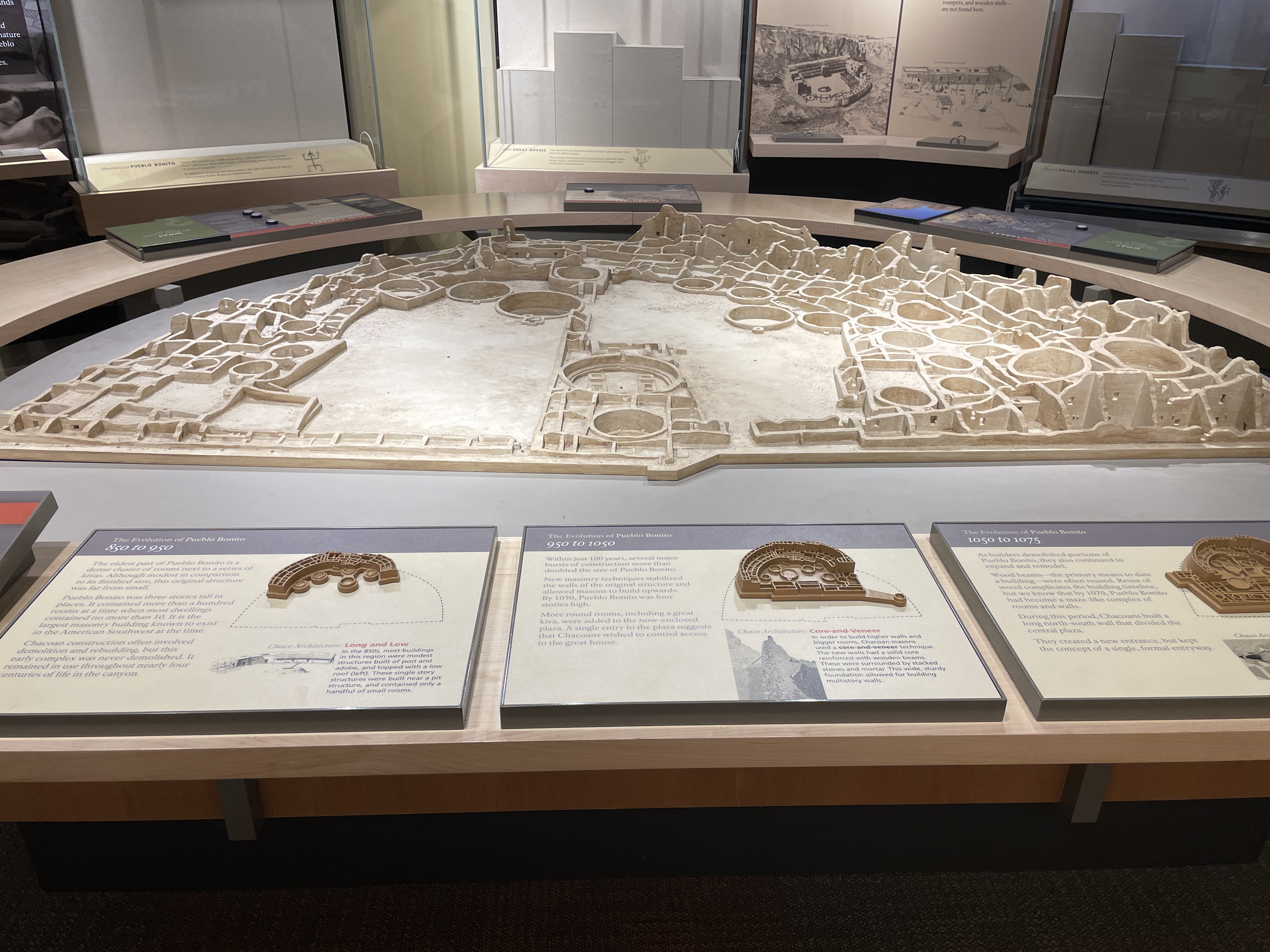
The following depicts an overview of the site as it would have been in the past. In the 1940s part of the wall of rock behind the site collapsed onto it and destroyed some of the buildings.
Here is how it looks today. Many of the doors and windows align with astronomical events, e.g. solstices, the two equinox, and astronomical events that occur only every 17 years.
All sites here contain many kivas, many of which are very large. It is speculated that these were used for various sorts of ceremonies, including religious events.
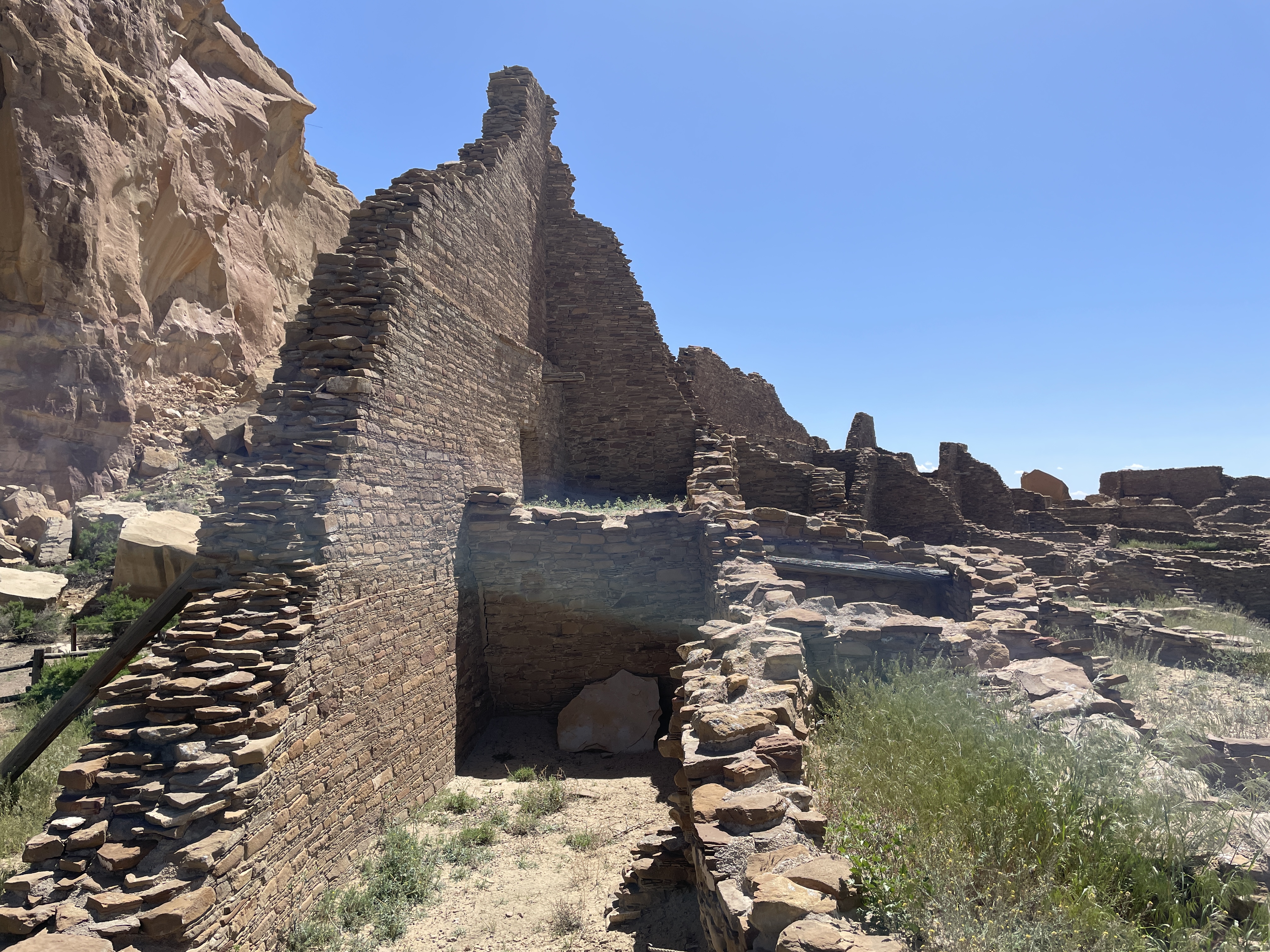
In this view you can see how the rocks that fell from the cliff have destroyed parts of the structures.
Many of the buildings were several stories high. In their heyday, they did not look like this. They were covered with something like stucco and painted white. What an impressive site they must have been–large white structures in the middle of the brown desert. Archeologists think few people lived here. It was a place for gathering, for ceremonies, for trade, for people from long distances to meet.
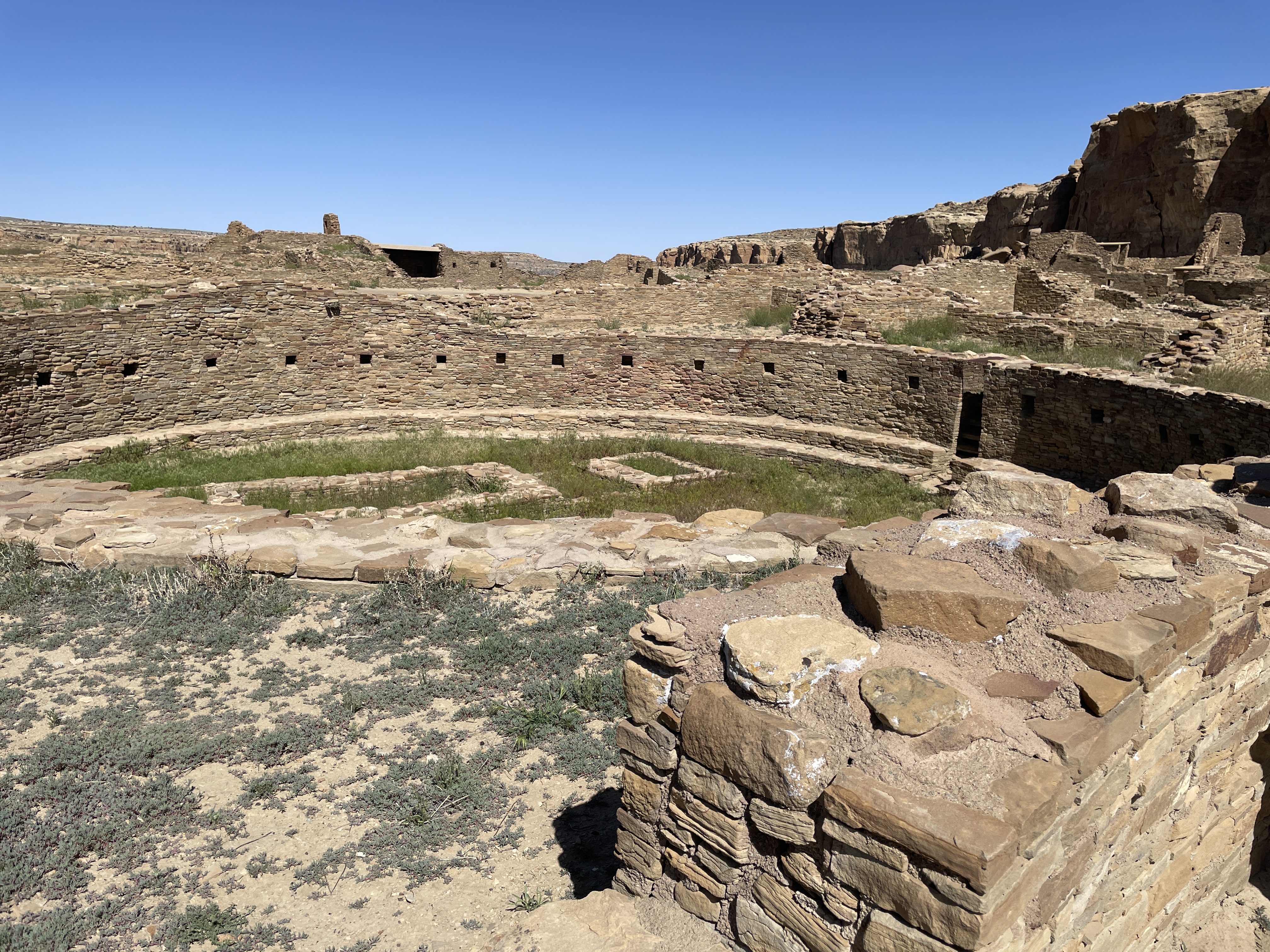
Across from Pueblo Bonito is the largest kiva found in the area.
Behind the bars on the far side of the photo is an area that was used for ceremonial dancers to don their costumes. At the bottom you can see a depression with a small door. Before centuries of sand filled it in, this place would have be large enough for the ceremonial dancers to enter through it.
If you follow a trail along the cliff from Pueblo Bonito, you will find another area built at different times hundreds of years ago.
Another large kiva and many smaller ones are located at this site, including this famous long wall built at two different times.
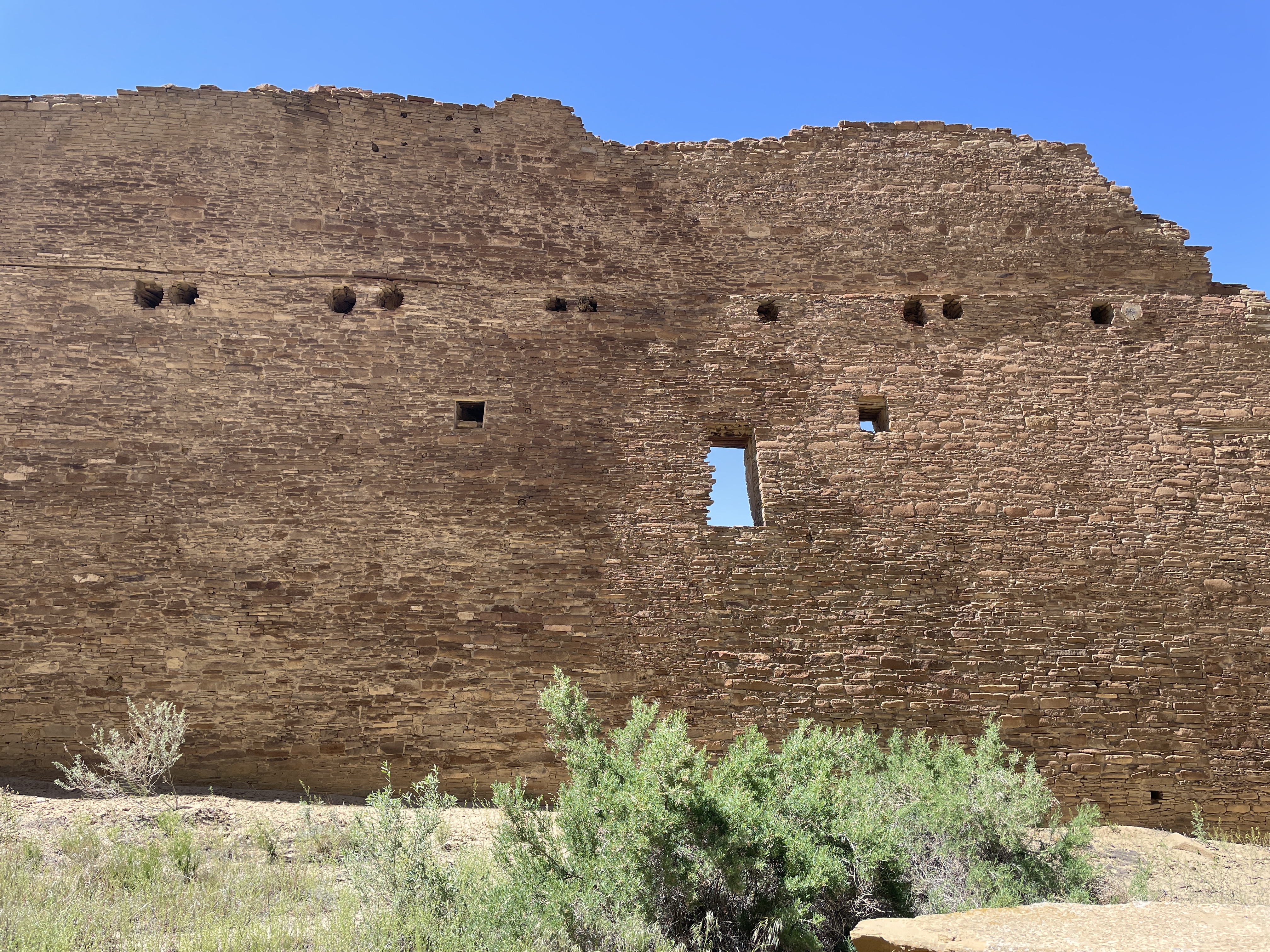
The following shows where at some point the wall stopped, then later it was continued using somewhat different building material and techniques.
The top photo is considered the newer part of the wall.
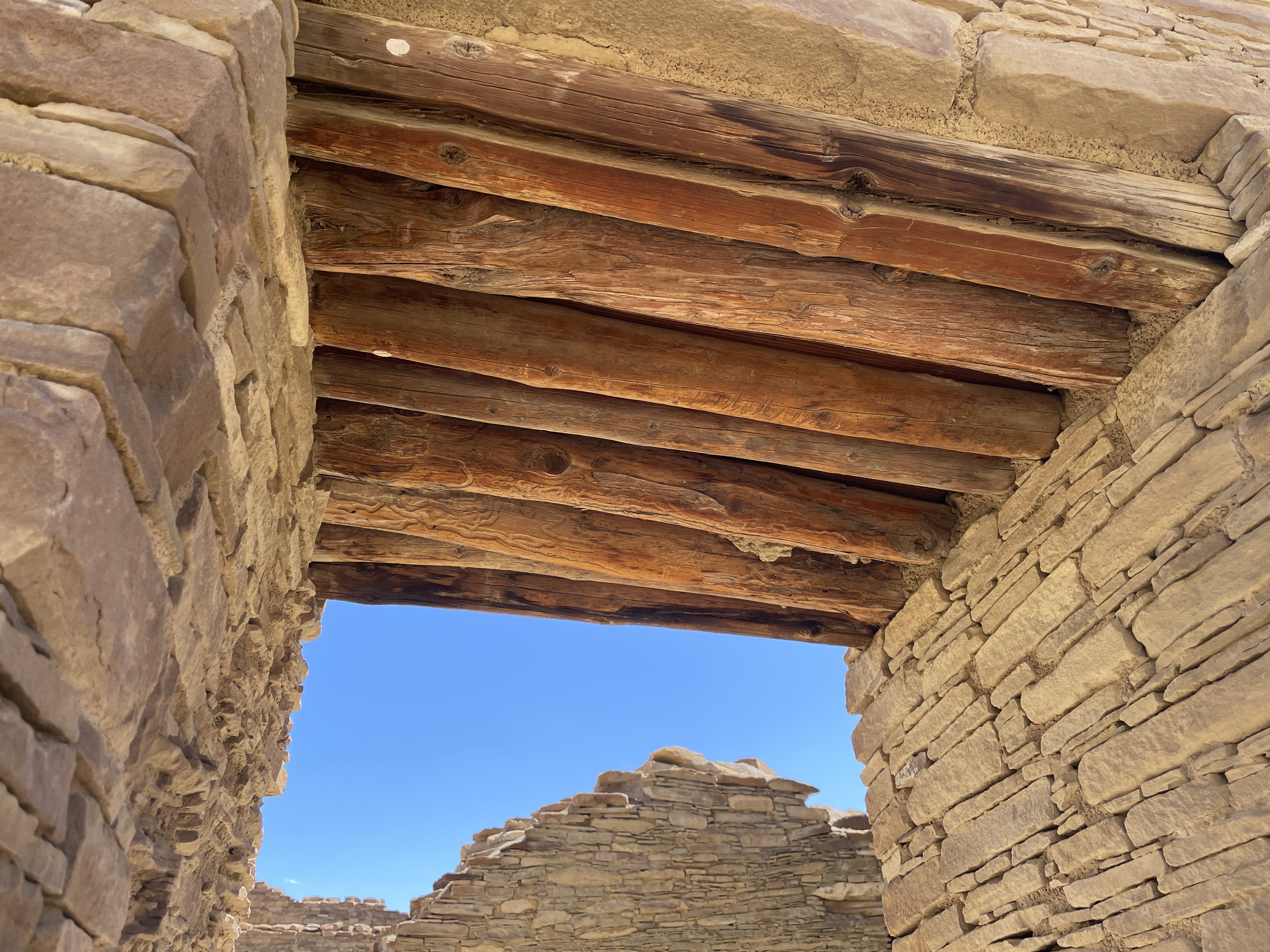
The wood used for tops of windows and doors was brought from forests hundreds of miles away. The desert air has enable it to be preserved.
When you walk the trails, you see wild flowers and native plants. This is desert rhubarb and it is edible.
While these are photos of the more impressive structures at Chaco Canyon, more than two hundred ceremonial and meeting sites can be found in this area of NM and AZ.
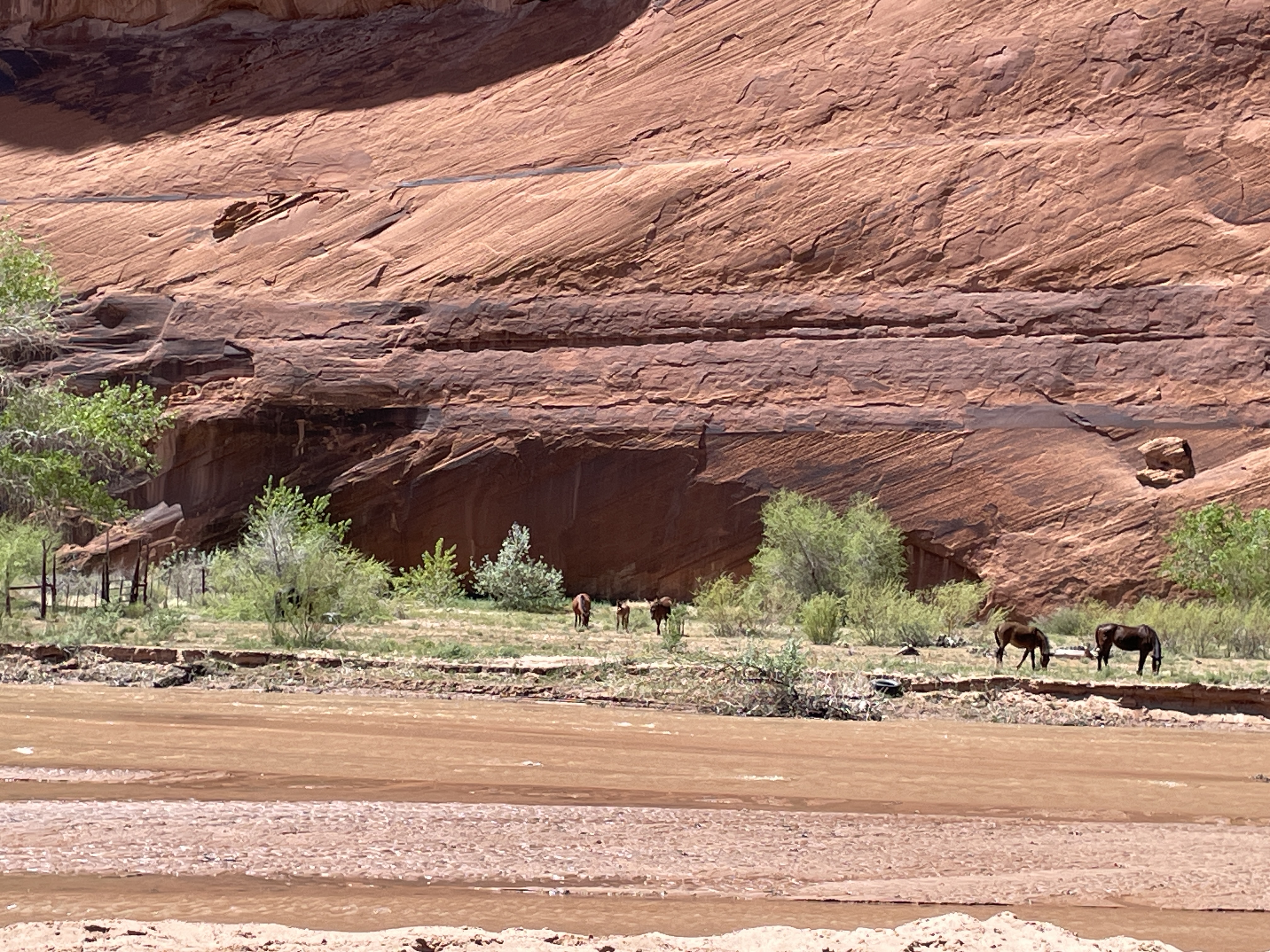
Canyon de Chelley was named by the Spanish who could not quite pronounce the Diné (Navaho) word for it and hence this name which is pronounced like de shay. It is more than 30 miles long and has a river running through it at least a substantial part of the year. In summer native people live there with sheep, horses, etc. even though fewer and fewer of the younger generation choose to do so. To enter the bottom of the canyon, you must acquire a permit and hire a Navaho driver. This is to protect it from the vandalism that occurred in the past. Canyon de Chelley is jointly managed by the National Park Service and the Navaho Nation.
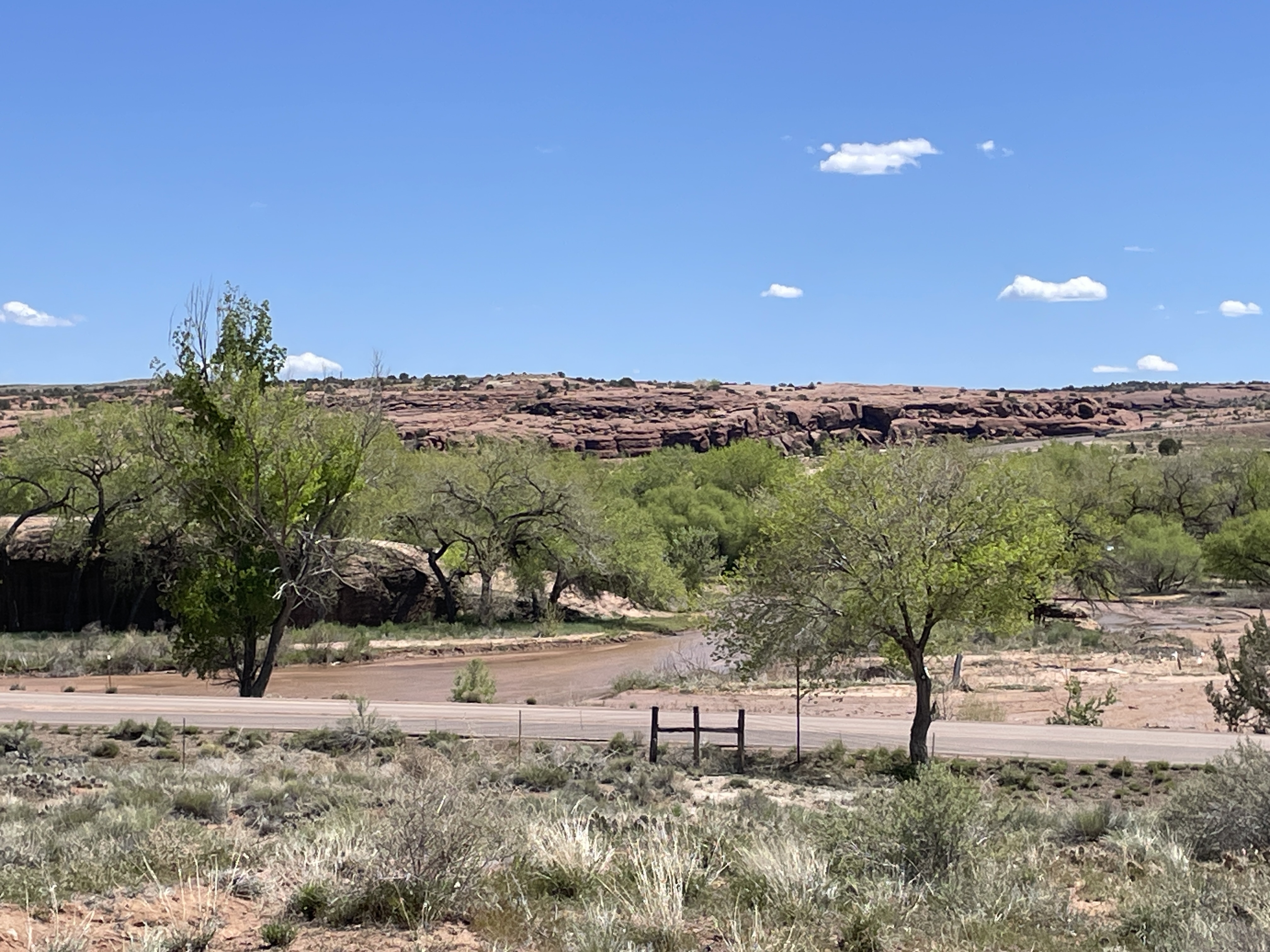
Canyon de Chelley begins at the edge of Chinle, AZ, near the Holiday Inn which, by the way, serves traditional food such as mutton stew and blue corn fry bread. Yes, I ate both. This photo shows the beginning.
It was quite a trip; I sat between two women in the back of a Jeep with a perfect view of everything right in front of me. Oscar, the driver, knew exactly how to traverse the water, the wash (what they call this stream), run up and down the banks.
Driving right up the middle of the wash.
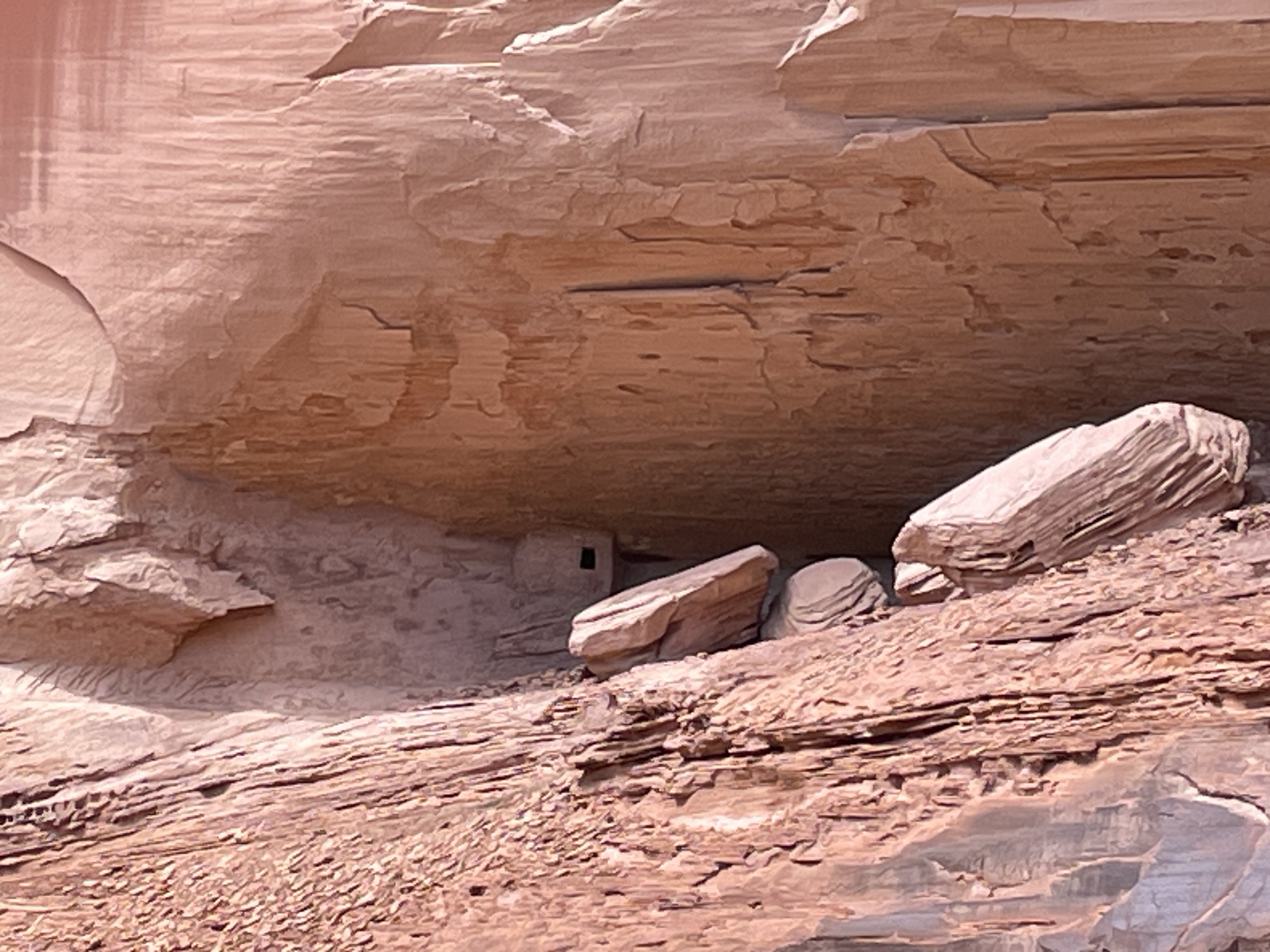
Petroglyphs can be seen in so many places we stopped that I lost count. Oscar said they are nearly endless and can be found throughout the canyon walls.
A few days previous to our arrival it had snowed so everything was green and lush from snow melt.
In addition to petroglyphs, there are etchings in the rock walls.
In this case an etching/rock carving of horses.
Yes, we drove under this overhanging tree limb.
Sometimes the wash was narrower and deeper and we drove up and down steep banks and through deeper water.
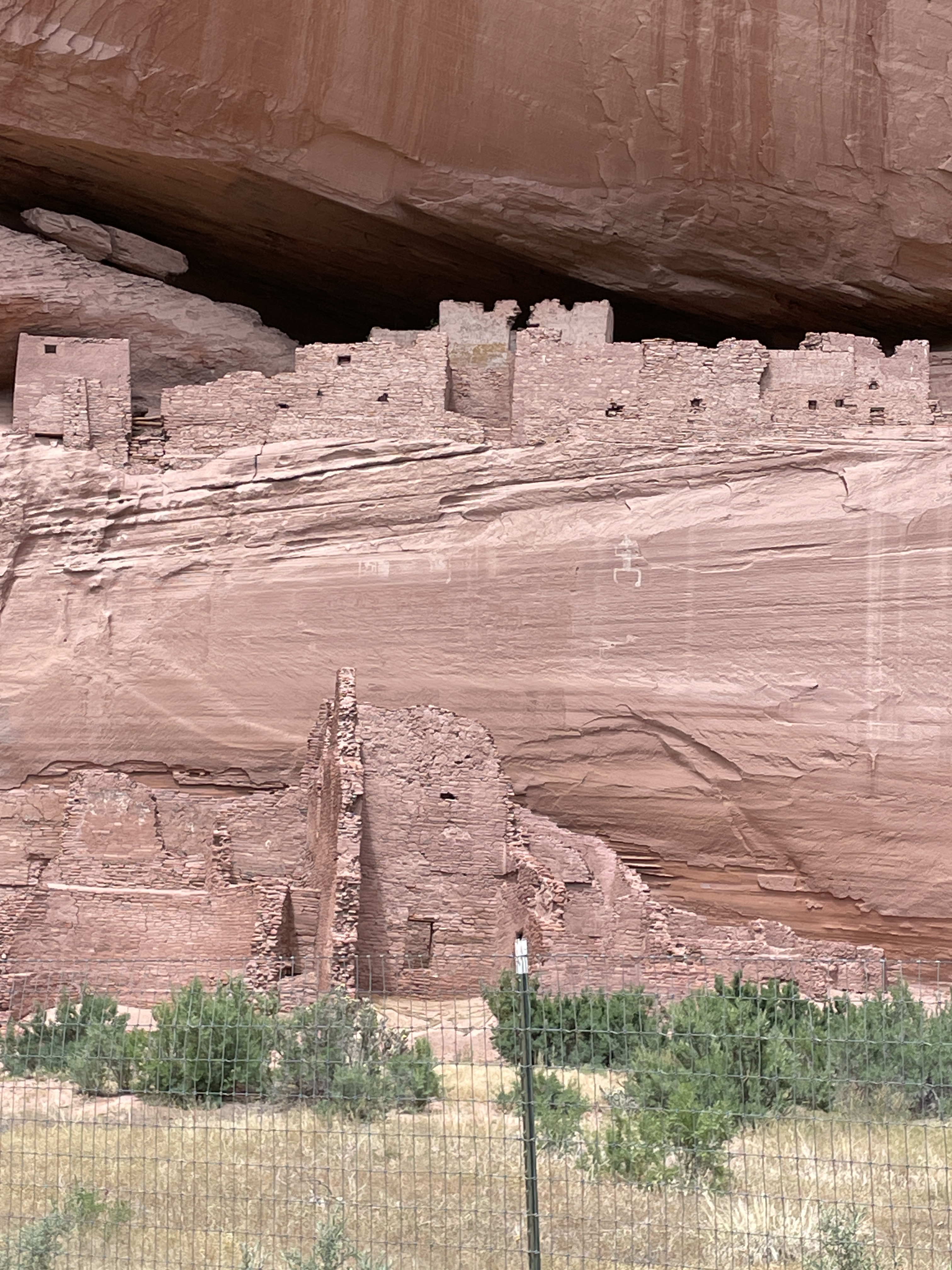
Ancient pueblo people lived here for centuries, some more than 5,000 years ago. This is one of the largest pueblo structures in the canyon (The White House–due to a white washed wall which you cannot see from this vantage point). The fence was built to protect it from vandals. We saw many smaller dwelling places and Oscar said there are hundreds in the canyon.
Headed back down the wash. This was a half day trip so only saw less than half of the canyon. You can hire for an all day trip complete with picnic lunch and go all the way to some of the famous formations that can be seen from the road at the edge of the top. There is also a side canyon called Muerto–due to a massacre of the natives that occurred after the Navaho forced long march.
The Jeep needs a bath after this trip.
Note: With a permit and guides, there is camping and horseback riding trips up the canyon in addition to this type of tour.
One of the most famous canyons in the country resides inside the Dine (Navaho) Nation. While administered by the National Park service, it is also the home of several Dine families. You can drive through the roads on the top freely, stop at various viewpoints, take photos, etc. Here are the various views I saw last week while there. The bottom of the canyon is restricted. To go there, you need a permit and a Dine (Navaho) guide. More about that in the next post.
Several families live in the bottom of the canyon, especially during the summer months. You cannot go into the bottom of the canyon without a permit and a Navaho guide.
The author of this book, Guadelupe Rivera, is the daughter of Diego Rivera by the woman to whom he was married before he married Frida. Diego went on a trip to Russia and his then wife, the author’s mother, became attached to her previous boyfriend, the poet Jorge Cuesta. She and Diego divorced and then he married Frida. Eventually, the two couples became friendly and at one point they all lived in the same house.
Thirteen years after Diego married Frida, the author moved in with them. This book details her life living with Frida and her father, how Frida learned to cook, how she decorated the Blue House in Coyoacan, the fiestas, the food, the adventures. The book includes photos and recipes of Frida and Diego’s favorite foods, photos of the house, and places the author visited with Frida. It is also a story of many of Mexico’s famous people at the time.
I own several books about Frida but this one is the most revealing and intimate in many ways. If you like Mexican food and find the life and art of Frida and Diego of interest, read this book.
Note: It was also written by the journalist Pierre Marie-Colle with photos by Ignacio Urquiza.
Want to learn a lot in less than 400 pages? Read this book. Published this year, it is the most recent book by a prominent Latin American scholar and historian. After humans learned agriculture and built cities, most of the population of the world became increasingly patriarchal and warlike. The divide between rich and poor increased. Egalitarian foragers and wandering hunters existed only in more remote areas. A few still exist in those remote and less modern corners of the world, often places where few others want to even go. This quote says a lot about the current state of affairs:
“Our civilization has thousands of years practice making war. We have almost NO practice making global peace, but without it we are doomed. Today’s pervasive nationalism and rearmament is unlikely to help us make global peace.”
And a page later:
“Only a true unanimous global effort has any chance to preserve our common home.”
He notes that saving Earth will take huge social transformations, including curbing the excessive consumer capitalism that currently pervades plus overcoming a world wide history where half of humanity mistreated the other half, a practice that still continues.
The lady in charge of the College Center at Mendez Learning Center told me about this book, one of her favorites. I received it for Christmas from my grandson. It is the first book I read this year.
Although it reads like an epic novel, it is non-fiction, the story of Victor Villaseñor’s family tracing back to his four grandparents in Mexico, one set from Jalisco and the other from the rugged mountains closer to the US border. All left Mexico to escape the violence of the Mexican Revolution and eventually settled in Southern California.
Some of the events in this story are heart wrenching incidents of violence, even death, blatant prejudice, and economic poverty. On the other hand, I often found myself laughing out loud, it was so funny. The author’s parents remain perfect examples of strong people who never give up, whose persistence and determination lead to prosperous lives as successful business owners. The author continues to live on the ranch where he grew up in northern San Diego County. Now 83, he has authored many books including a sequel to this one. His website not only talks about his life and writing, but also struggles with dyslexia.
If you have read “Killers of the Flower Moon” and/or seen the movie, this is a must read. Published in 2002, this Osage novel details the daily life of John Grayeagle from his viewpoint. A young, oil wealthy Osage man at the time he tells his story, John was raised by his grandfather because his parents, like many other Osage, were killed under strange circumstances, in his parents’ case an odd car wreck. He is the cousin of Molly, a main character in “Killers of the Flower Moon”. Although he received a college education, spent months traveling in Europe, lives in an elegant house, and drives an expensive car, he still follows many of the Osage traditions, which he details as he talks about his life throughout the novel. The novel describes the murders (which officials usually claimed were accidents or suicides) from the Osage point of view. They knew something was going wrong but were having difficulty determining what they could do about it. They were suspicious of the guardians assigned them by the US government who thought they were too stupid to manage their oil wealth, yet were often stymied when they tried to gain control of their own affairs. This is their story.
The author, who died in 2017, was a prominent member of the Osage Nation, a member of the Peace Clan as is the novel’s main character. The novel’s Foreward is written by Martin Scorsese, who cowrote the screenplay for “Killers of the Flower Moon” and coproduced and directed the movie.
















 writingontherim