Book 12 for 2025: “Girls of Riyadh”, Rajaa Alsanea


I was not looking for this, but rather accidentally found it while strolling through the stacks at the local library. What an informative and entertaining book. When it was first published in Lebanon in 2005, it sort of shocked the Arab world causing public debates about the subject matter and story both pro and con. The novel centers on the lives of four upper class Saudi young women who have known each other for years and are friends. Because the book openly discusses the difficulties young educated Saudi women have pursuing education and careers while also trying to find suitable men to marry, the religious conservatives found the novel blasphemous and wanted it banned. Others said it disrespected Saudi women. Black market copies showed up everywhere and the author became an overnight sensation.

The book focuses on the difficulties these women experience as they navigate the modern world while still living in a society founded in very conservative patriarchal cultural conditions. They want to believe in love and hope they will find someone to marry they also love. However, traditions get in the way of this goal more often than not. Some of them find someone they love and who loves them but families forbid it–the person is not high enough status or has been divorced, or…the barriers seem endless, focused on family connections. Love is considered a frivolous, unhealthy distraction.

Contrary to what I believed before reading this, most of these higher class Saudi young women are going to college, often in subjects like medicine and dentistry, and plan to pursue careers in their fields. Many have travelled to Europe where they are freer to roam, not dress conservatively, etc. Yet they return home because of close family ties and love of country. Several of the fathers in this novel are considerably more liberal than the girls’ mothers. Like any society the view of progress and tradition vary greatly by family and individual.

Because as a reader you get to “know” these young women, I found myself reading nonstop because I really wanted to know what was going to happen, whether any of them would be allowed to marry someone they loved or would be heartbroken and forced into unwanted situations. The latter never occurred thankfully. None were forced to marry someone they disliked. It is a great read for those who are curious about other cultures and how women navigate their lives in a place dramatically different from what is more common in Europe and the US.

Book Nine for 2025: “Martyr”, Kaveh Akbar


“She was Christian but American Christian, the kind that believed Jesus just needed a bigger gun”–part of the description of the main character’s rich, not dentist mom rich but oil, trust fund rich, blue-eyed, blond girlfriend. Cyrus, the main character is an Iranian American whose father immigrated to the US when Cyrus was a baby after Cyrus’ mom was killed when the US shot down an Iranian passenger plane thinking it was a bomber (July 1988). His dad acquires a job at a Midwestern chicken farm, counting eggs, but special eggs. This farm breeds chickens to grow faster to get to market faster. He works six days a week, long hours, until Cyrus, who excelled in elementary and high school, becomes a sophomore in college. Suddenly, his dad dies.

Cyrus becomes an addict using alcohol and drugs and writes poetry and eventually finishes college. He becomes obsessed with and researches martyrs throughout history–people like Hypatia of Alexandria, Bhagat Singh, Emily Wilding Davison, the Soulit Women. He gets sober and obsessed with his own past. This eventually leads him to travel to Brooklyn to talk to a famous artist whose last exhibit is herself talking to visitors as she dies of cancer. In researching this woman’s paintings, he discovers a strange painting of a young man dressed as an angel whose job as a soldier is to ride at night with a flashlight through the fields of the dead and dying Iranian soldiers consoling them during the Iran/Iraq War. Cyrus knows that his mom’s brother had this actual job during that war and wonders can there be a possible the connection.

Throughout these events the reader is lead to not only explore Cyrus’ thoughts and beliefs but also those of his father, mother, uncle, and best friend, Zee. It is rare for a novel to be both heart wrenching and funny. Akbar accomplishes this task. One moment I found myself laughing out loud and the next almost in tears. I could not stop reading even though the paperback is long. Perhaps my knowing something about Iranian culture, food, etc. helped me appreciate some of the book more than I might have otherwise. Nevertheless, this is a universal story about love, discovering oneself, relationships, parenthood, human nature. It is definitely worth taking the time to read.

Book Eight for 2025: ” The Thirty Names of Night”, Zeyn Joukhadar


While his previous novel, Book Seven for the year, focused on map making, what it is like to be a refugee, and the stories of two, strong girls centuries apart, one of this novel’s main focus is birds. One narrator, at first no name and then later Nadir, relates part of the novel. His mother was an ornithologist who died in a tragic fire. Her ghost often speaks to him. The other main character, Laila, was a famous artist, an illustrator and painter of birds who mysteriously disappeared decades ago. She and a Black ornithologist insisted they had seen a new species of ibis, and she is supposed to have made drawings and paintings of this rare bird but all evidence disappeared with her.

This is also the story of various non-cisgender characters, some of whom hid their true identities from even those closest to them. Additionally, it is the tale of the lives of Syrian Americans in a NYC neighborhood, plus its destruction and renewal. As in his previous novel, the language and descriptions are poetic, often haunting, and sometimes heartbreaking. It also illustrates how our lives are often interrelated even when we are unaware, only to be discovered after years of searching.

I am guessing that the novel is at least somewhat autobiographical given that Nadir, born a girl, knows inside that he is really a boy. Between this novel and the first one, the author transitions from female to male.

Both books are beautifully written and I highly recommend reading them.

Book Seven for 2025: “The Map of Salt and Stars”, Zeynab Joukhadar


Two young heroines dominate this fascinating novel which switches back and forth between the Syria of 2011 and the 12th century. The latter is a girl who disguises herself as a boy to join the quest of a famous mapmaker. Nour, the first girl, lost her father to cancer in NYC. Then her mother, a mapmaker, decides to move herself and the three daughters back to Homs, Syria. They barely settle into their new life when the civil war breaks out and a bomb destroys their house. They become refugees. This is the tale of their harrowing journey from Syria to Jordan to Egypt to Libya to Algeria, then Morocco and finally to Cuenta, the Spainish city on the north coast of Africa, where their uncle lives.

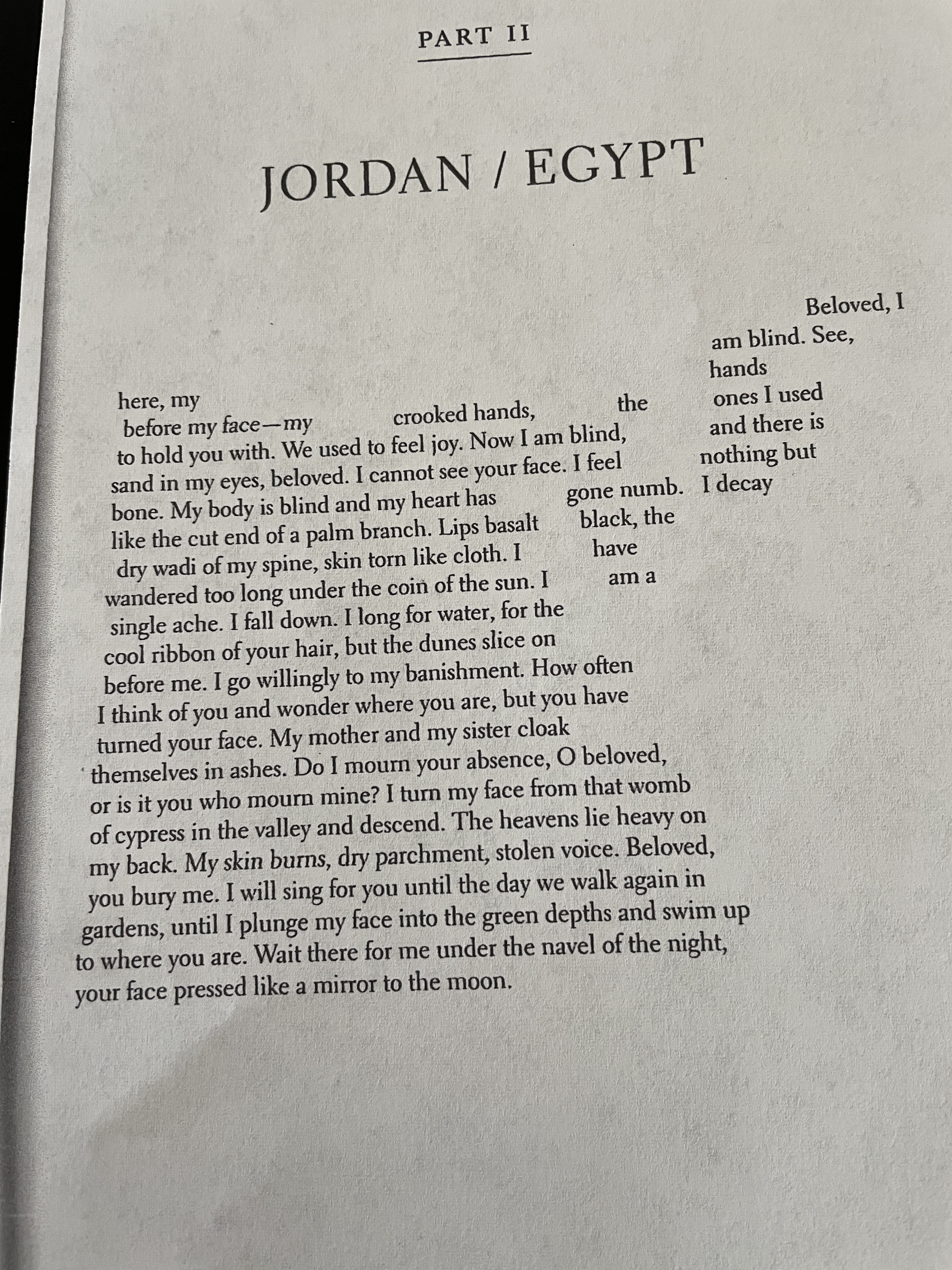
To keep sane, Nour repeatedly tells herself the story of Rawiya, the disguised girl who is an apprentice to the map maker. When he was alive, this was the favorite traditional story her father told her. The book alternates between what is really occurring to Nour and her refugee family and this ancient story. At the beginning of the section for each country through which they travel, there is a touching and beautifully written poem in the shape of the map of that country. The poem for Jordan/Egypt is printed below.

Book 46 for 2024: “What Happened to Ruthy Ramirez”, Claire Jiménez


The Puerto Rican Ramirez family lives on Staten Island. The book begins years after one of the three daughters, Ruthy, disappears at the age of 13 while on her way home after her school track practice. Twelve years later while watching TV, Jessica, the oldest daughter, sees someone on a reality show who looks like Ruthy. The woman on the TV has red hair like Ruthy and the same birthmark mole. Jessica tells her younger sister, Nina. They concoct a plot to go to the reality show site and bring Ruthy (if she is really Ruthy) home. They avoid telling their mother, Delores, who has never ceased struggling over Ruthy’s disappearance. Delores discovers their plot and insists on not only joining them, but also bringing her older Pentecostal friend who frequently falls into spiritual spells on the floor at church. Eventually, they all head to Boston where the show is located and all kinds of turmoil occurs.

The novel is told from the viewpoint of each sister and their mother, providing endless details about their Puerto Rican culture, their jobs, their views, and how they feel about each other, all done with dialogue. Sometimes it is loving, sometimes snarky as it deals with their experiences with racism, sexism, family secrets, and violence. As a reader, I, too, wanted to know what happened to Ruthy. Definitely worth the read.

Book 45 for 2024: “How To Stop Time”, Matt Haig


What would your life be like if you did not age like everyone else? How would others treat you, your family? Would they kill your mother because they think she is a witch? Could you love someone who grew old while you stayed young? Would you have to move all over the world to avoid detection?

These are the issue the narrator faces because unlike ordinary people, he does not age normally. At the beginning he is living in London as a forty-one year old history teacher but has been alive for centuries. He’s met Shakespeare, travelled the oceans with Captain Cook, and played piano at clubs in Paris.

One organization, the Albatross Society, hunts down and “protects” people like him. Their leader has one rule: do not fall in love. He is also convinced that certain groups want to find these non-agers and imprison them for research. What is factual, real? Does life have meaning without love?

Book 42 for 2024: “These Is My Words: The Diary of Sarah Agnes Prine, 1881-1901, Arizona Territories


This fictional work is based on the life of the author’s great grandmother. Written as a diary with specific dates, the narrator is not yet a teen when the novel starts. Her parents are wanderers, always looking for a better, new place. Sarah’s character is that of a tough, pioneer girl and then a woman. She can ride horses, shoot to kill, manage a ranch, do whatever it takes to survive. Much of it includes a rather accurate portrayal of life in Arizonan territories as well as Texas at the time including the prejudices of many of the white inhabitants toward the Spanish speaking people already there, fights with Apaches, and the hunt for Geronimo. It is not just the story of her own life, including her relationship with the Army Captain whose job initially is to protect a wagon train, but also portrays other people living in the Southwest during that time period.

I read this as part of a book club. Reactions to the book varied widely from those of us who thoroughly enjoyed the book to at least one person who insisted it is poorly written and viewed it as a romance novel. The rest of us did not. She used an audio book edition. After her descriptions, it appears the audio book does not correctly follow the book itself and is poorly done which may have contributed to her view of this work. I borrowed this novel from the public library and it was obviously well read because it was not in the best condition.

Book 35 for 2024: “Woman of Interest: A Memoir”, Tracy O’Neill


In 2020, the author, Korean, adopted as a child, nearly 30, decides she needs to find her biological mother before her mother dies. Finding few leads, clues, she hires a private detective who disappears. Then she takes the task of investigating on her own. This book details her investigation, her long relationship with a Serbian furniture mover, life with the parents who adopted her, and her career as a writer, plus going to South Korea to meet her biological family.

Her writing style is a bit different and somewhat rambling. However, for those who have experienced the same sort of search, this book provides details on how to go about finding “the lost”.

Book 33 for 2024: “Three Daughters of Eve”, Elif Shafak


Shafak is a popular Turkish writer. One of my all time favorite books is her novel about the life of Rumi.

“Three Daughters of Eve” takes place one evening in Istanbul in 2016. Peri, one of the daughters from the title, is on her way to a fancy party when a thief snatches her purse out of the back seat of her car which is stalled in traffic. She parks the car and chases him through back alleys. As she fights him for her purse, an old photo falls to the ground. It portrays three young women and their university professor. This photo jars her mind, takes her back to her time at Oxford University when she was a student there in 2000-2002, her childhood in Istanbul in the 1980s and 90s, and her life. She thinks back to her life with her two friends, Shirin, an adventurous Iranian young woman, and Mona, a devout Egyptian Muslim who word a headscarf out of choice. And then there is the famous professor Azur, whose class on God either makes students hate or love him and the scandal that caused Peri to return to Istanbul.

Until her daughter, who was in the car and eventually chases her mother down in the alley, sees the photo, no one, except her husband, seems to have known Peri even went to Oxford. Her daughter mentions it at the party while everyone is arguing about East and West and politics and who has the most money and how they acquired it. Peri tries to deflect questions, changes the subject, and keeps remembering her past: her parents, a father quite irreligious, her mother a devout Muslim, their endless arguments and hostility, her brothers, her childhood and her stint at Oxford.

Through the story of Peri’s life, this novel explores personal identity, East-West history and politics, the meaning of marriage and friendship.

Book 31 for 2024: “Tender”, Sofia Samatar


This book contains 20 fantastical and dystopian short stories. I found them fascinating with topics ranging from selkies to ogres to ghouls to jinns to witches (in this case positive ones). The settings range from US to Africa to a settlement in outer space (the story “Fallow”). Divided into two sections, Tender Bodies, Tender Landscapes, these stories address human frailty, anger, greed, extreme religions and how humans treat each other (both good and bad) and what might occur in the future if people do not behave better. “Fallow” is a sort of handmaid’s tale where instead of being on Earth–which has been basically destroyed–a group of extreme religious folks have made a place for themselves on another planet after escaping Earth. If anyone from Earth accidentally shows up, they are in big trouble unless they become just like the people already there. Otherwise, they do not kill them–that is wrong–but just sort of let them slowly die. These stories, both brutal and lovely, display an incredible imagination.