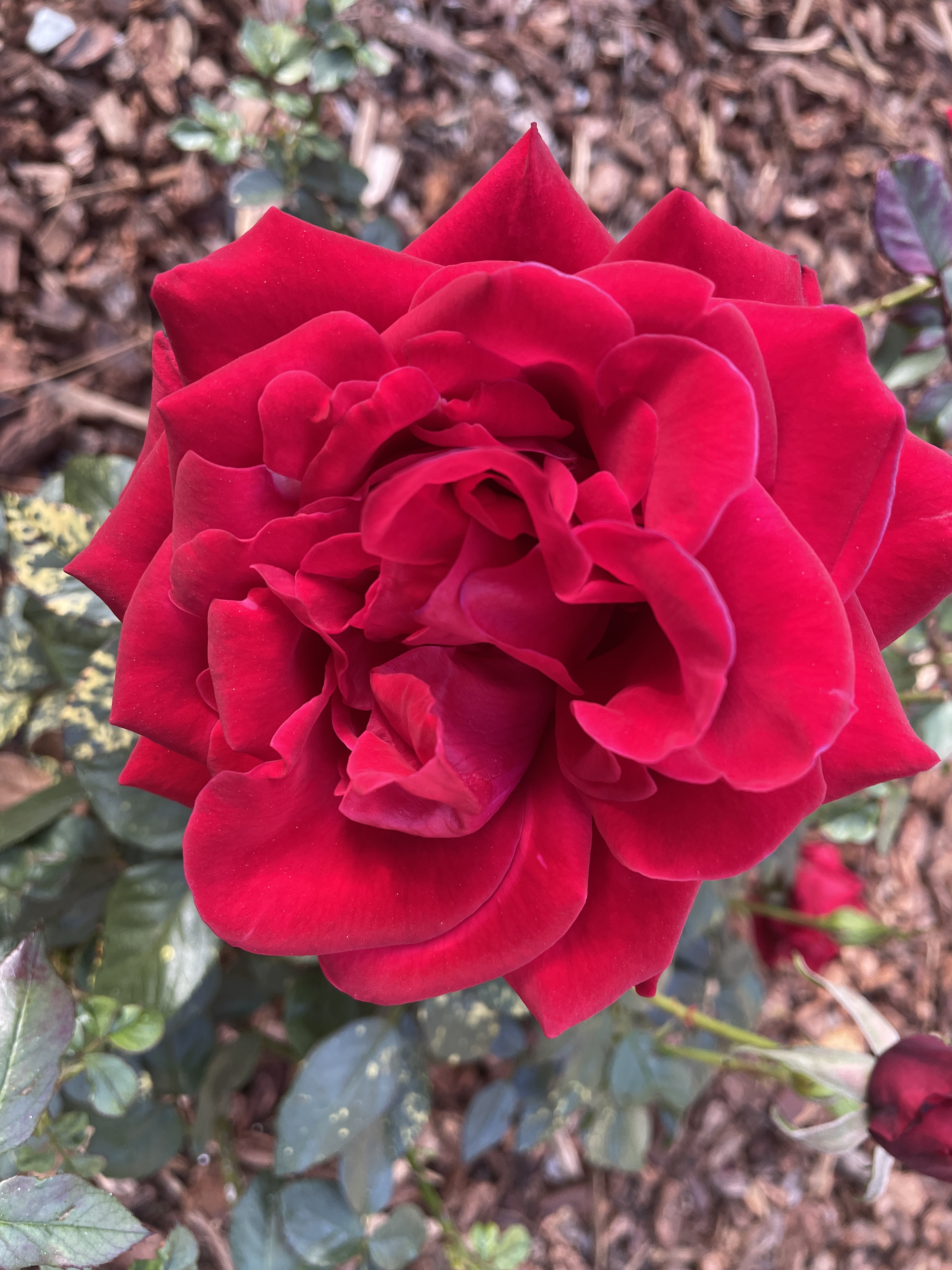
Red Roses


He’s very good at wooing:

gifts–chocolate cherries,

red roses, delicate lingerie,

I love you.

He wears his mask well,

keeps calm, a handsome spider,

weaving a silken web.

She laughs, tells her friends

just how very special she’s

sure he is.

He wears this mask for months,

finds them the perfect apartment,

swimming pool, gym, marble,

granite, luxury appliances.

She’s sure he loves her:

the gifts, the perfect apartment,

fancy restaurants, luxury weekends.

She’s late, heavy traffic, an

emergency at work. He

screams, wants to know

why; no explanation matters.

He hits her for the first time, her

torso, knocks her down.

Tomorrow 24 red roses

arrive at work. He begs

forgiveness. She’s sure

he’s sorry; it won’t happen

again.

Two months later, she’s

late again. Real reasons he

does not want to hear. He

screams, he hits, he knocks

her down.

She dreads red roses.

Note: This is part of my writing a poem per day for National Poetry Month. Regarding this poem, 34% of female homicides are women who have been killed by intimate male partners. Often when women kill a man attacking them, they are convicted of murder even when trying to defend themselves.

Book 14 for 2024: “The Invisible Hour”, Alice Hoffman


This is a book for those who believe in the power of books to transform life, who are fans of Alice Hoffman, and who like time travel. It also about how a charismatic man can ruin the lives of many, especially women, by controlling everything around him through fear and coercion. In his Community books and contact with the rest of the world are banned. Mia is a young woman who sneaks into a local library and finds Hawthorne’s “The Scarlet Letter”. She realizes the life she is living in the Community is like the lives in the book. Through this book she manages to attain the courage to escape such a man, the man who destroyed her mother, Ivy. She makes her way back in time to the period in the book, has a love affair with Hawthorne, and finally escapes the horrible man who tracks her everywhere she goes.

Book 13 for 2024: “The Blueprint”, Rae Giana Rashad


In this dystopian novel white men in Texas run everything and carry guns, have taken over what was the US, eliminated The Constitution, and now use a Blueprint one of the main characters created. There is no choice for much of anything especially if you are a Black woman. An algorithm determines your occupation, spouse, residence, well, everything. Black men have a bit of choice, mainly to be in the military and die young. You can raise to a high rank, have some power, and be honored for your bravery. Sometimes young Black girls around 15 are assigned by this algorithm to be the concubines of powerful white men. This is how the main character, Solenne, ends up living with the most powerful man, becomes his lover. Unlike other circumstances where later she might have a choice, he becomes so obsessed with her that he never wants to let her go. To keep sane she writes about her enslaved ancestor, Henriette, the concubine of a powerful white planter in the 1800s. Women have a tracker implanted in their thumbs so men can see where they are and what they are doing. The only place to escape to is Louisiana, a free state, but even there greed and power can entrap you and force you to return to Texas. The prevailing attitude is this:

“The Councilmen said a nation was only as strong as its hold on its women. They had to squeeze the life out of the women’s liberation movements, give it no air…It begins at home with the wives.”

Book 10 for 2024: “The Furies: Women, Vengeance, and Justice”, Elizabeth Flock


This book raises these questions: Can women gain true safety and equality without violence? Can we end misogyny without fighting back?

The book details the stories of three women, one from Alabama, a woman from northern India, and a Kurdish fighter in northern Syria. All use a form of violence to overcome abuse and mistreatment they have experienced and see other women experiencing. The author personally interviewed all of these women and others close to them and visited them repeatedly.

The first is Brittany Smith, who shot the man who had raped her and was trying to kill her brother. Her story details how Stand Your Ground laws work for men, but often fail for women, especially in areas of the US South where men are protected by their beliefs in a male Code of Honor.

The second is the story of Angoori Dahariya, a Dalit woman, from Uttar Pradesh, India. Fed up, she creates a group called the Green Gang (they wear green saris) dedicated to defending poor, under caste, female victims of abuse. Note: Dalit refers to the lowest caste.

The third is the story of Cicek Mustafa Zibo, a Kurdish fighter in the female militia that fought ISIS in northern Syria. She and many others follow the teachings of Ocalan, a Kurdish leader imprisoned by the Turks for leading the Kurdish militia who for years have fought the Turks for independence. He teaches equality between men and women and women’s rights, which is anti the general cultural beliefs in this area of the world. Note: Ocalan is labeled a terrorist by many.

Books 3-5 for 2024: “Happening”, “The Young Man”, “Simple Passion”, Annie Ernaux


In the last few days, I’ve read three books by Annie Ernaux who won the Nobel Prize for literature in 2022. Although she is a major writer in France, I had never previously heard of her. Since the local library possessed none of her books, I drove to Claremont and checked out all of her books that were available. The publication dates range from 1974 to 2022.

Most of her books defy categorization. The librarian helped me find them because some were in fiction and some nonfiction. From just reading them, it is impossible to determine whether what I’m reading is real or imaginary or a combination. She writes about women’s lives mostly and issues that only women experience.

“The Young Man”, copyright 2022, tells a detailed account of a love affair between a young male student and a 50 something woman, thirty years older than he. They meet on weekends often at his apartment, make fervent love, visit sidewalk cafes, wander. The narrator notes that people sometimes look askance at them in a way they never view an older man and a younger woman. She finds love making helps her write, “Often I have made love to force myself to write.” At the end of the book are photos of Ernaux over the years (she was born in 1940) and a detailed biography.

Next I read “The Happening”, (2001) a detailed account of a young female student seeking an abortion when it was illegal in France. She manages to hide her state from most people including her parents. She finally finds an elderly nurse, but later experiences complications and ends up in the hospital where a young doctor, who thinks she is just some poor woman off the street, treats her badly. When he discovers she is a university student, he finds her and apologizes. It seems mistreating the poor is okay but not someone from his own class status.

Then I read “Simple Passion” (1991), a short (64 pages) detailed account an illicit love affair between a young, married man from Eastern Europe and the narrator. The telling part of this story is the narrator’s (the author?) obsession with this man she calls A. She waits for his calls 24/7. She thinks about him every waking moment and dreams about him at night. I kept thinking of myself and many women I know who have become obsessed with some man to their own detriment.

A a writer, I find her work totally fascinating in its extreme courage. She writes in detail about experiences few would dare to even talk about, but many experience and keep silent. Much of it is autobiographical, an even great demonstration of bravery. Who dares tell the truth of many of our own experiences? Very few of us.

At the Coffee Shop–Part One


I did not know we were coming here.

I say, “I didn’t bring any money.”

He says, “That’s what they all say.”

I’m shocked, speechless.

Does he think women just want

a man’s money? What?

It’s too late to cancel my coffee order.

I wish I’d turned around, walked out,

walked home.

It’s only two miles.

One Book a Week-41: “Woman of Light”, Kali Fajardo-Anstine


This historical novel lead me to learn a lot about the history of the Denver area and nearby indigenous areas with regard to both Hispanic and other immigrants, e.g. Greek. I had no idea Denver was once such a racist place with the KKK marching in the streets and white men killing men of color over women and land.

The title comes from the nickname of the main character, Luz Lopez, luz being the Spanish word for light. The novel traces her family’s sad and unjust history from the indigenous areas of CO and NM where her family originated to their migration to Denver in search of work. Luz has special powers, reads tea leaves, initially works as a laundress, and lives with her aunt because her parents were both killed. Her brother, a snake charmer, has to leave town to save his life after white men beat him nearly to death because he dares to love a white woman. This is a book about survival, love, jealousy, hatred, joy, and the history of various indigenous and immigrant people in Colorado and New Mexico.

The author’s earlier book, “Sabrina and Corina”, a collection of stories, was a finalist for the National Book Award and won a number of other prizes.

One Book a Week-40: “Wifedom”, Anna Funder


I found this new non-fiction book both fascinating and disturbing. Like Funder, I’ve always considered George Orwell (not his real name) a great writer and appreciate his insights into the methods used to gain power and control people plus the clever ways those who wield power draw masses under their influence.

After reading several biographies of Orwell, Funder began to wonder about his wife whom these authors barely mention. What Funder discovers is both enlightening and dismaying. Did Orwell love her or just use her as an editor and fancy typist? Did he even like women or just use them? Would “Animal Farm” and “1984” even have been written without her help? The subtitle of Funder’s work is “Mrs. Orwell’s Invisible Life”. Her real name was Eileen O’Shaughnessy. She married him in 1936.

What does it mean to be a writer” What does it mean to be a writer’s wife?

In many ways this work is a tribute to the unrecognized contributions of women though out time and everywhere.

Note: While reading about Orwell and his wife and family, the reader also learns about what it was like to live in the middle of nowhere in the English countryside without adequate heat and even sometimes a lack of food. It also details Orwell’s stay in Spain during the Spanish Civil War and his travels to France as a journalist toward end of WWII. He also suffered from TB about which he continually lied to everyone.

One Book a Week, 36-39: See notes below plus “Mrs. Caliban”, Rachel Ingalls


“Mrs. Caliban”, once called “The Perfect Novel” by the New York Times, was a book ahead of its time. A sort of magical realism story, its message remains relevant over the decades. Mrs. Caliban’s husband just lives with her and only returns home to eat, and after going out for the evening, to sleep. He’s polite and indifferent. One day a green, sort of humanlike, highly intelligent monster shows up. He is hiding from the authorities who found him and experimented on him. She listens to his relating the horrible things done to him and hides him in the guest room where her husband never goes. He transforms her life. In the meantime, she goes to visit a close friend and listens to the friend’s stories of multiple simultaneous affairs she is having with multiple men friends. They give each other advice, exchange stories about various people they know. Mrs. Caliban tells no one about her house guest. Then a shocking accident and astonishing information she never guessed occur.

This short novel reveals so much about life, human behavior, and the status of men and women. I highly recommend it.

Note: The other three books I read for a project and cannot discuss them at this time.

One Book a Week-31: “Miracle At St. Anna”, James McBride


The third novel I’ve read by McBride in the last year, “Miracle At St. Anna” brings to life a little know part of WWII. Toward the end of the war, the US sent the Army’s Negro 92nd Division to Tuscany. Due to the ineptitude of one of their superiors, several soldiers find themselves behind enemy lines. This is their story–they sneak through dangerous mountain passes and ravines and find themselves in the tiny village of St. Anna di Stazzema where the peasants take them in and treat them more respectfully than they had been treated at home. It is also the story of this village, the residents there, and an orphan boy one of the soldiers rescues, a story of the tragedies of life and war and the miracles the villagers, the soldiers, and the boy experience.

While heart wrenching, it also inspires.

Note: I read this book last week and started on two others, one of which is the original “The Little Review ‘Ulysses'” which is how the first copies of James Joyce’s “Ulysses” were published. From March 1918 to December 1920, the Little Review published chapters of “Ulysses” in serial form. They had to quit because the material was considered obscene and censored. My reading of this is a long work in progress. This copy is not edited; the original spelling and other mistakes remain.