Woman, wondrous, wild
daughter of the moon,
mysterious, magnificent
fierce secret keeper
guardian of the universal key.
Woman, wondrous, wild
daughter of the moon,
mysterious, magnificent
fierce secret keeper
guardian of the universal key.
My grandson cuts himself into 16 equal pieces:
4/16 Urhobo from Africa
3/16 Spanish from Spain
4/16 European–two Swiss German great, great-grandfathers
(Werth and Kaiser), Irish, English and who knows what
3/16 Mexican–whatever mixtures that may be
2/16 Navaho
Who am I? What am I?
Who are you? What are you?
Do we really know?
Who sets the rules?
white men
black
Indian
Native American
Irish
English
German
from where and for whom?
He looks Navaho:
-blue black straight hair
-pale brown skin
-obsidian eyes.
One four year old girl asks him,
“Are you American Indian?”
His six year old self says nothing.
She repeats,
“Are you American Indian?”
He says, “It’s complicated.”
The Navaho won’t claim him, too little blood.
He needs 1/4, not 1/8.
Caddy and Fort Sill Apache allow 1/16, not Navahos.
1/4 blood is for
-Sioux
-Cheyenne
-Kiowa
-Navaho
1/8 works for Comanche and Pawnee.
Some Cherokees only want a Cherokee ancestor.
But he is none of those.
Is he Navaho?
Is he white?
The old South goes by the one drop rule:
one drop of Negro…
Is a person with 99/100 per cent white
and 1/100 black, black?
Who says?
Kids at school ask, “What are you?”
He tells them.
They say, “You’re lying.”
I only know specifically about two ancestors,
the Swiss Germans.
Another great grandfather disappeared during the Civil War.
I don’t even know his name.
Who am I?
Who are you?
I think I’ll get a DNA test.
Then I’ll know how many pieces I need to cut myself into.
Note: This was originally published in my book “On the Rim of Wonder”. I had a cousin send me 75 pages of ancestry information. I looked up more myself. That one great grandfather remains a mystery. I had my DNA done. It did not match what I expected from the ancestry work.
Blood quantum is the term the US government used to determine whether a person would be qualified as an Indian. Now many Indian Nations use it to decide who can be on the tribal rolls and who cannot.
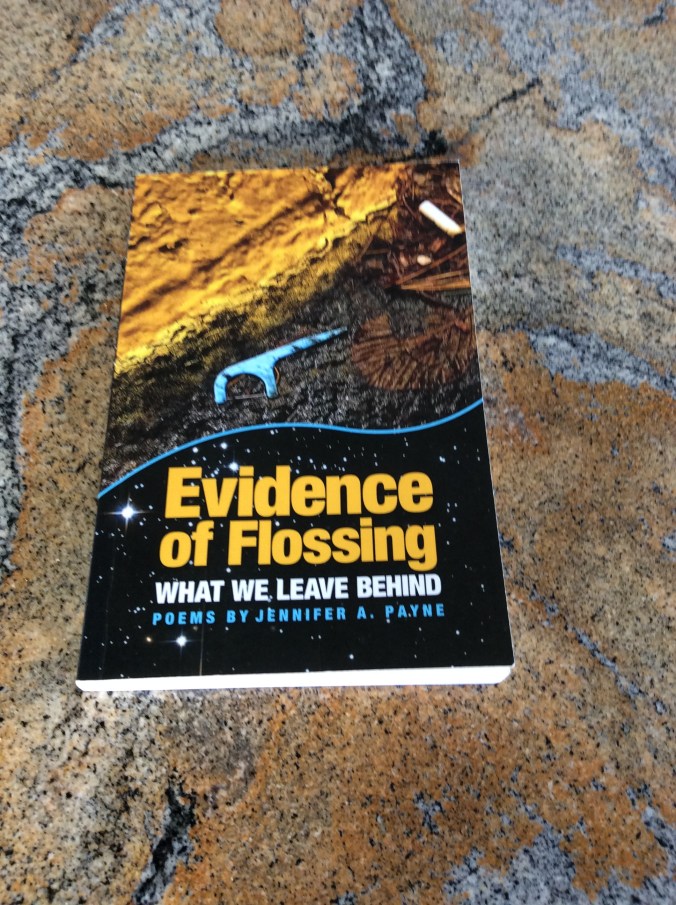
Evidence of Flossing, WHAT WE LEAVE BEHIND provides an unexpected metaphor for individual life, culture, and so much more. Nearly all the poems are accompanied with a photograph, often of trash in which lays a dental flosser (yes, one of those instruments with which you floss your teeth) with date and location. Flossing is supposed to prevent anything from being left behind. Hence, the title brings up an unusual play on words.
The first section Damage contains more than 20 poems which are a lament about much of modern life–mass shootings, the demise of wildlife, unpleasant changes. One poem asks the question: “Would God floss?” In the second section, Contact, the poems focus on the natural world, walks in the city, the woods, beaches. The third section, Connection, emphasizes the interconnectedness of everything, especially the relationships between humans and animals and nature. There are poems about frogs, storms, birds. One called Evidence of Fairies makes the reader feel the magic of old growth forests with moss and ancient trees. In the footnote to another poem she discusses the fact that wolf spiders actually create songs to lure lovers. Then, toward the end, the Alice poems appear, Alice as in “Alice in Wonderland”. In my favorite poem Payne relates her encounter with a stranger picking oyster mushrooms near a path in the woods.
After reading the poems and comments in this book, I will never view flossing the same way again. Will I find dental flossers now, something I never even previously thought about? I use those long strings of floss not flossers. Apparently the poems and flosser photos affected enough people that some sent Payne photos of flossers they saw here and there on the ground, some of which she has included in the book.
Even if I find no flossers, now I will certainly give a lot more thought to what I and others leave behind.
About the author: Jennifer Payne is the owner of Words by Jen, a graphic design and creative services company in Connecticut. She belongs to the Arts Council of Greater New Haven as well as several other arts and poetry organizations. Her work has been featured in various publications, including The Aurorean, Six Sentences, and the Story Circle Network. You can read some of her writing on her blog Random Acts of Writing.
“Most people are about as happy as they
make up their minds to be.” Abraham Lincoln
When I was twenty something, I chose happiness, not the sappy, syrupy, cheery, but a deeper joy of cherishing the small, the unique, the everyday, smiling with sunsets, the song of the mockingbird in spring, horses running free, the nearly invisible bobcat climbing the canyon wall, the taste of fine coffee at the first wakeful moments in the morning, cooking for friends, taking a “property walk” with my grandson, laughing with the teenagers I teach. I am driven to do little–obsessions, compulsions do not run me. I choose. Choose life, choose joy, or choose whining, choose lamenting. Choose!! Be who you want to be; do what you want to do.

Note: this is a poem from my book, “On the Rim of Wonder”.
A few years ago Uno Mundo Press published my second book, a book of poems. Reviewers say it is a memoir. Oddly, that was not the plan; in retrospect, it seems apt. The poems’ topics are not chronological but rather via topic with quotations before each topic as a sort of introduction. For the foreseeable future, while I continue writing another book, I will post one poem from the book every Sunday.
The book begins with this quotation:
“Do something scandalous to give your descendants something
to talk about when you are gone.” Vanessa Talbot
The first section begins with this quote by Judith Jameson, the famous dancer and choreographer:
“I always tell my dancers.
You are not defined by your fingertips,
or the top of you head,
or the bottom of your feet.
You are defined by you.
You are the expanse.
You are the infinity.”
The first poem in the book goes like this:
I Have Lived
Depression, sad days, melancholy.
Gone!
At 26, I said, “To hell with this!
You control you life, live it!”
I tried forbidden liaisons, trained horses,
Traveled around the world, a cobra wrapped around my neck,
Walked the Shalimar Gardens in Kashmir,
Stood before the Jama Masjid in Old Delhi,
Watched the Taj Mahal reflected in still waters,
Walked the streets of Katmandu,
Talked to monks at Shwedagon Pagoda,
Bargained with sticks in dirt, math our only common language,
Downed raw turtle eggs in Costa Rica,
Danced on table tops, sang “Adonai”,
Roamed empty roads across the Navaho Nation,
Divorced four times,
Raised two talented children.
I have lived, running on the rim of wonder.

Checked my Facebook today and this quote showed up–posted by a fellow friend and author. It is from Ann Lamont:
“You own everything that happened to you. Tell your stories. If people wanted you to write warmly about them, they should have behaved better.”
Note: In spite of a few men having referred to me as a scandalous woman after reading my book, “On the Rim of Wonder”, I still have not been sued for slander. It has been a few years. I think I am safe. Always tell your truth. Be open to adventure. Live your life. Be the best you that you can be.
The first woman to write a book in English–in the 1300s.
 Doing a recent talk on pioneering woman writers, I like to do the Before Jane Austen test with my audience. Who can name a single woman writer in the English language before Jane Austen? Alas, because woman have been written out of history to such a large extent, most people come up blank. Then we talk about pioneering Renaissance authors, such as Aemilia Bassano Lanier, the subject of my recent novel, THE DARK LADY’S MASK, or her mentor, Anne Locke, the first person of either sex to write a sonnet sequence in the English language.
But my next question takes us even further back into history. Who was the first woman to write a book in English?
The answer is Julian of Norwich, who wrote Revelations of Divine Love.
View original post 679 more words
A habit I acquired years ago, perhaps even during my childhood, is reading just before I go to sleep. Picking the right books remains key unless you want to stay up half the night either reading or thinking about something horrifying or depressing you’ve read. Lately, my reading has not been conducive to sweet dreams. Earlier this week I finished Among the Ruins, an Iranian mystery of sorts, by Ausma Zehanat Khan. It’s fiction but one of the characters writes letters from prison which are anything but cheery. Now I am reading the Pulitzer Prize winner, The Return. Since Hisham Matar never saw his father again after he was captured and hauled off to a Libyan prison, sleep inducing it is not. Last night I decided perhaps for bedtime I needed to find something not exactly boring but somewhat less stimulating. It may take me all summer given that The Silk Roads, A New History of the World by Peter Frankopan is 505 pages. If I get bored with that, I can go back to two books I reread off and on and save for bedtime reading, When Women Were Birds by Terry Tempest Williams and Sor Juana Ines De La Cruz, Selected Works translated by Edith Grossman. Both inspire reflection and contemplation. For those who do not know Sor Juana Ines De La Cruz, she lived in Mexico in the 1600s. She became famous for her intellectual capacity, her poetry, and was referred to as “the Phoenix of Mexico” when women rarely rose to such heights.
What are you reading this summer?
Negatives emerged lately in my life, the events in the last two posts, two good friends with health issues and a lot of pain. Nevertheless, yesterday, I started thinking of so many things for which I feel grateful. Then I said to myself, I am going to work on a week of gratitude, a week where everyday I make a list of things for which I feel grateful. Out of years of habit, I make a mental gratitude list every night as I drift off to sleep. This is more formal, a list I write down.
Yesterday’s list includes these:
-pure water from a deep well
-healthy food I cook myself
-children who live good, productive lives
-my own good health
Today’s list includes:
-a job I really enjoy in spite of paper grading tasks
-students who make me laugh and tell me they love me–who knows whether they mean it and honestly it’s ok either way
-outside chores, e.g feeding horses morning and evening. I cannot imagine life without this even when it is cold and miserable
-singing–after I post this, I will head to my weekly chorale practice. Currently, we are singing all these touching songs, poems by Octavio Paz and Pablo Neruda put to music.
-taxes–crazy, I know. I recall someone once telling me he was happy to pay taxes because it meant he was making decent money and was not poor.

Although I do write many original blog posts, many times I see something that I think needs to be shared with others, something new, enlightening. This post tells a story I had not previously heard, an important story.
 Although “the” Ramayana is a fluid narrative, scholarship has traditionally recognized the Sanskrit Valmiki Ramayana as the most authoritative of Ramayanas. But recent studies have brought to light the hundreds of regional stories of Rama and Sita which are more popular with the masses. These would include Krittibasa’s Ramayana in Bengal, Kamban’s Tamil Iramavataram in South India, notably in the state of Tamil Nadu, Tulsidas’s Ramcharitamanas among the Hindi-speaking belt of northern India, and so on. But even here, a pattern seems to emerge; all the above-mentioned authors are male. Within this scenario, a rather unique text stands out, and that is Chandravati’s sixteenth century Bengali Ramayana, for its author was a woman. Even more fascinating is the double-toned nature of the narrative – through Chandravati’s own voice and through the voice of its tragic heroine, Sita.
Chandravati (ca.1550-1600) was born in a village in eastern Bengal, today in…
View original post 1,122 more words
Travel the World 4 Less
A Glimpse into My Life & Passions
Ceto-Magoism, the Whale-guided Way of WE in S/HE
Exploring the F-word in religion at the intersection of scholarship, activism, and community.
ANCESTRAL FOOD. HERBAL WISDOM. MAGICAL COOKERY. SEASONAL CELEBRATION.
inesemjphotography
politics, engineering, parenting, relevant things over coffee.
Food is the best expression of every emotion. Explore through my reviews, recipes, events and more.
Smile! A Site for Friends Wherever You Are!
inspiring personal growth through poetry and writing
Combining atheism with whimsy. This is a Fair and Balanced blog based on opinion unencumbered by fact.
Odds and ends ~ My Life
Original poetry, commentary, and fiction. All copyrights reserved.
bripike@gmail.com
A wildlife filmmaker in Africa
A Geeky Feminist's Musings On Pop Culture
"5 minute walks"


 writingontherim