Blackwater Draw


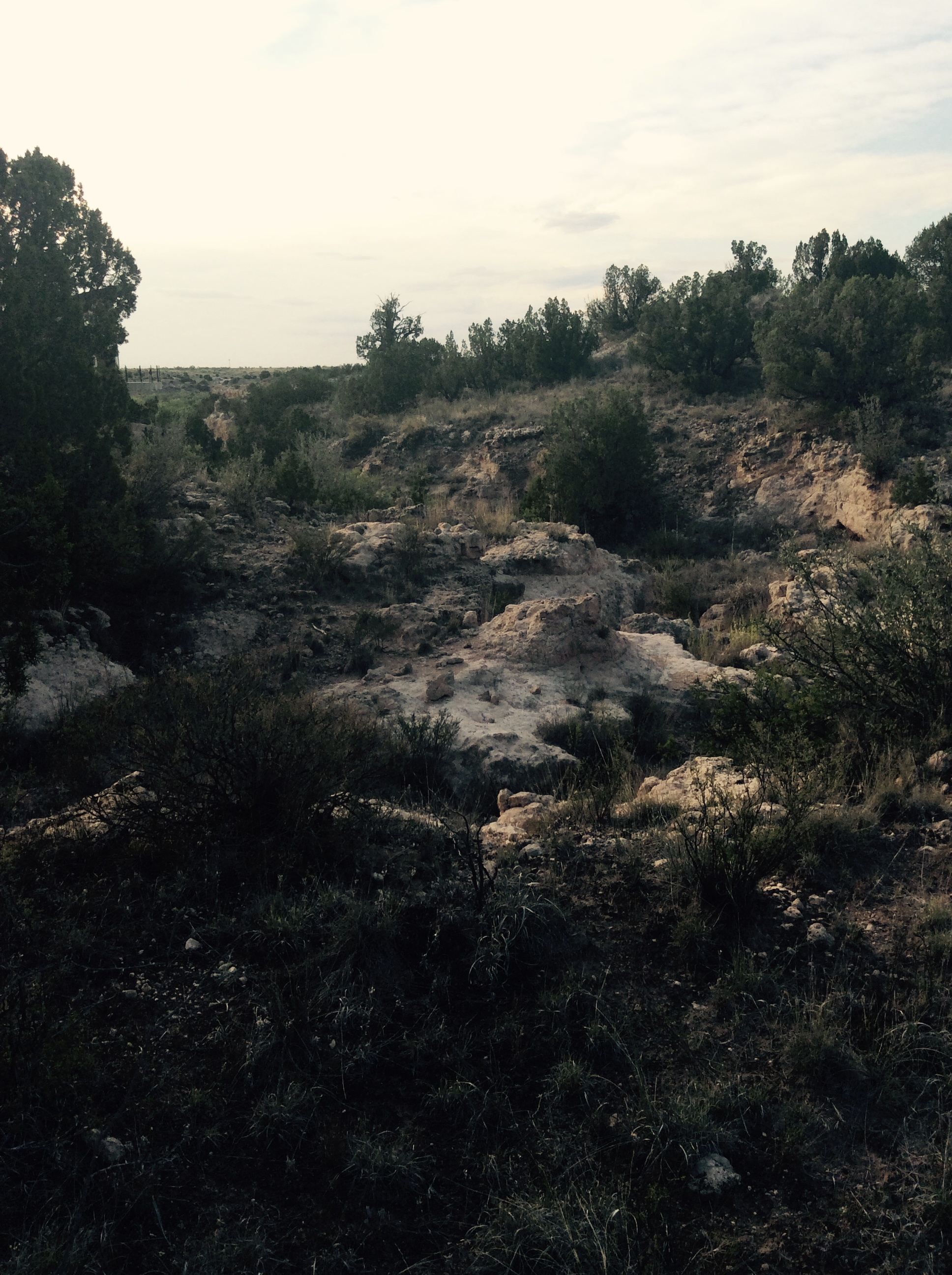
I walk the mile long trail down into the depths,

caliche, gravel, larger rocks strewn by millennia.

The ancients–Clovis, Folsom, Portales

Man–hunted here at the shores of a lake

nearly 12,000 years ago. In 1929, an amateur

archeologist discovered a spear point lodged in bone.

Scattered cottonwoods whisper in the wind,

timeless voices call me, beckoning.

Who were these people? What did they

look like? Where did they come

from? In whose gods, goddesses, did

they believe? Doubtless hunger

drove them to this place of water

and plenty. Columbia mammoths, giant

sloths, dire wolves, saber toothed cats.

I walk this long path, read signs

that tell what diggers found at specific

spots along the trail: bison horns

spanning seven feet, mammoths twice

the size of elephants. I stand in the shade

of the cottonwoods. They whisper to me.

They tell me ancient tales of hunger, strife,

beauty, love, endurance, woe, war, weaponry,

courage and community. How did they overcome

danger, fear? My skin tingles strangely

in the summer heat. Now this land is dry,

desert, the water that sustained teeming life

evaporated in the crystalline air.

Twelve thousand years from now who will stand here?

Will this place exist? Will someone wonder the meaning

of our bones, who we were, what we believed?

Hot Pink Toenails


Since this is National Poetry Month, I have decided to post a few of my poems from my book “On the Rim of Wonder” which can be found on Amazon. This particular poem has been one of the more popular poems.

The day I met Tom

my toenails were pink.

A big mistake!

He called me the lady with the hot

pink toenails.

I am not a hot

pink person.

They should have been red

or orange.

I am orange person–

mixed with lot of red.

It took me two weeks

of looking at those hot

pink toe nails

to paint them red.

Am I happier now?

Not really

but I know

it is the real me,

my own toes when I

look down.

When she painted them pink

the woman said,

“Old ladies want red toenails.”

Will I be able to look

at my toenails and not

think “old lady”?

Will I have to find

a new color?

Probably.

Maybe orange marmalade or cinnamon spice or burnt sienna.

A Letter for International Women’s Day


Dear Fellow Females:

Celebrate yourselves today,

tomorrow, every day!

Stand strong, be brave, promote persistence, purpose.

Without you, your will, your abilities, your strength

humanity cannot continue to exist.

I salute you!

The Huntington Gardens–Part Two


In the last six weeks I have travelled to these gardens five times, two alone and three with house guests. Amid all the turmoil in the world today this is a place where nature continues its grand display, instilling a sense of peace and quiet.

My son headed to the Chinese and Japanese gardens.
Earlier photos were the walk to arrive here at the Japanese Gardens.

Depending on how you walk through the gardens, you walk to Japanese first, then Chinese, then back to the Japanese Gardens. This and the following few photos are the Chinese Gardens.

The Chinese Garden is filled with various sizes of limestone that looks like sculptures but is natural. The next time I go, I am going to learn what is written on many of the pieces of limestone.

In many places you can see the San Gabriel Mountains which are not far away.
The pond is filled with fish.
My son enjoying the waterfall.
I sat on a bench and stared at this for a long time, wondering how they do this without messing any of it up. There are doze
Looking back as we are on the way out.
And finally something European as we headed toward the parking area.

After five times, I have seen most of the gardens–next post will be some photos of the Australian area–and the two art galleries. Never made it to the library yet.

Ponies


Mom loved Shetland ponies.

not so much the stocky, chubby ones,

the fancy show ponies.

We had so many, I’ve lost count–

black, pinto, dappled grey with silver

mane and tail–the fanciest one.

Midget, a pinto, was the first one.

They bought her so I could learn to ride.

I was six.

At the country fair, I rode her.

She zigged; I zagged, fell off.

Utter humiliation.

On rainy days my sister and I would

put a few in the barn, dress them up,

play games with them,

living toys.

We even rode them when in high school

along the cornfields, across the terraces.

My last memory–riding, ambling along, not paying attention,

suddenly lots of noise in the cornfield,

an animal running through the cornstalks.

Pony bolted; I jumped, landed wrong,

limped for days at school, climbing

up and down the steps.

Did I ride again?

I don’t think so, not for years and

then I rode horses.

Winter Afternoon


No wind, stringy high clouds block a bit of blue.

Someone bounces a ball next door,

I hear the intermittent sound.
Suddenly several dogs bark across the golf course green,

Suddenly stop.

Across the turquoise pool water burnt orange leaves waft downward,

some land on the pale gold rocks,

some float at the pool’s terracotta edge,

others lay across the dark green rosemary bushes.

Bird song I cannot identify fills the background.
Two men, voices loud, banter –they’re neighbors, friends.

One of their small children cries, stops, cries again.

A late day golfer strides a ball, shouts.

Breeze arises, quits, more leaves fall,

the pool and birdbath water slightly ripple.

The lemons glow against the dark green leaves,

a painting emerald and bright yellow.

I sit beside the African multi-colored granite table my son made,

admire the colors:

-succulents called fire sticks match the falling leaves.

shades of orange, red, and green.

-the pots that house them match the dark blue of the pool’s old fashioned

Mexican tile.

-roses still display a few blossoms, dark red, pale pink, peach.

Tomorrow the gardener will trim them back to help them bloom lushly n spring.

-the oleander, still green, quit blooming weeks ago.

-rosemary loves this time of year, covers itself with tiny, fragrant, grey-blue flowers.

-in the distance mountains arise, a purple haze.

Now, no sounds, only silence.

I sit in the quiet beauty, write, drink green tea, feel grateful.

The Boy From Honduras


My current writing endeavor is part of a challenge to write 20 minutes per day six days a week. The story I am going to relate now was written as part of that project. The brief introduction here was part of something I wrote the day before I wrote about the boy.

I watched “60 Minutes” on Sunday about German Jewish Americans who volunteered to go behind enemy lines before and after the end of WWII to either spy on or interrogate Nazis, often officers of higher rank. One of them related that he never met a Nazi who had any remorse for atrocities he had committed, who thought what they had done was wrong. How horrifying, to hate anyone, any group so much over religion, ethnicity, sexual preference, status, remains to a great degree beyond my comprehension. Although I may view people like the Nazis as my moral enemies, to hate anyone so much as to torture and murder them seems incomprehensible.

These views also affect my attitude toward immigration. People rarely leave their countries because they want to, they leave because they need or have to in order to survive. Often it is a matter of life or death. Now I will tell you about the boy from Honduras.

Short, straight black hair, obsidian eyes, skin the color of café con leche, he showed up at high school one day absent any knowledge of the English language. His brother, married to a US citizen, lived across the street from the high school secretary. The assistant principal brought him to me. By Texas state law he had to spend at least one period of the day with a certified ESL teacher, me. He came often even from his other classes because everything except Spanish class was in English. Written Spanish helped him only somewhat. In Honduras poor country students only attended school for a few years. The more advanced middle and high schools were in cities and required fees paid.

The counselor claimed he had not been to school at all. I knew better; he knew things that a kid only learns if he or she has gone to school. When I did not understand his Spanish, I asked him to write it down. It took me a while to figure out some of his written Spanish. He sounded it out and so instead of writing habla (h is silent in Spanish), he would write abla. When I really could not understand, I went to the Spanish teachers from Mexico; they could not always understand him either. One, who had travelled all over Mexico, said he spoke a dialect she had never heard. Over time, I learned he had started school at six, attended for four years, then went to work on a coffee plantation. He was 15 when I met him. After I showed him a photo of me picking coffee in Costa Rica, he became very excited.

His father had been murdered; his mother feared for his life so she sent him to his brother in the US. He was cheery, always smiling, played soccer at lunch with the other students, missed home. He told me his family was working with an immigration lawyer so occasionally he traveled to Dallas to meet the lawyer. Then one day he disappeared. We never saw him again. Later one of the Spanish teachers told me he had come, smuggled in a shipping container, had survived this for days. And now he was gone.

Students asked about him; we had no answers. Some who had ranted about illegal immigrants stopped ranting. It was someone they knew, liked, who had left with no answers. He was a kind, funny kid whom everyone liked. Is he in hiding? Is he safe? Is he alive? Who knows?

Christmas Thoughts


While many around the world are celebrating the birth of Jesus today, it seems worthwhile to recall some of the things he taught:

Blessed are the meek for they shall inherit the earth.

Blessed are the merciful for they will be shown mercy.

Blessed are the pure in heart for they shall see God.

Blessed are the peacemakers for they shall be called the children of God.

I keep thinking how much better this world would be if people would follow these teachings, care for others. be kind.

Note: painting is by Israel Guajardo.

An Old Bowl and the Silver Spoon


My Aunt Julia, Mom’s sister, lived to 94. She loved fine antique china, linens, and French furniture. The ordinary bowl in this photo defies those inclinations, its origins a mystery. How did she acquire such a plain bowl and why? I will never know. In spite of its age, cracks, dull finish, I have used it every morning for decades. It is my breakfast bowl, filled with yogurt or cottage cheese with dried blueberries and a handful of walnuts, or, occasionally, oatmeal.

The spoon, on the other hand, is not ordinary, but rather good silver from the set Dad gave Mom on their first wedding anniversary. Unlike Mom, who saved her good silver for holidays and special occasions, I use these spoons daily and think of her unconditional love, strong will, determination, and love for beauty.