Book 23 for 2024: “Off With Her Head: Three Thousand Years of Demonizing Women In Power”, Eleanor Herman


Starting with ancient Egypt and later with the ancient Greeks and Romans and ending in current times, this highly researched book (there are 15 pages of Bibliography) details millennia of lies told about and attacks against women in power. Ridiculous things have been attributed to women, powers that no human has, in order to control them. Here is an example: Pliny the Elder (23-79 CE) wrote that menstruating women caused hailstorms, lightning, and whirlwinds. And worse yet, demons come from this blood (various medieval medical authorities) and it can shrivel the penis.

Then there is the whole thing about raging hormones. The word hysteria, which supposedly is an ailment of women, comes from the Greek word for uterus. During the 2020 presidential campaign, Marco Rubio, currently a possible candidate for vice president, tweeted a photo of ten missiles exploding and asked if you want a woman a heartbeat away from the presidency.

During the Middle Ages millions of women were put to death in various horrible manners after being accused of witchcraft. Even in current times various male political candidates and media announcers (a Newsmax journalist, Zinke of Montana, Ben Carson, Chris Matthews–list is almost endless) have called powerful political women witches. The victims of these pejorative rantings even include Margaret Thatcher when she held office.

Marie Antoinette never said, “Let them eat cake”. Various forms of this phrase had been around for over one hundred years. Ann Boleyn originally wanted to marry the love of her life who also wanted to marry her but the powers at the time, including Henry VIII, forbade this. Many of the ridiculous stories about Cleopatra can be easily disproven, e.g her being so rich she dissolved a giant pearl in vinegar to prove her wealth. Unless powered, pearls do not dissolve in vinegar. Catherine de Medici was attacked as some sort of sex pervert when she was 42, obese, and anything but a sexy seductress.

The documented lives of many powerful women for the last three thousand years contains endless abuse of all sorts. How is this possible? Because there is an informal Misogynist Handbook that has been used for millennia to control women. The above is only a smattering of what you will learn about this Handbook if you read this book. In the last chapter, the author does provide recommendations for overcoming this abuse of women. However, she also notes currently there is a “furious backlash against this long-delayed crawl toward justice, resulting in the increasing viciousness of sexist tweets and memes, more violent threats, more savage abuse.”

Weekend Trip to Northern Baja


This past weekend I headed to Mexicali in Northern Baja to visit the town of San Felipe and see a new development about an hour south of there. San Felipe is a small fishing town of approximately 20,000 people where there are no fast food restaurants and no Starbucks. Excellent restaurants and good coffee can be found but not at the places mentioned above. They do not exist there. The town of San Felipe has a long boardwalk right along the Sea of Cortez with restaurants across the street. This past weekend they were holding a ceviche contest and fiesta on a cross street. This is shrimp season and the city is known for its shrimp. Unlike the Pacific side of Baja, there is no large commercial fishing allowed in this part of the Sea of Cortez because it contains many endangered fish and the place where whales come to mate. Locals can fish and you see smaller fishing and shrimp boats in the sea. Not only is the Sea of Cortez protected but so are the plants and animals in the desert. Certain plants, like ironwood trees, are ancient and rare. If you want to build a road, it has to be around them. Many other species are also protected.

Unlike the Pacific side of Baja, the water in San Felipe is safe to drink from the tap. It comes from an aquifer up in the mountains to the west.

We spent most of Sunday at the new green development (it is totally off grid) called Rancho Costa Verde. Solar is used for power and each house has a large underground water tank where water comes from an aquifer up in the mountains. This is a newer development so although many of the lots are already sold, except for beachfront, many houses are just now under construction.

This is a very modern beachfront property with marble floors and a glass wall facing the Sea of Cortez.

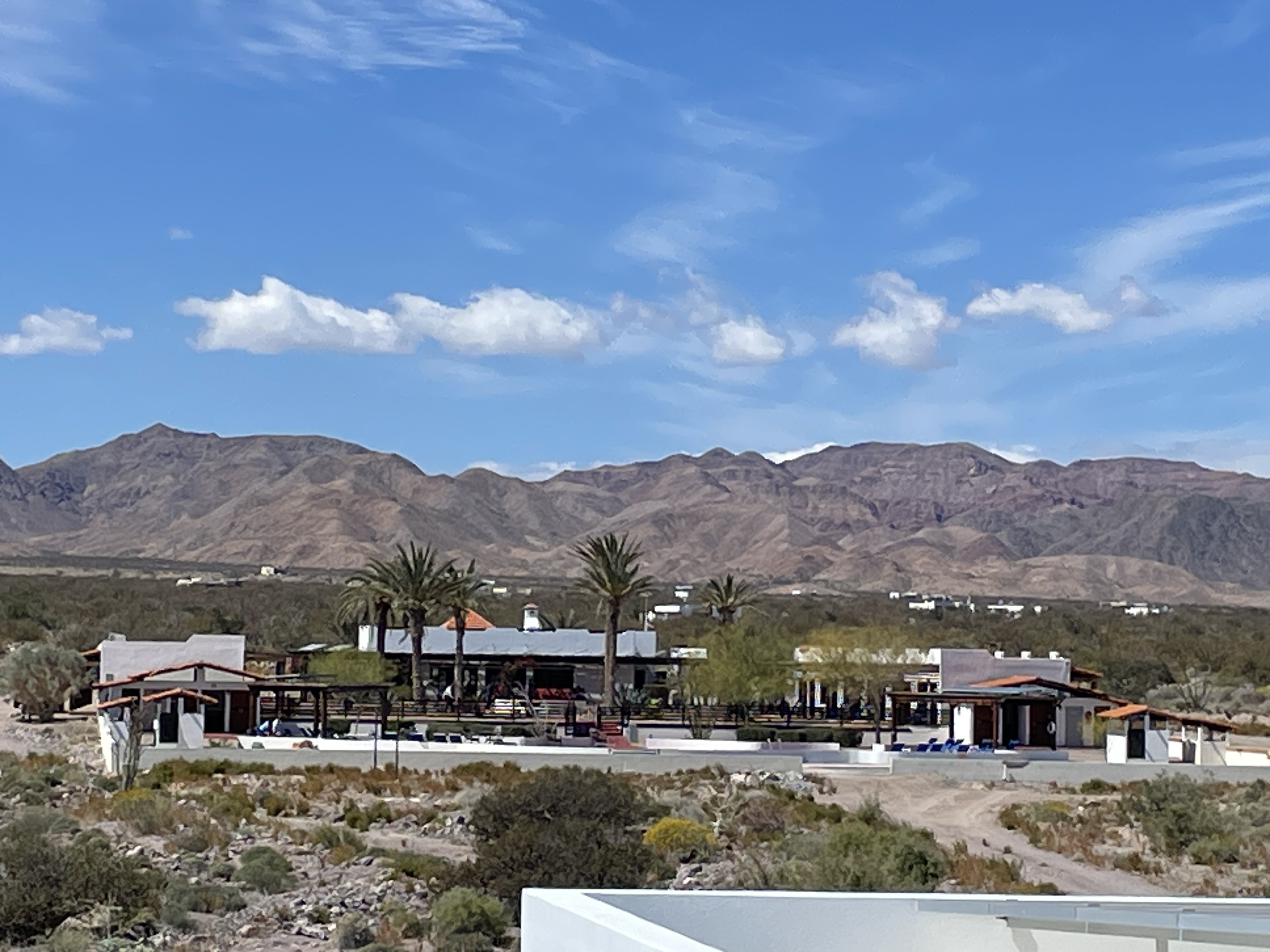
This photo is of the clubhouse and looking the opposite direction toward the mountains. Here I am standing on the roof of the house in the previous photo.

Here I am in front of the pool in front of the clubhouse facing the Sea of Cortez. The house in the first picture is on the left in the distance.

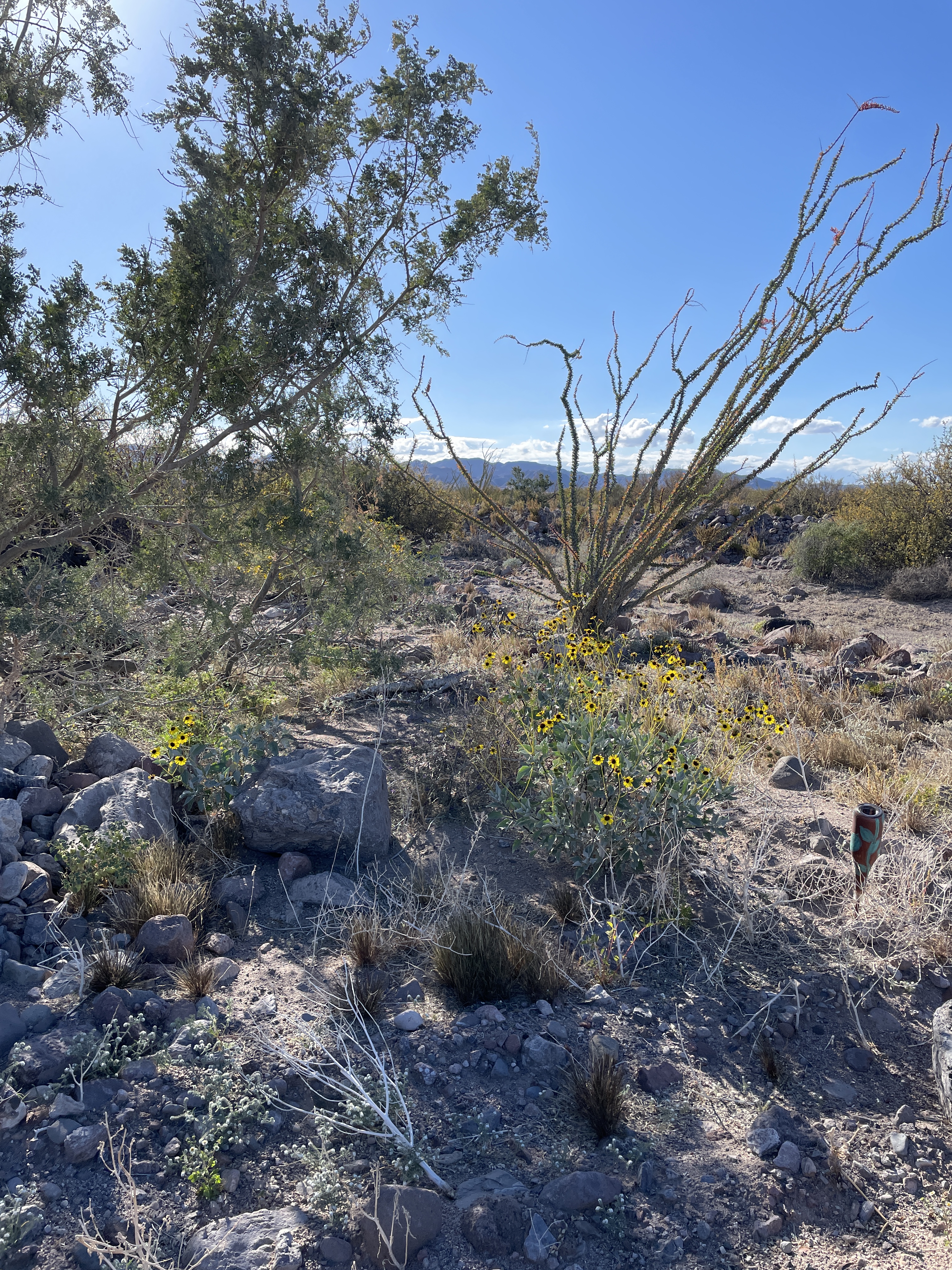
This is desert land where even though it can get hot in summer, the sea breeze keeps it relatively cool.

The plant on the right is ocotillo which is protected. If you are building a house and it is in the way, you have to move it elsewhere. You cannot just get rid of it.

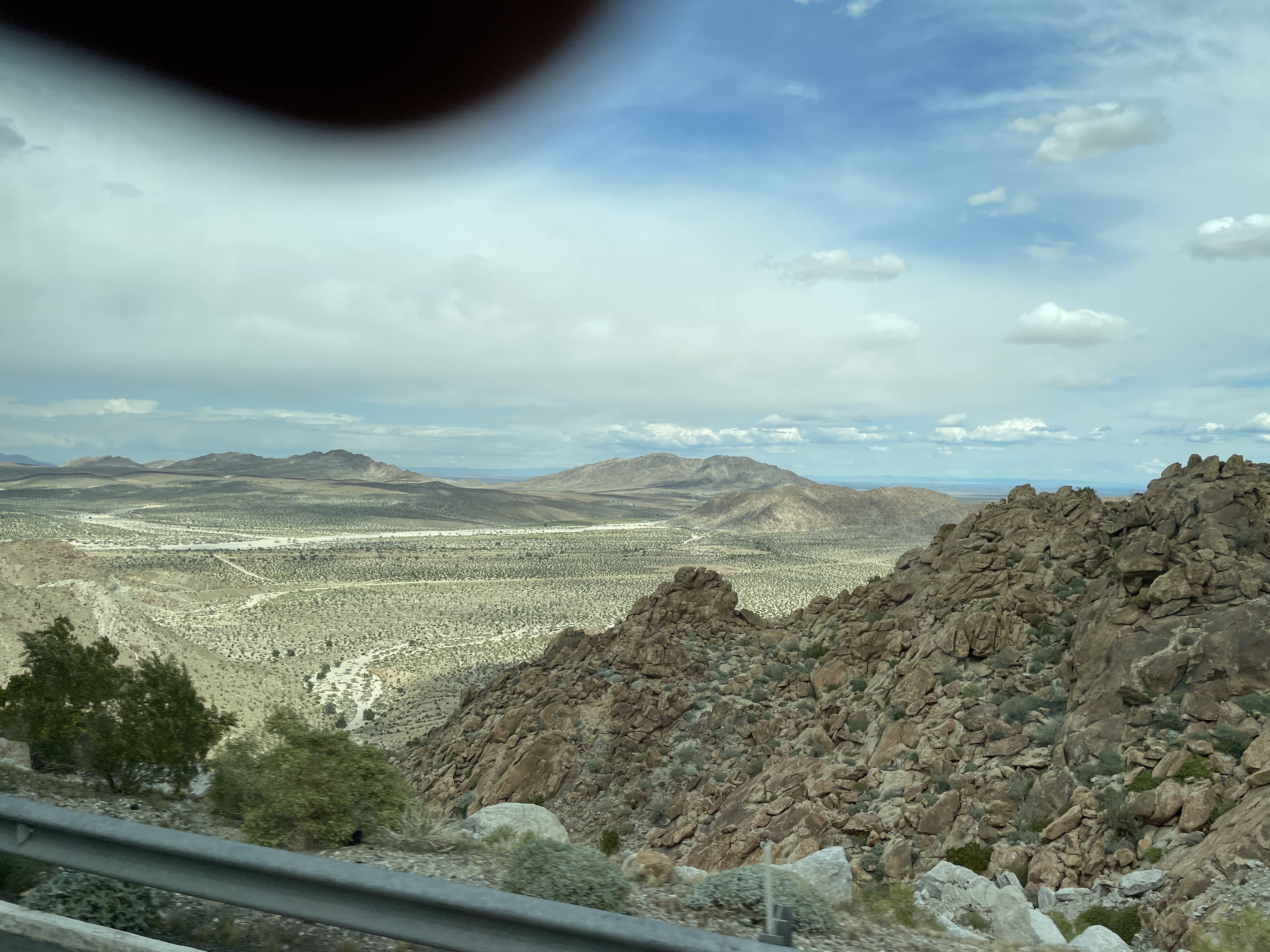
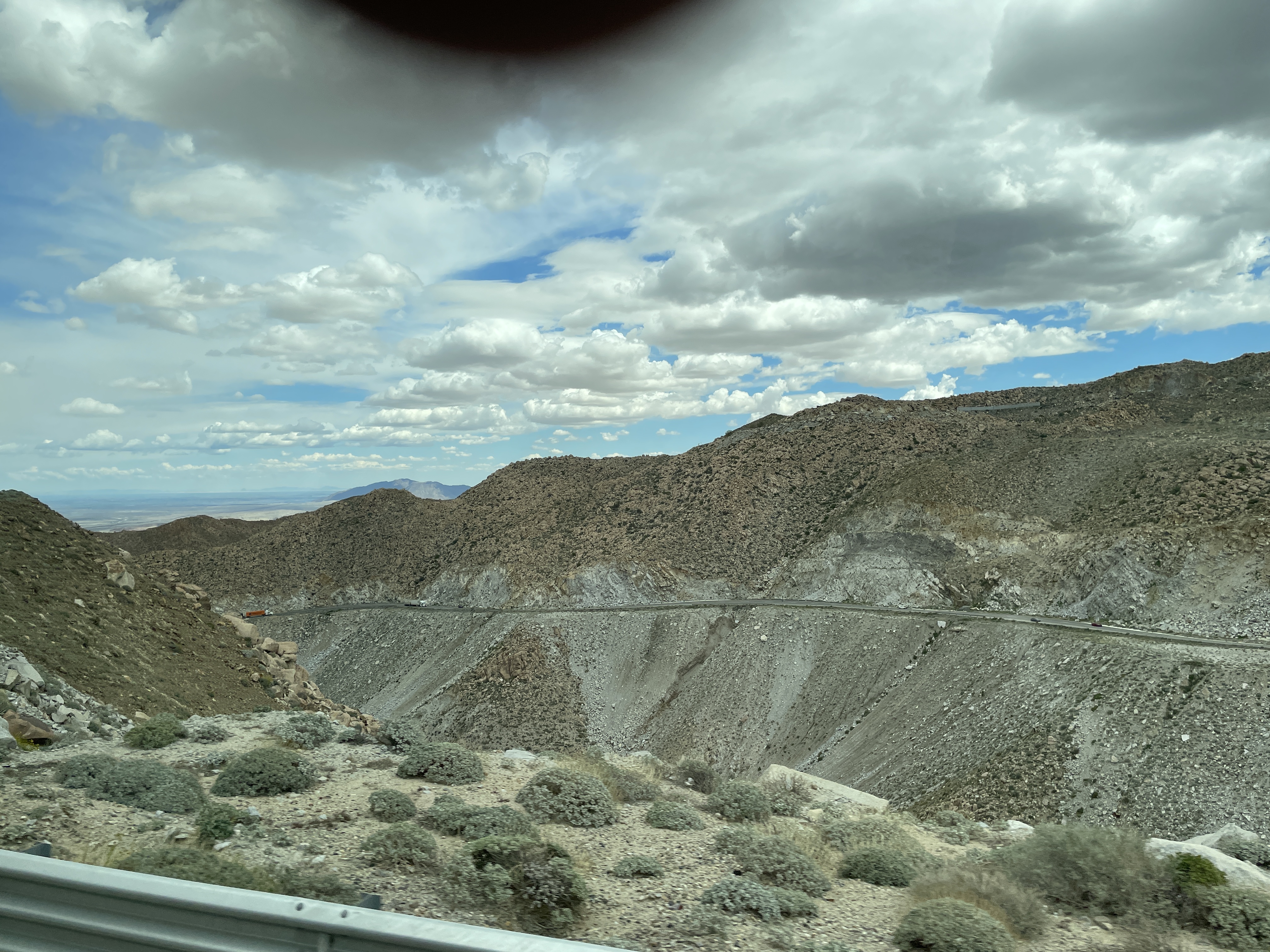
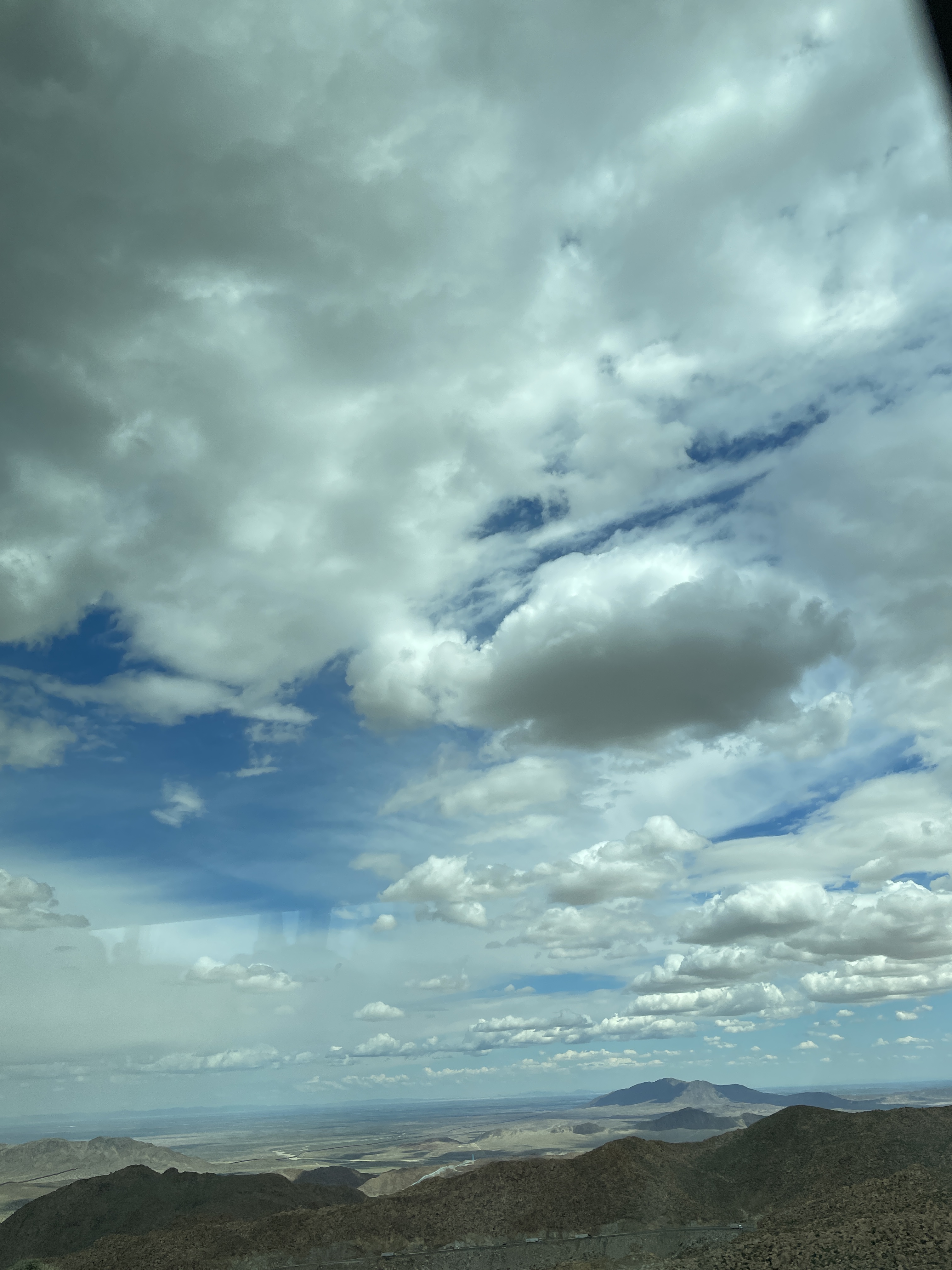
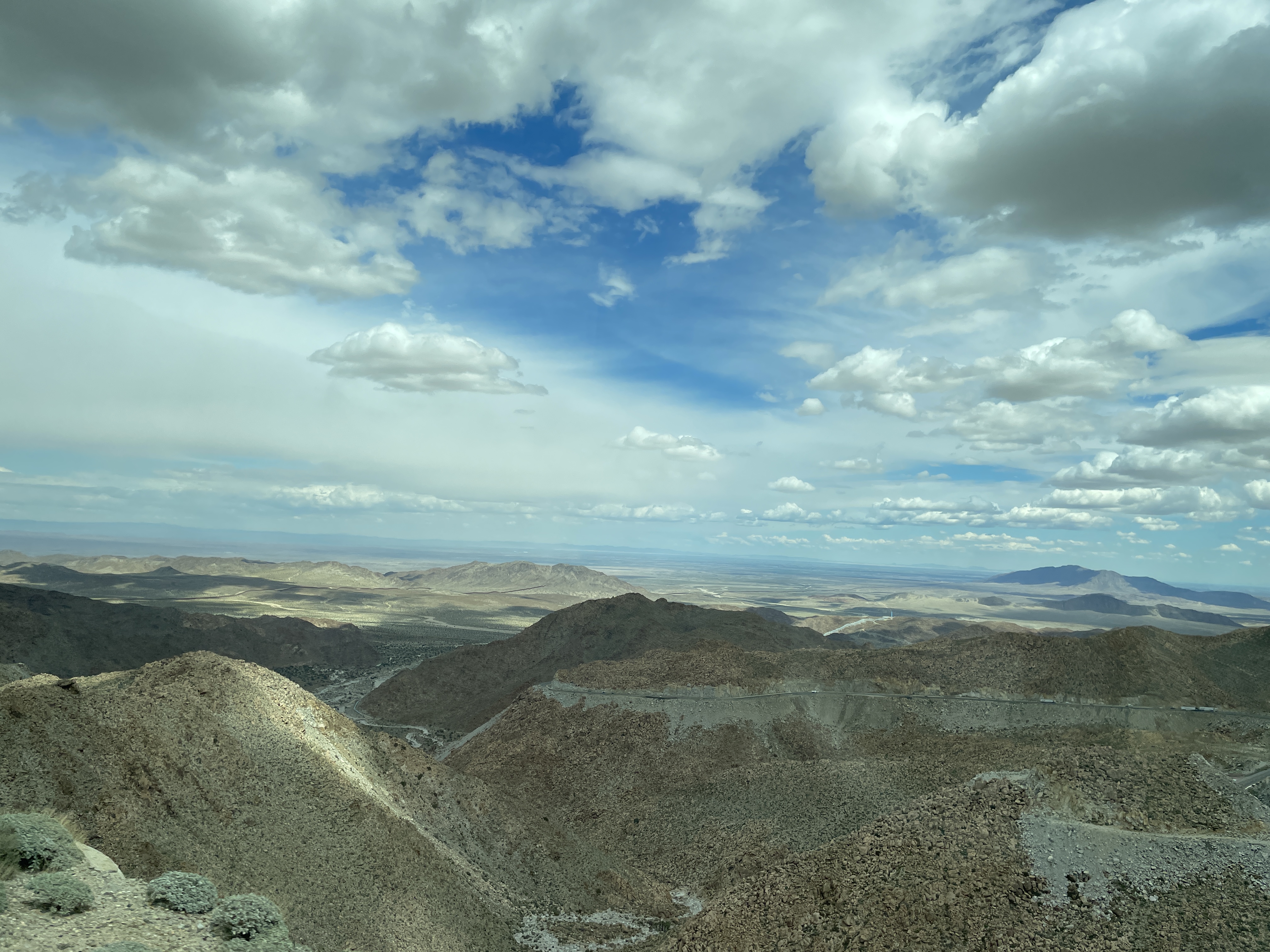
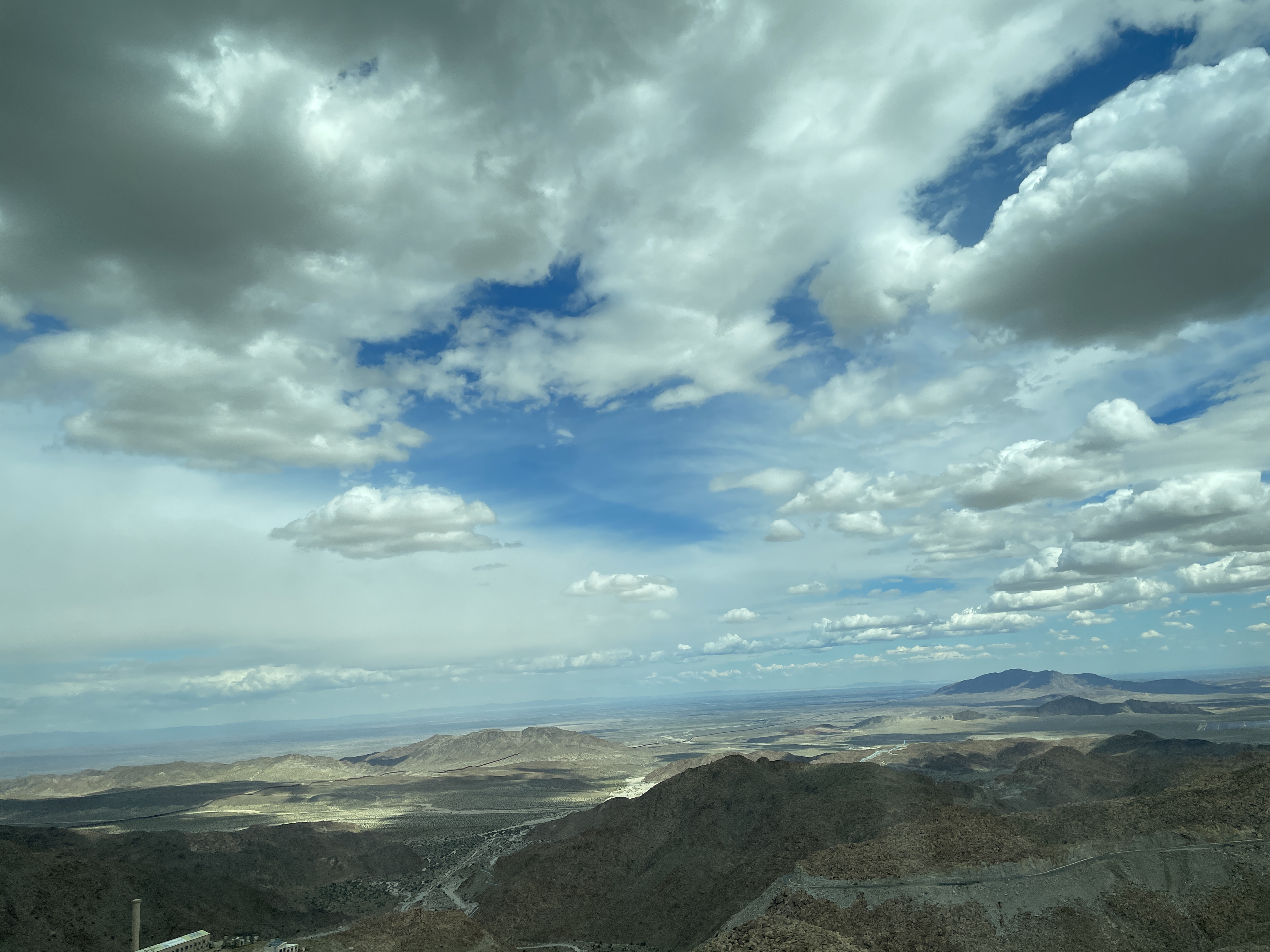
Monday was a big adventure trying to cross the border. We arrived in Mexicali only to discover no busses could cross the border there so we had to take the highway to Tijuana and cross there. To do this you must cross a mountain pass. What a feat of engineering building this road must have been. It is quite incredible and as you climb higher and higher the views go on forever into the far distance. The following are photos I took from the bus window as we drove higher and higher.

These mountains are made of rocks of all sizes that are just stacked on top of each other. Here only these small blue-green plants seem to thrive.

In this photo you can see the highway where we had just traversed.

Here you can see how at this height the mountains are nothing but stacked rocks of all sizes.

After the summit as we went down toward the town of Tecate, it started to rain and it rained most of the way to Tijuana. The Pacific side of this part of Baja gets rain and it was lush green this time of year while the Sea of Cortex side is desert.

I do not recommend crossing at Tijuana in a large bus. Even though we had sent all our passport information in advance, they made the bus sit there for nearly an hour and wait. Meanwhile those on foot and in cars were just zooming along at a rather rapid pace. Then we had to get out of the bus with all our luggage and everything and wait more. I crossed the border (not in a bus) last April and it did not take long at all. I have heard that Tijuana is the busiest port of entry from one country to another in the world but have not verified that. It certainly was busy yesterday.

Book Seven for 2024: “After Eden, A Short History of the World”, John Charles Chasteen


Want to learn a lot in less than 400 pages? Read this book. Published this year, it is the most recent book by a prominent Latin American scholar and historian. After humans learned agriculture and built cities, most of the population of the world became increasingly patriarchal and warlike. The divide between rich and poor increased. Egalitarian foragers and wandering hunters existed only in more remote areas. A few still exist in those remote and less modern corners of the world, often places where few others want to even go. This quote says a lot about the current state of affairs:

“Our civilization has thousands of years practice making war. We have almost NO practice making global peace, but without it we are doomed. Today’s pervasive nationalism and rearmament is unlikely to help us make global peace.”

And a page later:

“Only a true unanimous global effort has any chance to preserve our common home.”

He notes that saving Earth will take huge social transformations, including curbing the excessive consumer capitalism that currently pervades plus overcoming a world wide history where half of humanity mistreated the other half, a practice that still continues.

One Book a Week-51: “The Watch”, Joydeep Roy-Bhattacharya


I could not stop reading this book. The setting is a US military outpost during the Afghan war in the middle of nowhere in the mountains of Kandahar. The weather is brutal–extremes of cold and heat, sand storms, heavy fog early in the mornings. Suddenly, after a brutal battle where they lose some soldiers, a young Afghan woman, Antigone, with stumps for legs shows up pulling a cart. Her brother, who the soldiers think was part of the Taliban, was killed in the battle; she wants her brother’s body for a proper Muslim burial. The soldiers do not know whether she is who she says she is or a suicide bomber. It confuses them even more when she plays hauntingly beautiful music on her rubab every night. All this leads to a lot of confusion over and raises many questions about morality and duty. Each chapter is from a different viewpoint, the young woman and various soldiers in the outpost.

Note: The rubab is a traditional Pashtun 12 string guitar-like instrument. You can find recordings on YouTube.

One Book a Week-46: “Road Fever”, Tim Cahill


After reading two intense, somewhat depressing novels, I decided to read a lighter non-fiction work. An article I read mentioned a tale of two guys, Tim Cahill and Garry Sowerby, who drove a GMC Sierra pickup truck from Tierra del Fuego, Argentina, to Prudhoe Bay, Alaska in less than 25 days. I like adventures and the best vehicle I ever owned was a Sierra 4 by 4 Off Road. I sold it to a former student when I moved. It was still going strong at over 300,000 miles.

In order to follow along on their adventure, I dug out my atlas and followed their trip through 13 countries, finding cities, little towns, rivers, mountains. When they traveled in 1987, the only place with no road was the Darien Gap on the border between Colombia and Panama–today still no road and now famous for all the migrants who labor through this dangerous, swampy, jungle area on foot on their way north. Since no road there, Tim and Garry had to load the truck onto a container ship in Cartagena and unload it in Panama. They also rode on the ship as passengers. This lead to their meeting some of the most colorful characters on their trip.

Along the way, they meet all sorts of people, e.g. sadistic police, kind employees of international GMC, a weird consulate employee, and helpful women, describe them and the landscape in detail. Procuring the right documents and proceeding across borders is sometimes easy and sometimes grueling, again described in detail. Of course, political leaders, ease of travel, etc. have changed in many places–I’ve been to or lived in five of the countries they traverse.

Want to explore new places, meet all sorts of folks?? Then this is the book for you and a fun read.

One Book a Week-42: “Where There Is Fire”, John Manuel Arias


Before and since my two trips to Costa Rica, I thought Costa Rica had miraculously escaped the Banana Republic fate of many other Central American countries. This historical novel enlightened me to just how wrong I’ve been and how some of this continues today–huge US agricultural corporations controlling much of the agriculture.

In the 1960s, large US corporations invaded Costa Rica and controlled large blocks of land to raise bananas and cause havoc among large segments of the population. To increase yields the American Fruit Company doused their giant, lucrative, banana plantations with Nemagon, a pesticide that causes cancer and sterility. The novel includes letters indicating that both this company and Dow, the producer of the pesticide, knew this, did nothing about it, did not inform workers (until they had no choice), and continued its use.

The novel contains the story of one family’s history who lived near the largest plantation, the father and grandfather who worked there, a devastating fire, and the effects of this company’s policies on several generations.

Note: As recently as last year, the BBC reported on the use of this pesticide and its effects on workers and people living near plantations where it is still being used. Online you can find numerous articles about how these practices (the American Fruit Company is now Chiquita) fueled neocolonial exploitation and drug cartels.

One Book a Week-23: “The Devil’s Highway”, Luis Alberto Urrea


Even though the events described in this non-fiction work occurred exactly 22 years ago in May in southern Arizona, not much has changed except the nationality of the immigrants. Few Mexicans try walking across the Arizona desert these days. Now it’s mostly people from certain Central American countries, Venezuela, and various other countries, generally places where the climate of the Sonoran Desert is unknown.

In 2001, a group of men, mostly from the state of Veracruz, tried it. More than half died and the coyote who led them remains in prison. This book tells their story. It also describes in detail the networks that lure immigrants to attempt the long journey to the US border, who benefits, who gets paid, the geography and climate of the desert–a true tale of deceit, disillusion, desperation, and loss.

4000 migrants have died in the last two decades trying to cross the Arizona desert. This number equals bodies found; many tell tales of others whose bodies remain lost. 2021 saw a record number of deaths. 2022 data is not yet published.

Note: I like Urrea’s books and have read most of his novels. I recommend starting with “The Hummingbird’s Daughter”.

One Book a Week-13: Blue Desert, Celia Jeffries


As an ardent reader who prefers what are usually referred to as literary novels and serious non-fiction, few books impact me deeply and emotionally like this one has. As soon as I finished it, I reread parts of it several times, then sat silently stunned.

After her family moves to North Africa for her father’s work, an 18 year old British girl, rescued by a Taureg leader, is believed dead by her family until she resurfaces years later at a Catholic “home” run by nuns in North Africa. She re-enters British society, marries, leads a relatively “normal” life while keeping a secret for decades. When she receives a telegram, “Abu is dead”, everything changes. Her past comes rushing back in unexpected ways.

The White Supremacist History of Tear Gas


One hundred years ago, a racist US General, Amos Fries, transformed tear gas from a wartime chemical into use against protestors. He loved war gases and saw them as the ultimate in US technology.  He advocated the use of tear gas against any form of civil disorder.  As head of US Chemical Warfare Services, he pedaled his favorite gas to private security firms, police departments, and the National Guard.  According to him, tear gas in the hands of the “White man can quell any uprising.”  He went on to talk about how White men are set apart from the Negro, Gurkha, and the Moroccan. In his effects were letters from the women of the Ku Klux Klan praising his efforts.

Today the tear gas he loved is used all over the world by tyrannical governments to control their people.

“All Children Are Our Children” by Carol P. Christ


This is a rather long read the gist of which is this: what if “we were taught to love and nurture and be generous to others” and these were the primary values in the world rather than the current values. “What if we were taught to open our hearts to the world? Would domination, violence, and war be possible?”

Carol P. Christ's avatarFeminism and Religion

Carol P. Christ by Michael Bakas high resoultion“All children are our children.” As I was posting my recent blog about the shooting of black men by the police, these words came into my mind with the force of revelation. At the time I was looking at a photograph of Philando Castile, taken at his place of work. Yes, I thought, my heart opening: “he is my child too.” This widening of the heart is at the center of the maternal values of ancient and contemporary matriarchal cultures around the world. It is a feeling some of us who were mothered well enough or who mothered children—including children not our own—carry within us. Is this the healing balm our world needs today?

Maternal  values?  So many of us turn up our noses at such a “gendered” term. Perhaps we were not mothered enough in our families of origin. Perhaps we still feel un-mothered. Perhaps we don’t want…

View original post 814 more words