Book Nine for 2025: “Martyr”, Kaveh Akbar


“She was Christian but American Christian, the kind that believed Jesus just needed a bigger gun”–part of the description of the main character’s rich, not dentist mom rich but oil, trust fund rich, blue-eyed, blond girlfriend. Cyrus, the main character is an Iranian American whose father immigrated to the US when Cyrus was a baby after Cyrus’ mom was killed when the US shot down an Iranian passenger plane thinking it was a bomber (July 1988). His dad acquires a job at a Midwestern chicken farm, counting eggs, but special eggs. This farm breeds chickens to grow faster to get to market faster. He works six days a week, long hours, until Cyrus, who excelled in elementary and high school, becomes a sophomore in college. Suddenly, his dad dies.

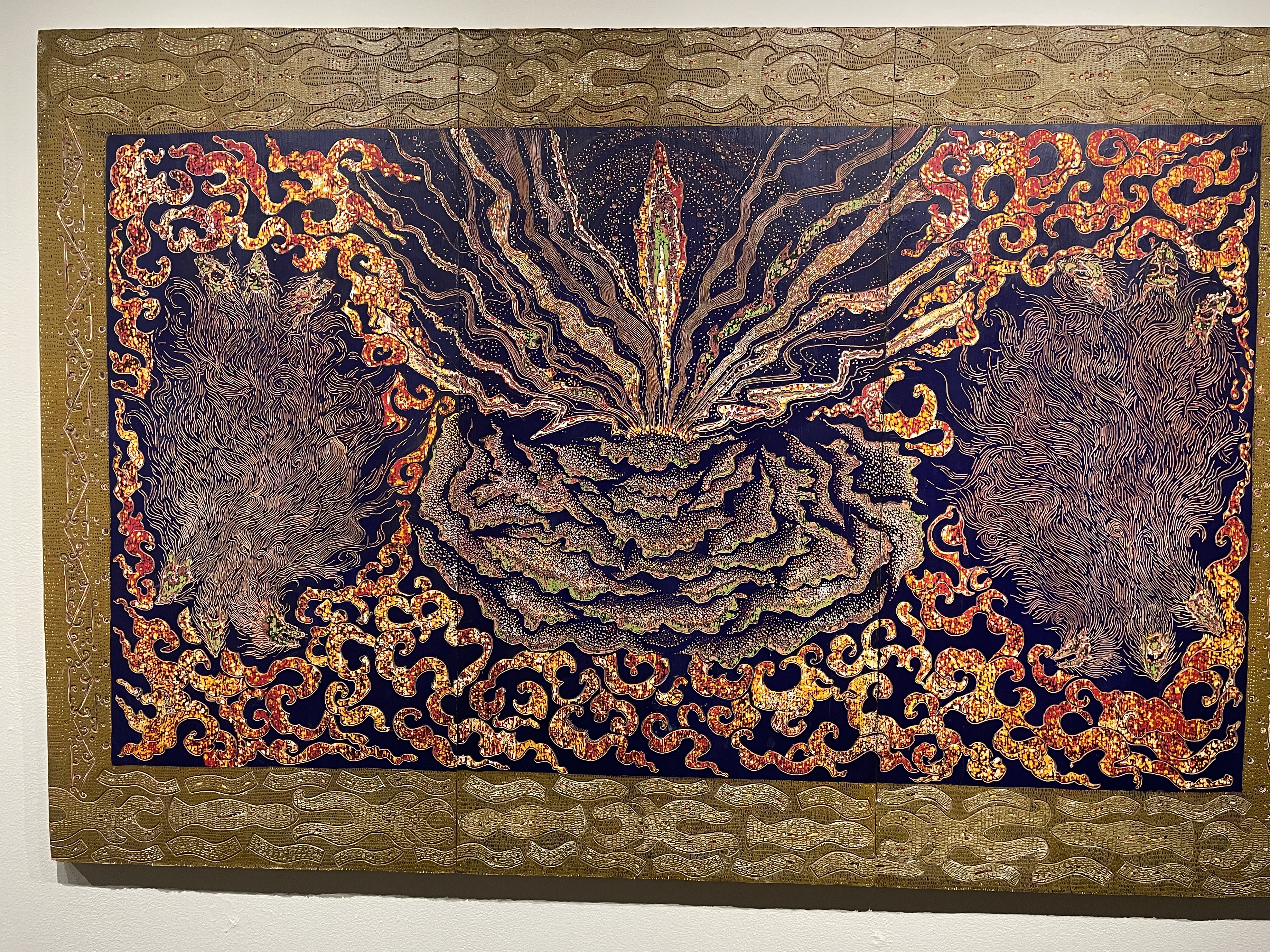
Cyrus becomes an addict using alcohol and drugs and writes poetry and eventually finishes college. He becomes obsessed with and researches martyrs throughout history–people like Hypatia of Alexandria, Bhagat Singh, Emily Wilding Davison, the Soulit Women. He gets sober and obsessed with his own past. This eventually leads him to travel to Brooklyn to talk to a famous artist whose last exhibit is herself talking to visitors as she dies of cancer. In researching this woman’s paintings, he discovers a strange painting of a young man dressed as an angel whose job as a soldier is to ride at night with a flashlight through the fields of the dead and dying Iranian soldiers consoling them during the Iran/Iraq War. Cyrus knows that his mom’s brother had this actual job during that war and wonders can there be a possible the connection.

Throughout these events the reader is lead to not only explore Cyrus’ thoughts and beliefs but also those of his father, mother, uncle, and best friend, Zee. It is rare for a novel to be both heart wrenching and funny. Akbar accomplishes this task. One moment I found myself laughing out loud and the next almost in tears. I could not stop reading even though the paperback is long. Perhaps my knowing something about Iranian culture, food, etc. helped me appreciate some of the book more than I might have otherwise. Nevertheless, this is a universal story about love, discovering oneself, relationships, parenthood, human nature. It is definitely worth taking the time to read.

Book Seven for 2025: “The Map of Salt and Stars”, Zeynab Joukhadar


Two young heroines dominate this fascinating novel which switches back and forth between the Syria of 2011 and the 12th century. The latter is a girl who disguises herself as a boy to join the quest of a famous mapmaker. Nour, the first girl, lost her father to cancer in NYC. Then her mother, a mapmaker, decides to move herself and the three daughters back to Homs, Syria. They barely settle into their new life when the civil war breaks out and a bomb destroys their house. They become refugees. This is the tale of their harrowing journey from Syria to Jordan to Egypt to Libya to Algeria, then Morocco and finally to Cuenta, the Spainish city on the north coast of Africa, where their uncle lives.

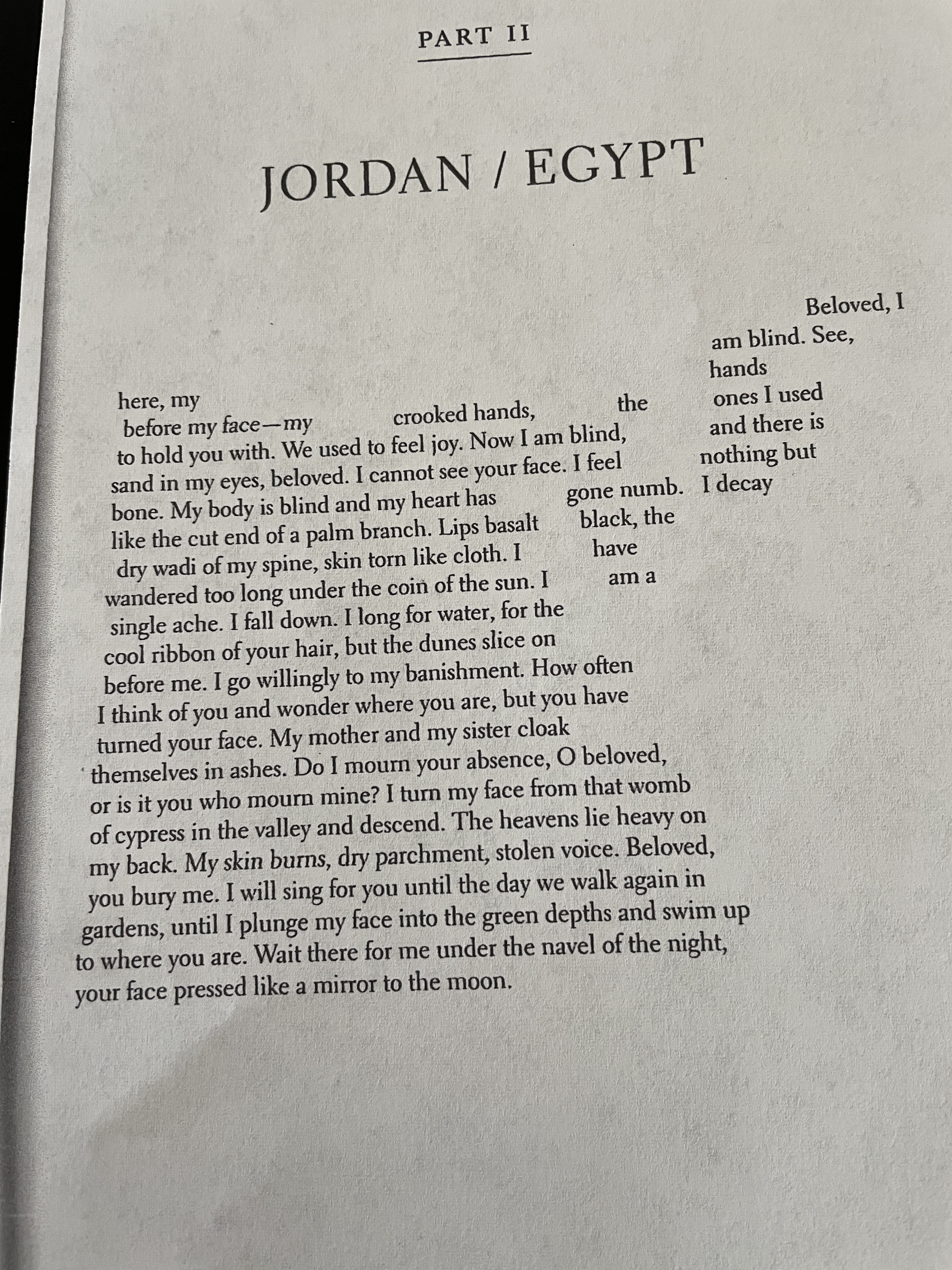
To keep sane, Nour repeatedly tells herself the story of Rawiya, the disguised girl who is an apprentice to the map maker. When he was alive, this was the favorite traditional story her father told her. The book alternates between what is really occurring to Nour and her refugee family and this ancient story. At the beginning of the section for each country through which they travel, there is a touching and beautifully written poem in the shape of the map of that country. The poem for Jordan/Egypt is printed below.

Book 40 for 2024: “If We Are Brave: Essays from Black Americana”, Theodore R. Johnson


Johnson, a columnist for The Washington Post, notes that the US was founded on a set of ideals but for much of its history agreement on what those are ideals are has not existed. What are these ideals, who are they for? Today there is little agreement on much of this. There seems to be a lack of a common vision on what a democratic system is and should be and for whom. The essays in this book address these questions both today and from the origins of the country when only white men who owned land could vote. This book also discusses how different races in the country and the changing predominance of cultures affects the ideals people hold and the kind of country they envision for themselves.

As a Black man who is a retired Navy Commander, he also discusses his own experience, extensive research, and personal views. This short book is an excellent primer on how different races and cultures experience living in this country and their varying visions of the meaning of democracy.

Book 39 for 2024: “The Return”, Hisham Matar


This book won the Pulitzer Prize in 2016. The subtitle, “Fathers, Sons, And The Land In Between” indicates a bit of the subject matter–how sons and fathers relate, but in this case it is a tale of horrible grief and suffering when Matar’s father is arrested and imprisoned in the notorious prison of Qaddafi in Libya. For decades Matar tried to find out what happened to his father. There is no record of his death and no one knows what happened to his body. The book details the lives of his family and their search for news of, hopes he might be alive, and what happened to Matar’s father. To this day no one knows. In 2012, 22 years after his father’s kidnapping when Matar was 19, he returned to Libya to try to learn more, met with uncles who had also been imprisoned, some for 20 years. This is the tale of his family’s suffering and hope. It also relates in detail the horrors of Qaddafi’s reign, what happened to many in his most notorious prison, and the resilience of so many who managed to survive, including close relatives of the author.

Note: After Qaddafi fell, there was hope for a new, unified government. However, as of the present, Libya is ruled by two rival administrations and is a divided country.

Langston Hughes in Uzbekistan


It’s 1932.

Movie roles promised to 22 Black Americans.

“Black and White” in the

Uzbek Soviet Socialist Republic.

Treated like royalty, wined, dined, at

their own expense.

Hughes–ridiculous script. All went

home except Hughes. He stayed,

traveled, saw cotton grown from Aral

Sea water–now no water, desolate

desert.

In Tashkent, Uzbeks, Turkmen, Tartars

honored him, flowers, fruit.

No English.

He met a Red Army Captain from

high Pamir Mountains. Hughes

described him, Black with Oriental eyes.

Hughes called him Yeah Man.

He called Hughes Yang Zoon.

Weeks together never understanding

each other’s words.

Hughes’ poetry book

“The Weary Blues” first

American book translated to

Uzbek. Original English version

lost. He describes this new place:

“Look: here

Is a country

Where everyone shines.”

Note: You can find a version of this book translated into English from Uzbek by Muhabbat Bakeava and Kevin Young.

Book 34 for 2024: “The White Mosque”, Sofia Samatar


This memoir tells the tale of an unusual tour for a specific purpose, to follow the path of Mennonites who left Europe to escape conscription into the army since the Mennonites are pacifists. The author’s own life is unusual. Her mother was a Swiss Mennonite missionary to Somalia. Her Muslim Somali father taught the Mennonite missionaries Swahili. The two met and married. Samatar grew up and lives as a Mennonite. She teaches African and Arabic literature at James Madison Un. She is most famous for her fantasy novels and short stories which is how I discovered her writing.

In the late 19th century a group of German speaking Mennonites left Russia for Central Asia where their leader believed Christ would return. They suffered many hardships, rejection, abuse, but finally found a place that welcomed them in the Muslim Khanate of Khiva in what is now Uzbekistan. There they built a white church which the locals called Ak Metchet, the White Mosque. Their village lasted 50 years.

If you go online, you can find tours today that follow the route of these Mennonite travelers, trace their route. This book details Samatar’s experiences on the tour, the tour guides, the food, the architecture, the culture and the history: a 15th century astronomer king, the first Uzbek photographer, Mennonite martyrs. She also discusses her own unique upbringing, local beliefs and culture, how people develop their own personal identity, and the surprising interconnections people sometimes discover.

Book 33 for 2024: “Three Daughters of Eve”, Elif Shafak


Shafak is a popular Turkish writer. One of my all time favorite books is her novel about the life of Rumi.

“Three Daughters of Eve” takes place one evening in Istanbul in 2016. Peri, one of the daughters from the title, is on her way to a fancy party when a thief snatches her purse out of the back seat of her car which is stalled in traffic. She parks the car and chases him through back alleys. As she fights him for her purse, an old photo falls to the ground. It portrays three young women and their university professor. This photo jars her mind, takes her back to her time at Oxford University when she was a student there in 2000-2002, her childhood in Istanbul in the 1980s and 90s, and her life. She thinks back to her life with her two friends, Shirin, an adventurous Iranian young woman, and Mona, a devout Egyptian Muslim who word a headscarf out of choice. And then there is the famous professor Azur, whose class on God either makes students hate or love him and the scandal that caused Peri to return to Istanbul.

Until her daughter, who was in the car and eventually chases her mother down in the alley, sees the photo, no one, except her husband, seems to have known Peri even went to Oxford. Her daughter mentions it at the party while everyone is arguing about East and West and politics and who has the most money and how they acquired it. Peri tries to deflect questions, changes the subject, and keeps remembering her past: her parents, a father quite irreligious, her mother a devout Muslim, their endless arguments and hostility, her brothers, her childhood and her stint at Oxford.

Through the story of Peri’s life, this novel explores personal identity, East-West history and politics, the meaning of marriage and friendship.

An Abecedarian Poem for Sudan


While a lot of the world is focused on Ukraine and Israel/Gaza, since April 2023, two groups, the Sudanese Armed Forces and the Rapid Support Forces, have been fighting for control of Sudan. 11.1 million people are displaced and more than 17,000 killed, mostly civilians including children. Currently, for the second time since 2003, famine lurks at the door of Darfur state. Although I wrote the poem thinking about Sudan, a lot of the same conditions apply to Congo.

Amidst the denuded trees along a wide

boulevard walked a tall, dark-haired girl

carrying a large basket filled with a few

deep red pomegranates, two brown

eggs and three delicate pastries

filled with pineapple, cinnamon, and

guava, her favorite. She felt lucky.

Her mother sent her to the market, her mother

ill with ague, shivering, fevered,

jaundiced, too young to be dying, her father

killed in the endless wars which had

leveled so many cities and villages.

Men filled with the desire for revenge, for power,

never thinking how forgiveness and love could

overcome the endless devastation.

People plagued by angry men, men so

quick to condemn all not their tribe, their own,

retribution driving them week after week.

Some lay dying on the streets or dead as

the girl walked around their bodies

under the relentless, tropical sun.

Void of relief, fearful but determined, she

walked on toward the remains of her home.

Xenophobia once again stalked the streets,

young men brandishing assault rifles. Animals in the

zoo seem kinder, more caring.

Book 28 for 2024: “Gun Island”, Amitav Ghosh


A tale based on a Bengali legend about a merchant called the Gun Merchant, Bonduki Sadagar, this novel not only takes place in the mangrove swamps of the Sundarbans but also in Venice. It has nothing to do with guns but demonstrates how differences in language use among languages and translations can lead to total mistranslation. The narrator is an older, male, Bengali, rare book dealer who grew up in Kolkata but now lives in Brooklyn most of the year and goes back “home” occasionally. When he meets a distant relative by chance at a party, he finds himself enmeshed in the Gun Merchant tale and finds himself in search of a remote shrine where a king cobra lives. His adventure leads him to meet two young men and reconnect with an old friend, an Italian woman who is a famous historian.

What fascinated me most about this novel was learning all about the immense number of historical connections between the Bengali part of India and Venice especially related to trade and persons of Jewish descent. It is also filled with lessons in relationships among languages and history. For example, I learned the origin of the word ghetto. During the 17th century a part of Venice, Getto, was where their large and prosperous Jewish population was forced to live, Venice being one of few European cities where Jews were safe. Thus the word designating a part of the city became the word ghetto.

It is also a story about the risks and dangers of immigrants trying to get to Europe. I learned many Bengalis, mostly from Bangladesh, live in Venice and the numerous historical connections between the Bengali speaking areas of the world and Venice.