Books 47-49 for 2025: See below


Three books but since one was tiny, “The Strange Library” by Haruki Murakami, and two might not count since I did not read all of them?? At first I thought the Murakami book might be a children’s book until I arrived at the end; it definitely is not a children’s book. This young boy goes to the library to check out books like he usually does and finds a different woman at the circulation desk. She gives him some odd instructions about where to find new books after he returns the books he has already borrowed. He has to walk through a sort of maze, meets some very strange people, and various unpleasant events occur. And the end is terribly sad. The book is short, with a fold up cover and illustrations of all sorts on every other page. The back cover is sort of like a mandala.

Then I tried to read “Yellowface” by R.F. Kuang but only managed to get half way and quit. This is highly unusual behavior for me because if I start a novel, I finish it no matter what. In this case, reading about a woman who steals a dead friend’s unpublished novel and makes it her own which becomes a best seller and then whines when she is attacked because she is white and the friend is Chinese and some question whether is she committing cultural appropriation and is this ok. There is also a lot about the intricacies and unfairness in the publishing industry with so much detail that I gave up. Do I feel guilty? A little.

The third book is “Cheating Death: The New Science of Living Longer and Better” by Dr. Rand McClain. I read most of this nonfiction book, picking and choosing the parts that seem most relevant to my own life and health. I highly recommend this book because it gives useful advice about supplements that can help with sleep, arthritis, diabetes, etc. instead of using some of the usual NSAIDs and some prescription drugs. However, he is not anti-many popular medicines like metformin, for example, so this is not an anti-prescription medicine book. There is a very informative chapter, “Bioidentical Hormone Replacement Therapy”, that details the pros and cons and suggests certain foods to eat, e.g. cruciferous vegetables, to counter some of the negative side effects. This book is useful in many ways. He also discusses some cutting edge therapies that are not available to most people but might be of interest to those searching for what is new and innovative regarding aging.

Book 42 for 2025: “Hope In A Time of Dying”, Len Leatherwood


This autobiographical novel was written by a good friend of mine whose own family experienced some of the horrors of the AIDS epidemic in the 1990s. The main character, Hope Winterfield, and her husband make their living as antique dealers in Texas when her elder brother, Robert, a doctor with HIV, convinces them to move with their three daughters to the LA area to help him out. Because their antique business is not doing well and she wants to help her brother, they move, thinking that if it does not work out, they can move back to Texas.

Robert has an ex, Anthony, who is also his business partner, who hates Robert’s new love, the charming, handsome, younger man, Cody. Hope takes the job Robert has offered her, only to discover the dynamics surrounding the job, her brother, friends she has known for years, and many others are nearly overwhelming and that quite often nothing is as it seems. Added to all this is Hope’s difficult mother who often denies the realities of her own life. This is the tale of a family and complicated family dynamics where the main characters have to decide what it most important in life and what they should value the most and fight for.

Book 26 for 2025: “How the World Eats”, Julian Baggini


Although the subtitle says “A Global Food Philosophy”, most of it is an analysis of actually how the world does eat, including some rather remote tribal people, rarities in this contemporary world. This how also includes an analysis of how food affects health in different parts of the world, noting that although contemporary recommendations push vegetables and the Mediterranean diet, some people have no access to vegetables and eat mainly meat and fat and remain healthy. In other cases, like the Masai, cattle provide everything in their diet. The reader gets a broad based view of the best and the worse of diets and food practices worldwide.

A substantial portion of this tome–it is nearly 400 pages long with notes and index of more than 50 pages, looks at industrialized nations and world food supply, including the monopoly large food producing corporations maintain over what is available at grocery stores. Food is big business. The different definitions of food processing is covered as well as the good and bad. He debunks some common beliefs about food and health and notes that while people go hungry in some parts of the world, there is a surplus of food in others.

After all the analyzing and discussions, the last chapter covers “A Global Food Philosophy”. This includes recommendations for what we can do to create a healthier and more equitable worldwide food system while also saving the environment. He lists seven principles one of which is that our food management should be compassionate toward animals if we are going to eat them.

Book 11 for 2025: “The Serviceberry”, Robin Wall Kimmerer


A tiny book by the author of “Braiding Sweetgrass” envisions a totally different economy than the kind we have now. She uses a plant, the serviceberry, as a symbol for what she calls the “gift” economy. Instead of everything being focused on maximizing profit, it focuses on sharing and exchange and the idea that natural resources are gifts from Earth, from nature, rather than commodities to be exploited for profit.

She notes that capitalist economies hinge on the concept of scarcity and personal accumulation of wealth often at the expense of others. Gift economies, which occur in many indigenous cultures, focus on the mutual benefit of all which encourages gratitude and trust. Later in the book, she discusses how gift economies can be implemented and flourish alongside the current capitalist economy.

There must be considerable appeal for her concepts because this book has been on the non-fiction best seller list for weeks.

Book Seven for 2025: “The Map of Salt and Stars”, Zeynab Joukhadar


Two young heroines dominate this fascinating novel which switches back and forth between the Syria of 2011 and the 12th century. The latter is a girl who disguises herself as a boy to join the quest of a famous mapmaker. Nour, the first girl, lost her father to cancer in NYC. Then her mother, a mapmaker, decides to move herself and the three daughters back to Homs, Syria. They barely settle into their new life when the civil war breaks out and a bomb destroys their house. They become refugees. This is the tale of their harrowing journey from Syria to Jordan to Egypt to Libya to Algeria, then Morocco and finally to Cuenta, the Spainish city on the north coast of Africa, where their uncle lives.

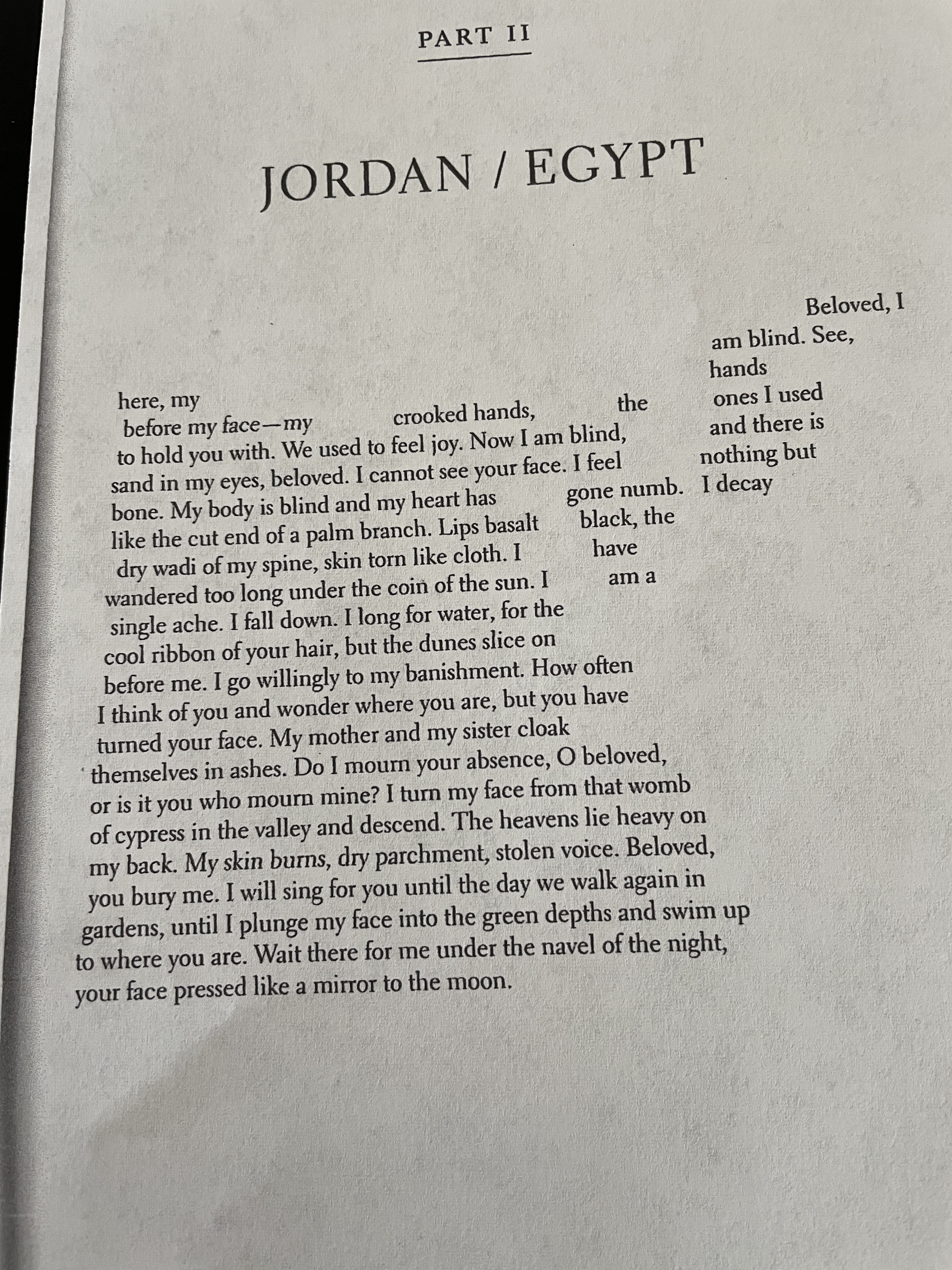
To keep sane, Nour repeatedly tells herself the story of Rawiya, the disguised girl who is an apprentice to the map maker. When he was alive, this was the favorite traditional story her father told her. The book alternates between what is really occurring to Nour and her refugee family and this ancient story. At the beginning of the section for each country through which they travel, there is a touching and beautifully written poem in the shape of the map of that country. The poem for Jordan/Egypt is printed below.

Black Bean and Corn Chili


Some probably would not call this a real chili. Nevertheless, it is healthy and vegan unless you garnish it with shredded cheese.

1 cup chopped purple onion

3 garlic cloves, coarsely chopped

Olive oil

2 cups black beans–either use canned or cook your own. I prefer to cook my own.

I can corn, drained

1/2 red bell pepper, seeded and chopped

1 cup canned salsa–I used one that was fine and medium heat. Add more depending on your preferred texture for chili.

1-2 Tablespoons berbere or chili powder. I used berbere.

Saute the onion and garlic in olive oil. Add bell peppers and saute until tender. Add the black beans and corn. Stir and add salsa and spices. Heat through and serve with condiments and shredded cheese of your choice.

Book One of 2025: “The Heaven and Earth Grocery Store”, James McBride


This is another great novel by one of my favorite authors. The book begins with the finding of a skeleton in a well in 1972. Since it is located near the site of an old synagogue, the police start to question a local, elderly Jewish man, Malachi, but get nowhere. Before they can come back to ask him more questions, Hurricane Agnes washes away the skeleton and many houses in the lower, wealthier part of town. When they do finally get around to hunting for him again, he has disappeared.

Then the novel goes back 47 years in this nondescript Pennsylvania town where the white people live in the lower, nicer part of town, and the Jews and black people live in or near an area called Chicken Hill, a poor area with little water and no plumbing. It is the story of a Jewish couple, Chona and Moshe. She runs the grocery store in the title, and he runs a dance theatre where he hosts dances, sometimes showcasing very famous musicians, mostly Jewish or black or Latino. It is also the story of some of their black neighbors, one of whom was Chona’s best friend in school, Jewish immigrants from Europe like Malachi, and a deaf black child, Dodo. When the state comes for Dodo because his mother has died and they think he should be institutionalized, Chona’s kindness and the courage of a local black worker, Nate Timblin, bring the black and Jewish people together to save him. While all this can be sad and serious, I also found myself frequently laughing. This novel reveals the quirks of all sorts of people, how they relate to one another, the dangers of racism, and ultimately the meaning of community, courage, and friendship and how much these things matter.

Book 37 for 2024: “Follow the Science: How Big Pharma Misleads, Obscures, and Prevails”, Sharyl Atkinson


The title tells it all. The author is an investigative journalist. The book is filled with details of varying science reports and studies. A lot of what she quotes is the opposite of the official narrative and science for vaccines in particular, especially those related to childhood vaccinations and Covid vaccines. Technically, both flu and Covid shots are not vaccines in that they do not keep the recipient from getting the disease in all cases like the vaccines for smallpox, measles, and polio do. This does matter in considering whether individuals should get the shots. She also discusses general public immunity in regard to flu and Covid, especially the latter. She also questions the claims that childhood vaccines as they are currently given never cause autism and whether some children are susceptible to extremely negative reactions to these vaccines when the majority of children are not. The main claim is that the giant pharmaceutical companies have enormous power to control the narrative about medications they produce, have huge influence with elected officials of both parties, and will do whatever it takes to make a profit on the drugs they manufacture.