The novel fascinated me in so many ways, the style of writing, the subject matter, what I learned about some famous paintings and especially Turner. I will never see works by Turner in the same way as I previously did. Before mostly I noticed the colors, the translucence. I totally missed the details and the violence nearly hidden.
The novel takes place after an ecological collapse in England where first violent floods occurred followed by a devastating drought. Now it has not rained in three years and Penelope, the main character, spends most of her time working as an archivist for the notable collection at a soon to be demolished estate in the English countryside. She has lived here for two decades with her current partner, Aidan, who owns the estate. The disasters have nearly destroyed the once magnificent mansion. Now Penelope and Aidan allow refugees from the disasters to live there with them as they transition to new places and housing until the new buyers demolish the place.
Most of the novel is Penelope’s diary, what she writes about her life present and past. In the midst of this her archivist notes appear as well as descriptions of famous paintings, most of which show women being brutalized in one way or another, e.g. The Abduction of the Sabine Women, 1633-34, Nicholas Poussin. Later in the novel there are segments from the viewpoint of Aidan’s brother, Julian, who previously owned the estate and with whom Penelope experienced a violent and disastrous relationship.
This is a tale of survival, redemption, memory, and art as a means of renewal. I liked this novel so much that I spent time looking up the art the protagonist describes, researching Turner, writing down passages, etc.
Piketty is Professor of Economics at the Ecole des hautes etudes en sciences sociales and Paris School of Economics. Sandel is a Professor of Government at Harvard University. This small book (119 pages) is the discussion between the two on the value of equality. In this discussion they debate what citizens and governments should do to narrow the economic gaps that separate people. This includes looking at the dangers of political instability and environmental issues. Rather than summarize their discussions, I am going to quote various parts:
“Mainstream politicians…have faith in the market because of a belief that markets deliver rising prosperity and yield Wall Street campaign contributions. A deeper reason…is that markets seem to offer a way of sparing us as democratic citizens from engaging in messy , contentious, and controversial debates about how to value goods and how to value the various contributions that people make to the economy and to the common good.”
“We live in pluralist societies. We disagree about the nature of the good life. We disagree about how to value goods.”
Because of the above, it is just easier to use the market and avoid the discourse as to what is worth more, the work of a teacher or a laborer or a hedge fund manager.
“Those on the left and those on the right may may well disagree about what counts as the dignity of work and how to promote it…many working people and many without university degrees feel that elites look down on them, don’t value the work they do…individual upward mobility is not an adequate answer to inequality.”
They discuss credentialing and note that the government spends billions more on higher education than technical education. They note that this form of credentialism is something that many see as an acceptable form of prejudice. A survey was done of prejudices in both Europe and the US:
“The group most disfavored by the respondents were the poorly educated.”
They discuss corporate tax rates and world wide efforts to have a world tax on multinational corporations:
“So, really, it’s a game between tax administrations in Washington, Paris, and Berlin to split some of the tax revenues that are now in tax havens among them, leaving aside the countries in the South.” –referring to the Southern Hemisphere where most of the poorest countries in the world exist. “Don’t companies have a patriotic duty to pay taxes and contribute to the common good in the country that makes their success possible?”
They view the success of far right groups and the election of Trump as more due to job losses in manufacturing than due to the inflow of migrants. They note an anti-immigrant view in places where there are even few immigrants and see it as related to the destruction of jobs:
“It’s not about immigration, but it’s about feeling looked down upon. It’s about recognition. It’s about dignity. Throughout this conversation, we’ve discussed three aspects of equality. One is economy, about the distribution of income and wealth. A second is political, about voice and power and participation. Then there is a third category, about ‘dignity,’ ‘status,’ ‘respect,’ ‘recognition,’ ‘honor,’ and ‘esteem.’ My hunch is that the third is the most powerful politically and maybe also morally. Any hope we have of reducing inequality in the first two dimensions, economically and politically, will depend on creating conditions for greater equality of recognition, honor, dignity,. and respect.”
Although the subtitle says “A Global Food Philosophy”, most of it is an analysis of actually how the world does eat, including some rather remote tribal people, rarities in this contemporary world. This how also includes an analysis of how food affects health in different parts of the world, noting that although contemporary recommendations push vegetables and the Mediterranean diet, some people have no access to vegetables and eat mainly meat and fat and remain healthy. In other cases, like the Masai, cattle provide everything in their diet. The reader gets a broad based view of the best and the worse of diets and food practices worldwide.
A substantial portion of this tome–it is nearly 400 pages long with notes and index of more than 50 pages, looks at industrialized nations and world food supply, including the monopoly large food producing corporations maintain over what is available at grocery stores. Food is big business. The different definitions of food processing is covered as well as the good and bad. He debunks some common beliefs about food and health and notes that while people go hungry in some parts of the world, there is a surplus of food in others.
After all the analyzing and discussions, the last chapter covers “A Global Food Philosophy”. This includes recommendations for what we can do to create a healthier and more equitable worldwide food system while also saving the environment. He lists seven principles one of which is that our food management should be compassionate toward animals if we are going to eat them.
A tale based on a Bengali legend about a merchant called the Gun Merchant, Bonduki Sadagar, this novel not only takes place in the mangrove swamps of the Sundarbans but also in Venice. It has nothing to do with guns but demonstrates how differences in language use among languages and translations can lead to total mistranslation. The narrator is an older, male, Bengali, rare book dealer who grew up in Kolkata but now lives in Brooklyn most of the year and goes back “home” occasionally. When he meets a distant relative by chance at a party, he finds himself enmeshed in the Gun Merchant tale and finds himself in search of a remote shrine where a king cobra lives. His adventure leads him to meet two young men and reconnect with an old friend, an Italian woman who is a famous historian.
What fascinated me most about this novel was learning all about the immense number of historical connections between the Bengali part of India and Venice especially related to trade and persons of Jewish descent. It is also filled with lessons in relationships among languages and history. For example, I learned the origin of the word ghetto. During the 17th century a part of Venice, Getto, was where their large and prosperous Jewish population was forced to live, Venice being one of few European cities where Jews were safe. Thus the word designating a part of the city became the word ghetto.
It is also a story about the risks and dangers of immigrants trying to get to Europe. I learned many Bengalis, mostly from Bangladesh, live in Venice and the numerous historical connections between the Bengali speaking areas of the world and Venice.
Want to learn a lot in less than 400 pages? Read this book. Published this year, it is the most recent book by a prominent Latin American scholar and historian. After humans learned agriculture and built cities, most of the population of the world became increasingly patriarchal and warlike. The divide between rich and poor increased. Egalitarian foragers and wandering hunters existed only in more remote areas. A few still exist in those remote and less modern corners of the world, often places where few others want to even go. This quote says a lot about the current state of affairs:
“Our civilization has thousands of years practice making war. We have almost NO practice making global peace, but without it we are doomed. Today’s pervasive nationalism and rearmament is unlikely to help us make global peace.”
And a page later:
“Only a true unanimous global effort has any chance to preserve our common home.”
He notes that saving Earth will take huge social transformations, including curbing the excessive consumer capitalism that currently pervades plus overcoming a world wide history where half of humanity mistreated the other half, a practice that still continues.
If you LOVE the West, but sometimes struggle with its violent history, this is the memoir for you. Here is a quote from page 178: “I’m embarrassed at how long it has taken me to notice that a rancher’s view of the natural world is blindered in comparison to the hunter’s perspective; that driving livestock from one field to another is nothing like stalking free-ranging herds; that finding, gathering, and preparing a hundred different wild plants bears no resemblance to growing alfalfa or oats…”
Andrews also discusses the difference between sustainability and reciprocity. Before reading the book, I had never thought about this. He notes that sustainability is taking without damaging. Reciprocity entails giving back, e.g. nature, asking, “What can I give back? What can I do to take care of this place that feeds and shelters me?” This is quite different from “How much can I sustainably take?”
Andrews grew up in the West. However, after cowboying on several ranches in Montana, hunting annually, and later inheriting his grandfather’s Smith and Wesson revolver, he begins to question the gun violence and destructiveness of Western culture. This book details his journey. He continues to live on a farm in the Montana mountains, slowly transforming the land to make it profitable but also a place for nature, for wildlife to prosper.
Yesterday I drove to this place about six miles south of Julian, CA, a small, touristy, mountain town east of San Diego. Owned by the Nature Conservancy, the ranch abuts Anza-Borrega Desert Park, but this area is not desert. On the way, I drove through at least four Indian Reservations on Highway 76. California has more Native American residents than any other state.
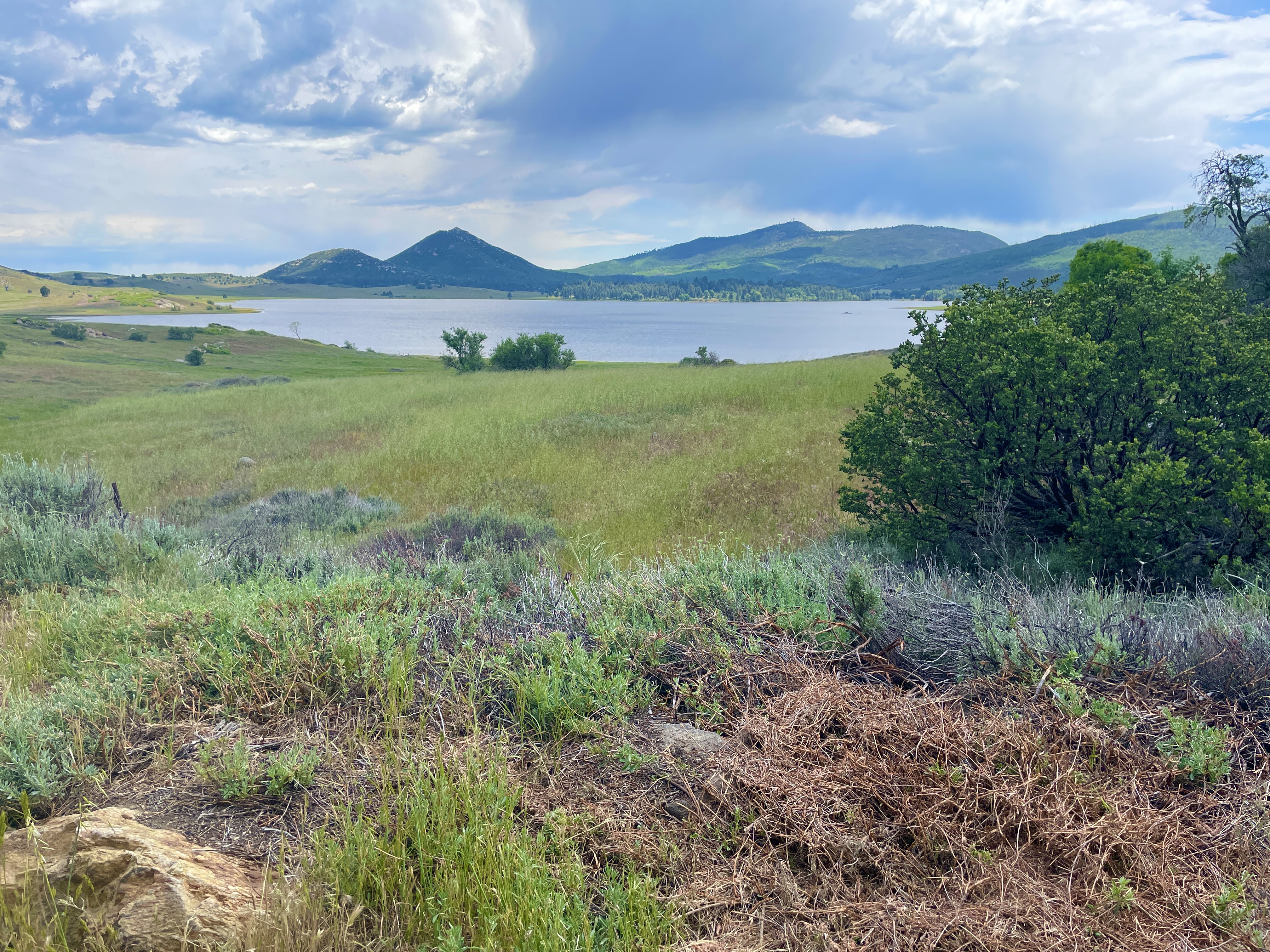
This is Lake Henshaw on Highway 76 on the way to Julian. It is so full now that tops of trees stick out of the water. People told me that last year it was more like a big puddle.
The three mile hike was not long but quite strenuous as we climbed approximately 800 – 1000 ft. in altitude on the hike.
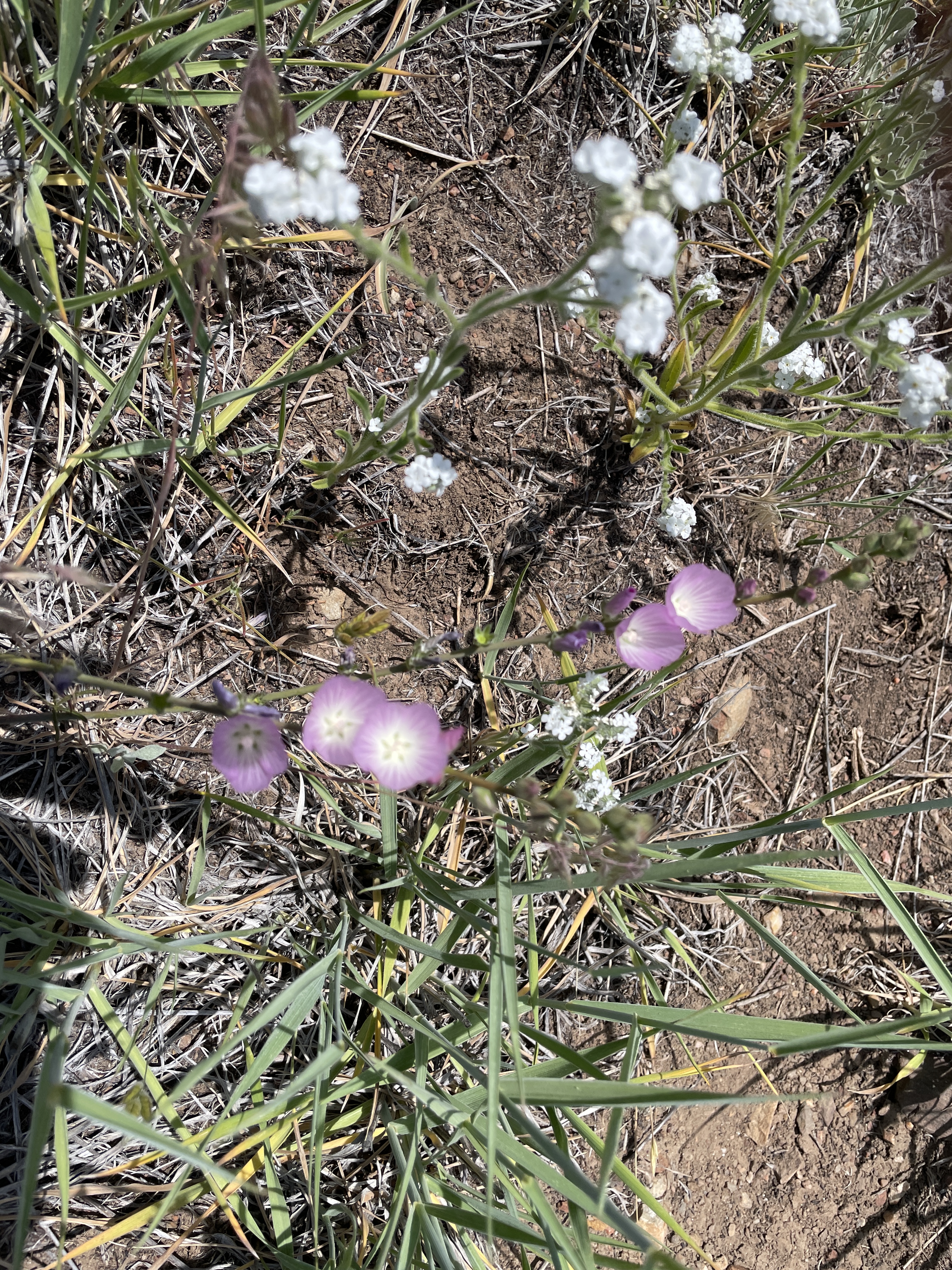
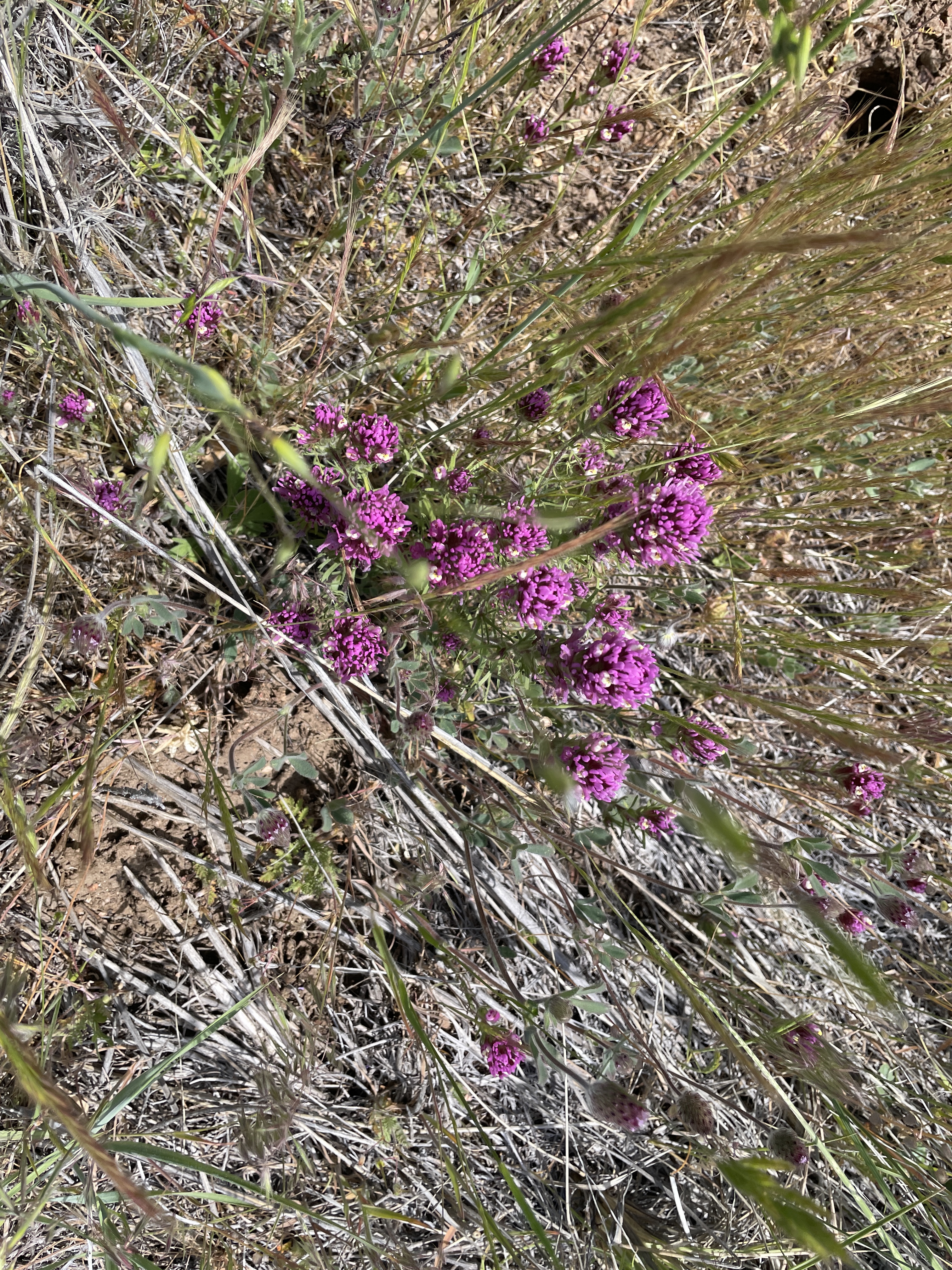
Lots of wild flowers everywhere due to abundant rain this year. We had to find parts of the trail because it had not been used since before Covid and was overgrown.
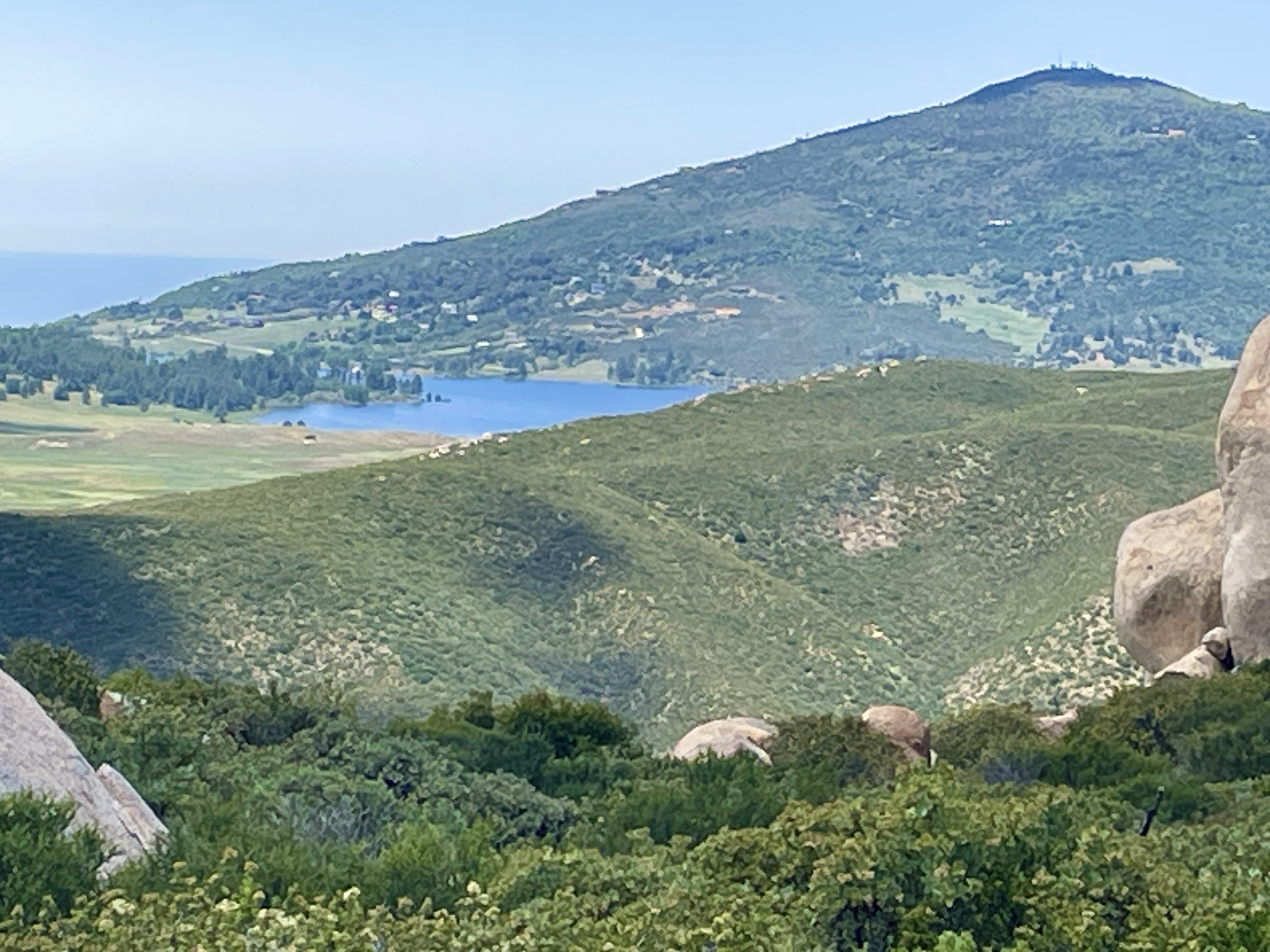
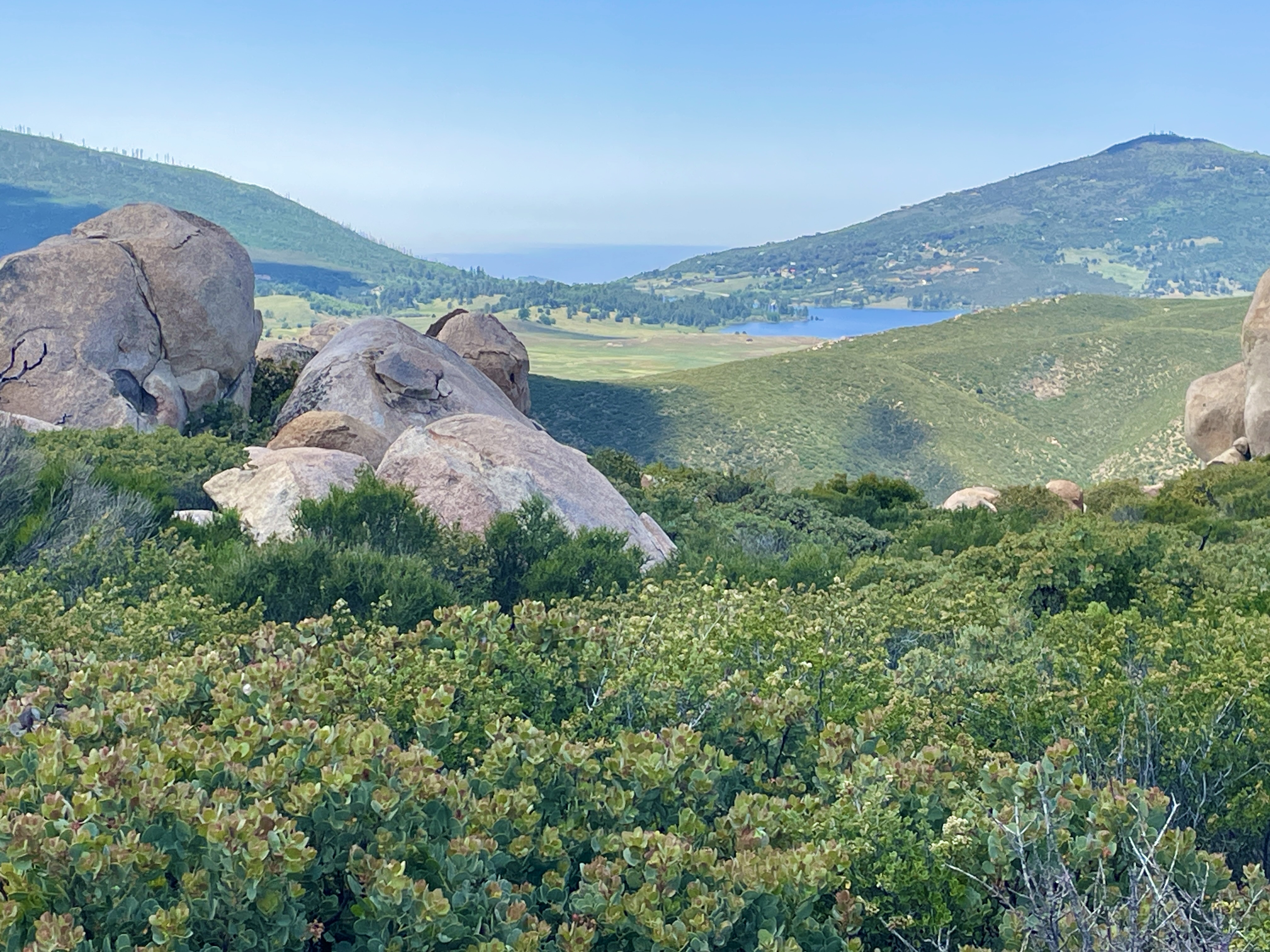
Views of Lake Cuyamaca which we could see in the distance as we climbed up and down.
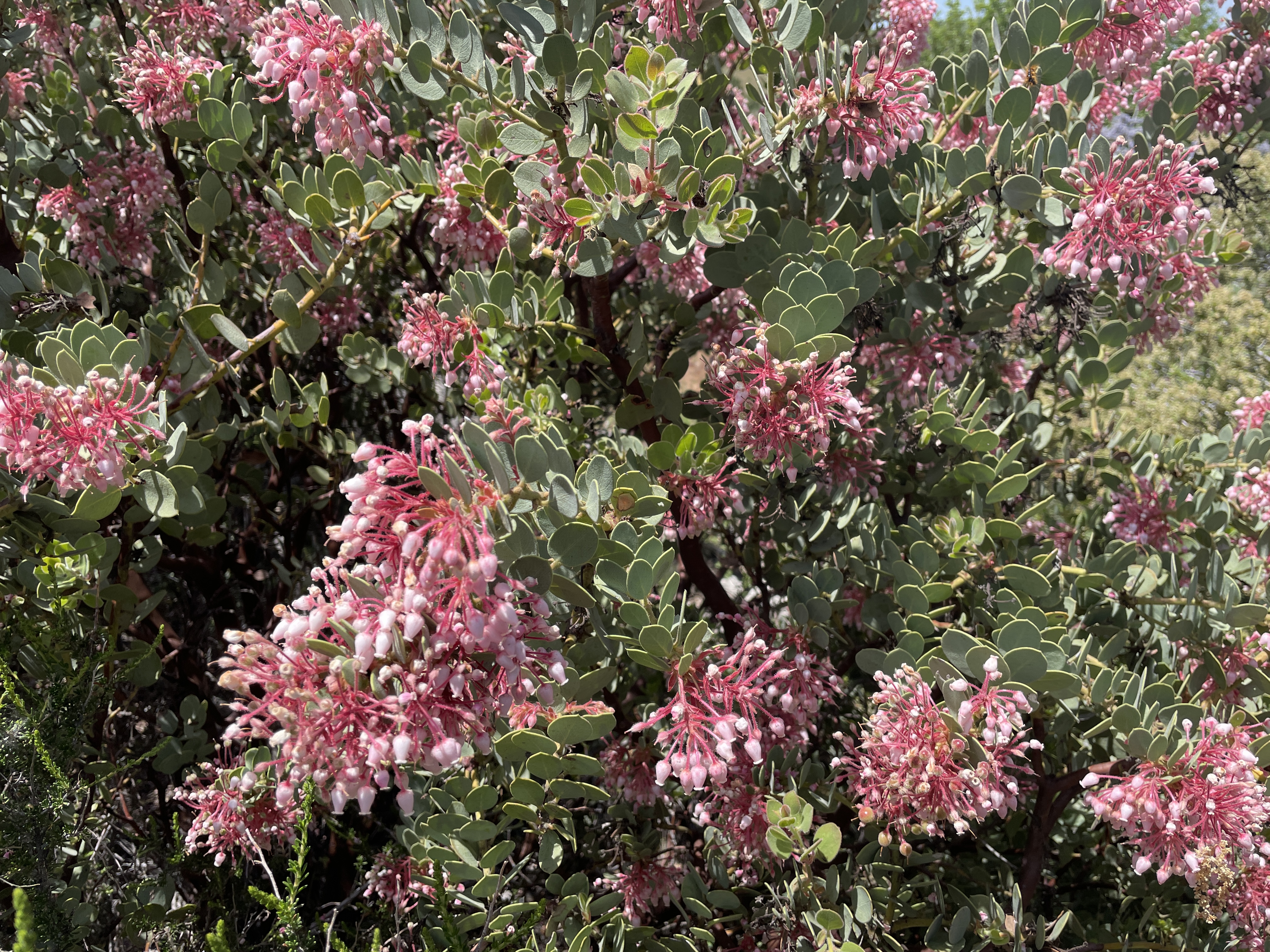
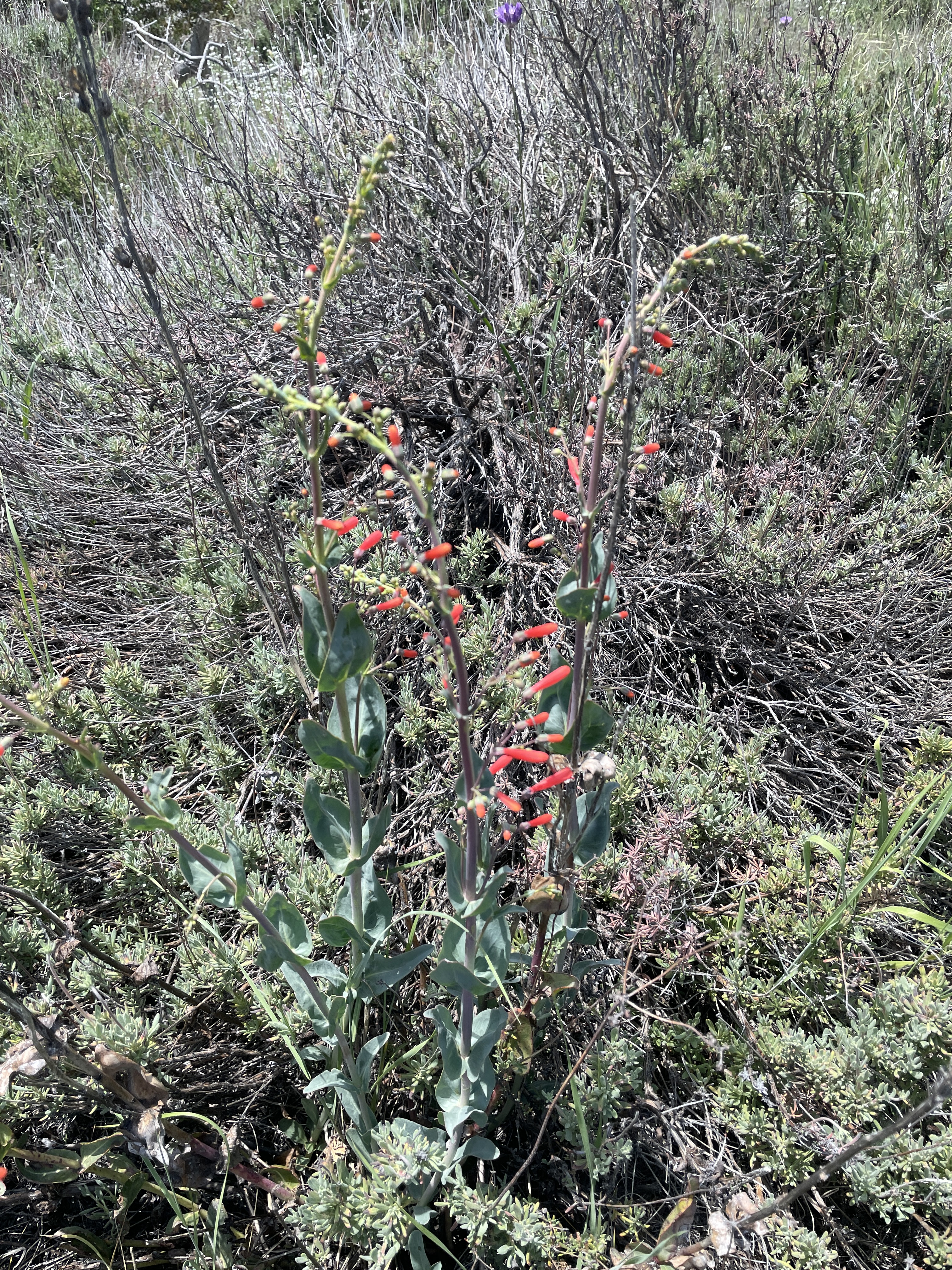
The manzanita are in full bloom and luxurious this year. There were other flower the names none of us knew.
Lupine.
We kept climbing up steep slopes higher and higher. The climb was more difficult because lots of loose, little rocks and gravel in many places.
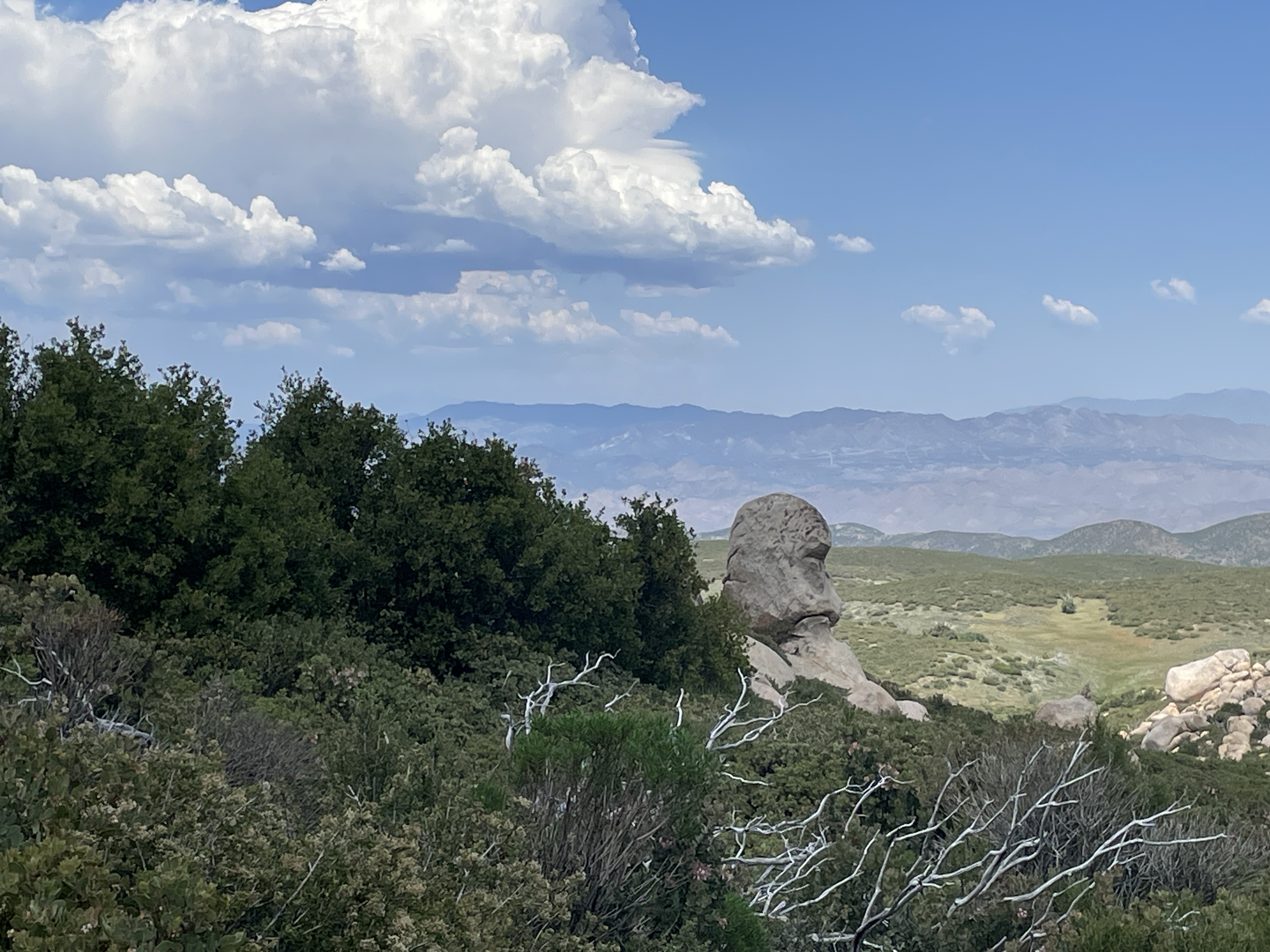
Where we ate lunch at the top which is slightly over a mile high. There are these dead, bleached out branches everywhere, the result of a big fire in 2003 which killed a lot of plants and some of it has never recovered.
Lunch up high among the rocks.
A different type of yucca than grows everywhere in the many other places where I have previously lived.
On the way down from the top. Everything is still quite green here and there were storm clouds in the distance.
Some people call this California lilac. It grows everywhere here and is in full bloom glory.
When it first came out in 2018, I read The Overstory by Richard Powell. Finding the Mother Tree: Discovering the Wisdom of the Forest by Suzanne Simard appears to contain the endless years of detailed research and life story behind one of the characters in Powell’s novel. In fact, in her Acknowledgements, Simard thanks Powell for helping to make her life’s research more accessible to the general populace.
Simard’s book is part memoir, part detailed scientific explanations of her research and how a forest works and lives, and part how difficult it is to be taken seriously in the science world if you are female and your research contradicts the norm. She grew up in Canada. Her family made a living cutting down trees. Her family and life was and is intricately interwoven with nature. Even as a child, she was obsessed with tree roots, crawled around on the forest floor to see what lived there. A specific fascination was all the types and colors of fungi that grew just under the surface. Why were they there? What purpose did they serve? Later this became her life’s work, leading her to discover how trees of varying species use these fungi to communicate with and nurture each other. Of special significance are the “mother trees”, older, larger trees who provide nurturance to all the younger trees around them, recognize their kin, favoring them as they nurture all the other trees as well.
Traditionally, loggers and timber companies clear cut, then replanted with seedlings of all the same species of evergreen. It took Simard decades of research to convince them that it was not only the poorest way to grow new trees but also the least economical. For decades they saw her as some nutty woman, laughed at her research, laughed at her, even using epithets to her face. Ultimately, however, her work led to changes in how forestry is practiced.
This book relates her long struggle to save the forests. For those who are science minded, the final pages of the book contain 32 pages of Critical Sources. If you are interest in learning more about “mother trees”, go to http://mothertreeproject.org. It defines the term “mother tree” and explains how trees communicate. It also contains videos.
Some of you may remember the comedy duo Cheech and Chong way back in the day. Cheech has spent his life collecting Chicano and Chicana art. This year he gave a lot of his art collection to open a new museum in Riverside, California. Earlier this week my grandson, his girlfriend and I went to visit the museum. Photos and videos are allowed without flash. The following is the first set of photos I took. Please note that you need to see this art for yourself. Photos do not do it justice. Much of it is multidimensional and looks very different depending on where the viewer stands.
This is what you see when you enter the door; it is two stories high and multidimensional. Look how different the next photo of it looks from this one.
Walk farther to the side and it looks totally different again.
This speaks for itself. Right now where I live the air is clean enough that unless it is foggy, I can see all the way to downtown LA 30 plus miles away.
All the art at this museum has a message; much of it illustrates the ills of society.
The influence of indigenous art, e.g. Aztec, Mayan, can be seem in much of the art and the statements the art makes.
The woman above and the woman below hang next to each other.