Book Seven for 2025: “The Map of Salt and Stars”, Zeynab Joukhadar


Two young heroines dominate this fascinating novel which switches back and forth between the Syria of 2011 and the 12th century. The latter is a girl who disguises herself as a boy to join the quest of a famous mapmaker. Nour, the first girl, lost her father to cancer in NYC. Then her mother, a mapmaker, decides to move herself and the three daughters back to Homs, Syria. They barely settle into their new life when the civil war breaks out and a bomb destroys their house. They become refugees. This is the tale of their harrowing journey from Syria to Jordan to Egypt to Libya to Algeria, then Morocco and finally to Cuenta, the Spainish city on the north coast of Africa, where their uncle lives.

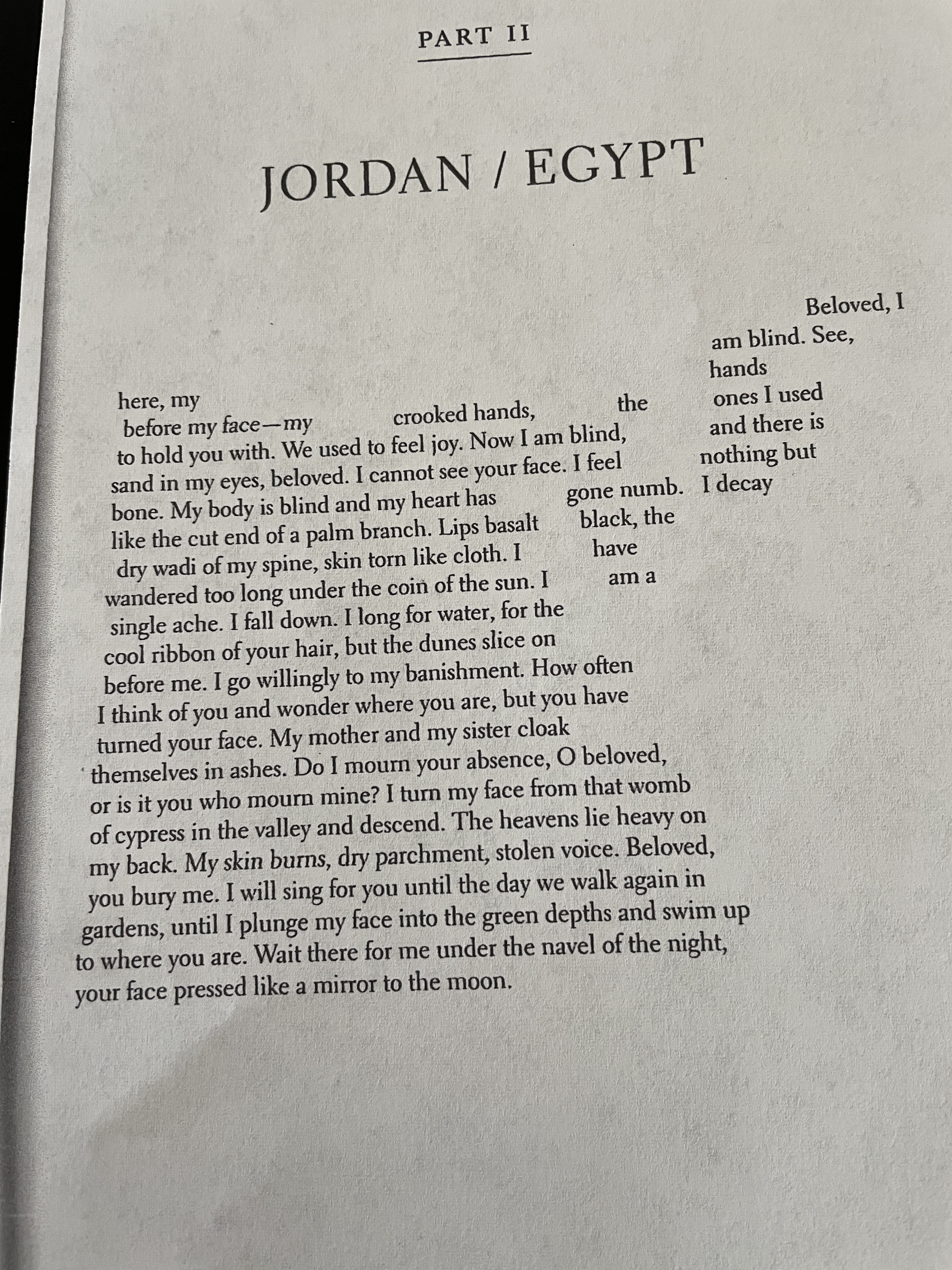
To keep sane, Nour repeatedly tells herself the story of Rawiya, the disguised girl who is an apprentice to the map maker. When he was alive, this was the favorite traditional story her father told her. The book alternates between what is really occurring to Nour and her refugee family and this ancient story. At the beginning of the section for each country through which they travel, there is a touching and beautifully written poem in the shape of the map of that country. The poem for Jordan/Egypt is printed below.

Book One of 2025: “The Heaven and Earth Grocery Store”, James McBride


This is another great novel by one of my favorite authors. The book begins with the finding of a skeleton in a well in 1972. Since it is located near the site of an old synagogue, the police start to question a local, elderly Jewish man, Malachi, but get nowhere. Before they can come back to ask him more questions, Hurricane Agnes washes away the skeleton and many houses in the lower, wealthier part of town. When they do finally get around to hunting for him again, he has disappeared.

Then the novel goes back 47 years in this nondescript Pennsylvania town where the white people live in the lower, nicer part of town, and the Jews and black people live in or near an area called Chicken Hill, a poor area with little water and no plumbing. It is the story of a Jewish couple, Chona and Moshe. She runs the grocery store in the title, and he runs a dance theatre where he hosts dances, sometimes showcasing very famous musicians, mostly Jewish or black or Latino. It is also the story of some of their black neighbors, one of whom was Chona’s best friend in school, Jewish immigrants from Europe like Malachi, and a deaf black child, Dodo. When the state comes for Dodo because his mother has died and they think he should be institutionalized, Chona’s kindness and the courage of a local black worker, Nate Timblin, bring the black and Jewish people together to save him. While all this can be sad and serious, I also found myself frequently laughing. This novel reveals the quirks of all sorts of people, how they relate to one another, the dangers of racism, and ultimately the meaning of community, courage, and friendship and how much these things matter.

Book 50 for 2024: “Teddy and Booker T”, Brian Kilmeade


I finished this book on New Year’s Eve, missing my goal of reading a book a week all this past year, but not by much. No excuses except one book I read was nearly 800 pages which took a bit longer.

This last book was full of surprising information. I had no idea that Teddy Roosevelt and Booker T. Washington were friends. This book is very detailed with loads of historical information about the lives of both of these men. Born worlds apart in terms of freedom, economics, and race, they both had a goal to further the status of Black people. In terms of his political future, Roosevelt made a big mistake when he invited Washington to the Whitehouse for a family dinner. Once this event became known, white people in the South were outraged. Jim Crow incidents, e.g. lynching, increased. Roosevelt felt he had to backtrack some to save himself and this included one his worst decisions in terms of racial equality. Meanwhile, they tried to hide their relationship more, did not visit each other as often, and Washington had to go to great lengths to appease some whites in the South to keep Tuskegee growing and flourishing. W.E.B. Du Bois viewed Washington negatively and thought he went too far to appease white people and did not do enough for his own race. Du Bois who had grown up free in the North did not understand Washington’s viewpoints and did not know what he did secretly to help Black people. If you are interested in the actual history of this period and how these three men affect the present, I highly recommend this book. There are 35 pages of references, notes, and documentation at the end of the books for those who want to read further on this topic and time period.

Celebration in Downtown LA


As a counselor for College Match LA, I joined a group of current students in college and alumni at Perch LA, a restaurant in downtown with a rooftop venue. The views there are fantastic, the finger food yummy, and seeing some of my students delightful–they are at Oxy and loving it. Here are a few photos.

The view after dark.

Ice skating.

Tis The Season


Tis the season to…

Feel joy when the morning

sun caresses your face;

Laugh when you hear

children playing in the

street;

Give thanks for being alive,

having friends and family;

Walk down your street or

take a hike, touch a flower,

a tree and appreciate nature’s

simple bounties;

Remember the time your

loved one took your face

in gentle hands and smiled;

Give the gift of kindness,

peace, and compassion to everyone,

strangers, friends, family,

the unknown;

Promise yourself to live your

best self in the year to come,

to never forget that life

is a gift.

Book 45 for 2024: “How To Stop Time”, Matt Haig


What would your life be like if you did not age like everyone else? How would others treat you, your family? Would they kill your mother because they think she is a witch? Could you love someone who grew old while you stayed young? Would you have to move all over the world to avoid detection?

These are the issue the narrator faces because unlike ordinary people, he does not age normally. At the beginning he is living in London as a forty-one year old history teacher but has been alive for centuries. He’s met Shakespeare, travelled the oceans with Captain Cook, and played piano at clubs in Paris.

One organization, the Albatross Society, hunts down and “protects” people like him. Their leader has one rule: do not fall in love. He is also convinced that certain groups want to find these non-agers and imprison them for research. What is factual, real? Does life have meaning without love?

Book 42 for 2024: “These Is My Words: The Diary of Sarah Agnes Prine, 1881-1901, Arizona Territories


This fictional work is based on the life of the author’s great grandmother. Written as a diary with specific dates, the narrator is not yet a teen when the novel starts. Her parents are wanderers, always looking for a better, new place. Sarah’s character is that of a tough, pioneer girl and then a woman. She can ride horses, shoot to kill, manage a ranch, do whatever it takes to survive. Much of it includes a rather accurate portrayal of life in Arizonan territories as well as Texas at the time including the prejudices of many of the white inhabitants toward the Spanish speaking people already there, fights with Apaches, and the hunt for Geronimo. It is not just the story of her own life, including her relationship with the Army Captain whose job initially is to protect a wagon train, but also portrays other people living in the Southwest during that time period.

I read this as part of a book club. Reactions to the book varied widely from those of us who thoroughly enjoyed the book to at least one person who insisted it is poorly written and viewed it as a romance novel. The rest of us did not. She used an audio book edition. After her descriptions, it appears the audio book does not correctly follow the book itself and is poorly done which may have contributed to her view of this work. I borrowed this novel from the public library and it was obviously well read because it was not in the best condition.

Book 41 of 2024: “Crazy Horse”, Larry McMurtry


One of the saddest books I’ve ever read, this short piece of nonfiction details not only the life of Crazy Horse but also the demise of the traditional lifestyle of the Plains Indians. Crazy Horse has been the subject of endless legends and myths, many of which apparently have nothing to do with reality. He was not a chief; he often defied traditional Sioux customs. He was very much his own person. Among his people, he was especially known for his kindness and support of the poorest and weakest and for his prowess as a warrior. Crazy Horse died young due to not only white betrayal but also that of some of his own people.

I highly recommend this book if you are interested in this particular period of US history. At the end is a comprehensive list of sources with notes about each one of them.

Langston Hughes in Uzbekistan


It’s 1932.

Movie roles promised to 22 Black Americans.

“Black and White” in the

Uzbek Soviet Socialist Republic.

Treated like royalty, wined, dined, at

their own expense.

Hughes–ridiculous script. All went

home except Hughes. He stayed,

traveled, saw cotton grown from Aral

Sea water–now no water, desolate

desert.

In Tashkent, Uzbeks, Turkmen, Tartars

honored him, flowers, fruit.

No English.

He met a Red Army Captain from

high Pamir Mountains. Hughes

described him, Black with Oriental eyes.

Hughes called him Yeah Man.

He called Hughes Yang Zoon.

Weeks together never understanding

each other’s words.

Hughes’ poetry book

“The Weary Blues” first

American book translated to

Uzbek. Original English version

lost. He describes this new place:

“Look: here

Is a country

Where everyone shines.”

Note: You can find a version of this book translated into English from Uzbek by Muhabbat Bakeava and Kevin Young.

Book 33 for 2024: “Three Daughters of Eve”, Elif Shafak


Shafak is a popular Turkish writer. One of my all time favorite books is her novel about the life of Rumi.

“Three Daughters of Eve” takes place one evening in Istanbul in 2016. Peri, one of the daughters from the title, is on her way to a fancy party when a thief snatches her purse out of the back seat of her car which is stalled in traffic. She parks the car and chases him through back alleys. As she fights him for her purse, an old photo falls to the ground. It portrays three young women and their university professor. This photo jars her mind, takes her back to her time at Oxford University when she was a student there in 2000-2002, her childhood in Istanbul in the 1980s and 90s, and her life. She thinks back to her life with her two friends, Shirin, an adventurous Iranian young woman, and Mona, a devout Egyptian Muslim who word a headscarf out of choice. And then there is the famous professor Azur, whose class on God either makes students hate or love him and the scandal that caused Peri to return to Istanbul.

Until her daughter, who was in the car and eventually chases her mother down in the alley, sees the photo, no one, except her husband, seems to have known Peri even went to Oxford. Her daughter mentions it at the party while everyone is arguing about East and West and politics and who has the most money and how they acquired it. Peri tries to deflect questions, changes the subject, and keeps remembering her past: her parents, a father quite irreligious, her mother a devout Muslim, their endless arguments and hostility, her brothers, her childhood and her stint at Oxford.

Through the story of Peri’s life, this novel explores personal identity, East-West history and politics, the meaning of marriage and friendship.