Book 33 for 2026: “The Stationery Shop”, Marjan Kamali


I said I was going to read all her novels. This one is the middle novel but they are not a series. The time span in this one goes from 1913 to 2013. The political events are more detailed in this novel, including how the toppling of Mossadegh by the Shah’s forces and Britain and US, the later revolution, and the Iran-Iraq War affects various characters and their families. The novel’s title comes from the stationery shop owned by Mr. Fakhri where the other two main characters in the novel meet when both are 17. They love books and fall in love via their visits to this shop. Then the events of 1953 occur, family’s histories create havoc, and people’s pasts catch up with them in unexpected ways.

This novel also goes into greater depth about how Persian traditions affect lives, how much social class matters, arranged versus love matches, modern families versus more traditional families and how all these issues affect individual lives for better or worse. As in the others, the reader learns a lot about Persian food with some details as to how to make various dishes–no recipes, just descriptions. My reaction to the events and characters in this novel were stronger than for the others. I would even call this novel a sort of tear jerker if you are inclined to react emotionally to what you read.

Note: I recommend all three of her novels. They are entertaining, well written, and an excellent way to learn a lot about the last 80 or so years of Iranian history that still affects all of us.
Book 32 for 2026: “Together Tea”, Marjan Kamali


The previous book I read is the author’s most recent novel. This one is her first novel published in 2013. Like the Lion Women novel, this one tells the story of Iranian families. When the novel begins in 1996, an Iranian couple who have lived in NYC for decades are trying to find a man for their daughter to marry. Well, the mother is, not so much the father, who is a successful doctor. He has adapted very well to the US, is into self help books, optimistic and enthusiastic. Although she has a job she likes, she misses Iran.

Part II begins in 1978 when their children are younger–they have two older sons and a younger daughter–and the Shah’s power is crumbling but its sequence is in question. Some of their relatives suddenly become so religious that they hardly recognize them. Then the revolution occurs, their daughter’s school has become all girls with mandatory hijab. Then the Iran/Iraq war occurs and the grandmother is killed by an Iraqi bomb while out buying pomegranates. They cover their windows with aluminum foil so Iraqi pilots cannot see the lights in houses. Finally, in desperation they leave for NYC after medical colleagues the father knows in NYC help them find a place there. While studying to take the test for his US medical license the dad works in a pizza parlor making pizza.

Then back to 1996, the daughter, Mina, decides she needs to visit Iran even though her father does everything he can to dissuade her. Mother, who still misses Iran and her family there, decides it is ok if she goes too. This part of the novel relates their visit to Iran, Mina’s reconnecting to her best friend who never left, how people there manage to live double lives with parties, Western clothes, and alcohol at home, but hijab and conservative behavior in public, including avoiding the morality police.

Like her other novel, this one is a good way to learn recent Iranian history while learning about Iranian food, family, friendship, love, and every day life.

Book 31 for 2026: “The Lion Women of Tehran”, Marjan Kamali


This novel narrates the lives of two women who became best friends in elementary school in Tehran in the 1950s. One, Elaheh, who has lived in luxury until the death of her father forces her and her mother to move to a poor part of the city. Two, Homa, a rambunctious seven year old who lives nearby. Elaheh’s mother has no choice but to enroll her in the nearby public school where they meet and become best friends against the objection of Elaheh’s mother who thinks the people there are tacky and beneath her. Because Elaheh’s (Ellie) prefers to spend time at Homa’s house where there is an entire family–father, mother, children, who are warm and loving, her mother does various things to keep her from Homa’s family. It does not work and Homa’s mother teaches Ellie how to cook and they treat her as one of the own.

Their happy friendship is disrupted when Ellie’s mother marries her former husband’s brother and they move back to the wealthy part of town and Ellie is enrolled in one of the best schools in Tehran. Ellie works hard at her studies and becoming popular and succeeds. She is very embarrassed when Homa gets a scholarship to this school and shows up. Nevertheless, they reestablish their friendship and everything seems to go well until political turmoil occurs. They finish high school and enroll in the University of Tehran. Then betrayal and disaster ensues.

I could not stop reading because of the story. For those who know little of Iranian history in the last 100 years, through the events in the novel, the reader not only learns how difficult life can be in Iran but also a lot of recent Iranian history. It reveals the determination of Iranians to live the best they can regardless of the circumstances and how life can change instantly because of someone’s misguided words. After I finished this novel, I went to the library and requested Kamali’s other two novels.

Delights–Three


There is nothing like meeting a goal while enjoying it to bring a sense of delight as well as accomplishment. I walk daily–today I arrived at day 707 without ever missing a day–looking at the flowers, visiting with all the other walkers. I live in a walking neighborhood with friendly walkers who at a minimum wave. Some stop to chat and some check on me if they have not seen me out walking in a while because of the different routes we take or different times we walk. One particular person who checks on me taught me how to make some of her native food–India. Another lady several blocks away prefers to walk with others, not alone, so if she sees me out, we join together in the company of her little dog, June, whom I have never seen actually walking. June rides in a baby carriage.

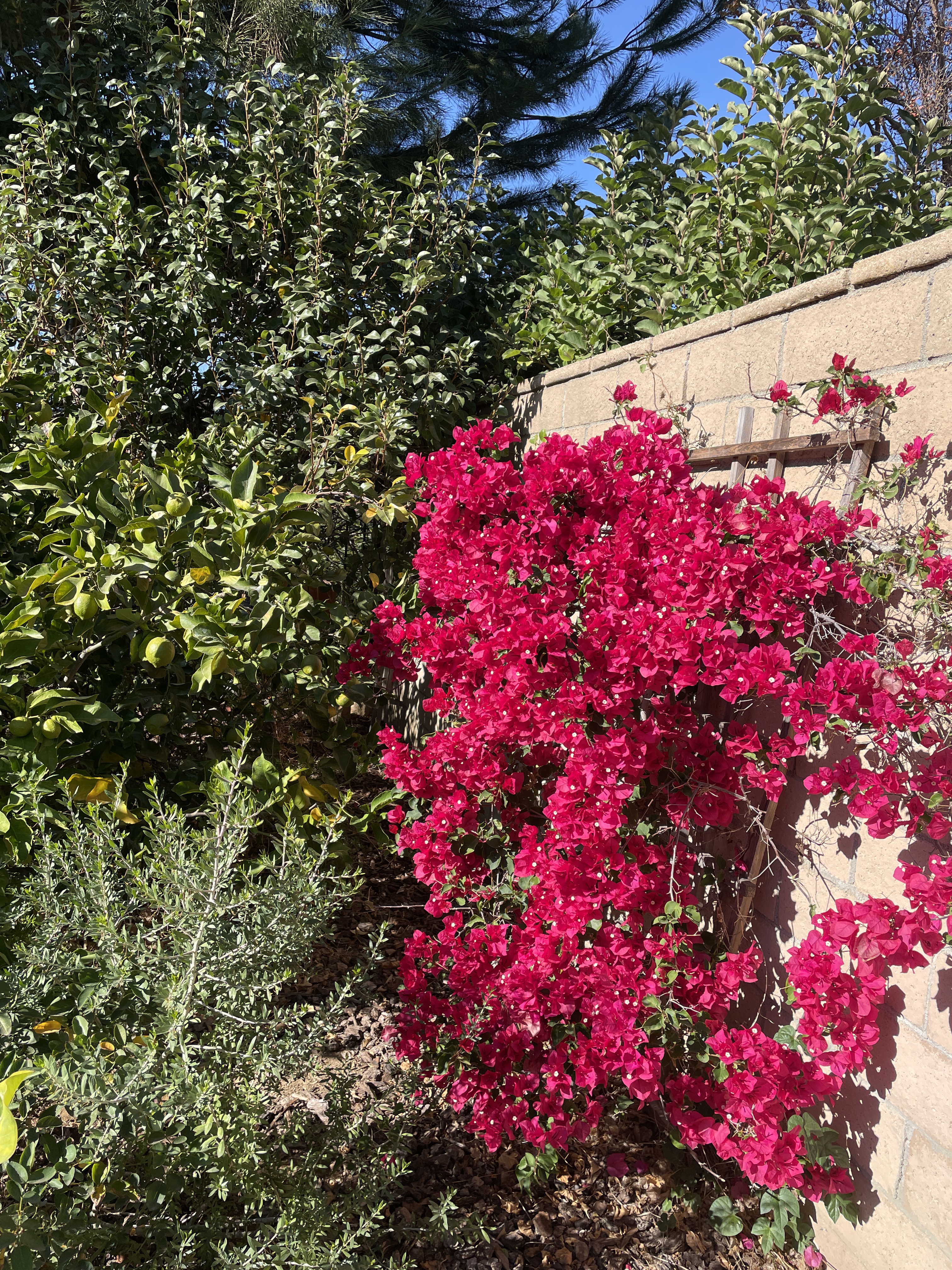
Now, as I write this, I’m enjoying another late afternoon of delight in my backyard. The hibiscus is full of ruby flowers. Freeway daisies, bright white and purple, pop up everywhere. Four different colors of bougainvillea sport their joy. One nasturtium–they are popping in places I never even planted–is sporting the same color of ruby as the hibiscus. The lemon tree is full of almost ripe lemons some of which I have promised to friends and neighbors. One woman cannot eat all these lemons. Meanwhile, I listen to different birds singing their varied songs and to the gurgle of the water fountain by the Nile Blue French doors and watch the hummingbird who is watching me.

I feel grateful to be surrounded in beauty and quiet joy.

Book 7 for 2026: “Never Let Me Go”, Kazuo Ishiguro


Categorized as science fiction, this novel relates a story so possible, it no longer seems like science fiction. Because it is so possible, I found it one of the most disturbing stories I have ever read. The first person narrator relates her personal story, the story of two of her best friends, and that of several other students at the boarding school where they have lived all their lives until they turn 16. Her feelings, her relationships with the other students and with the guardians who run the school are described in great detail and always from her point of view. At the age of 16, they are all sent to various places called Cottages where they experience their first interactions with anything beyond the perimeter of the boarding school where they have always lived and begin the training for the rest of their lives.

As I read this novel, I kept thinking of Epstein and his international ring which seemed to be out of the public eye until recently. If he could do this for decades without the general public knowing, I kept wondering if something like what occurs in this novel is actually occurring internationally and we just do not know it. I do know there is a black market for what occurs in the novel and that little to nothing is done about it. And given how little reaction officially overall has occurred regarding the Epstein files, would the general public accept what occurs in this novel if they felt it would benefit them personally. I do not want to say too much because it might ruin the novel for those who might want to read it and find out.

Book Six for 2026: “THE BOOK OF (MORE) DELIGHTS,” Ross Gay


As I mentioned in a previous post, his books on delights were mentioned to me by two different people in two totally different settings so I decided to stay sane in all the seriousness of my life, reading something lighter might be a good thing to do. I guess I was thinking delights like flowers, food, etc. but this is more like a series of short essays about life all written in the span of one year–his gardening, experiences strolling around his neighborhood and favorite coffee shops, food, his parents, his wife, some personal history, his experience as a college professor, children. However, he also addresses serious issues–his meeting a homeless veteran just out from a stint in a mental facility and how he was compelled to help out after first driving off, racism he has experienced, his issues with the government and social media, family death, and life in general. And above all, what it means to him to identify as a poet.

Book Four for 2026: “Playground”, Richard Powers


Another intriguing novel by an author who has won both the Pulitzer and the National Book Award. Initially the four main characters do not seem to have any interactions with each other. 12 year old Evie’s life is changed forever when her father, the inventor of the first aqualung, makes her submerge in a pool to prove it works. She becomes one of the world’s most famous divers and oceanographers. Ina, an artist, grew up in US naval bases all over the South Pacific and eventually finds herself at a university in Illinois. Rafi, a genius black child, is pushed by his dad to apply to a private Jesuit high school where he meets Todd, a rich kid whose whose family provides scholarships to the school. The two become best friends in spite of different interests. Rafi loves literature and Todd loves computers. They bond over a thousands of years old Chinese game with which they become obsessed. They become roommates at the same university where Ina is a student. The three become best friends.

Decades later all these lives become intertwined on an island in the South Pacific–Makatea in French Polynesia, an island where the harvesting of giant phosphorus deposits nearly ruined it while furnishing the rest of the world with fuel to make planets grows faster and better and feed the world. Because of Evie’s obsession with the sea, I learned enormous amounts about the ocean and the varied animals that live there, some of which I had never heard of before. Because of Todd’s obsession with computers and his invention of an AI game, I learned a lot about how gaming works and how people become addicted. For Rafi, the agony and anger of often being the one left out, the one seen as the smart Black kid, and the only one in many circumstances affect how he views the world and himself and where life eventually takes him. From his character I learned new things about literature and how books and writing affect people and their relationships.

I could not stop reading this book. Years ago, when it first came out, I read the author’s novel, “The Overstay”. While the topics and characters are totally different, in some ways this novel reminded me of that story, of how our lives are often intertwined in all sorts of ways we never expected.

Turtlenecks and Dressing in Black


Last week a writer friend commented on the notion that writers are known for wearing turtlenecks. That’s news to me even though I am a writer and I wear turtlenecks plus multiple layers. I’m cold. I’m cold at least half of the year even here in Southern California. This comment caused me to count mine. It seems I own 25 turtlenecks–white, off-white, various shades of beige and brown but none dark, several black, two red, two orange, two coral one of which one is darker than the other, two striped (one black and white, one tan and creme), deep green, two hot pink, and one sheer in shades of black and brown and creme and a sort of burgundy color. Another is a color I am not even sure how to describe which I will call pale peach. Since I’ve been the same size for decades, I am guessing some of these border on the ancient but not worn out. I never dry them in the dryer. Drying clothes in the dryer wears them out faster and changes their color.

About one-third of the way through his “Memoirs”, Pablo Neruda talks about a poet friend of his in Spain who wore turtlenecks which Neruda claims was a huge no-no at the time. What does he say poets should wear? Black from head to toe. He had been wearing black practically since birth. His mother died from tuberculosis a month after he was born. Perhaps the endless rain and endless mud he describes in the area of southern Chile where he grew up made wearing black the most practical color. Doubtless the poverty he witnessed as a young man working as a poor employee of tiny Chilean consulates in places like Ceylon (now SriLanka), Indonesia, and India did not inspire him to wear colorful clothes. Then not long after he arrives in Spain, Franco comes to power and one of his best friends, Federico Garcia Lorca is assassinated. As for me, when I am not wearing colorful clothes, I wear black, not due to rain or mud or sadness. The reason I am drawn to black mystifies me–another thing to ponder.

Not sure this qualifies as a turtleneck but it comes close.

New Year’s Wishes


In a hurting, damaged world

where greed and hatred often reign

I wish for

the beauty of flowers to flow into hearts

kindness toward those different from self

to permeate hearts and mines

the light of joy create compassion

toward each other

the knowledge that we are all one race,

one people flow through humanity

Hold friends and family close

Smile, greet strangers

Release hatred, anger into air

Promise yourself to love more,

let others be themselves,

be grateful, find joy

Book 52 for 2025: “The City And Its Uncertain Walls, Haruki Murakami


This is my fourth Murakami book in the past couple of months and his latest work. In the Afterword he notes that the core of this long novel is a novella published in 1980 in a literary magazine. He was never satisfied with it and never allowed it to be republished in book form. Yet he knew “this contained something vital for me.” Like his other works I have read, the settings include young people, libraries, and strange events many of which are akin to what is called magical realism. The boundaries between reality and the imagination are blurred and questions who we are and what is real.

It begins with a young couple, 17 and 16, in love. The girl tells the boy about this strange walled town and tells him her real self resides there. She describes it in detail and tells him he could go there and become the Dream Reader in the library in this town which has no books, just old dreams that need to be read and where the main animal form is unicorns who often die in mass during the harsh winters there. One day with no warning, she disappears. In one form or another he spends the rest of his life searching for her. Somehow he ends up in this bizarre town where he has to give up his shadow to remain. He has substantial issues with this as he watches his shadow become ill and nearly die.

Later, after a successful career as a book dealer for a large corporation, he suddenly retires and decides to apply for a head library position in a small town in the remote mountains. He meets the previous head librarian whose life is full of mystery and where the reality of this real place and the bizarre town seem blurred. He meets a strange teenager who practically lives in the library reading books with great rapidity day after day. His relationship with the boy develops and he sees what he has been seeking his entire life.

This book takes a look at what is reality, the subconscious, and life’s meaning. It is also an ode to libraries and books and love.