Fascinated since childhood by the lands surrounding the Mediterranean Sea, I accidentally discovered this book when I had to go to a new LA County library because the one near me is closed for renovations. The book describes in detail the life of Mohammed and the controversy that ensued after his death as to who should be in charge. This dispute ultimately caused the division into Sunni and Shia which continues today. It also covers other less well known groups such as Ismailis, a missionary sect of Shia Islam, and Sufiis, Muslim mystics.
I found the book extremely informative in describing how a small group of Arabs managed to conquer most of the land south of the Mediterranean and the lands to the east and eventually convert Central Asia and a substantial portion of West Africa. It also details the reign of many of the more famous caliphs, wars among various Muslim ruling families, and the building of Alhambra. While most of Europe was still feudal and in the Dark Ages, many Muslim cities such as Cairo and Damascus were centers of scientific research and learning as well as the arts and literature. Unlike what many continue to believe, Muslim women often held jobs and sometimes positions of considerable power and had legal guarantees to property and inheritance when women in Europe did not.
As I mentioned in a previous post, his books on delights were mentioned to me by two different people in two totally different settings so I decided to stay sane in all the seriousness of my life, reading something lighter might be a good thing to do. I guess I was thinking delights like flowers, food, etc. but this is more like a series of short essays about life all written in the span of one year–his gardening, experiences strolling around his neighborhood and favorite coffee shops, food, his parents, his wife, some personal history, his experience as a college professor, children. However, he also addresses serious issues–his meeting a homeless veteran just out from a stint in a mental facility and how he was compelled to help out after first driving off, racism he has experienced, his issues with the government and social media, family death, and life in general. And above all, what it means to him to identify as a poet.
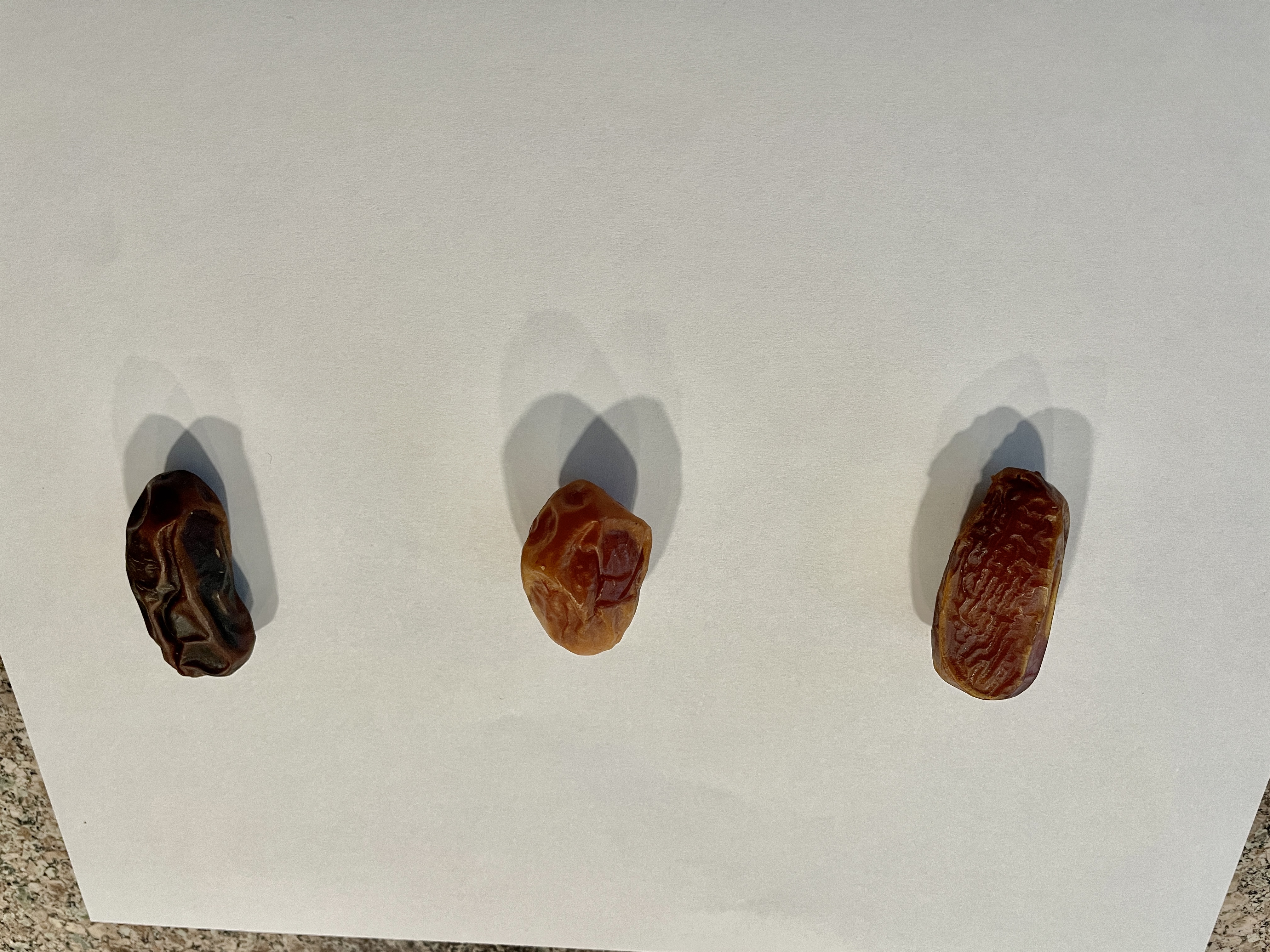
After reading about the nutritional value of dates for the brain, I headed to the nearby farmer’s market where they sell everything you can imagine from the Middle East as well as other international foods. At the dried fruit section, I studied the different kinds of dates. Medjool and deglet were familiar. Then I saw a box with three kinds of dates I had never heard of: piarom, zahedi, rabbi. They even looked a bit different. Tired of the same ole stuff to eat, I bought the box then went home and decided to research the origin and characteristics of each one.
Unlike medjool dates which are considered wet, these three are considered semi-dry. The piarom are grown primarily in southern Iran. Some depending on exact origin and harvest are one of the most expensive dates in the world. They are longer and thinner and a dark chocolate color so often referred to as chocolate dates due to both color and flavor. Another common name for them is maryami. The pits are smaller and so there is more flesh per date. They contain less sugar (lower glycemic) than the wet dates like medjool.
Zahedi dates even look really different. They are shorter, a bit fatter, and golden colored. The pit is easier to remove than most dates too. They have less sugar content than most other dates and therefore can be eaten in moderation by diabetics. They are primarily grown in Iraq and Iran but some are grown in certain areas of North Africa and Asia.
Although the majority of rabbi dates are grown in Pakistan, their origin is Iran. They too contain less sugar than wet dates like medjool. They are reddish brown and usually a bit fatter than piarom dates. Their flavor depends on the soil and the weather conditions under which they are grown. Generally their flavor tends to be caramel-like and nutty.
Like most dates, these support gut health and provide electrolyte balance due to high levels of potassium and magnesium. One big advantage is their lower sugar levels. In addition to the above, like all dates they contain high levels of polyphenols. I will buy them again.
On the left is piarom, then zahedi, and finally rabbi. Some of the zahedi are very light colored.
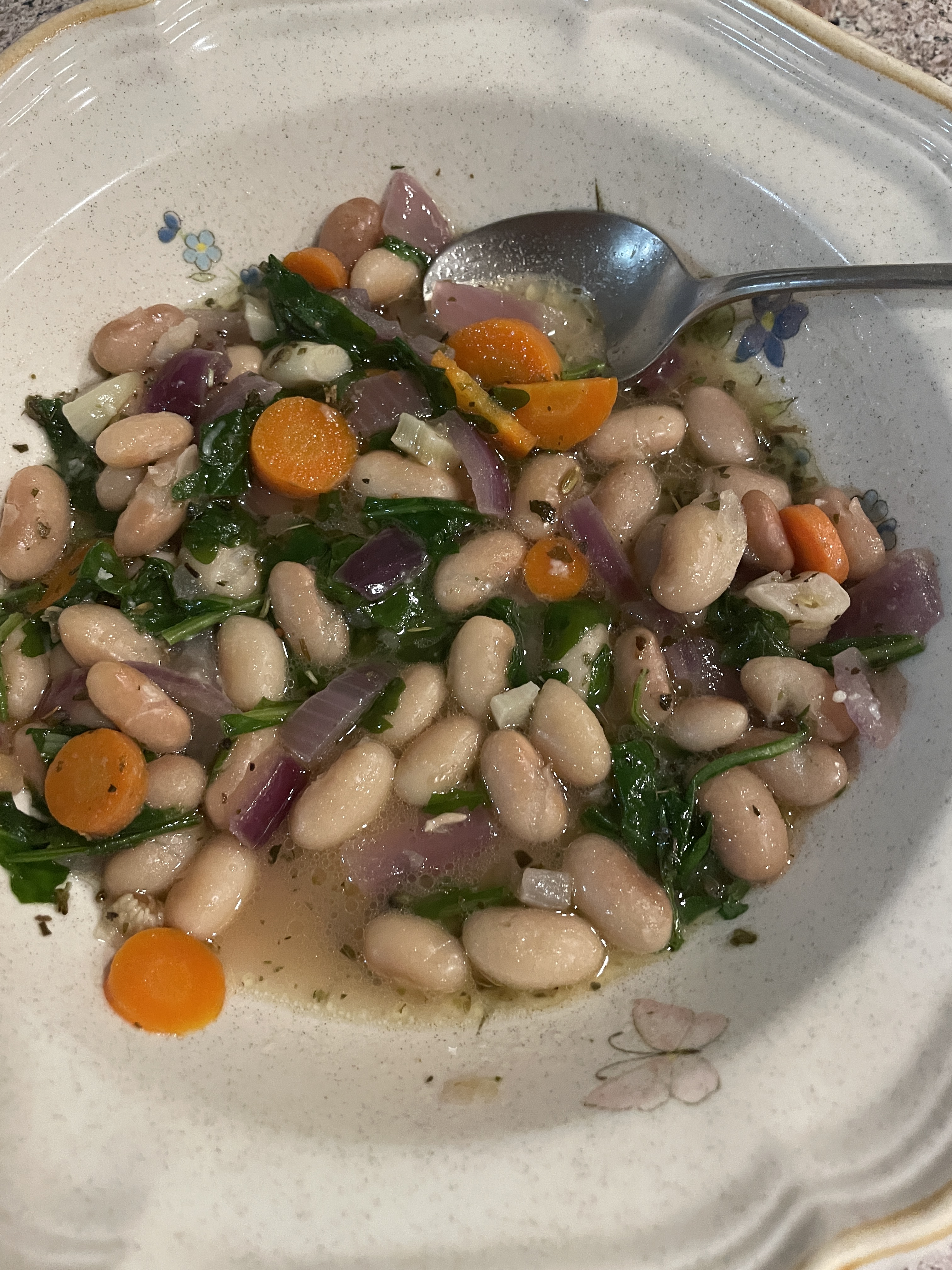
To prepare the beans, place dry beans in sauce pan covered with water and bring to boil. Turn off heat and soak for one hour, drain, and recover with fresh water. Cook until done. These beans cook rather quickly so do not over cook. You can add ground onion or garlic powder as they cook if you so desire.
Saute onion, garlic, and carrots in olive oil until tender. Add beans and herbes de provence. Once combined, add arugula and cook only until wilted.
Note: If you leave enough broth with the beans as you cook, you will have soup. Want less broth, cook down liquid until desired amount. Peruano beans nearly double in size from dry to cooked.
Three books but since one was tiny, “The Strange Library” by Haruki Murakami, and two might not count since I did not read all of them?? At first I thought the Murakami book might be a children’s book until I arrived at the end; it definitely is not a children’s book. This young boy goes to the library to check out books like he usually does and finds a different woman at the circulation desk. She gives him some odd instructions about where to find new books after he returns the books he has already borrowed. He has to walk through a sort of maze, meets some very strange people, and various unpleasant events occur. And the end is terribly sad. The book is short, with a fold up cover and illustrations of all sorts on every other page. The back cover is sort of like a mandala.
Then I tried to read “Yellowface” by R.F. Kuang but only managed to get half way and quit. This is highly unusual behavior for me because if I start a novel, I finish it no matter what. In this case, reading about a woman who steals a dead friend’s unpublished novel and makes it her own which becomes a best seller and then whines when she is attacked because she is white and the friend is Chinese and some question whether is she committing cultural appropriation and is this ok. There is also a lot about the intricacies and unfairness in the publishing industry with so much detail that I gave up. Do I feel guilty? A little.
The third book is “Cheating Death: The New Science of Living Longer and Better” by Dr. Rand McClain. I read most of this nonfiction book, picking and choosing the parts that seem most relevant to my own life and health. I highly recommend this book because it gives useful advice about supplements that can help with sleep, arthritis, diabetes, etc. instead of using some of the usual NSAIDs and some prescription drugs. However, he is not anti-many popular medicines like metformin, for example, so this is not an anti-prescription medicine book. There is a very informative chapter, “Bioidentical Hormone Replacement Therapy”, that details the pros and cons and suggests certain foods to eat, e.g. cruciferous vegetables, to counter some of the negative side effects. This book is useful in many ways. He also discusses some cutting edge therapies that are not available to most people but might be of interest to those searching for what is new and innovative regarding aging.
These are easy to make and about as nutritious as a cake like treat can be. I used regular flour but might try almond flour next time.
3 cups lightly packed shredded carrots
1 heaping cup coarsely chopped walnuts
1 Tb. grated ginger or more to taste
2/3 cup light brown sugar
1 tsp BP
1 tsp baking soda
2 eggs
1 tsp vanilla extract
1 tsp ground cinnamon
1/2 tsp ground nutmeg
2/3 cup avocado oil
1 cup unbleached flour
Grease an 8 inch square pan ( I used glass). Put the oil, sugar, eggs, vanilla, and spices in mixing bowl and combine. Add ginger, BP, and baking soda. Add carrots and walnuts. Stir to combine. Finally, add the flour and stir. Pour into the baking pan. Use spatula to level because mixture will be thick. Bake at 335 for 45 minutes or until a toothpick inserted in middle comes out clean. Remove from oven and cool before cutting into bars.
This is a sort of travelogue, memoir, and recipe book. The author begins in Odessa and travels south from there to the port of Constanza in Romania as well as various other seaside towns in Bulgaria, then to Istanbul. After spending more time there she heads east to all the ports and some inland cities near Turkey’s Black Sea coast.
I hope to learn new information and become a little more enlightened when I read–especially when reading non-fiction. This book did not disappoint. Here are a few of the things I learned:
-Odessa is a very old and once a very international city. At one point it had the second largest Jewish population in Europe. Now only about 1/3 of the residents are Jewish. Many of the restaurants serve traditional Jewish food even if not Jewish. Once in the past, Mark Twain visited there and made it famous for its ice cream.
-In Constanza, Romania, she witnessed a huge Navy Day celebration with booming gun salutes. Once upon a time, this city was famous for its Casino which now is just a glorious ruin. Here a breakfast mainstay is polenta with a mushroom topping. The author apparently liked the food because this section contains more recipes.
-Varna is the main seaport city in Bulgaria. The author’s main quest here was to see the gold, yes, gold. Once upon a time, this city was a major Roman port. Now the Museum of Archeology houses a spectacular collection of ancient gold. “Breastplates, bracelets, burial gifts, regal-looking head pieces, figurines, and pendants–all gold–shone for attention. The silent Midas room was deafening, ringing out with finery, treasure and opulence. And the loudest, biggest treasure of all, was the smallest. Tiny pendant earrings, almost inconceivably old, dating back 6000 years….these earring are the oldest ‘worked gold’ in the world. They belonged to the first known culture to craft golden artifacts, and they lived here, on Bulgaria’s section of the Black Sea in what some archeologists consider the oldest prehistoric town. But it was not gold that made this area wealthy; it was salt which was mined nearby. The world salary comes from the Latin word ‘salarium’–a Roman soldier’s stipend to buy salt.
-She goes to Istanbul and then on to Turkey’s Black Sea towns, Amasra, several a bit inland, Sinop, Trabzon, and Rize. Sinop has a particularly good harbor. There is a saying that the Black Sea has three safe harbors, July, August, and Sinop. This is in an area often targeted by Cossacks who crossed the Black Sea to raid these more prosperous areas. The town also houses an infamous prison where Russian convicts taught Turkish cellmates how to make model ships for which the town is now famous.-More than 3/4 of the world’s hazelnuts are grown in this area of Turkey. However, that did surprise me as much as the tea, yes, tea. When I think of Turkey, I think of that thick, strong Turkish coffee. However, Turkey is the fifth largest grower and exporter of tea in the world. The tea grows in the fog and mist on steep slopes that end at the sea. Several photos in the book illustrate the lush green mountains covered in tea bushes.
-When I think of Hagia Sophia, I think of the spectacular building in Istanbul, the one that has withstood invasions and earthquakes. But there is another one. On the western edges of the city of Trabzon, there is a smaller, more tranquil Hagia Sophia, one of the Black Sea area’s most spectacular monuments. It was built as a church in the 13th century, converted to a mosque, then to a cholera hospital, then a museum and finally back to a mosque in 2013. The ceiling and walls are covered with frescoes that for a long time no one knew existed until they were restored.
In addition to all the tales of her adventures and the ordinary people she meets, the book is filled with recipes that are specialties of the areas she visited. I’ve taken some ideas from several to experiment with new dishes like combining Swiss chard and sultanas (golden raisins) with chopped onions and garlic sautéed in olive oil and served over Basmati rice.
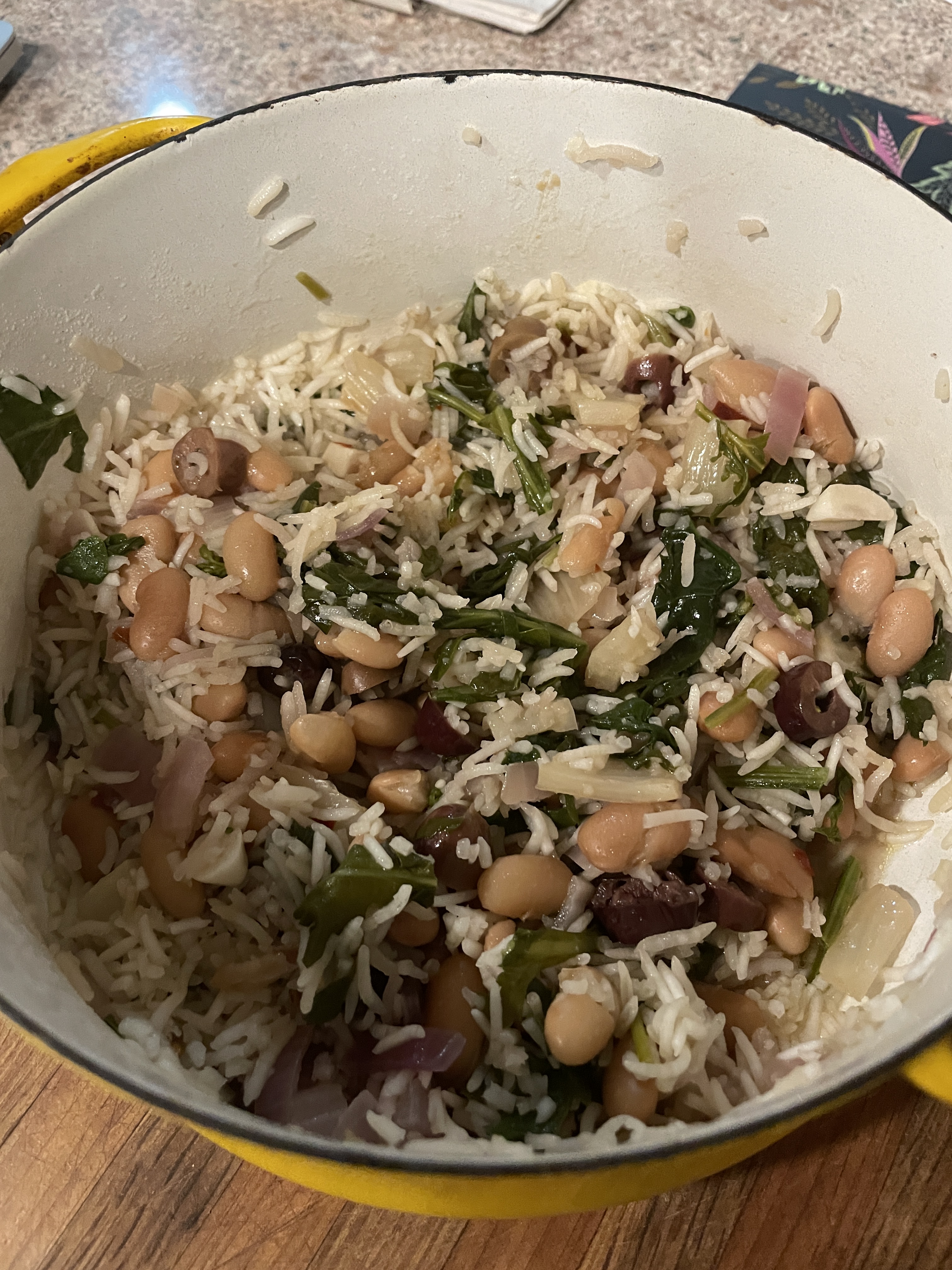
Plov is a common dish throughout Central Asia and is the national dish of Uzbekistan. All plov contains rice and usually meat like lamb or beef. Here is a vegetarian version. I found a vegetarian recipe and modified it using the ingredients I already had. The original recipe used chickpeas but I had already cooked Peruano beans so used them.
1/2 large purple onion, coarsely chopped
1/2 fennel bulb, coarsely chopped
3 cloves garlic, chopped
1/4 cup kalamata olives, chopped
1 drop coriander essential oil
1 drop cumin essential oil
1 drop cilantro essential oil
Chili flakes (optional and amount to taste)
1 cup cooked Peruano beans
2 cups greens (I used spinach and arugula), coarsely chopped
1 heaping half cup of basmati rice, rinsed
butter or olive oil for sautéing
Heat the oil or butter in a heavy casserole dish. Add onions, garlic, and fennel. Saute until tender. Stir in the spices. Scatter the beans and olives on top of the onion mixture. Do not stir! Add about 1/4 to 1/3 cup water. Layer the greens on top of the beans and olives. Flatten the greens with a spoon. Do not stir! Let greens wilt then layer the drained rice on top. Pour in enough boiling water to just cover the rice. Cook on high heat until the liquid has boiled off. Poke holes in the rice to allow steam to escape. Cover pan with lid and turn off heat but leave pan on the burner. Let the rice steam for 20-30 minutes.
To serve, stir the contents and serve in large bowls. You can add extra fresh herbs and lemon if desired. I just served as is and found it delicious. You do not have to use essential oil but can use ground herbs or fresh. If using essential oil, use a safe brand for cooking. I used Edens Garden but have used others, e.g. Doterra.
I enjoyed the previous book by Caroline Eden so much I searched for this one. I doubt I will ever make it to Samarkand or Tashkent, places sort of on my bucket list, so what I do is read everything I find about these fabled cities on the Silk Road. The sub-title of this one is “Recipes and Stories From Central Asia and The Caucasus”. It starts with Samarkand and the story of Tamerlane, the legendary hero who conquered a lot of this area and a large portion of surrounding areas in 1370. He was a military genius who loved chess and made up his own chess game with twice the number of pieces.
What foods show up in both the stories and recipes? Beets, fruit–dried and fresh for which the area is famous, tomatoes, cucumber, pomegranates, cabbage, lentils, rice, lamb and mutton, and all sorts of kebabs and flatbreads. I learned there is a huge beach on Lake Issyk-Kul in Kyrgyzstan. It is one of the world’s largest alpine lakes and in summer people from Russia and all over Central Asia flock to its shores. People who own guest houses there make all their money for the entire year in the brief summer between mid-July and mid-August.
In the remote mountains of Azerbaijan lies the small town of Gyrmyzy Gasaba above the Qudiyaleay River, a town where all the people are Jewish. Even though Azerbaijan is a predominantly Shia Muslim country, the people in this town have peacefully lived here for hundreds of years. This town is considered the last surviving pre-Holocaust Jewish town untouched by WWII.
If you are a lover of apples, then consider this country, Kazakhstan, the place where apples originated. All apples in the world today come from the original apples here. The name of the largest city, Almaty, whose older name was Alma-Ata means fatherland of apples. In Ile-Altalan National Park on the northern slopes of the Tien Shan mountain chain thousands of acres of wild apples flourish.
Even though this book was published less than ten years ago in 2016, a lot of people must have been interested in reading the stories and recipes because the copy the library found for me is not in the best condition. Before I return it, I will copy some of the recipes to try.






 writingontherim