This novel details the lives of several immigrants fleeing violence in their own countries. One is a five year old boy in Austria whose father disappeared during the beginning of the Holocaust and whose mother put him on one of the Kindertransport trains from Nazi-occupied Austria to eventually reach England. He never sees her again. All he was allowed to take is one change of clothes and his violin.
Another is Leticia who is now a US citizen; she was carried on her father’s back across the Rio Grande after they escaped the El Mozote massacre in El Salvador, only because they were out of town when when paramilitary men came and killed everyone in their village.
The third is Anita, a blind, eight year old girl whose mother brought her to the US from El Salvador to escape threats on her life from a former military officer who was dismissed because of his behavior. She is separated from her mother by US officials and taken first to a detention center and then later to various “foster” shelters for such children.
Other characters include Selena, a woman working for a non-profit that helps such children and Frank, the high powered attorney she convinces to help her with Anita’s case. The novel illustrates how so many lives intersect and inter-relate in ways no one ever expected.
I will confess that I read this book before when it first came out decades ago. This past week, I reread it because several women on the street where I live decided to start a book club and this is our first book. McBride’s mother was a remarkable woman who grew up under horrible conditions in the South. Her father, an orthodox rabbi, did not love his crippled wife and made everyone work hard. He was more obsessed with money than religion. Jews were not very welcome where they lived and McBride’s mother found more acceptance and understanding among their Black neighbors. She escapes to NYC, meets and marries a Black, Christian man, converts, and they start a church together. He dies suddenly; she is left with their many children and works hard to make sure her children are successful, sending them off to schools where they are often the only children of color. Then she marries another man and has more children so there are 12 children. This remarkable woman makes sure all of her children go to good schools, go to college, and become successful while she works at what most would consider menial jobs. In this book McBride details not only his own growing up but also the history of his mother and his siblings. It is a remarkable tale of one woman’s determination to keep going, educate her children, and never give up no matter the circumstances.
This latest Strout novel takes the reader back to Crosby, Maine, the site of most of her other novels. The same cast of characters appear, Olive, the Burgess boys, Lucy, William, Margaret, and all the others. This one, however, has a new twist, a heinous murder occurs. The most obvious suspect is the victim’s reclusive son who lived with her. Bob Burgess is hired as his lawyer. Lucy starts visiting Olive and they tell each other stories about people they have known , what Lucy calls “unrecorded lives”. Meanwhile, Lucy keeps asking, “What does anyone’s life mean?” Lucy and Bob take walks every week, spending the time talking about all the things they feel they cannot talk about with anyone else. William becomes more obsessed with the parasites he is studying and never quits talking about them.
This, like all of Strout’s novels, focuses on relationships, the good and the bad, and how they sustain us, sometimes transform our lives, sometimes nearly ruin us. Although, readers do not have to read her novels in sequence and this one could be read alone, I think it would make more sense to the reader to at least read three others first: “Olive Kitteridge”, “The Burgess Boys”, and “Oh, William”.
Strout has a unique, easy to read style, that is both simple and profound. She talks about people as they are with empathy and concern. She talks about the many forms of love–“…it is always love. If it is love, then it is love.”
Last year I read her novel “Gilead” which takes place in fictional, small, Iowa town in which the main character is the father of the main character in this novel, “Jack”. John Ames Boughton, Jack, is the wayward son of a Presbyterian minister. Previously, he has been wrongly imprisoned for a theft he did not commit. He loves literature, especially poetry. He lives off of odd jobs, drinks too much, smokes, and is somewhat of a lost soul who continuously philosophizes about live, religion, and societal rules. One day he sees a woman walking in the rain. When she drops her bundles on the sidewalk, he helps her. She thinks he is a preacher because of the way he is dressed and invites him in for tea. She is Della Miles, a teacher and the daughter of a Black Methodist minister. This is the story of interracial love when it was still illegal in the US, the lengths they go to resist and hide it, and the reactions of her family. Reading this, one realizes how it was not that long ago that most of the US was not only segregated, but sometimes even talking to someone on the sidewalk from another race could get a person into trouble with the police.
This is one of the most heart wrenching books I have ever read. As a child, the main character, David Winkler, discovers he possesses the ability of premonition via dreams that come true. Only his mother understands him; unfortunately she dies while he is still young, leaving him with father who is only physically there. He becomes an hydrologist, specializing in the structure of snowflakes, leading a rather lonely life as a weatherman in Alaska. While at the grocery store, he meets a woman. He knows what she is going to do before she does it. Eventually, they develop a relationship. The remainder of the novel details the consequences of their relationship and their having a child, Grace. David dreams that he will not be able to save Grace from flood waters, his wife thinks he is crazy, and then to avoid what he perceives will be Grace’s fate if he stays, he disappears. Eventually, he arrives hungry and destitute on a Caribbean island where he is taken in by a kind family who have escaped imprisonment in Chili during the military dictatorship there. He agonizes over whether his running away saved Grace and is unable to find out what happened to her. Eventually he saves up enough money to search even though he has no idea where she might be or how she will react of he finds her alive. Will her mother forgive him, will Grace if he finds her? He is driven to find out no matter the consequences.
This novel’s main themes include love, longing, forgiveness, the meaning of friendship, and the human search for grace.
Note: I have now read everything published by Anthony Doerr. His works contain beautiful prose and detailed descriptions. One of the most impressive things about his work is the amount of research required to write in such great detail about so many subjects, e.g. structure of snow flakes, the anatomy of different types of shells, the history of the city now called Istanbul and its ancient neighborhoods.
This Omani author has won prizes for his fiction. Only a few of his books have been translated into English. This one takes the reader into the remote villages and mountain regions of the interior of Oman. Azzan, the main character, had received highest honors as a child and teen for his academic excellence but fails to win a coveted scholarship to travel abroad for college. His father, who is mainly absent during his growing up, berates him, and Azzan turns to alcohol and addiction. Eventually, he saves himself by becoming a beekeeper. He finds solace in the more remote, wild regions rather than the narrow confines of village life which is controlled by gossip and tradition.
In these wild areas he meets two other men. Although they do not keep domestic bees, they go camping together in the far mountain areas hunting for the prized honey from wild bees. One of these men is a Bedouin who trains prized racing camels. Through him and his wife and friends, he learns how much freer Bedouin culture is compared to that of the settled villages. He learns to dance and talk more freely with women. While in one remote area, he meets a woman, Thamna, who too has escaped the traditional village life and roams the wadis and mountains with her herd of goats always looking for better pasture. He becomes obsessed with her, always on the outlook as he keeps his bees and roams the interior of Oman hunting bees.
This story is not only about Azzan, but also his friends, traditional Omani village life, bee culture, and Bedouin life. For those interested in bee keeping, the author provides detailed descriptions of bee keeping. The language is poetic and infinitely descriptive. I could feel the wind, smell the different wild flowers and the taste of the honey created from them, see the Bedouin dancing, and feel Azzan’s heartbreak when disaster hits.
Although this novel describes a culture far different from that of the US and Europe, I found some things not all that dissimilar: the strict rules of small town life, the greater freedom found in nature, how people develop and lose interpersonal relationships. The language used makes the reader feel there in the moment being described. Plus I learned that bee keeping is very labor intensive and wrought with many things that can go wrong. I eat honey daily and now will have a greater appreciation of what goes into its production and harvesting.
I was not looking for this, but rather accidentally found it while strolling through the stacks at the local library. What an informative and entertaining book. When it was first published in Lebanon in 2005, it sort of shocked the Arab world causing public debates about the subject matter and story both pro and con. The novel centers on the lives of four upper class Saudi young women who have known each other for years and are friends. Because the book openly discusses the difficulties young educated Saudi women have pursuing education and careers while also trying to find suitable men to marry, the religious conservatives found the novel blasphemous and wanted it banned. Others said it disrespected Saudi women. Black market copies showed up everywhere and the author became an overnight sensation.
The book focuses on the difficulties these women experience as they navigate the modern world while still living in a society founded in very conservative patriarchal cultural conditions. They want to believe in love and hope they will find someone to marry they also love. However, traditions get in the way of this goal more often than not. Some of them find someone they love and who loves them but families forbid it–the person is not high enough status or has been divorced, or…the barriers seem endless, focused on family connections. Love is considered a frivolous, unhealthy distraction.
Contrary to what I believed before reading this, most of these higher class Saudi young women are going to college, often in subjects like medicine and dentistry, and plan to pursue careers in their fields. Many have travelled to Europe where they are freer to roam, not dress conservatively, etc. Yet they return home because of close family ties and love of country. Several of the fathers in this novel are considerably more liberal than the girls’ mothers. Like any society the view of progress and tradition vary greatly by family and individual.
Because as a reader you get to “know” these young women, I found myself reading nonstop because I really wanted to know what was going to happen, whether any of them would be allowed to marry someone they loved or would be heartbroken and forced into unwanted situations. The latter never occurred thankfully. None were forced to marry someone they disliked. It is a great read for those who are curious about other cultures and how women navigate their lives in a place dramatically different from what is more common in Europe and the US.
“She was Christian but American Christian, the kind that believed Jesus just needed a bigger gun”–part of the description of the main character’s rich, not dentist mom rich but oil, trust fund rich, blue-eyed, blond girlfriend. Cyrus, the main character is an Iranian American whose father immigrated to the US when Cyrus was a baby after Cyrus’ mom was killed when the US shot down an Iranian passenger plane thinking it was a bomber (July 1988). His dad acquires a job at a Midwestern chicken farm, counting eggs, but special eggs. This farm breeds chickens to grow faster to get to market faster. He works six days a week, long hours, until Cyrus, who excelled in elementary and high school, becomes a sophomore in college. Suddenly, his dad dies.
Cyrus becomes an addict using alcohol and drugs and writes poetry and eventually finishes college. He becomes obsessed with and researches martyrs throughout history–people like Hypatia of Alexandria, Bhagat Singh, Emily Wilding Davison, the Soulit Women. He gets sober and obsessed with his own past. This eventually leads him to travel to Brooklyn to talk to a famous artist whose last exhibit is herself talking to visitors as she dies of cancer. In researching this woman’s paintings, he discovers a strange painting of a young man dressed as an angel whose job as a soldier is to ride at night with a flashlight through the fields of the dead and dying Iranian soldiers consoling them during the Iran/Iraq War. Cyrus knows that his mom’s brother had this actual job during that war and wonders can there be a possible the connection.
Throughout these events the reader is lead to not only explore Cyrus’ thoughts and beliefs but also those of his father, mother, uncle, and best friend, Zee. It is rare for a novel to be both heart wrenching and funny. Akbar accomplishes this task. One moment I found myself laughing out loud and the next almost in tears. I could not stop reading even though the paperback is long. Perhaps my knowing something about Iranian culture, food, etc. helped me appreciate some of the book more than I might have otherwise. Nevertheless, this is a universal story about love, discovering oneself, relationships, parenthood, human nature. It is definitely worth taking the time to read.
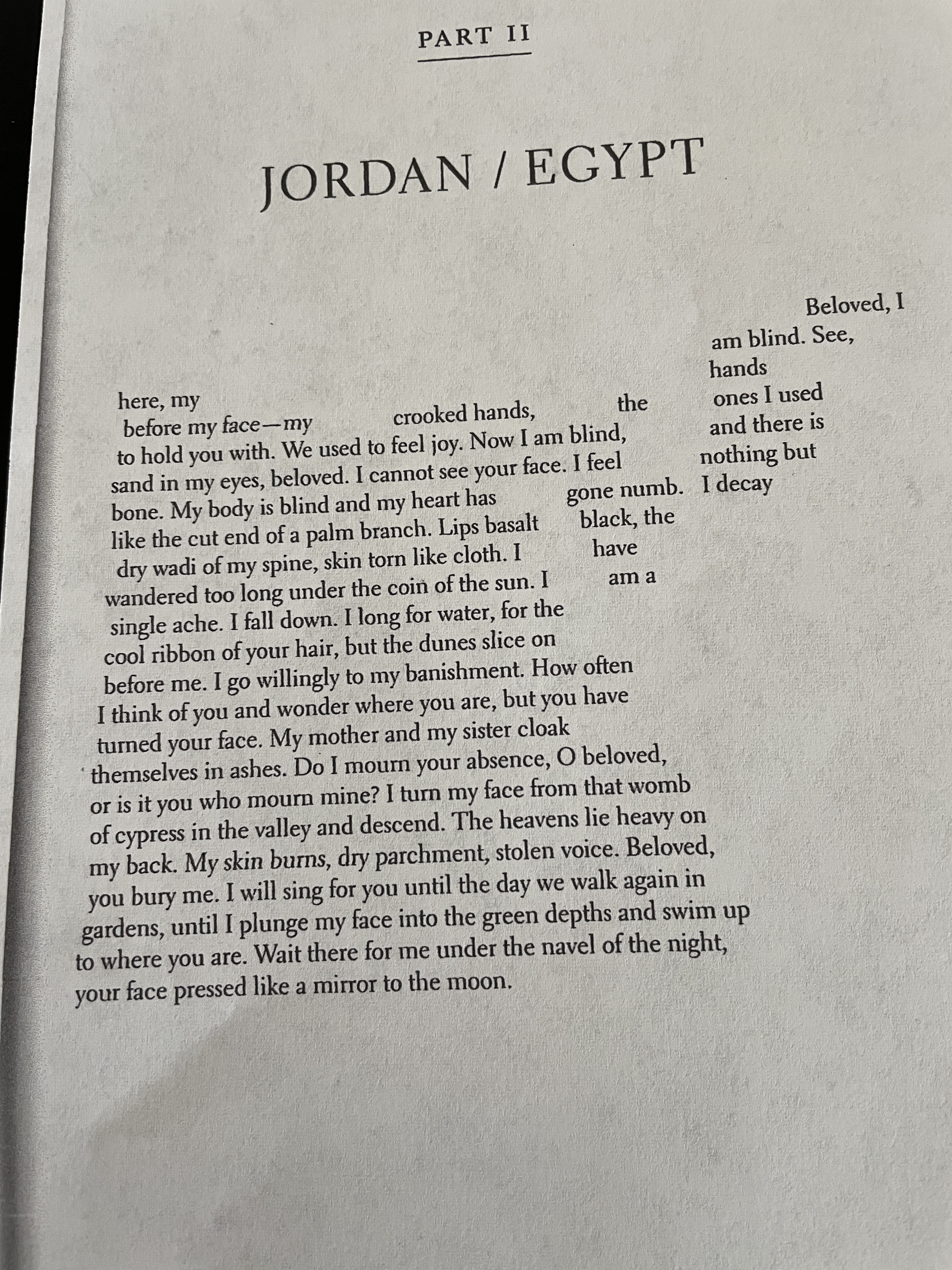
Two young heroines dominate this fascinating novel which switches back and forth between the Syria of 2011 and the 12th century. The latter is a girl who disguises herself as a boy to join the quest of a famous mapmaker. Nour, the first girl, lost her father to cancer in NYC. Then her mother, a mapmaker, decides to move herself and the three daughters back to Homs, Syria. They barely settle into their new life when the civil war breaks out and a bomb destroys their house. They become refugees. This is the tale of their harrowing journey from Syria to Jordan to Egypt to Libya to Algeria, then Morocco and finally to Cuenta, the Spainish city on the north coast of Africa, where their uncle lives.
To keep sane, Nour repeatedly tells herself the story of Rawiya, the disguised girl who is an apprentice to the map maker. When he was alive, this was the favorite traditional story her father told her. The book alternates between what is really occurring to Nour and her refugee family and this ancient story. At the beginning of the section for each country through which they travel, there is a touching and beautifully written poem in the shape of the map of that country. The poem for Jordan/Egypt is printed below.
The subtitle of this book is “The War of Brothers That Shattered an Empire and Made Medieval Europe”.
The empire to which they are referring is the empire created by Charlemagne which was at the height of its power in the early 800s. He had managed to combine the territories of almost all of what we now consider Europe except for the far north and southern Italy and Spain and Greece. He managed to do this through cooperation among the nobles and the elite and it held throughout his life. He helped the spread of Christianity throughout what was previously pagan areas, e.g. the Saxons. Then not long afterward chaos ensued.
This history book details what occurs when fissures develop in what was once a stable social and political network and the bloody consequences of disagreeing on facts and reality. What happened?
For some time after Charlemagne’s death one of his son’s was able to hold the empire together by deftly giving bits of power to various sons and relatives. Once he died, a chaotic blood bath arose. Fathers and sons, brothers, uncles, nephews, everyone was killing or maiming each other for power. If they felt it was too unChristian to kill you, they just blinded you and sent you off to a monastery. If that did not work, then they would declare a female relative to be a witch and we all know what happened to witches. Meanwhile while jockeying for power, all these men declared they were doing what they were doing in the name of Christianity. If one brother won a battle, then he declared himself to be a better Christian than the one that lost. Even monks and bishops and the Pope became involved.
Then came the Battle of Fontenoy in what is now a part of France. Brothers against another brother with each leading more than 10,000 troops and in some cases as many total as 100,000. Watching was a noble who also commanded a huge army, but mostly he decided to just watch. The end result was a total bloodbath with one side violating the then current rules of battle. Normally, battles before this did not include a huge amount of killings in spite of what we now see in movies. This battle left thousands dead for the wolves, vultures, and other scavengers to eat, and the nearby streams ran red with blood. None of the warring brothers were killed so their fighting continued but no one ever really won and the great Frankish Empire created by Charlemagne fell totally apart. Some claim this battle was the beginning of the separation of a lot of Europe into what we now call France and Germany. Currently there is a marker at the place where the battle occurred. Regardless, Europe was never the same again for many centuries.
Note: Many find the world a very violent place today. Currently, wars and revolutions of one kind or another are occurring in many places in the world. Generally speaking, however, we do not find fathers and sons and brothers killing each other for power. We are seeing the consequences of what was once a relatively unified populace disagreeing on the facts and reality. Will we too fall into a dark ages like Europe did?


 writingontherim