Ethiopian Journey–Addis Ababa


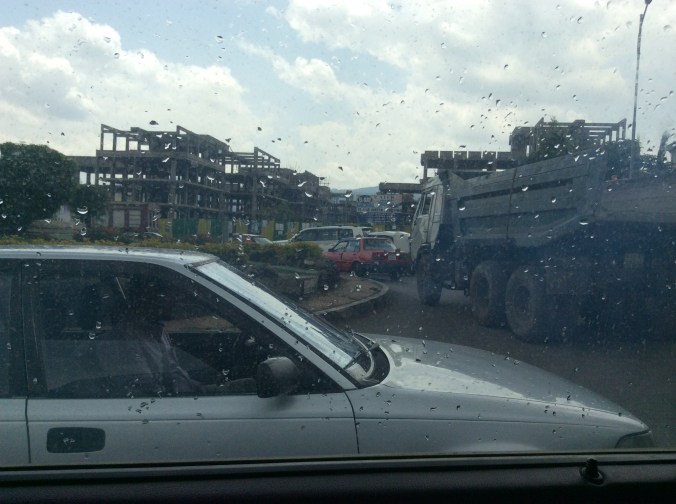
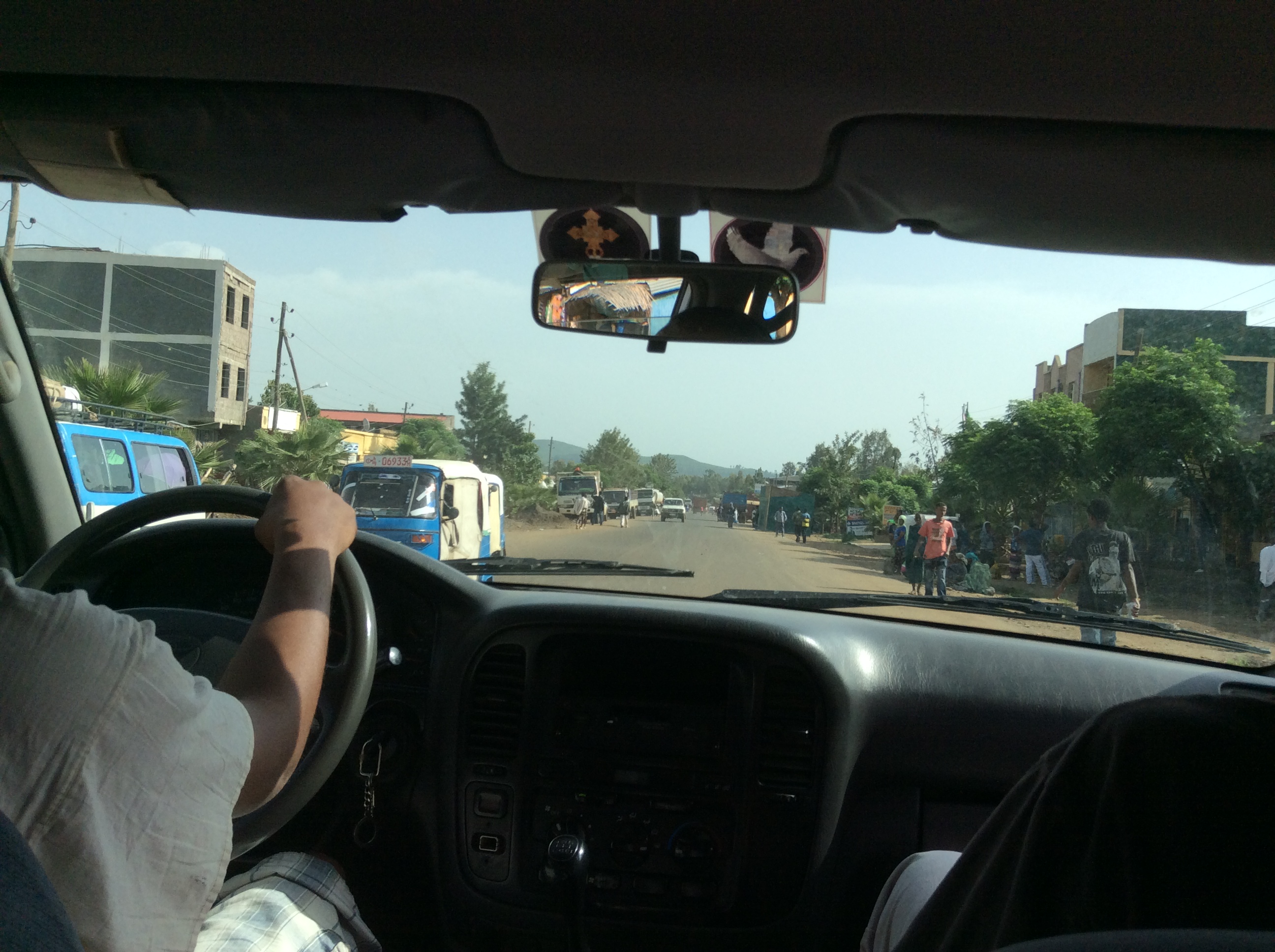
We spent a couple of days in Addis staying with my friend’s sister who lives there.  Addis traffic is incredible.  In a city with millions of people I saw only one traffic light and it was not working.  Most intersections are giant traffic circles and getting through them is a rather daunting task.  On the way to my friend’s brother’s house one day, we sat stuck for nearly one half hour–we could not get through the circle.  Finally, the passenger in the car to the right of us jumped out and stopped the traffic so we and his driver could get through.

IMG_0211

Additionally, it rained often, streets and buildings were under construction, and mud and potholes showed up everywhere.  This is a nice traffic circle.

IMG_0212

A nice day with little traffic.

IMG_0213

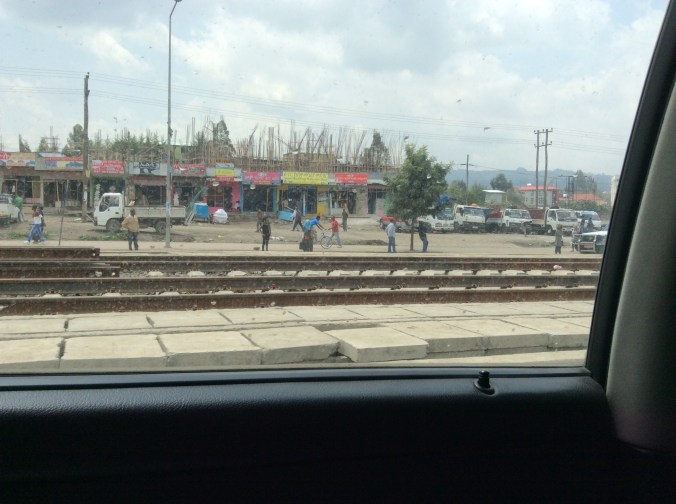
They were building a new rail line across the city hoping people would use the train instead of driving.

IMG_0214

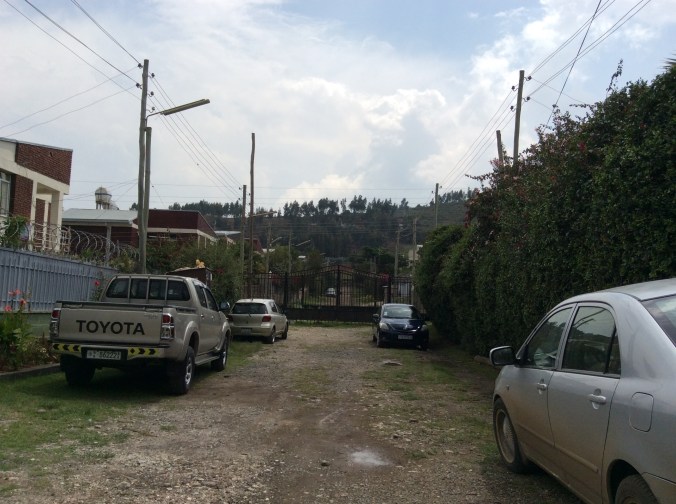
This is a typical residential street in a newer part of the city.  A gate with a guard can be found at each end of the street.

IMG_0215

In other parts of the city, houses have walls around them and you back your vehicle out into a street like this, then go to the main street.

IMG_0207

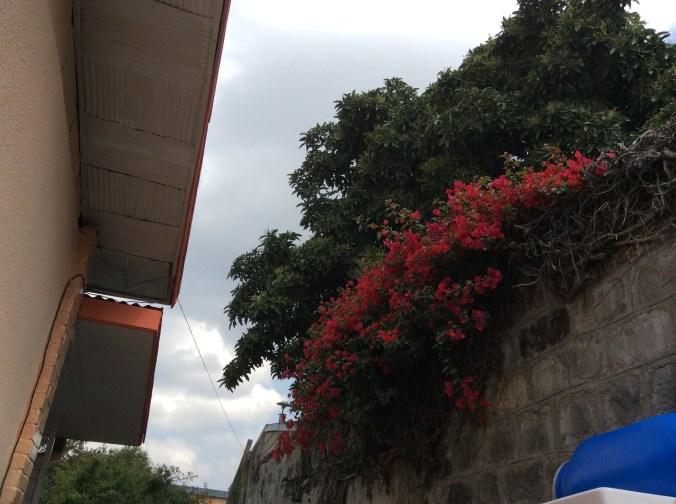
Walls around houses are not bare.  Lush tropical vines and flowers cover many of them.

IMG_0218

Many of the fancier, famous hotels, like the Hilton here, contain fountains and gardens. My friend and I could not resist a photo in front of the pool and fountains.

IMG_0219

After wandering around the Hilton we drove to see the grounds of another famous hotel where foreign diplomats often stay.  The plants in the foreground are papyrus.

IMG_0220

IMG_0222

These extensive gardens take a while to walk around.  Many of the plants and trees are labelled.  From here we could see the Addis skyline.

IMG_0227

We stayed in Addis a couple of days.  Before we left on a ten day road trip, my friend’s sister took us to a traditional restaurant.  I expected it to be filled mostly with tourists–was I ever wrong.

IMG_0240

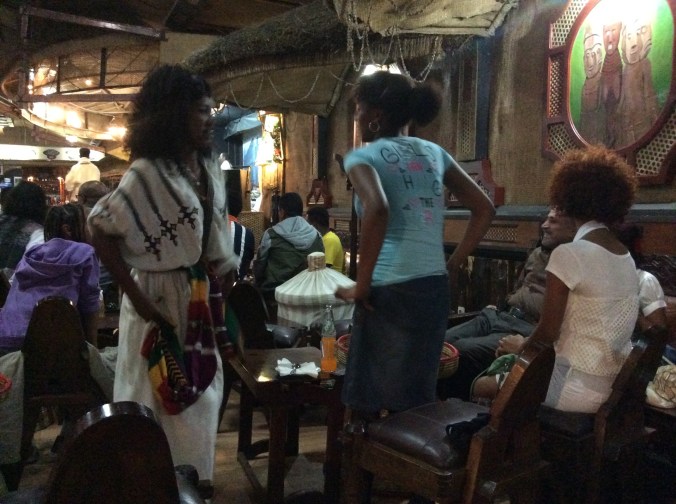
In addition to traditional food, this restaurant features traditional dancing.  Many locals came to compete, to try to out-dance the professional dancers.

IMG_0242

The lady on the left, one of the professional dancers, and the lady on the right having a little competition.  The lady on the left is dressed in traditional dress.

IMG_0243

In the background locals try to out-dance the professionals.


Ethiopian Journey–The Beginning


Two years ago today, two friends and I flew from here to Dallas to Dubai.  The final destination:  Ethiopia, where I spent nearly three weeks with them and my friends’s family plus a road trip through the north.  Ethiopia was nothing like what one sees in the news, in famine photographs, nothing like the image most people in the USA have of it.  My main goal when I returned home was to show people photos and inform them what it really looks like, how incredibly beautiful it is there.  This mission continues two years hence.  For the next several weeks I plan to relive this journey and share it on my blog here.

It is a short trip from Amarillo to Dallas via air.  In order to carry the baggage allowed on Emirate Airlines, we first flew via Southwest to Love Field, then took a taxi to Dallas International.  If you plan to fly long distances, I highly recommend Emirates Airlines.  Compared with all the others I have experienced even coach class is wonderful:  bigger seat room, more than a hundred movies to watch, good food, an area where you can help yourself to fruit and snacks, unlimited wine and beer, and an international group of flight attendants.

From Dallas to Dubai is fifteen hours of flying.

IMG_0155

IMG_0163

People wonder why they fly over Greenland, Iceland, northern Europe to get to Dubai.  Do not look at a flat map.  Get a globe and trace the route.  It is the shortest way to go.  Dubai is not like many think here.  No, I did not see endless lines of Lamborghinis and Ferraris.  In fact, I do not recall seeing any at all.  Tomorrow, photos of Dubai before heading on to Addis.

Old Barns and Blogging 101


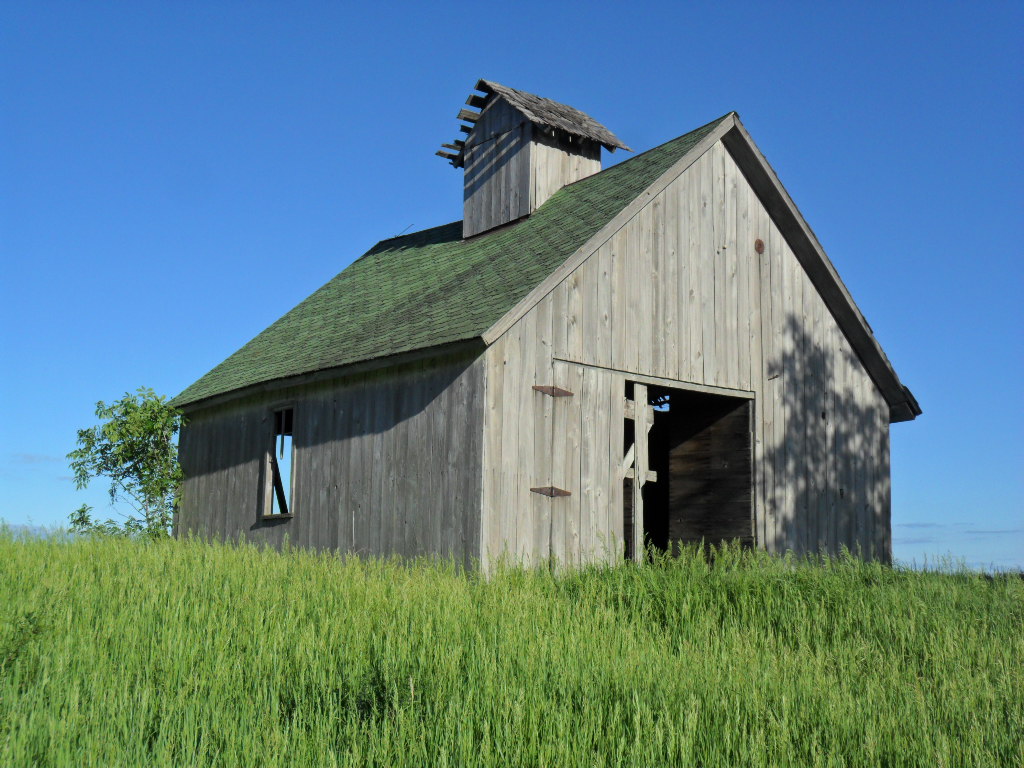
Previously I mentioned that I decided to try WordPress’ class to see if I could discover something new, broaden my horizons, play, explore.  In completing assignment for day eight, I found a blog with a photo of an old barn.  Old buildings fascinate me, lead to daydreaming.  Who lived or worked there, how old is it, why did they abandon, move on?  Several miles down the road from where I live stands an unusually large, faded, red brick barn.  On the edge an even taller, circular silo stands.  Part of the roof is falling in, a few trees shade the east side.  I used to drive by this barn every day, twice a day.  Still when I drive by, I think what a unique restaurant or house it would make.  Meanwhile, slowly it deteriorates; I feel sad.

While writing this and looking at the photo mentioned above, I remembered the old carriage house where I grew up.  It stands, the only building remaining where my father was born and lived until he reached the age of ten.  I still own the farm; the young man who farms it cannot bear to tear the building down.  When I was there 2 1/2 years ago, it housed a piece of farm equipment.  I remember large elm trees and the hollyhocks growing next to it, making hollyhock dolls as a child. Who will remember when it is gone?

SAM_1165

Gratitude


Usually, I plan my posts, write them out carefully, sometimes even proof a couple of times.  Today is Thanksgiving Day here in the United States.  Even though I know all about the historical lies to cover up the truth about the supposed original Thanksgiving, I continue to think this is a useful and fun holiday for several reasons.  Thankfulness, gratitude, remains the primary source of a happy life.  The list of things for which I am thankful seems nearly endless:

-health

-living in a place filled with natural beauty

-my daughter

-my grandson

-my son, even though we talk only occasionally and he lives far away

-teaching

-my students, one of whom posted on Facebook this morning that he is grateful that he had me as a teacher ten years ago

-the friends who took me with them to Ethiopia this past summer

-all my other friends locally and from all over the world

-the exchange students who have lived with me and from whom I receive messages regularly

-my parents for whom I owe eternal gratitude for teaching me values, independence, tolerance, a love of beauty and knowledge, and a sense of wonder

-music

-my ability to sing

-horses

-wildlife, nature–here where I am so fortunate to live

-art

-my ability to write

-all the people who love my book of poetry and tell me they do–I might also include the people, mostly men, who find it shocking

-happiness and the choice I made to be happy all those long years ago

-red wine

-plentiful food

I could go on and on.  However, it seems best to end with this fantabulous morning on my own little rim of wonder and say I am thankful for a life filled with so many astonishing events and experiences I never expected and for which I am endlessly grateful.

SAM_1454

My Ethiopian Adventure: Lake Tana, Where the Nile Begins–Part One


From Gonder to get to Lake Tana, you must retrace your route to go to Bahir Dar, the largest city on the lake.  The road around the west side of the lake is not a major highway so we traveled back past the Finger of God, past my favorite castle, through the valley with miles of rice, through Addis Zemen.  Altitude declines the closer you drive to Bahir Dar.  Although Simien Mountain National Park remains one of the most scenic places I have ever visited and Gonder is a city filled with unique history and beauty, I felt happier and happier as it became warmer, more tropical.  In keeping with the previous week, the emerald landscape continued.

IMG_0767

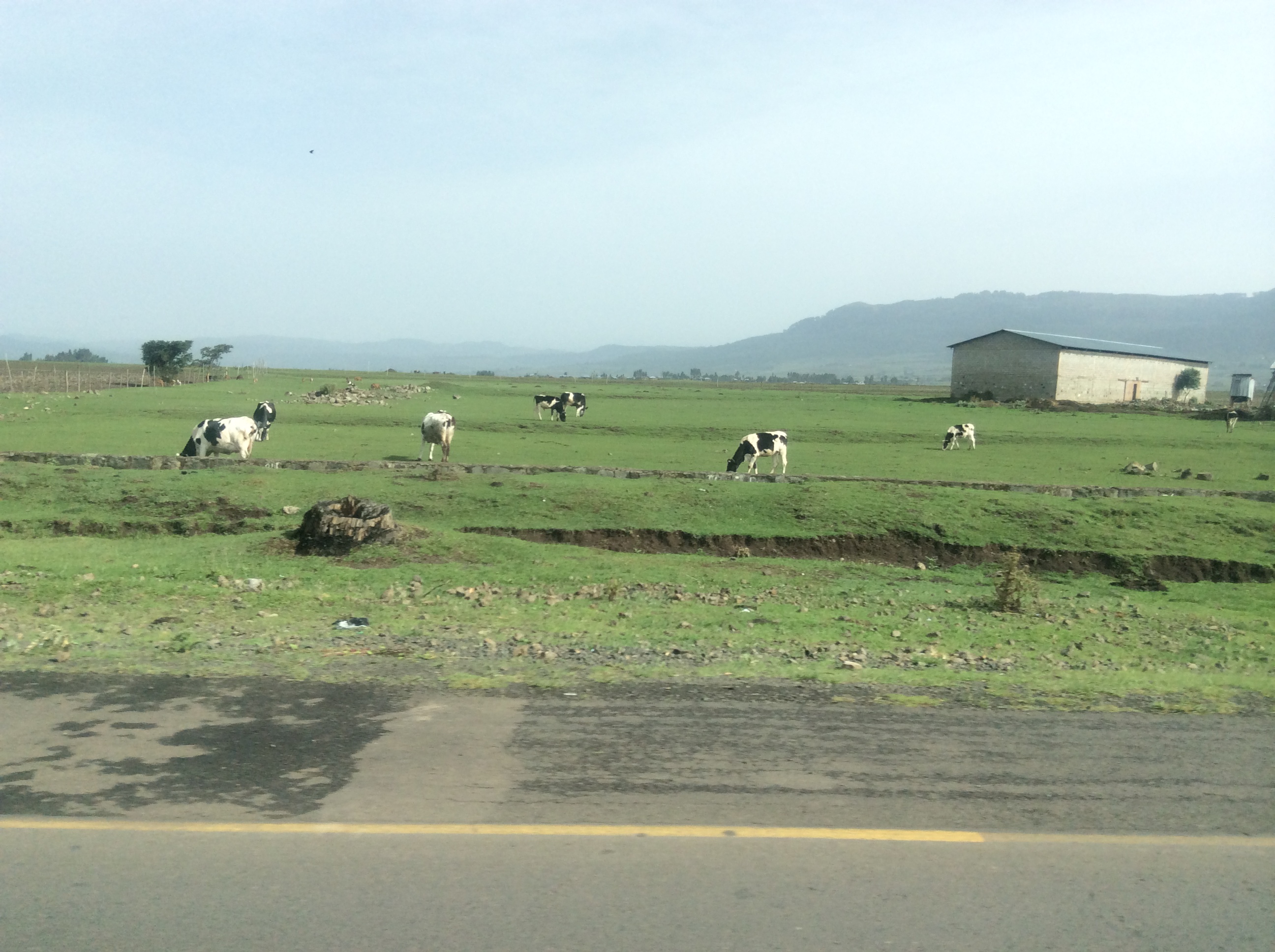
Here cattle grazed in the seemingly endless pastures.  As usual, livestock walked along the road.  The species of livestock varied with altitude and locale.

IMG_0763

When you drive through towns and even larger cities, expect to dodge people and animals.  Even in Addis, we saw goats.

IMG_0764

IMG_0774

These intensely yellow flowers in the foreground grew everywhere.  No one seemed to know their name.

IMG_0778

Dino wanted to buy the hat so we stopped to talk to this boy herding his animals along the roadside.  He told Dino he spent two days making it.  The hat along with baskets and other items bought on the trip took one and one half months to arrive in the US after being shipped from Ethiopia.

IMG_0780

In this area, these same yellow flowers appeared everywhere and in some places so close together as to make a fence.  Upon detailed inspection, I concluded they are some type of thistle. Later, we learned they are poisonous to the touch and cause massive swelling.  And to think I seriously concerned touching them. Finally, we arrived at Bahir Dar and drove onto this street.

IMG_0782

We reached a promontory overlooking the Nile.  The Nile!!!  All my life I have heard of the Nile.

IMG_0785

Here below me, flowing out of Lake Tana, the source of civilizations thousands of years old, the Nile begins its long journey to the Mediterranean  Sea.  We drove further down a dirt road to this overlook.

IMG_0791

Unlike the previous point, no one was here except two youngsters and us.  We watched cattle graze along the Nile, a couple walk on a pathway along the river, and a hippo cross from the near bank to the larger island, but too far away to capture with my iPAD.  Even now I can feel the emotion, an overwhelming, indescribable sense of amazement–the Nile, river of rivers, laying there below me.

IMG_0792

I stood spell bound for a long time, watching, feeling, thinking:  I cannot believe this, I am looking at the Nile.  Later, on the way to the hotel, we crossed a bridge over the river where hippos lounged.  We stopped, hoping to take photos, but the river guard said no.  We could look but no photos–he explained it is a strategic bridge.  We checked into our hotel on the shores of Lake Tana.

IMG_0797

IMG_0798

IMG_0799

Still, now, writing this, I feel the magic, the mystery.

My Ethiopian Adventure–Lalibela, Part Two–the Monolithic Churches


IMG_0397

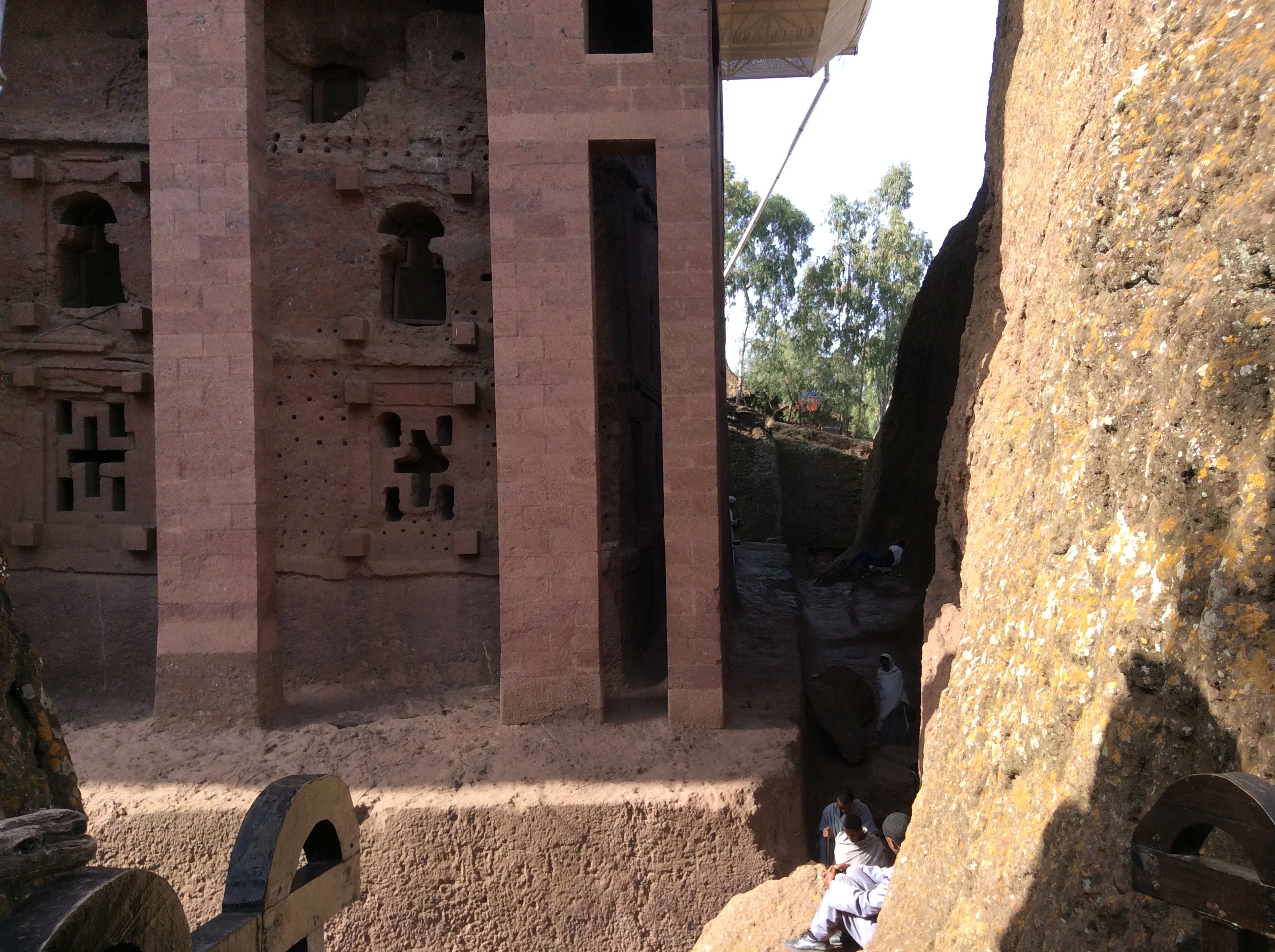
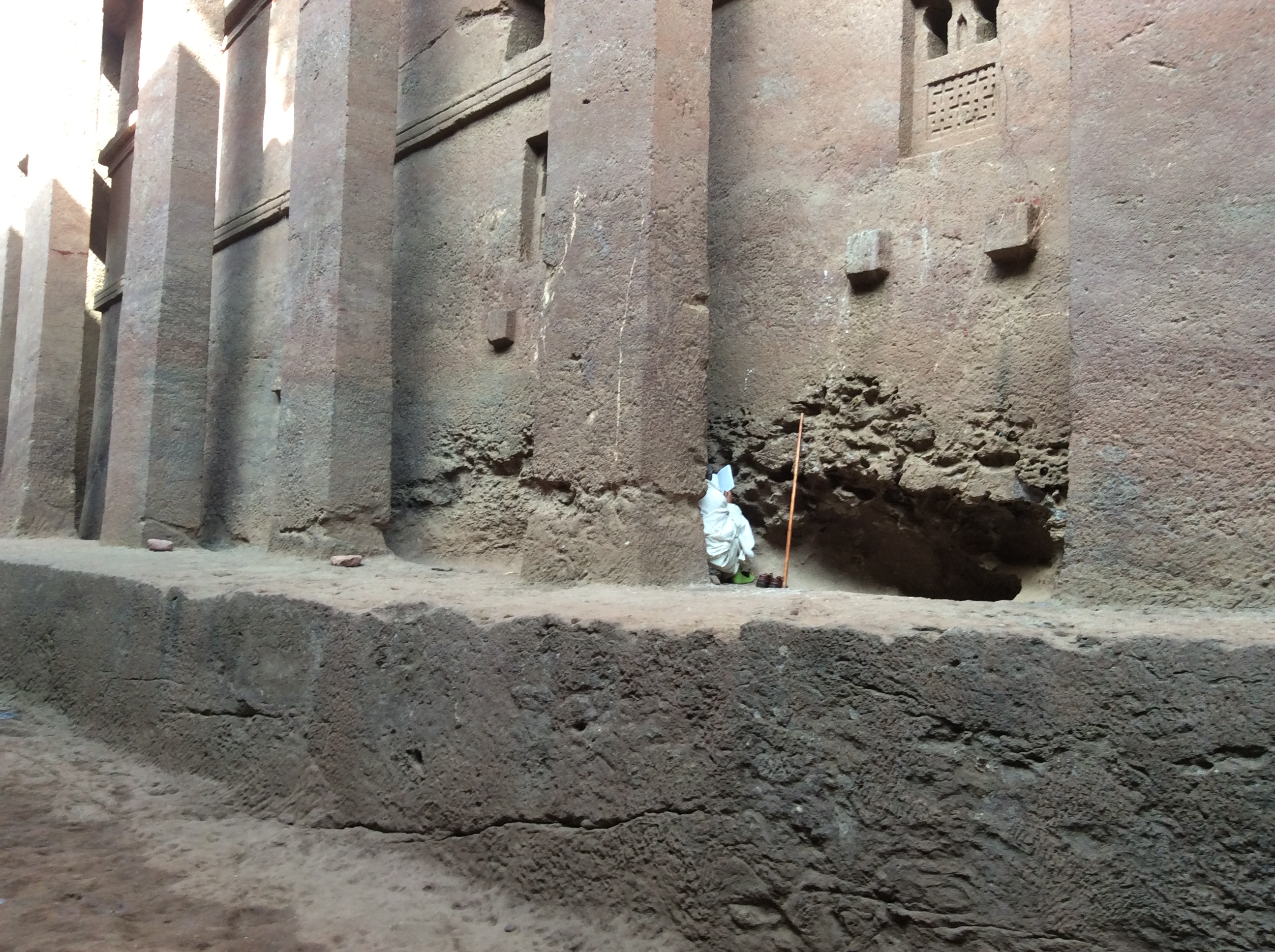
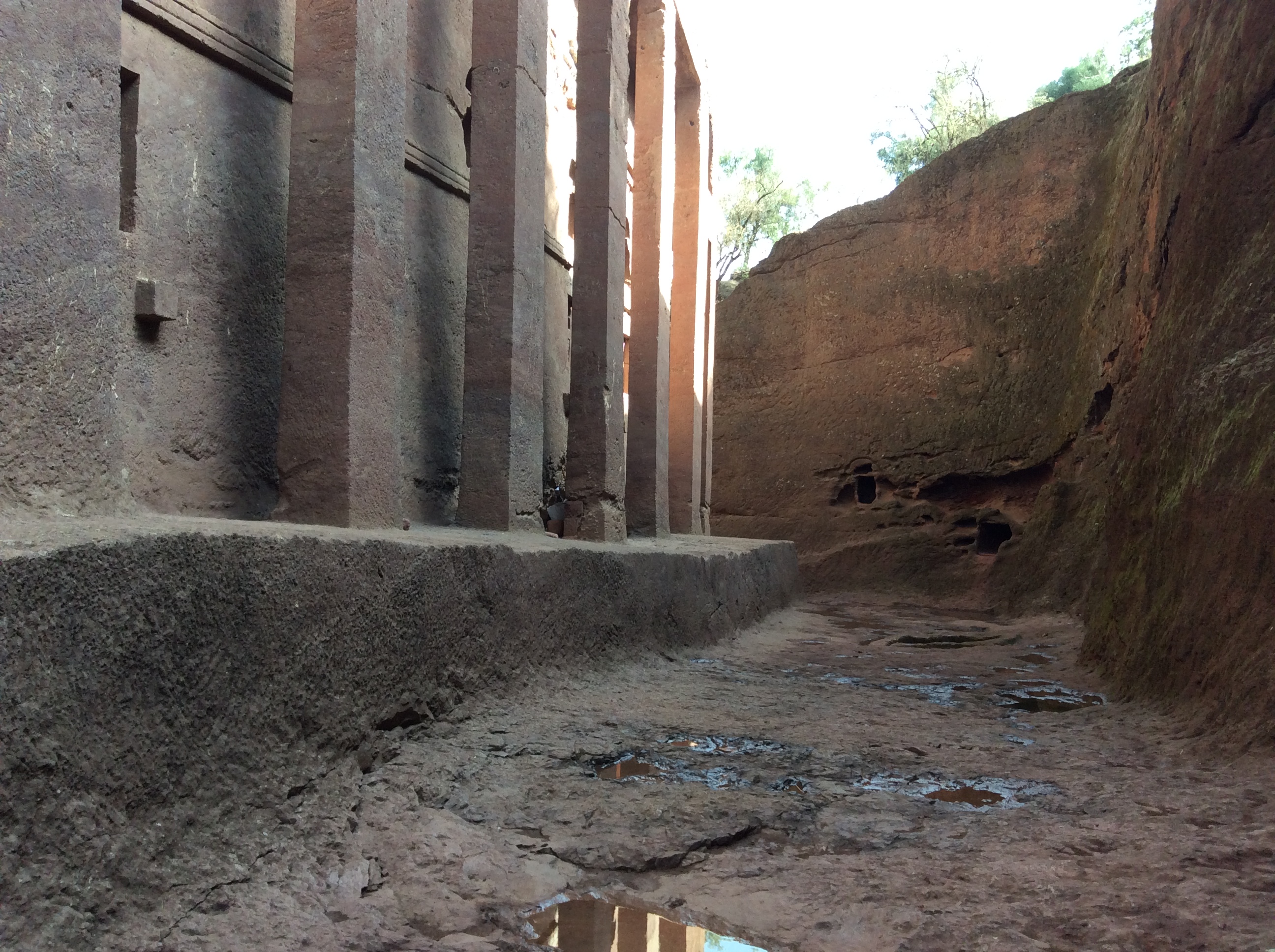
This is the first of the monolithic churches we visited.  Because the churches were built from the top down and actually cannot be seen until you are very near them, you have to climb down a lot of steps to get to the bottom level from which you can enter into the interior.  The “trenches” around them are the same depth as the churches are high because they were carved out of the solid stone.  As you look at these photos, you will notice multiple cross designs, including Greek, the type found in Axum, those referred to as Lalibela.  Every carving, every painting, every design possesses an explicit symbolic meaning.  I wish I had been able to record all the information provided by the guide.  This church, Bet Medhane Alem, is the largest of this type.  It’s approximate size is 33.7 meters  by 23.7 meters with a height of 11.5 meters (109.5 feet by 77 feet with a height of 37.4).  All sides have columns.

IMG_0399


IMG_0400

These churches are not mere tourist attractions.  We saw many people walking around, praying, and worshipping.  Services are still held here.  Carved into some of the “trench” walls opposite the church are tombs.  Those buried in these tombs have been removed and their graves now lie on either side of the River Jordan–photos of that later.

IMG_0398

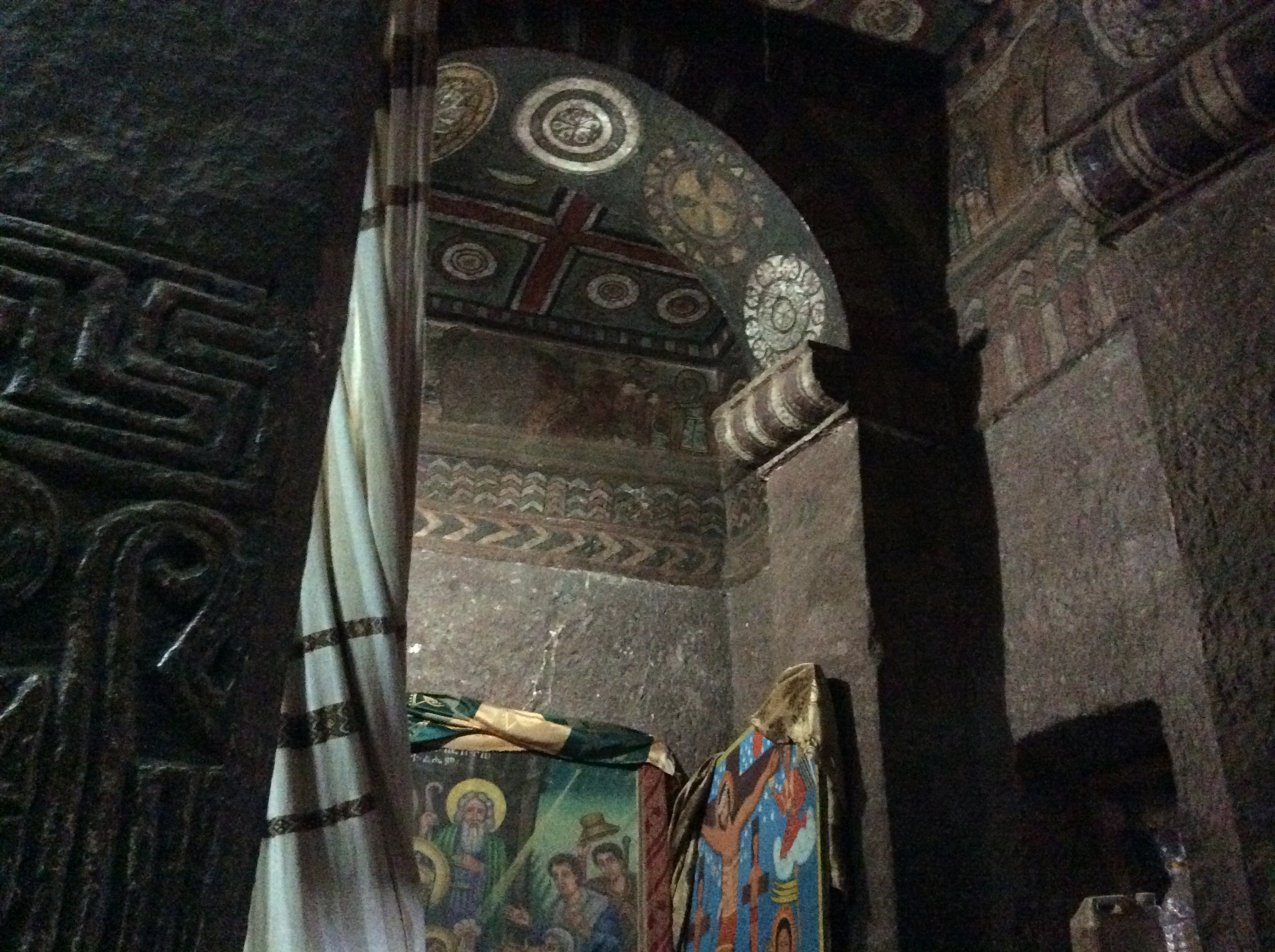
The interior decoration includes detailed carvings, elaborate drapes, and paintings.

IMG_0403

Certain areas, like this one behind the drapes, only priests can access, mainly because they contain the sacraments.  The floors of all the churches are hard rock so all contain coverings of cloth, Persian type rugs, and bamboo.  Accessing the interior requires a lot of climbing up and down very worn, slick, stone steps.

IMG_0405

While smaller trenches and areas separate this first group of churches from each other, the entire group is surrounded by the deepest, large trench.  This is the next church we visited.  It lacks outside columns.

IMG_0407

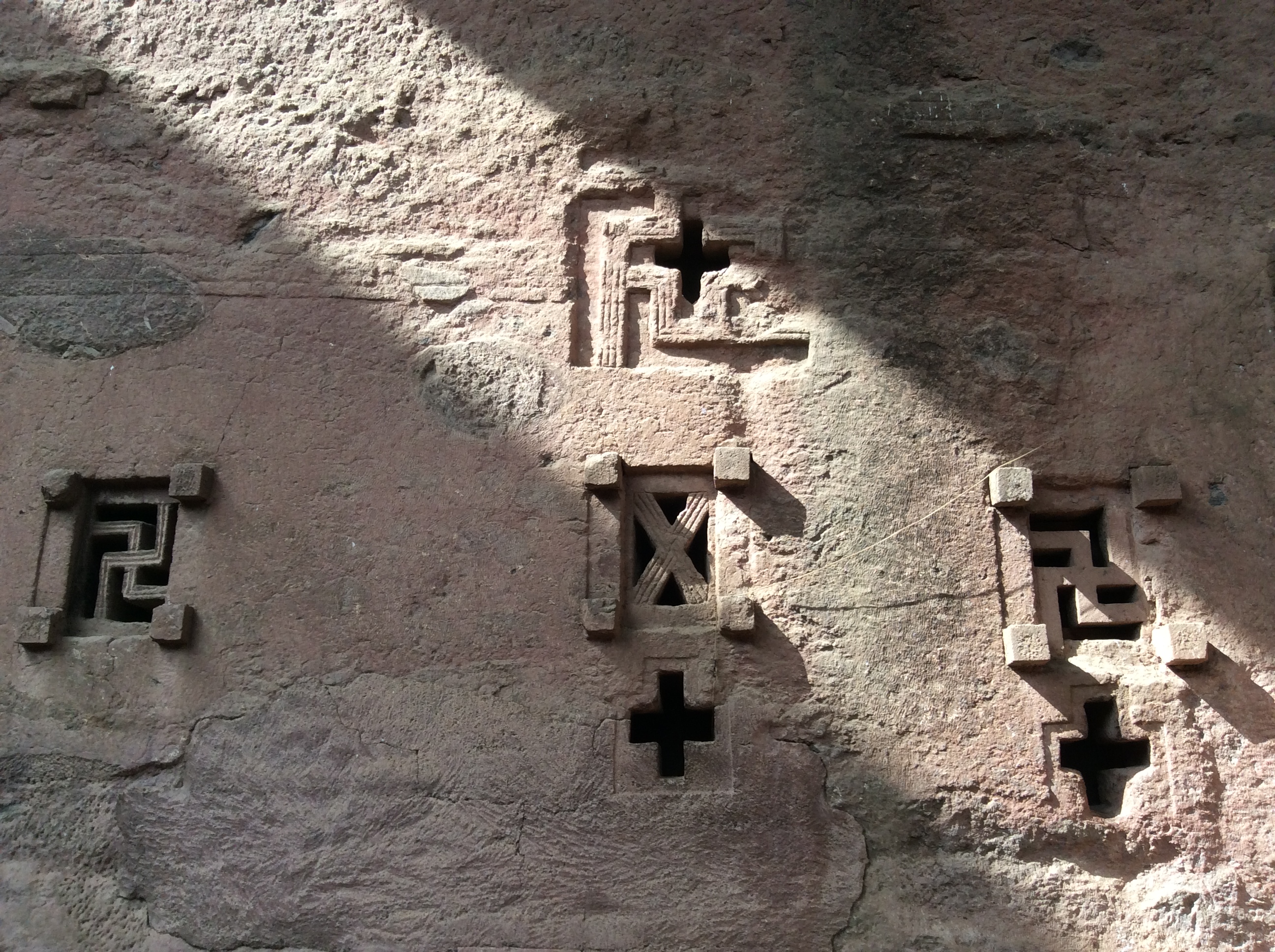
At first the sight of swastikas everywhere startled me until I remembered how old these churches are and the original meanings attached to this symbol.  Our deacon guide explained that they symbolize everlasting life (the circle of life) and also mentioned its meaning in ancient Hinduism–the continual, everlasting cycle of birth and rebirth.

IMG_0408

This is the fertility pool.  It is so deep that the priest must be lowered into the water attached to ropes as are the man or woman who wants treatment in this holy water.  At one point, someone realized that the pool was no longer as deep as it was originally.  When they investigated, they found the pool had been filled with dirt below where it could be seen.  When this dirt was excavated, a cache of ancient, holy artifacts were found.  They had been buried there to protect them.

IMG_0409

IMG_0411

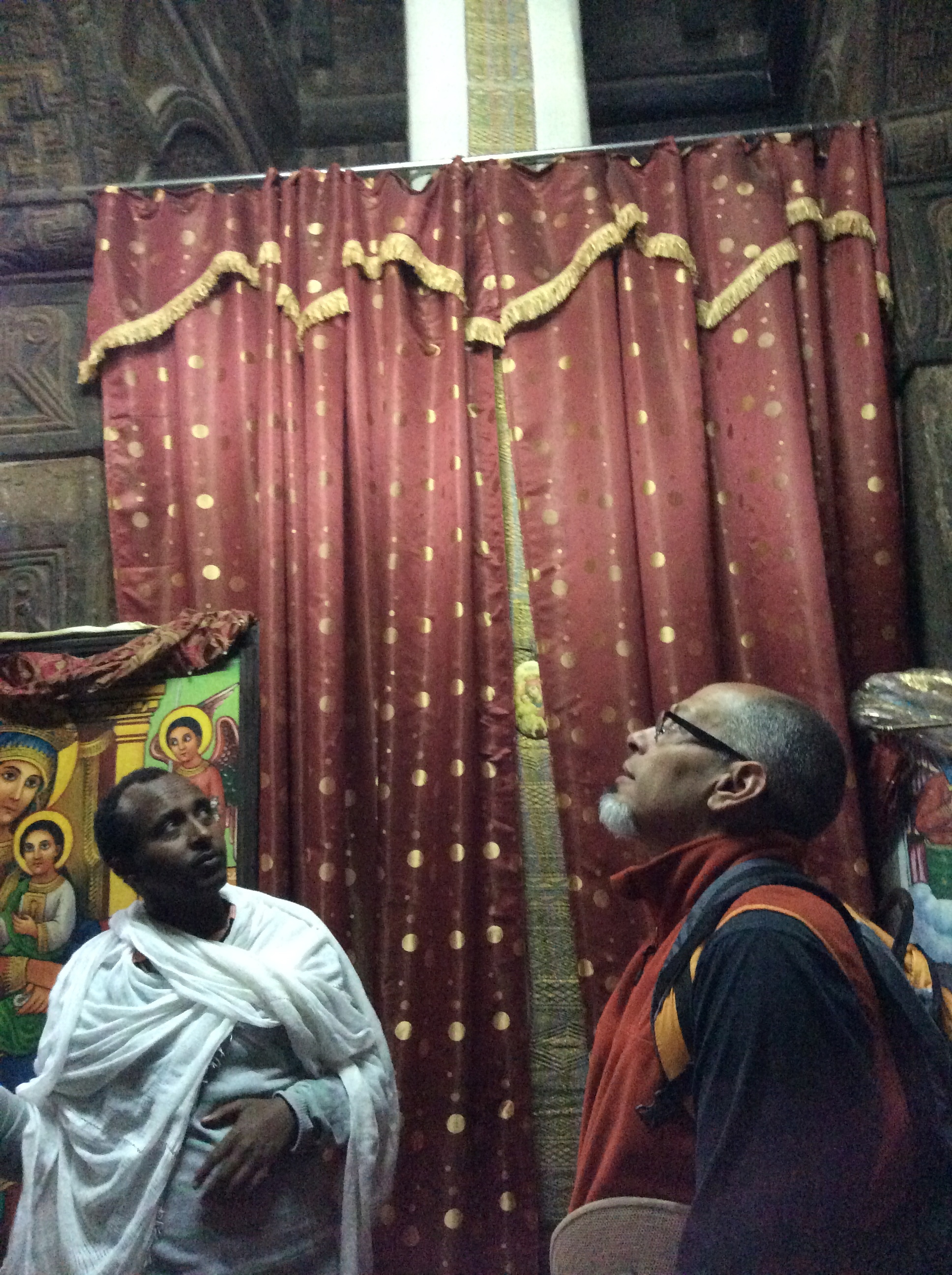
Ethiopians wrap themselves in white not just to go to church, but in general.  I constantly marveled how they keep these garments so incredibly white in spite of dirt and rain and walking through mud everywhere.  The person on the right is our guide, a deacon in the Ethiopian Orthodox Church.  He knows the meaning of every carving, every painting, every symbol.  The extent of information explained was not only detailed but extensive.

IMG_0412

Only some of the churches possess paintings on the walls as well as carvings.  The wise men, Mary, everyone looks Ethiopian at least to some extent.

IMG_0413

Notice the Star of David.  This symbol is everywhere because the Ethiopians believe they are descendants of Solomon and Sheba.  As a consequence, the paintings, carvings, all the symbols reflect not only the New Testament but also the Old Testament.

IMG_0414

Every church has this curtain behind which only a priest can go.  Every church has a copy of the Ark of the Covenant.  They believe the original was taken by Menelik I, the son of Solomon and Sheba, to its current location in Axum in a special treasury next to the Church of Saint Mary of Zion.  It has been safely kept there through the millennia.

IMG_0415

IMG_0416


IMG_0417

Protective roofs cover some of the churches.  The guide explained that the hardness of the basalt varies.  Because some of the stone is softer, churches carved out of this softer stone had begun to deteriorate.  The coverings protect and preserve them.

IMG_0419

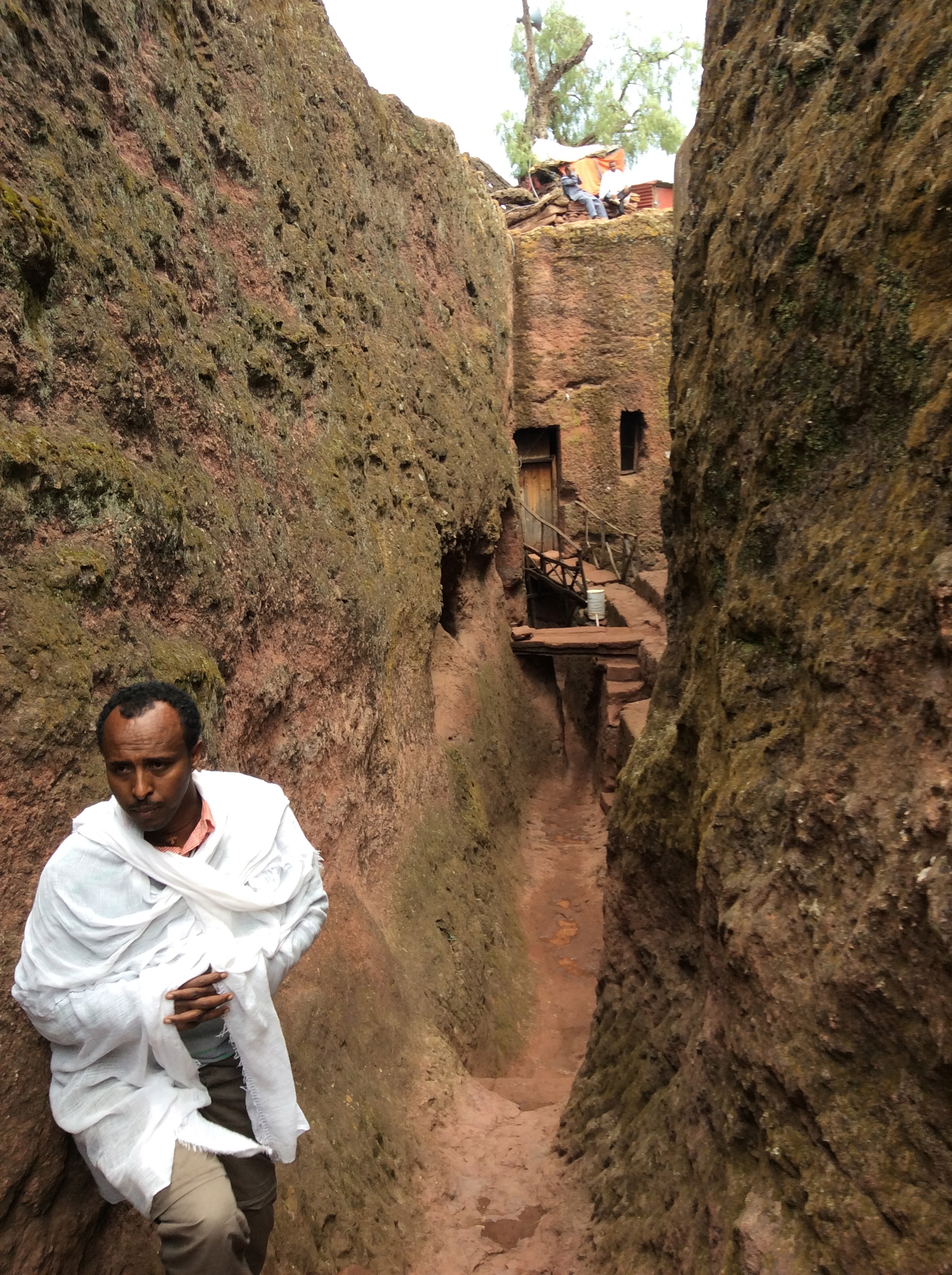
To get from church to church in this first group of churches, usually we walked through these trenches.  To reach the actual church entrances requires climbing up steps.  These trenches enable water drainage into the River Jordan during the rainy season.  The floor of the churches remain above the water.

IMG_0420

Walking through these churches kept me in a constant state of awe.  They were built more than 800 years ago without modern tools.  And there are eleven of them all here, carved out of solid stone.

IMG_0421

St. George and the Dragon hold a prominent place in Ethiopian Orthodox symbolism.  The dragon represents paganism.  St. George slated the dragon.

IMG_0422


IMG_0423

We left this  group of churches, climbing out from this trench and headed to one of the most photographed.

IMG_0425

We encountered two walking funeral processions complete with chanting.  I took no photos because it seemed disrespectful.


My Ethiopian Adventure–from Addis to Kombolcha


Saying goodbye to Addis at 8 in the morning, we headed northeast and later north toward Kombolcha–spelling differs, depending on whose map you view.  The official Ethiopian map spells the town as Kombolch.  Addis is high, the second highest capital in the world.  We drove northeast all morning across rivers and through green fields.
IMG_0246

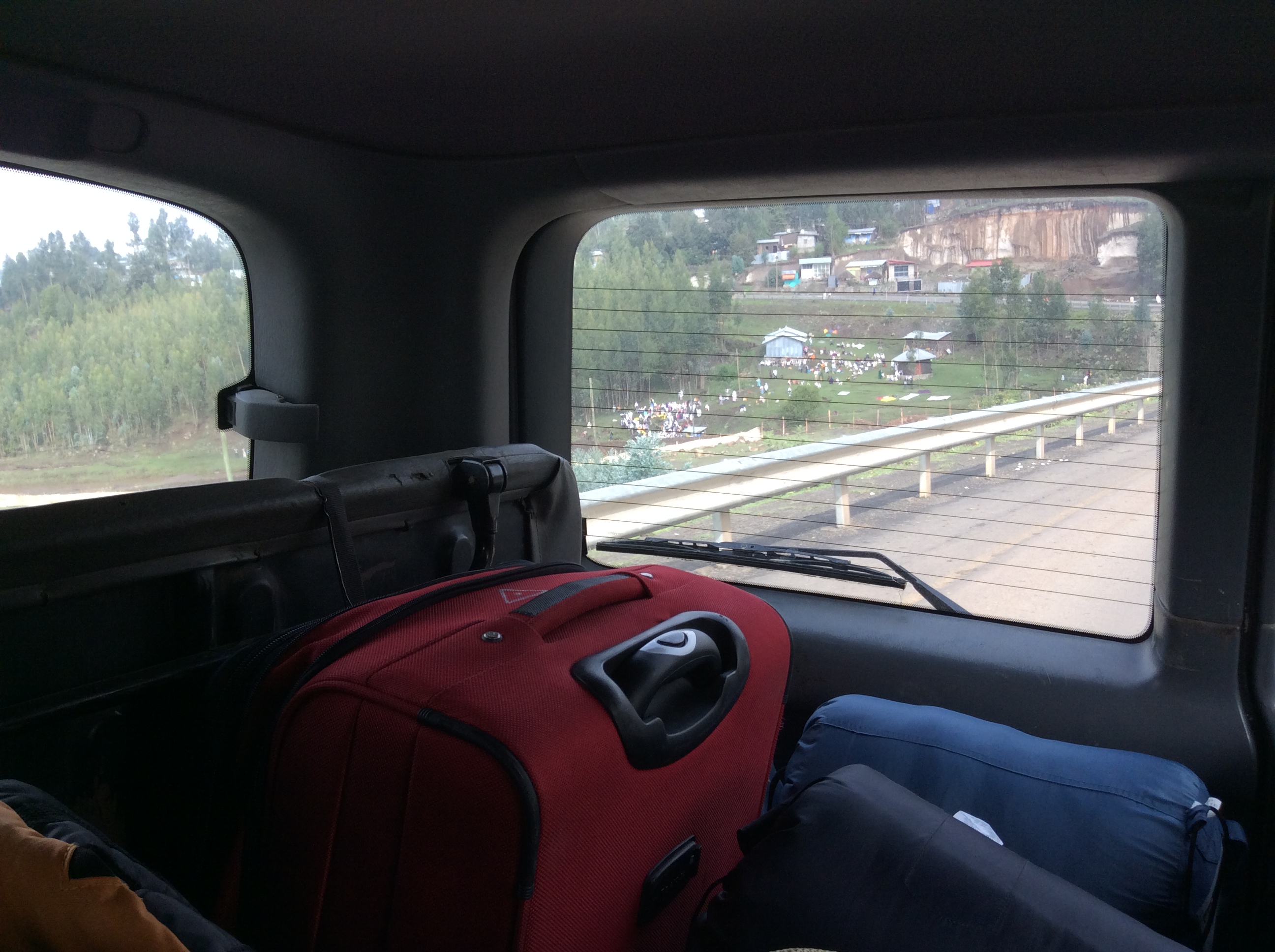
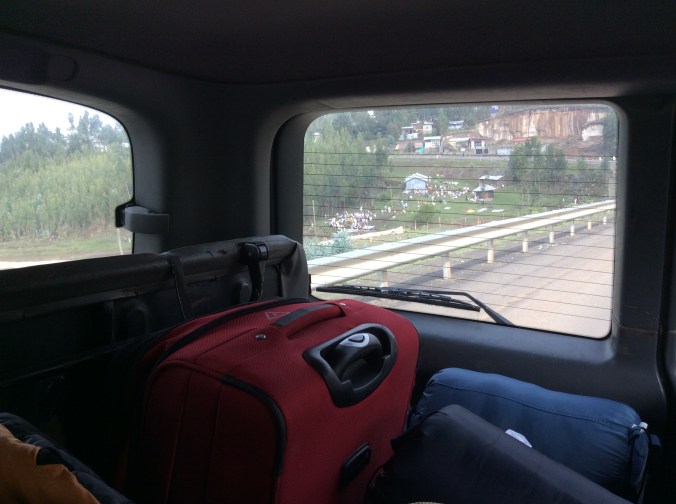
Not far outside Addis we saw this scene, a river with many people near it.  Our driver, Alemu explained this river contains holy, healing water and all those people you see through the window are pilgrims coming to be blessed by the resident priest and hopefully healed by the river waters.

IMG_0249

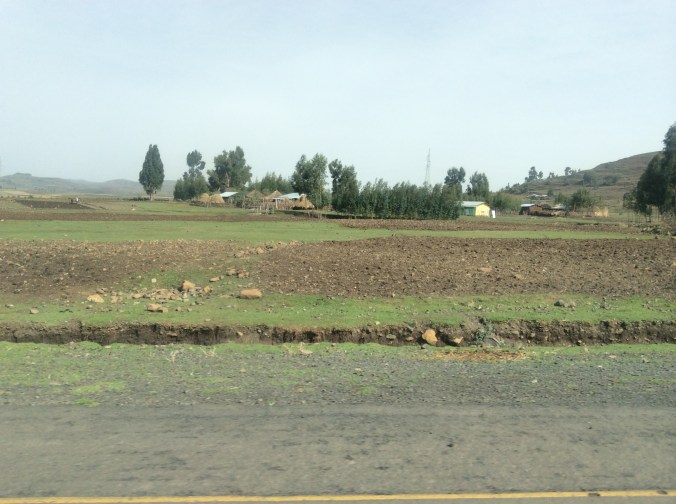
Who would know this is Ethiopia if no one told you? Not what I expected at all honestly.

IMG_0248

IMG_0250

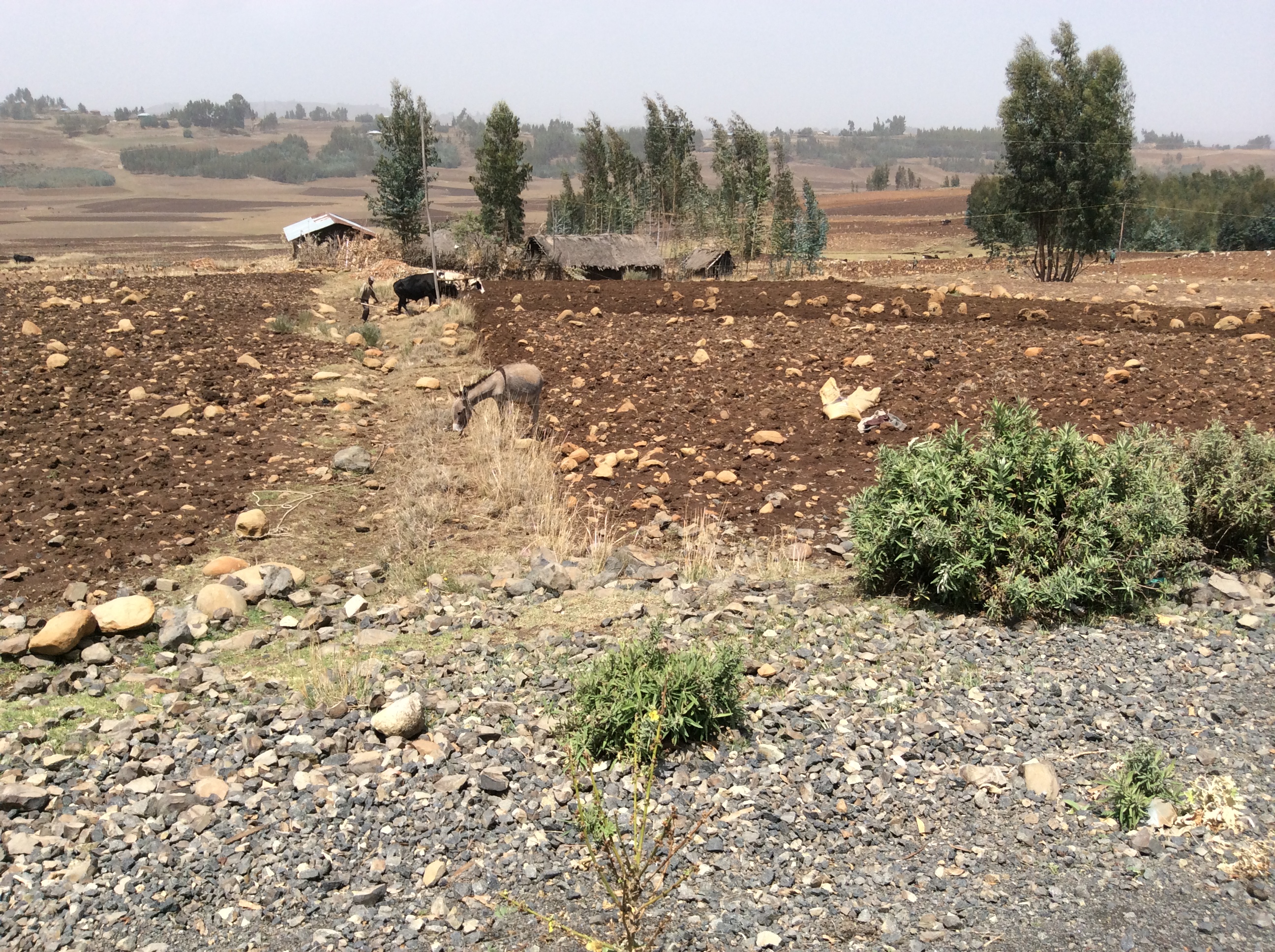
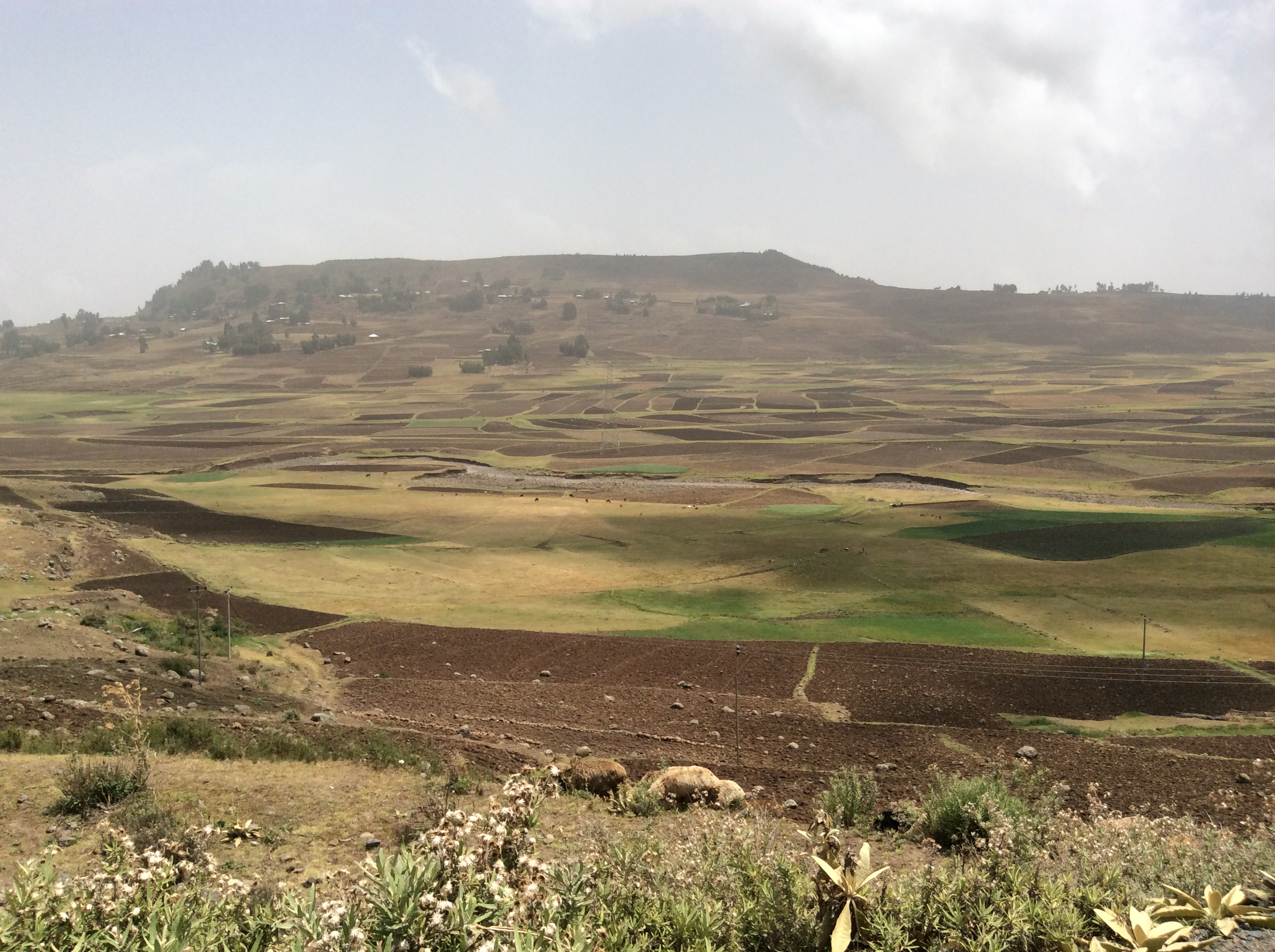
Most of the farmland is very rocky.  Farmers gather rocks, in some places make fences out of them or just pile them up.  Even with these efforts fields remain full of rocks.

IMG_0251

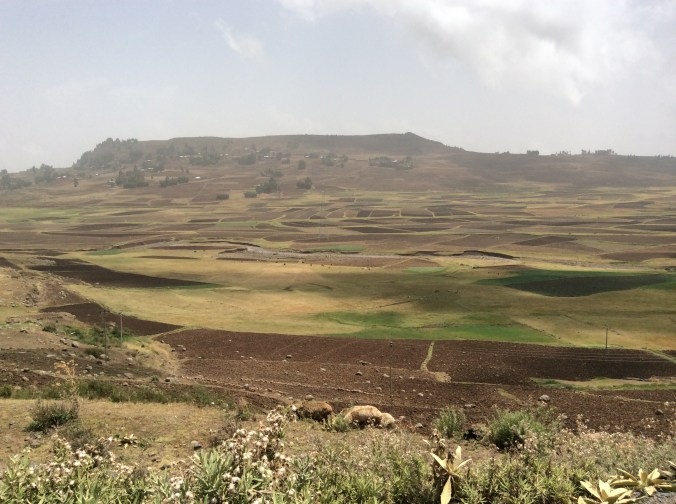
We drove for hours through this type of farmland.
IMG_0257

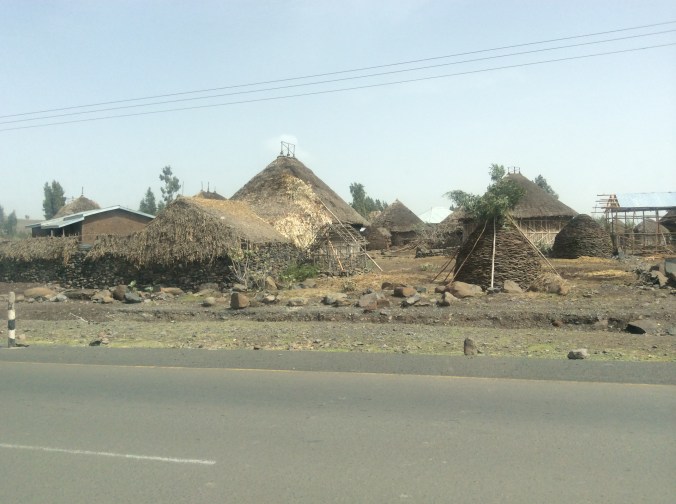
This is a typical country village which appeared off and on continuously along the highway.  Traditional buildings are usually round with thatched roofs.  More and more people have begun to use metal roofs which forces the building shape to rectangular rather than round.  We heard a story about a thatched roof house that caught on fire.  Nothing but the thatch burned because underneath the thatch was a meter of mud.

IMG_0258

Most Ethiopian farming is done the old way:  either horses or cattle pull the plow with a man guiding it usually through a lot of rocks.  I commented about seeing no tractors so then every time we saw one everyone shouted, “Juliana, there’s a tractor.”  I think I saw only five of them in ten days and only one was actually working in a field.  It became obvious rather quickly how totally impractical a tractor and its equipment would be in much of the farmland:  too many rocks and as you will soon see, too steep.  The tractor would fall over.
IMG_0261

Eventually we started climbing higher and higher.  To the left was one of Ethiopia’s high peaks near or over 4000 meters–13 to 14 thousand feet.

IMG_0262

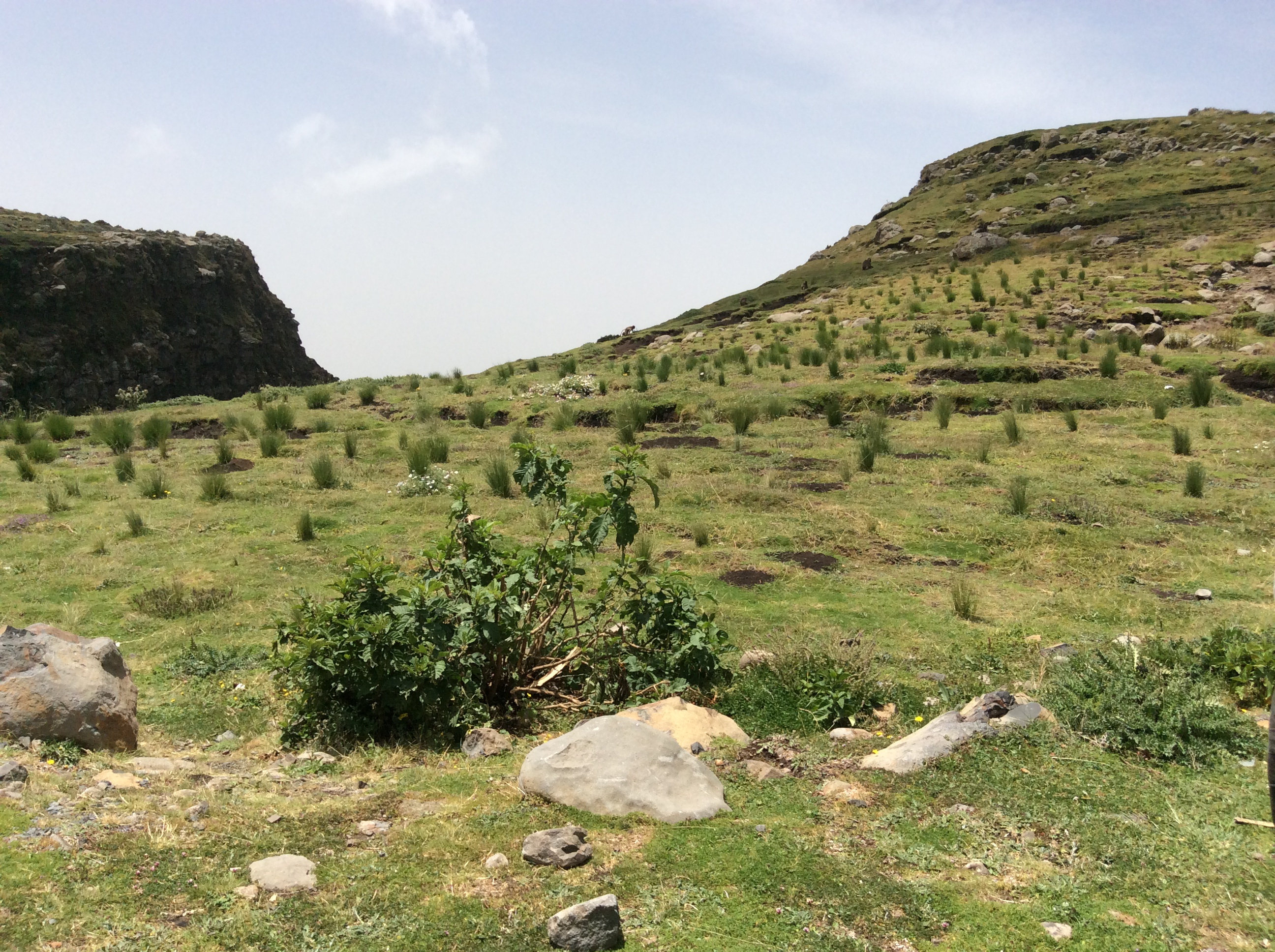
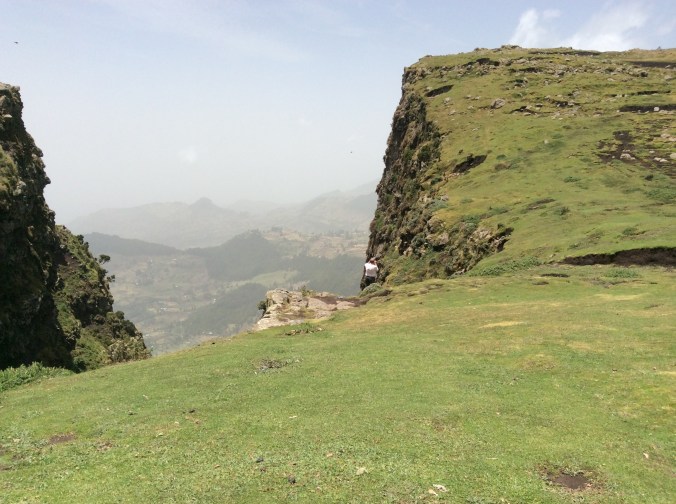
And then, there it was, Menelik’s Window.  This was the first area we saw with numerous gelada baboons.  However, these ran away unlike the ones later in Simien National Park.
IMG_0266

That’s Dino down on the edge.  At this point in the trip, I was still quite horrified by all the steep cliffs and stayed way back.  He was trying to get a good photo of the baboons.  Menelik II, the last Ethiopia leader to be able to claim himself as a direct male descendant of King Solomon, found this place special, a view into the real Ethiopia across miles of mountains. He is known for defeating the Italian invaders, expanding the kingdom, and especially for modernizing Ethiopia.
IMG_0267

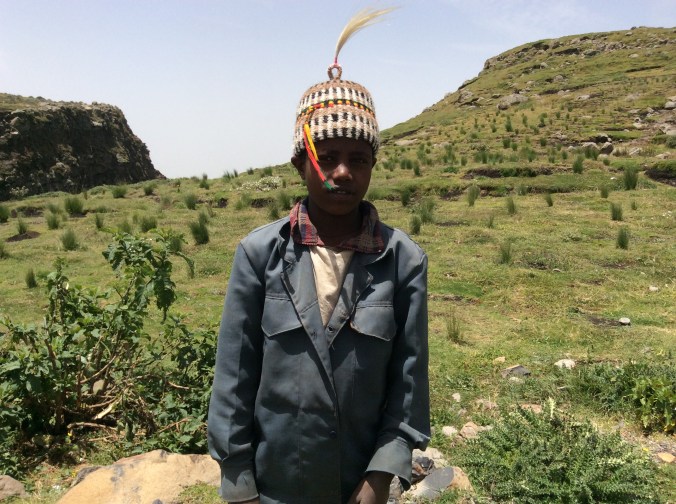
My grandson now owns this hat.  This boy and his friends spend their days chasing the baboons away from the tufts of grass, which their families use to make the thatched roofs, and making hats for sale.
IMG_0264

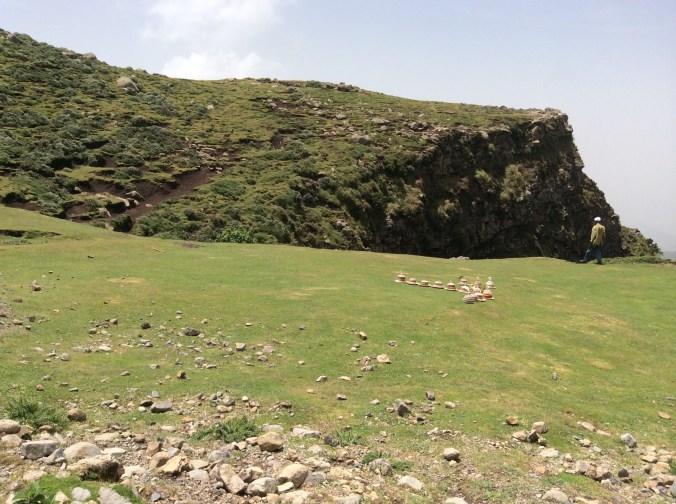
You can see the selection of different styles of hats on display on the grass.  On the mountainside in the back lots of herbs grew, including thyme.  The boys also sold packets of herbs they had gathered and dried.
IMG_0268

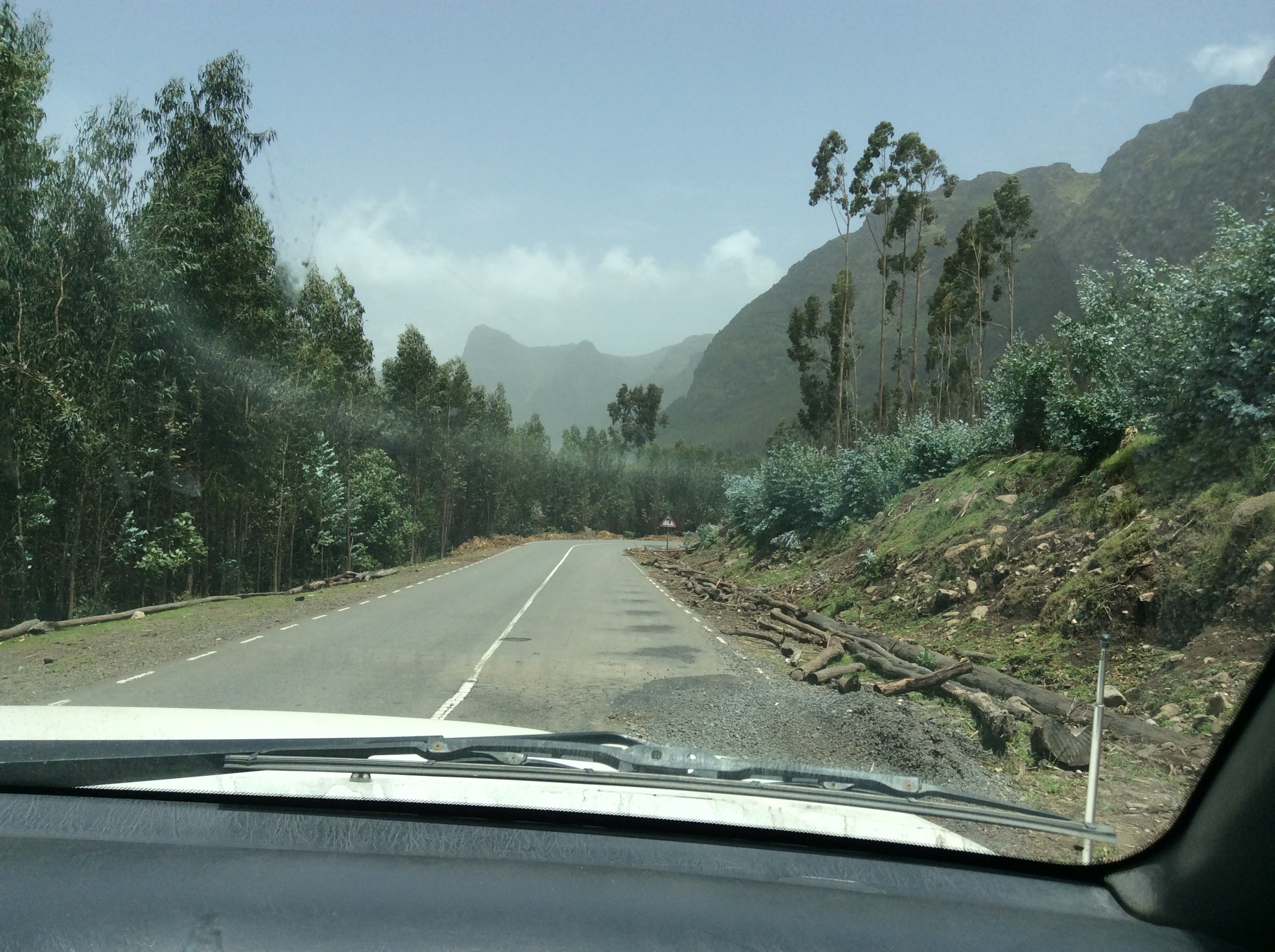
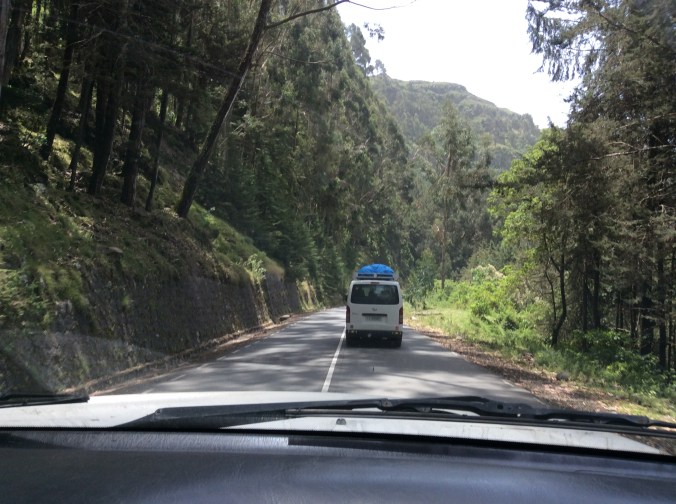
We dropped down on a winding mountain road through eucalyptus forests.  Eucalyptus is not native to Ethiopia, but grows everywhere there.  It is used as a basic material for building their houses, for scaffolding to build tall city buildings, for just about everything.  Several different species grew along the road.

IMG_0271

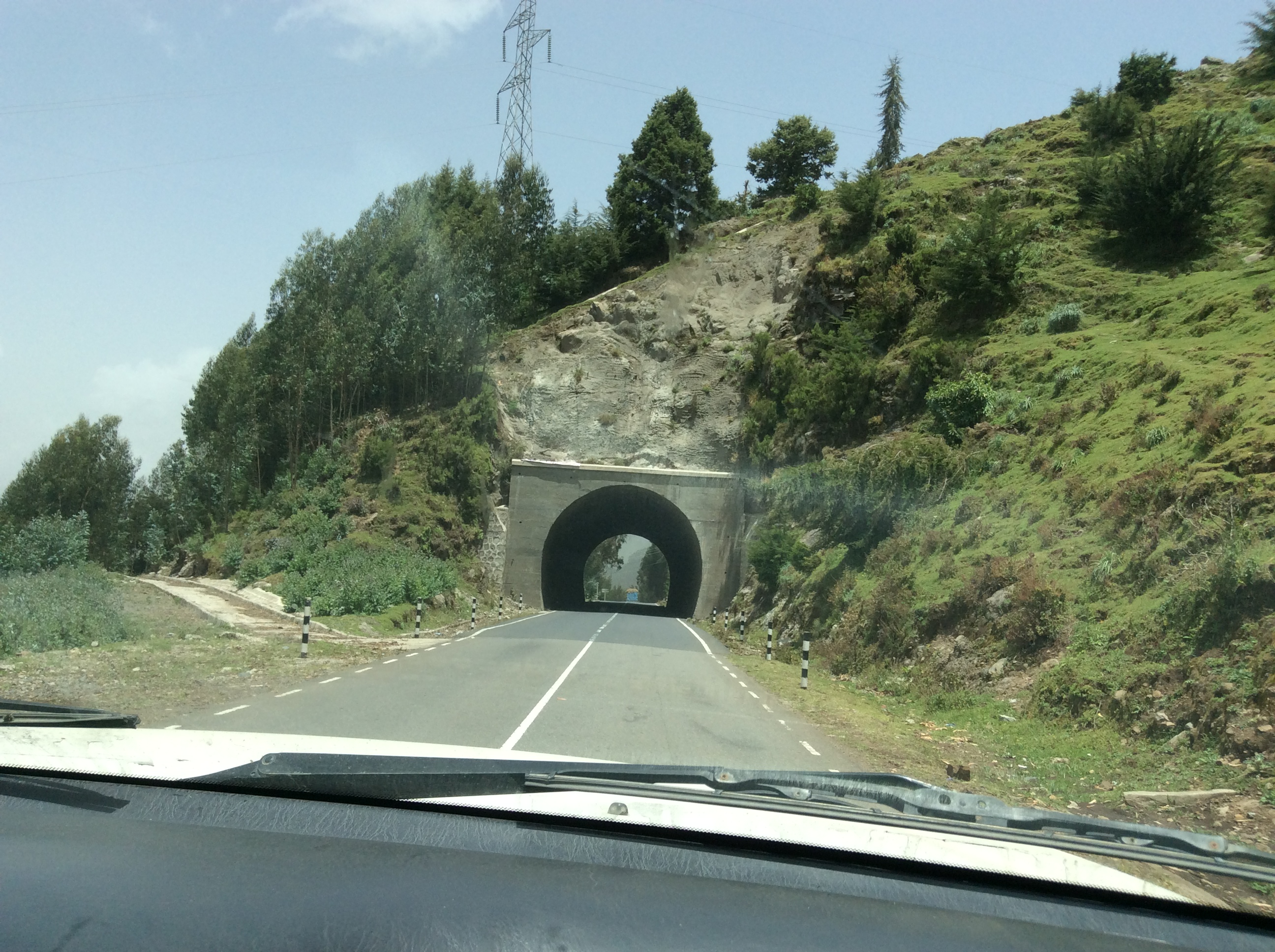
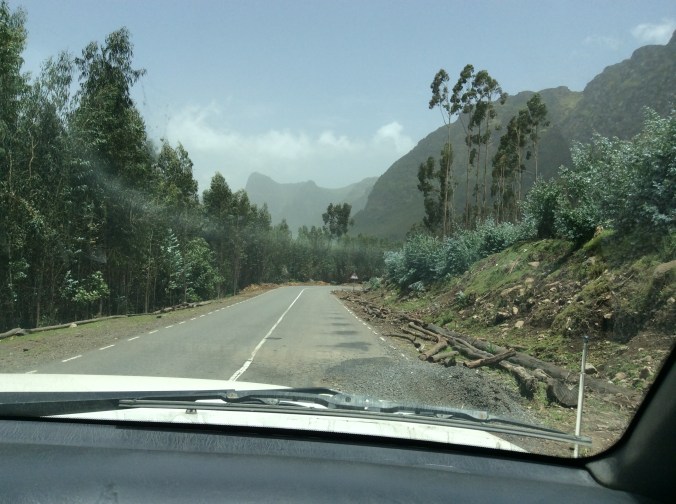
Ethiopia’s main highways are excellent.  Many were built years ago by the Italians, more recent ones by the Chinese.  Ethiopians make jokes about how long the Chinese roads might last.
IMG_0272

Eventually, we dropped down out of the mountains into an area that was much drier.
IMG_0276

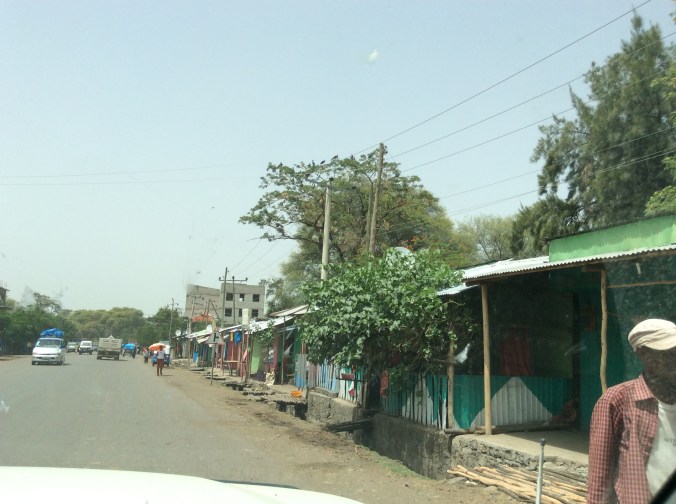
A typical town with all sorts of shops right along the road.  When driving in Ethiopia, dodging people, cattle, camels, horses, burros, and goats is the norm. Everything it seems likes these good roads.
IMG_0279

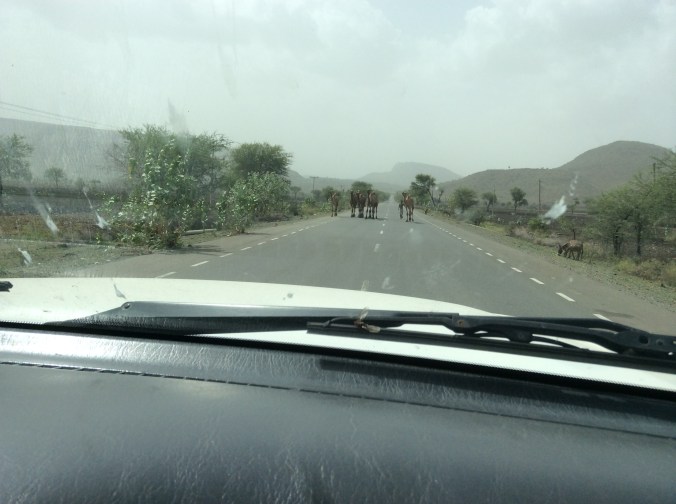
A boy driving camels down the highway.  Loose animals, like the burro on the right, roam seemingly unattended.  I saw few fences.

IMG_0280

In the small towns in this semi arid area, we saw several totally veiled women, faces covered totally except for their eyes.  Alemu informed us that this was a new thing, not seen until the last few years.  He seemed to think it had become fashionable to copy Saudi women.
IMG_0281

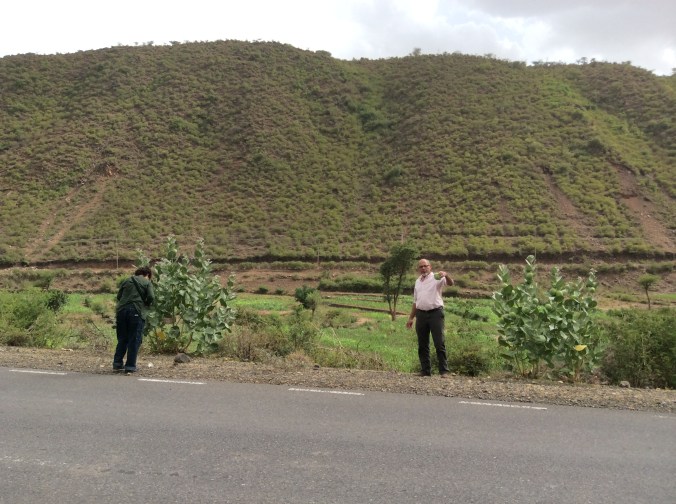
We stopped to look at certain plants beside the road.

IMG_0282

Dino recalled playing with these pretty green balls as a child with this forewarning,  “Do not eat them, do not touch your eyes or you will go blind.”  They are called the Apples of Sodom.

IMG_0284

At this juncture near the beginning of this adventure, I had not yet realized how everything in Ethiopia possesses symbolic meaning.

IMG_0285

We drove along this immense, lush valley for miles.  Alemu said this huge herd of cattle belonged to a semi nomadic group who brought their cattle here during the rainy season to graze and fatten.  A bit farther down the road the land belonged to one of the richest men in Ethiopia, indeed the world, Al Amoudi.  It was the only place where I saw a tractor actually used in a field.

IMG_0288

Arriving in Kombolcha, we saw this new college in the process of creation.  This became a common sight–new buildings, new schools, construction everywhere.

IMG_0289

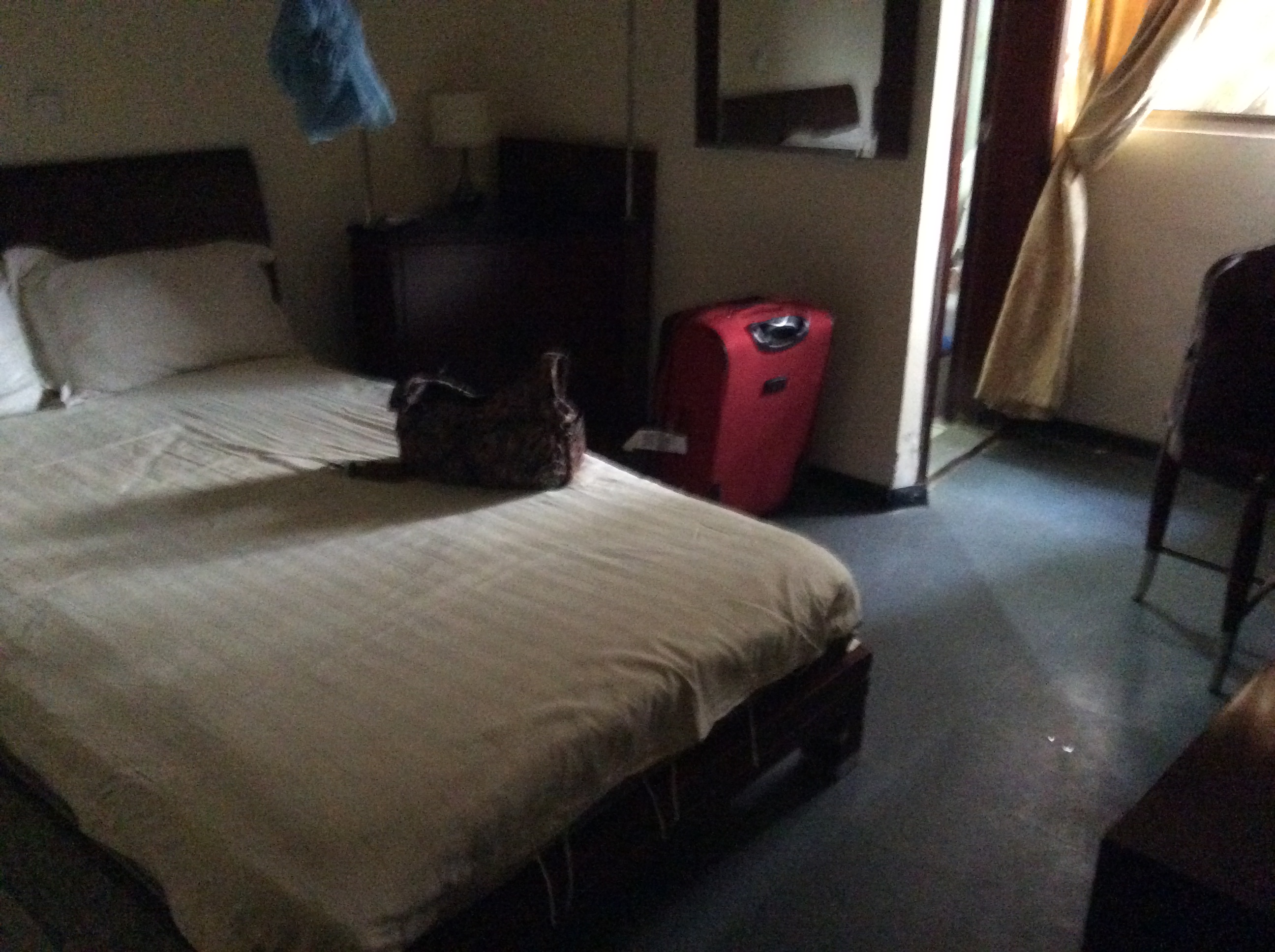
My first hotel room in Ethiopia at the Sunny Side Hotel in Kombolcha complete with mosquito netting–the blue blob above the bed.  At least it had a shower and toilet.  Many places use the style of accommodations one finds in a lot of Asia.  Forget toilets as you know them–just a tiled area with a hole in the ground and the ever present water with which to wash.  We carried our own toilet paper just in case.  However, many places had both so customers could choose.