Catrinas


In 1913, Mexican print maker Jose Guadalupe Posada sketched the original Catrina, an elegant, upper class skeleton woman in a ball gown to symbolize the emptiness of the upper classes.  Subsequently, Catrinas have come to be a part of El Dia de los Muertos, Day of the Dead.  None of this has anything to do with Halloween, absolutely nothing.  People sometimes associate the two erroneously, but only because of the dates when they occur.

This evening I was privileged to be one of the judges of a Catrina contest.  Before the contest occurred, the evening began with some traditional Mexican dancing.

img_2395


img_2400

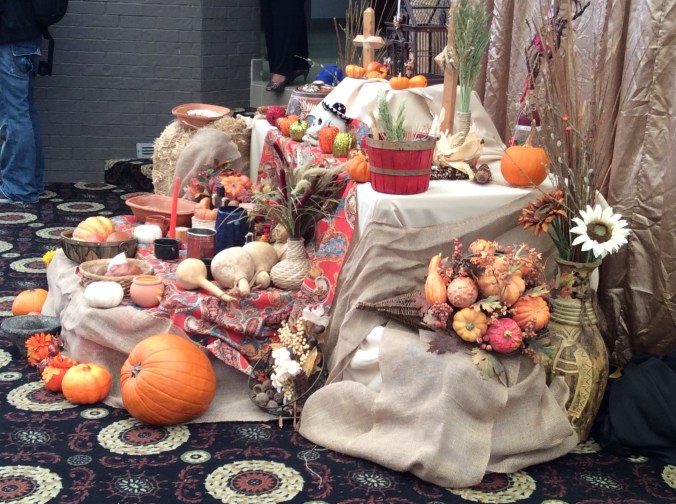
There were also several traditional El Dia de los Muertos  family displays to honor deceased ancestors.  The following was the most elaborate.

img_2399

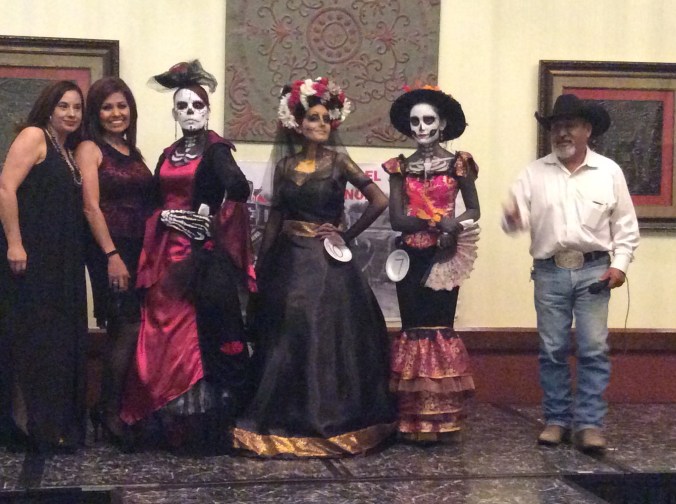
Finally, the Cartrinas were ready.  Ten young women competed.  The following photo shows the top three, judged for originality, costume, and makeup.

img_2406

The young woman on the left never smiled.  The top makeup impressed everyone.  The skeletal bones you see on the young woman on the right were all painted on and a backbone, etc. was painted on her back as well.  The young lady in the center won the costume portion–a bride in a black veil, elegant, empty.


Friends and Flowers


SAM_0483


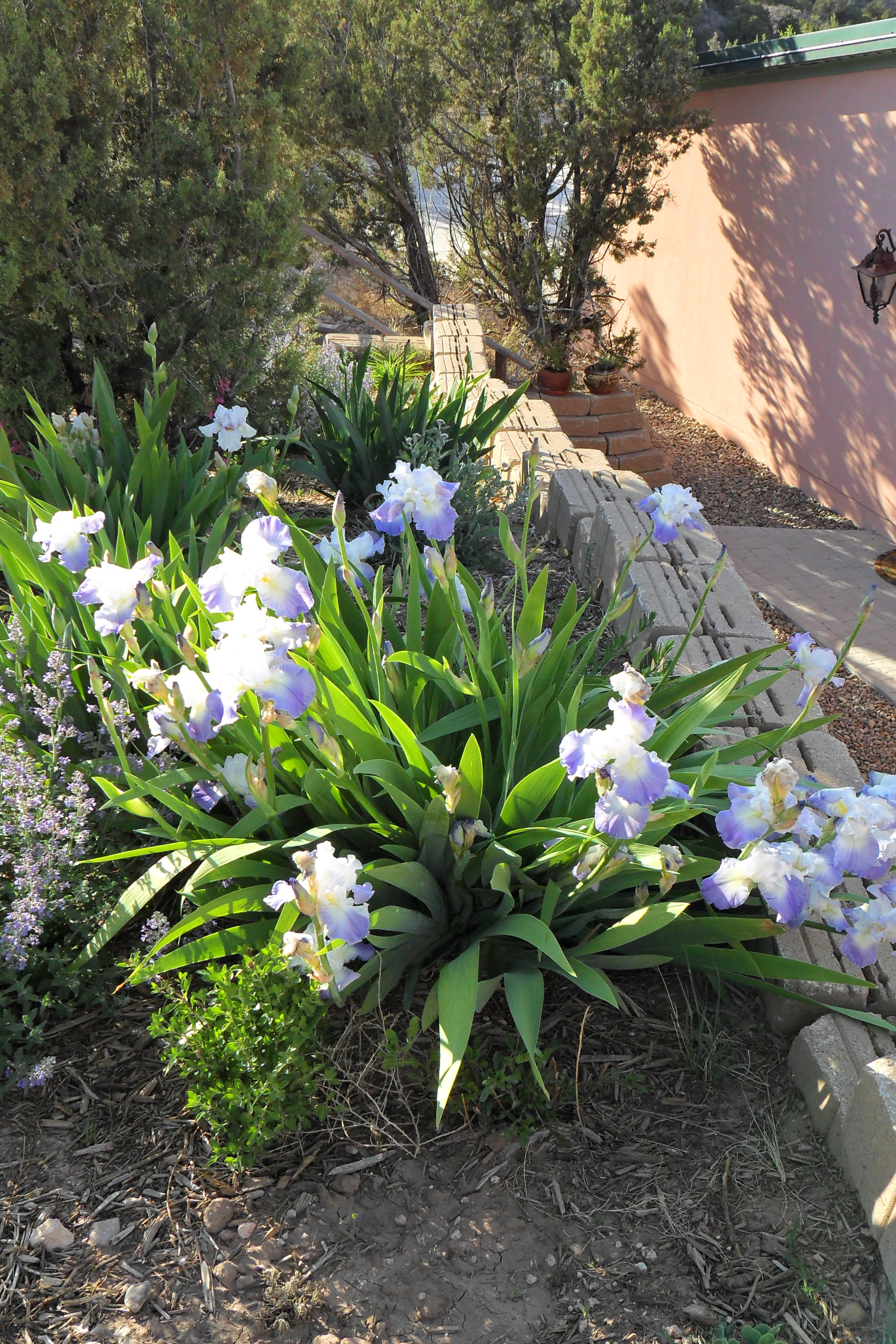
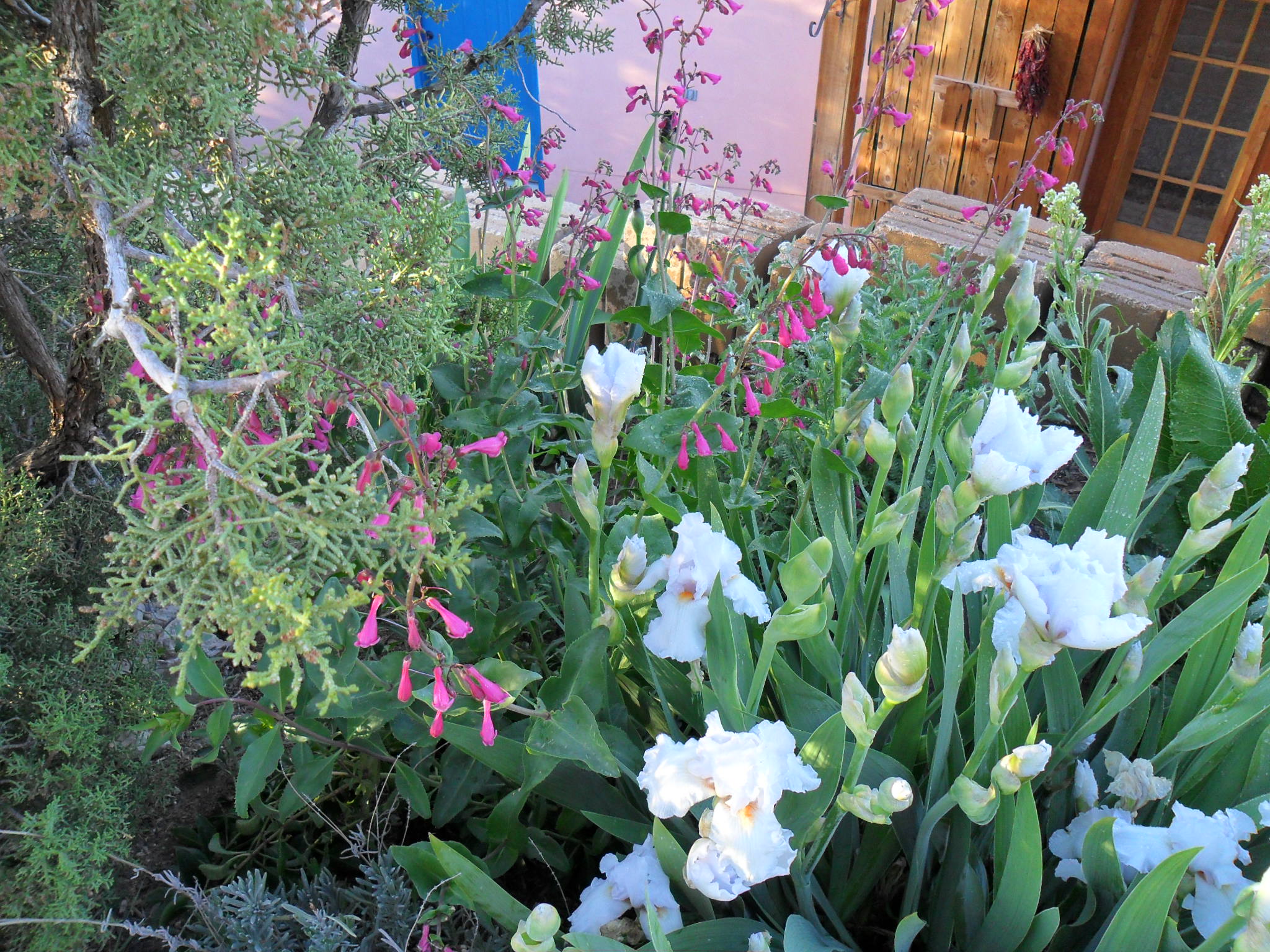
On my way home from work today, I stopped by a friend’s house to get some Black Eyed Susans.  She and her husband run a bed and breakfast with a spectacular garden in the back.  Iris of every color are blooming, yellow, lavender and white, peach, every shade of purple, and one a combination of colors I have never seen before.  The lavender and white combined in one flower I gave her in the fall of 2012.  They rebloom and spread rather rapidly.  Because of that and the fact that I cannot bear to throw any away, I have them by the barn and here and there.  Some do better than others–a lot of the soil here is either clay or caliche or a combination, not very conducive to anything but the toughest.  She has a rose bush taller than I am which means it must be about 5’6″ or 7″.  Another deep red rose was already blooming.  She gives me flowers and I wait and see how they do or if the deer or bunnies will eat them.

Today’s weather brought perfection, a rare treat of just the right temperature, sunshine, and no wind.  When I arrived, her husband was napping in the garden in a lawn chaise.  He got up, we all walked around the garden, looked in the koi pond, and commented what flowers seemed to flourish more readily than others.  Many flowers which do well in town either die out here in the country only twelve miles away or fail to thrive.  They just sit there and do nothing.  She and I have shared flowers for years, flowers and conversation and wine.  We all decided to sit town and share some wine and cheeses and crackers and visit.  They travel widely and always have tales to tell.  He is from Jordan so we discuss world events.  Part of today’s conversation centered on Boko Haram and the differences between Shia and Sunni.  He is Sunni and I used to be married to a Shiite.  Often we discuss extremism and how it harms everyone, regardless of religion.  None of us understand the hatred some people seem to feel toward others who are different from them either my race or religion or ethnicity or gender.

As soon as I returned home and changed into gardening clothes, I fed Rosie, and planted the Black Eyed Susans with a big dose of water and root stimulator.  Who knows if they will make it.  I will wait and see.  If they do, they will contrast nicely with the purple of the catmint and the white, tiny, native Blackfoot Daisies growing wild among the other plants in my little garden.  What more can a person wish for than spending time with good friends among the flowers.  And a little wine never hurts.


SAM_0161


SAM_0461


SAM_1503


SAM_0463


SAM_0459


Poverty


Proofs sent to the library at work–a high school–cannot legally be used on the shelves so they end up in various places.  Somehow I end up where they reside and read them.  My latest, The Boiling Season by Christopher Hebert provides abundant food for hard core thinking.  The setting, a Caribbean island, reeks of political turmoil and the legacy of slavery.  Unless you are totally ignorant of Caribbean history and the various cultures there, it does not take long to figure out the setting is Haiti.  In case you want to read the book, I will give you only a cursory introduction.  The main character grows up in basically what we call here a slum.  His mom dies of malaria when he is quite young and  his dad owns a small store.  He hates it and focuses most of his life on getting out of these circumstances.  He gets a job and a place to live with a senator, meets important people, and eventually discovers an abandoned estate out in the country.  He moves there after it is bought by a wealthy foreign white woman who hires him to restore it.  He absolutely loves the place.  It is an island of beauty and peace in the middle of squalor, poverty, and strife.

The details you can read for yourself.  It’s focus is the dilemma many who grow up poor and want to better themselves face:  if you progress, are you abandoning your roots, to whom do you owe loyalty.  And, indeed, what is progress?  Civil war breaks out and the main character is torn between his desire for peace and a more elegant lifestyle in this beautiful place and the needs of the poverty stricken people who surround it and who at one point work there.  Is he a free person or just a fancier slave for the rich who own the place?  Has he deluded himself into thinking because he worked hard to get where he is that he is better?

Although the book’s setting is a particular place, the theme remains universal.  I think of individuals I personally know who could not cope with success and riches, who felt they must “save” all their relatives and then were left with nothing themselves.  The thinking is this:  if you come into money, you must share it with everyone; to keep it for yourself is morally wrong.  If this is the case, how can the cycle ever break?  This sort of thinking is very difficult for those of use who work hard and save for the future to understand.  We question why we should help them when they hit the bottom.

Yesterday my hard working, single mom, going to graduate school daughter went on a rant about people she knows who get food stamps, Medicaid, etc. while she works and goes to school and gets nothing.  They have fancier cars, better TVs, etc. than she does.  I do understand both viewpoints although I admit I am the frugal without being austere.  I remember a time several years ago when several of my poorer students–I teach at a Title 1 school–wore jeans more expensive than I would ever buy–its jeans.  We got into a discussion about this.  I informed them that all the clothing I had on except for underwear and socks came from a thrift store.  When I take things to the thrift store, I actually shop.  Thrift stores are full of “finds”.  The response of one student was echoed by others, “I would never go into a thrift store.  Someone might see me go in there.”  Because they were poor, they wanted to avoid anyone seeing them do anything they thought might confirm this.

Although fraud exists in programs for the poor, it also exists in high end banking and just about everything.  The solution is to work hard to investigate and prevent it.  I keep wondering what is the solution for the people truly in need?  Do we punish everyone to prevent the fraudulent acts of the few?  And what about the children?  What happens to the dependent young?  Obviously, the world has not found answers.  I wonder if we ever will.

Amazon


His milk chocolate, heavy lidded eyes stare at me from the

front of the magazine.

His cheeks display charcoal tattoos, a criss cross

design, tiny Xs on top, stopping where his nostrils flare.

His straight hair barely touches his shoulders.

not the black I expected, but the color of mahogany.

His eyebrows grow thin and wide,

no visible eyelashes.

His skin, color of morning coffee with two teaspoons of milk,

looks clear, smooth.

His full lips only slightly darker than his skin

do not smile.

He, a Kayapo Indian, continues staring.

He lives in Kayapo Territory, Brazil, land the size of

Great Britain and Ireland.

He plans to save it from the rest of us.

He plans to save us from our own worst selves.


SAM_1502


The Kayapo and other indigenous Amerindians have lived in the rainforest for millennia.  They and most environmentalists view their rainforest as a priceless haven for biodiversity.  Their Amazon remains a major defense in the fight against global warming and habitat destruction.  Fifteen per cent of greenhouse emissions, more than all the trucks, cars, buses, and planes combined, come from deforestation.  Although Brazil has slowed the deforestation rate by 70 per cent in the last nine years, last year saw a reversal with an sudden increase of 30 per cent.  Brazil also began construction of a network of canals, dams, and a huge hydroelectric project on the Xingu River in the middle of Kayapo territory.  The Kayapo and other Amerindians defeated a larger project in the 1990s. They intend to defeat this one.

The chief of the Kayapo, Megaron, knows what is at stake, not only for his tribe, but also for the rest of us, long term survival.  One  National Geographic article noted, “It is one of the richest ironies of the Amazon that the supposedly civilized outsiders who spent five centuries evangelizing, exploiting, and exterminating aboriginal people are now turning to them to save ecosystems recognized as critical to the health of the planet–to defend essential tracts of land from the outside world’s insatiable appetite.”

Kayapo success can be attributed to their ability to embrace some of the best of the modern world while retaining a strong sense of identity, culture, and traditions, all of which come from the forest.  As Megaron notes, “Before the white man, we were always fighting other tribes.  Not anymore.  We stopped hitting each other over the head and united against a bigger threat.”  For our own long term health and success, we can support them and hope they succeed.


Much as Love and Murder, Freedom is a Many-Splendored Thing


danielwalldammit's avatarnorthierthanthou

17711-series-header Yapto Soerjosoemarno is a middle-aged man. He is the leader of Pankasila, an Indonesian youth group three million strong. The camera follows him out onto a golf course where he explains; “Gangsters are free men. They want to live life in their style. Relax and Rolex.” A moment later he tells his young caddy she has a mole on her pussy.

And she smiles.

Of course all of this comes after Yapto explains that Pankasila had killed all the communists in Indonesia. It comes after he has spoken at a Pankasila rally, one in which he calls himself the biggest gangster of all.

What else could the young girl do but smile?

KillingAs he and his friends try on colorful gangster outfits, Anwar Kongo waxes on about his inspirations; Al Pacino, John Wayne, and others like them. He goes on to relate the story of how he once placed the…

View original post 1,449 more words

On a cold winter evening


This post displays my occasional propensity for pensiveness and reflection.  The highest temperature today was 8 degrees.  The weather forecaster predicted a low of zero, very cold for here with more snow.  In  a few months, it is likely we will hit 100.  Who would want to live in such a place?  Yet people do, worldwide.  Some in places much colder and hotter.  How and why did they all get to wherever they are?  Millennia ago we all migrated from Africa and look at us now.  We think we are smarter, better, but are we?  Perhaps technologically, but psychologically??  War rages over differences in ethnicity and religion.  Clashes for thousands of years change little, just the nature of the weapons, the use of advanced technology.  The intent remains the same.

Sunday, I finished a book by the Turkish writer, Elif Shafak.  I have read all her books translated into English.  This, her latest, Honor, details the effects of the belief in honor of above all else.  To paraphrase one of the main characters, a poor man:  rich men possess money, fancy cars, lavish houses, travel, but poor men have nothing but their honor.  Acting on this belief leaves one family devastated.  For those who desire to learn about other cultures and to understand the behavior of the individuals in them, I highly recommend this novel.

Earlier, I donned two pairs of gloves and socks, four layers of clothes, and ventured out.  If you own horses, you have to feed them regardless of the weather.  Unlike me, my dog, Isabella, fares well in this weather.  Her part wolf blood gives her an undercoat perfect for winter extremes.  Inside, I viewed my larder–what to cook on a frigid winter night?  A simple chicken curry with onions, brussels spouts, jalapeño peppers, and chicken with Jasmine rice, red, white, and black.  And a glass of red wine, cabernet franc, from a local winery, the only wine I have ever seen from only this one grape.  It is usually added to blends.  Definitely haram–still thinking about that book.

SAM_1428

As the temperature drops, building a fire in the wood stove seems like a reasonable endeavor.  I love fires but hate to build them.  Nevertheless, sitting in front of the fire reading brings a silent joy, a paradise.  I feel at peace:  chores done, warm house on a frigid winter night, satisfying dinner homemade, and the knowledge that my book of poetry lays in its final stages with the editors and photoshoppers who will make it publication ready.  I feel extremely grateful, looking forward to dazzling dreams on the rim of wonder.

sam_0303.jpg

Geronimo: A Manly Legend, No Women Allowed!


Geronimo: A Manly Legend, No Women Allowed!.  This is from a blog I follow.  If you are interested in Native American history, this is definitely a must read, complete with photos of the Apache women who have totally been left out of most tellings of the Geronimo and Apache histories.  I also recommend the story by Leslie Marmon Silko, my favorite author, which relates another view.  The story is, “A Geronimo Story”.  It can be found in her book, Storyteller.  There is a belief among some that the real Geronimo was not the person captured and imprisoned.  Supposedly, the Apache tried to tell this to the whites, but they refused to believe it.

Bedtime Reading or Not–the Hazara


A lifelong habit that helps me settle down to sleep remains reading.  However, occasionally I delve into a book that turns out not to be so wonderful to read just before going to bed.  The topic turns to the disturbing and then, suddenly, my mind churns.  By that time, it is too late to go back.  Or, like the book I am reading now, parts of it consist of stories inspiring, amusing, enlightening, parables for life.  Then there are the other parts:  the abuse of an entire people by the other ethnicities surrounding them, genocide, turmoil, invasion.  I remain a lifelong lover of libraries.  Recently, while browsing through new books, I found this one:  The Honey Thief  by Najaf Mazari and Robert Hillman.  Mazari grew up in a Hazara village in the northern part of Afghanistan, the area known as Hazarajat, became a master rug maker and fled from the Taliban to Australia in 2000 where he met his now close friend and coauthor.  For several days now, it has been my bedtime reading.

The Hazara people speak a dialect of Farci, the language of Iran.  Data varies, but they number approximately seven million in Afghanistan and remain one of the largest ethnic groups there.  Nevertheless, in spite of this, other groups discriminate against them for various reasons, including the fact that most Hazara are Shia Muslims surrounded by Sunnis.  Until 1893, they were the majority when half were massacred and many fled to live in Iran, Pakistan, and India.  Some believe the Hazara are the descendants of Genghis Khan’s warriors.  Many resemble the people who live in Mongolia today and in many ways parts of their culture resemble that of Mongolia, e.g. their tents look like yurts; no one knows for sure.  They have lived in what is now known as Afghanistan for hundreds of years.  They are people of the mountains who have learned to cultivate beauty and farm in high, inaccessible places.  They are famous for poetry and story telling.  Unlike other women in Afghanistan, they shunned burkas, fought along side men as soldiers, and believed in education for women.  These attributes fueled discrimination by other groups there.

Now back to bedtime reading.  Several stories in particular contain what I consider the necessary qualities for bedtime perusal:  entertaining and instructive without gore, controversy.  They also hold an unusual quality of something you cannot quite quantify, a hint of the mystery of life, of a particular kind of not quite describable beauty.  Hoping that at least some of you will find the book and actually read it, I will first list the stories to read without dread or worry if you want to read at bedtime:  “The Wolf Is the Most Intelligent of Creatures”, “The Music School”, and the “Snow Leopard”.  Under no circumstances read “The Life of Abdul Khaliq” and “The Death of Abdul Khaliq”.  You will, indeed, learn a considerable amount of Afghan history, but unless you are quite heartless and insensitive, you probably will not be able to drift off to a pleasant dreamland for hours.

If all this stokes your curiosity, here are two websites to learn more about the Hazara:  www.joshuaproject.net and http://www.hazarapeople.com.

Blackwater Draw–Part One


Annually, I make a pilgrimage to this ancient place where people hunted on the shores of a lake nearly 12,000 years ago.  It continues to be the oldest evidence of human habitation in the Americas.  For a large part of the twentieth century it was a gravel pit.  The gravel mining created both positive and negative consequences.  Without it, the bones of giant bison, mammoths, dire wolf, saber toothed cat and camels might never have been discovered at all.  However, because the owners of the quarry refused to stop mining, some portions of the site were destroyed by big swoops of the excavator machines.  Frequently archaeologists worked simultaneously along with mining operations, continuing within sight of each other.    Various groups, including some private individuals, attempted repeatedly to buy the site to save its precious stash of bones, artifacts, and ancient wells.  The owners refused to sell.  Finally, in 1978, Eastern New Mexico University purchased the site and continues archaeological excavation there.  They also run the nearby museum adjacent to the university football stadium.

If you expect something wondrous and grandiose, you will be severely disappointed.  A small building houses a teensy museum, restrooms, a few sweat shirts and posters and books for purchase.  An individual sits by the door to take your meager entrance fee–at most five dollars–and answer questions.  These individuals explain they are majors in disciplines related to the site, archaeology, paleontology, anthropology, that sort of thing.  A simple gravel trail traverses the site and a smaller trail goes to an ancient well–16 have been found at or near the site–and to a dig inside a building where you can observe the layers unearthed, which group of people left which type of artifacts, and actual bones of mammoths, giant bison, and other animals from the end of the last Ice Age.

People react differently to such sites.  I always remain entranced, overwhelmed, reflective, thinking to myself, “I am walking where people walked and hunted and went about their lives more than 11,000 years ago.”  The most ancient evidence of people is labeled Clovis Man–Clovis, NM, is just up the road.  They never found human bones of these people here , just their spearheads stuck in the ribs and shoulders of mammoths which stood 15 feet at the shoulders.  The people who came later made a different type of spear, called Folsom points.  These people, Folsom Man, lived later by 1-2 thousand years.  Another site, called Folsom, is near the tiny town of Folsom, NM, farther north at the edge of the mountains.  This site is on private land and tours are available only twice a year.  Although I visited the town last year, I have not visited this site.  Other people arrived later and although the collection is smaller, their spearheads remain available for viewing at the nearby Blackwater Draw Museum on the main road between Clovis and Portalis, NM.

When I look at the list of animals who lived here at the end of the last Ice Age, I feel amazed because they include both camels and horses as big as our horses now.  Both of these became extinct as did the saber toothed cat with the humongous canine teeth and the dire wolf.  Giant sloths lived until modern times but nowhere near New Mexico.  How could all these animals live here?  It was wet and green then.  Until the last couple of decades, bodies of water of varying sizes have drawn animals and people to this area.  Giant fields of irrigated corn and dairy farms lowered the water table sufficiently to eliminate any evidence of water.  At the time of Clovis Man a large lake covered the site.  Later, during a 3000 year drought, people dug the ancient wells to reach water.  Because this remained the only place for hundreds of miles with a supply of water, people came.

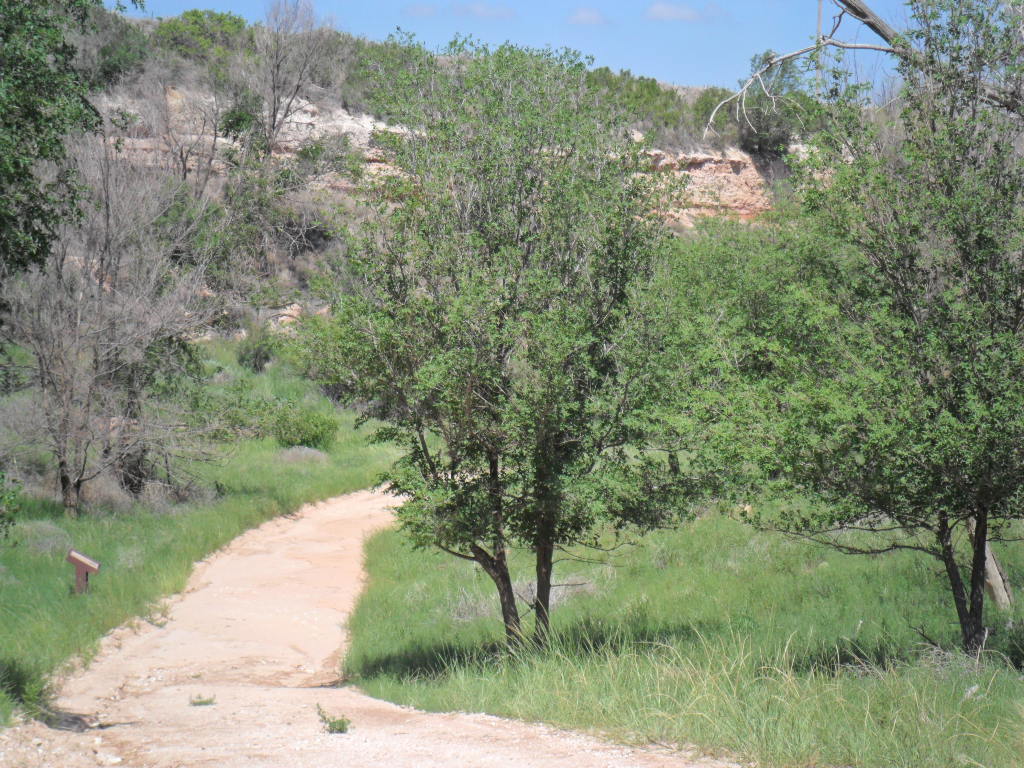
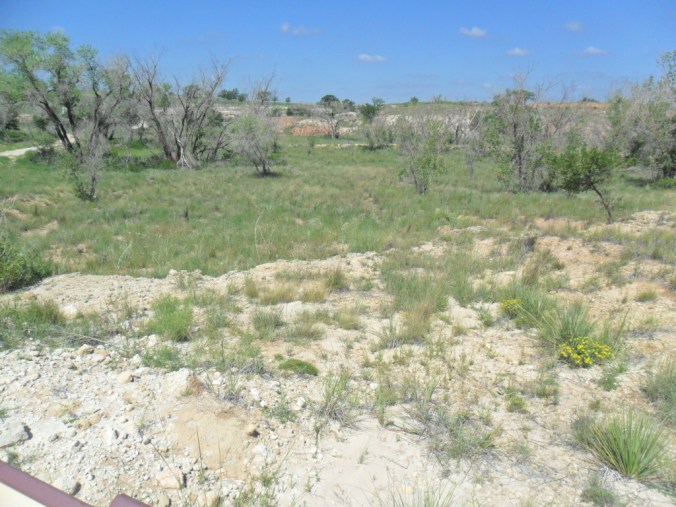
The trail begins just to the northwest of the tiny building and goes along the top for a couple of hundred feet before it drops down into the gravel pit remains.  The gravel was below all the layers containing human artifacts and ancient animal bones so the pit is wide and deep.
SAM_1302

SAM_1301

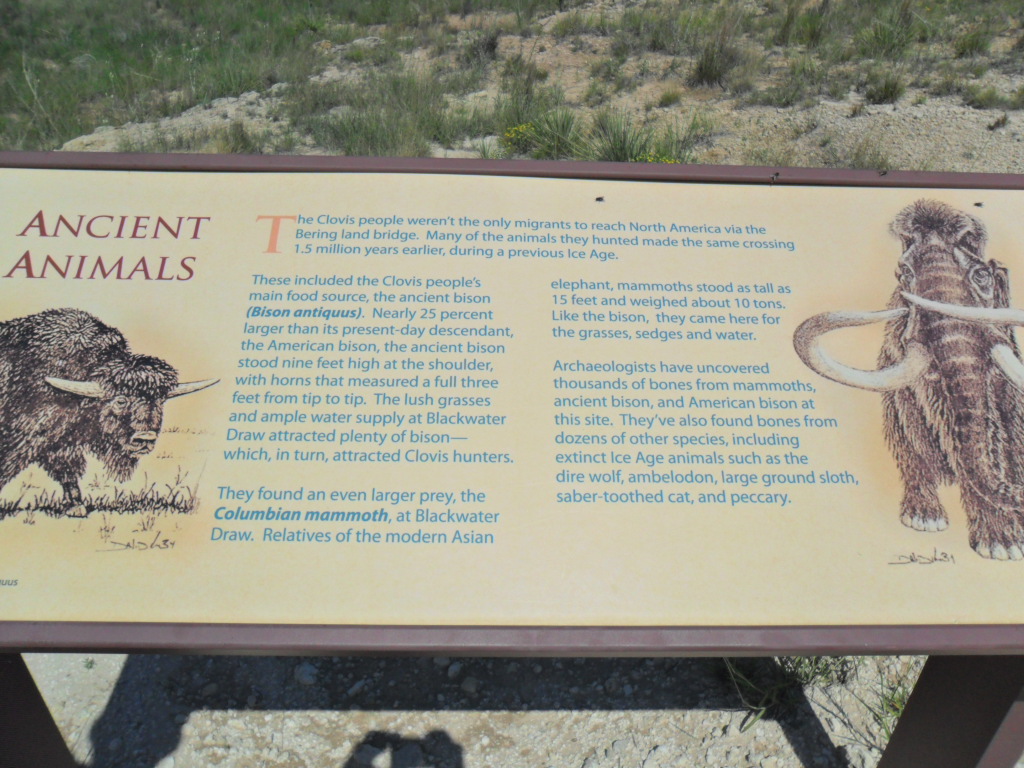
If your sight is good, you can read this.  The primary source of food for Clovis Man, giant bison and Columbian mammoths, came here for the water.  Archaeologists  theorize that hunters often killed these huge animals while they were in the water where it was more difficult for them to escape and move quickly.  In one place on the trail, evidence of a five bison kill complete with spearheads makes one think just how difficult and dangerous this hunting activity must have been.  I stand there, think about my own 5’4″ height, and wonder what it would be like to have a Columbian mammoth close to me.  Doubtless many died from injuries during such activities.
SAM_1304

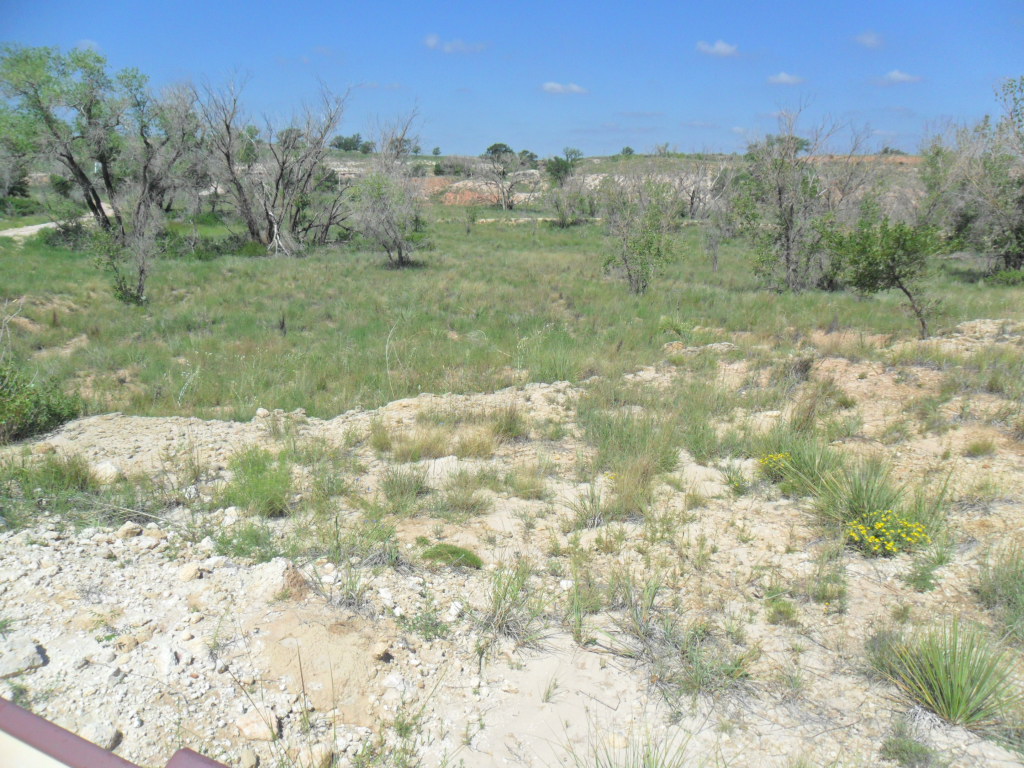
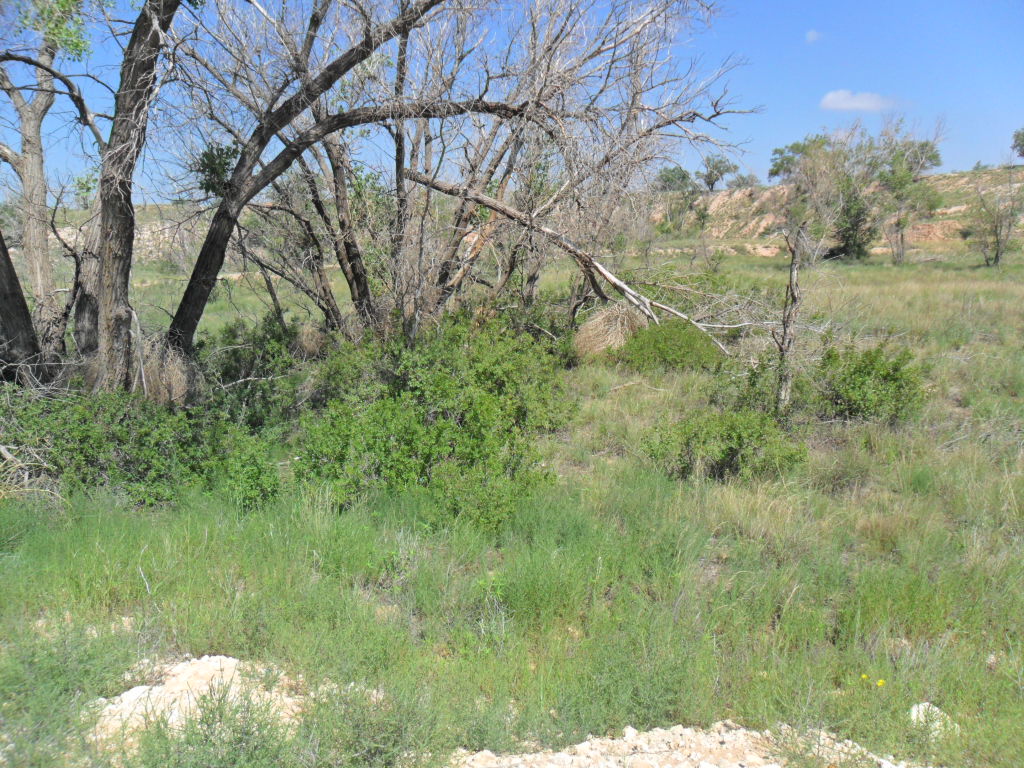
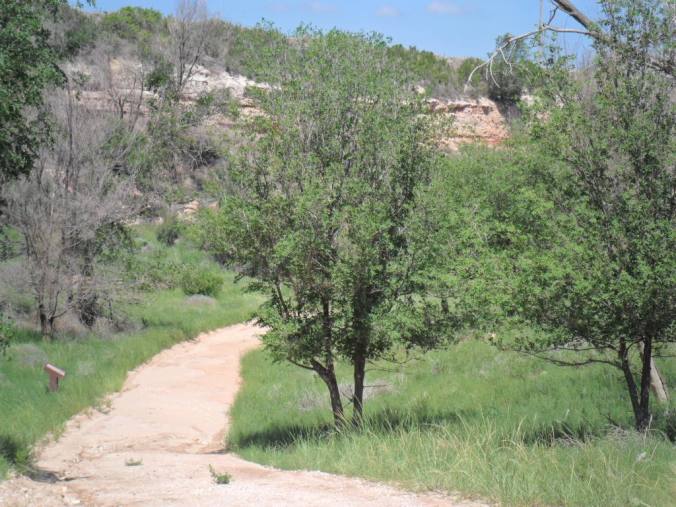
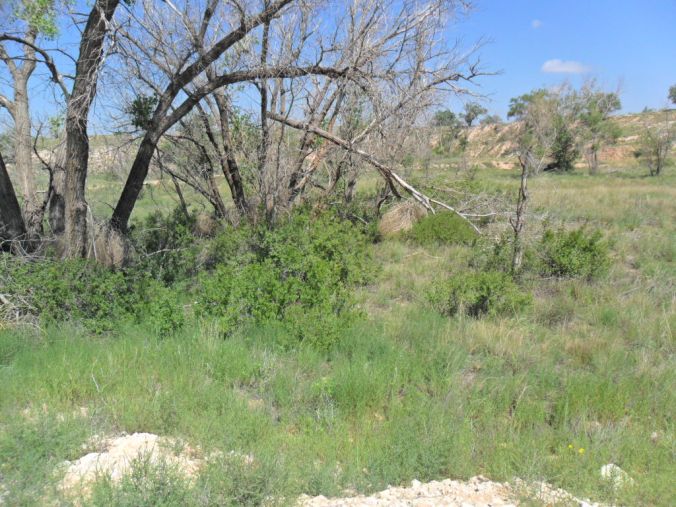
The train meanders along the bottom of the gravel pit.  This year, plentiful rain grows abundant grass.  During the last several years, little rain has fallen as evidenced by all the dead trees and bushes scattered around the site.  Normally, this area is semiarid with less than 18 inches of rain per year.
SAM_1303

If spectacular scenery appeals to you, do not go here.  Most of the bones and artifacts were found in the layers at the sides of the pit.  As you walk the trail, markers indicate the location of findings.  Few human remains are found at such sites because these were not permanent settlement places.  Ancient peoples roamed the land in search of water and food.
SAM_1305

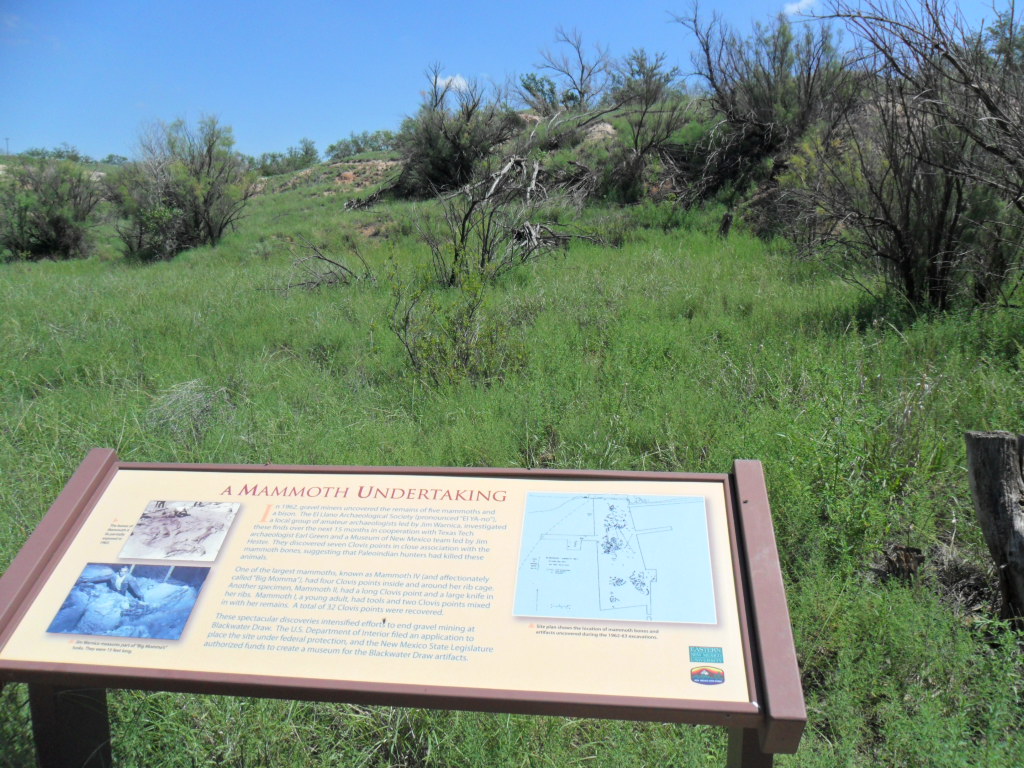
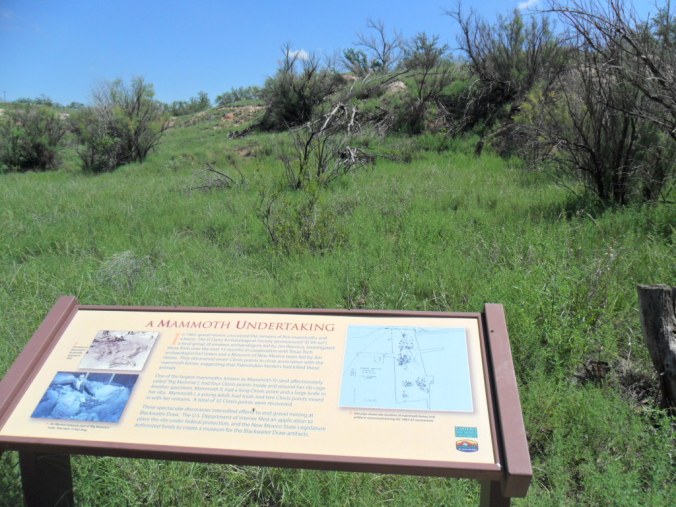
Signs, such as this along the trail, illustrate different places where specific bones and artifacts were found.  They also explain the different types of artifacts, their specific uses, and the history of the site.  Maps, like the one on this sign, help the viewer hone in on specifics in relation to where one is standing.  The photo illustrates archaeologists in action during site digs.
SAM_1307

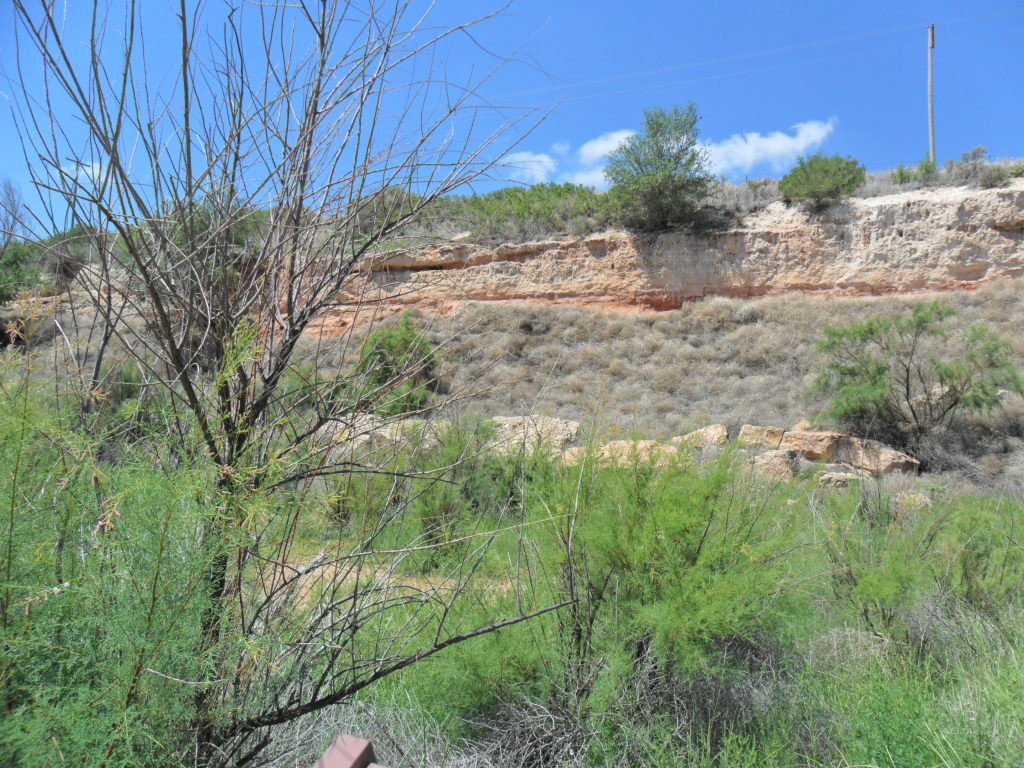
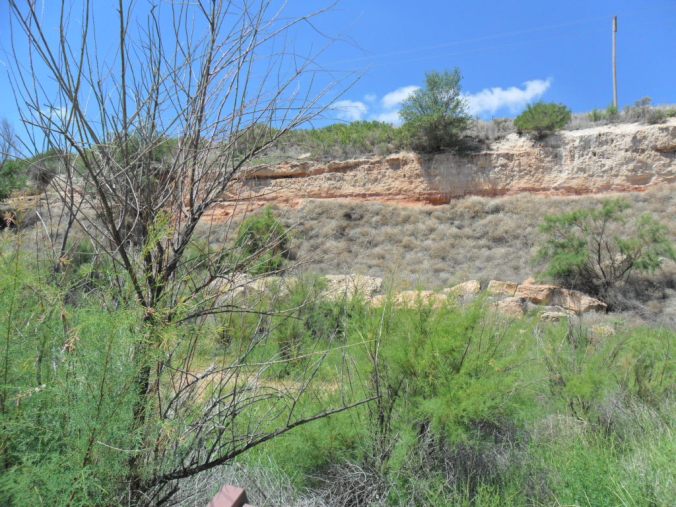
Cliffs, like the one here, surround the site.  In these small cliffs each layer indicates a different age of human activity by not only the type of sediment but also by the type of artifacts and animal bones found.  Just beyond this particular cliff at the west edge of the site, irrigation pivots run in a huge corn field.  The grey at the bottom of the cliff indicates an immense pile of dead, dried, tumble weeds.  This is dry country.
SAM_1308

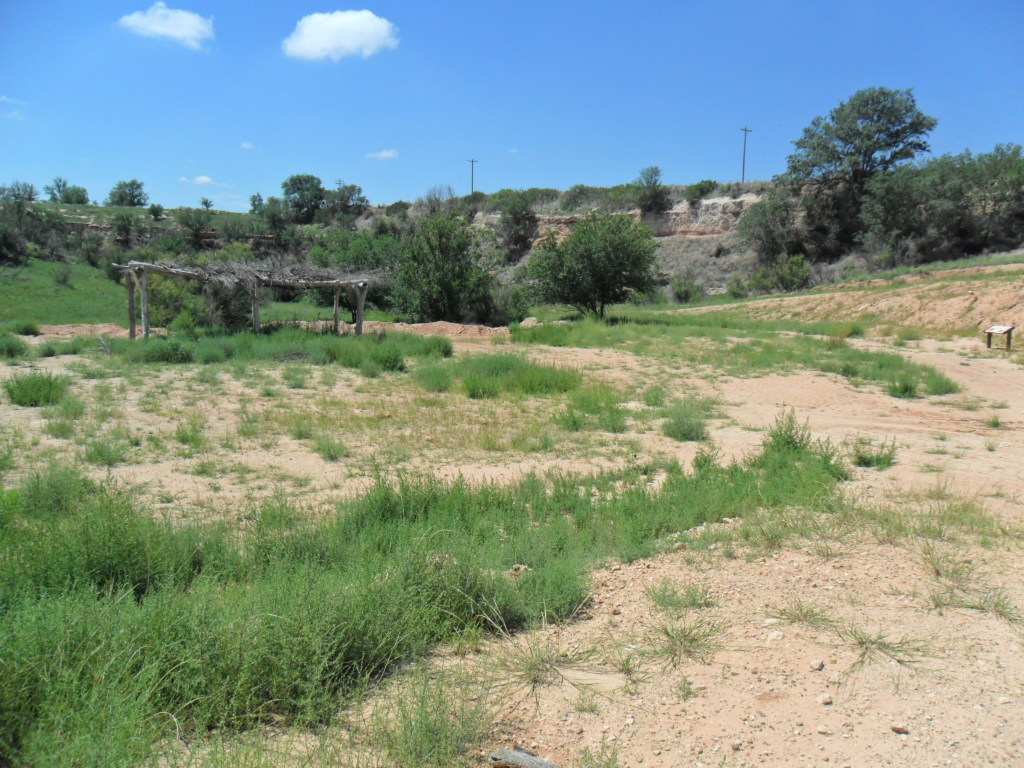
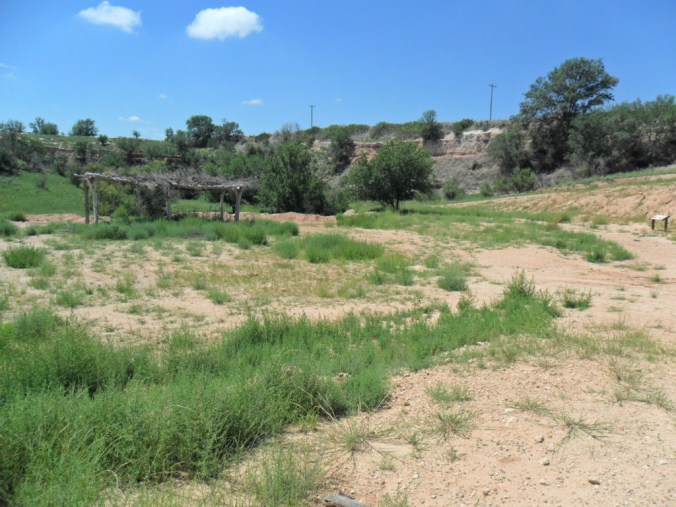
Approximately three fourths through the trail, the site mangers have erected several structures.  This one is the most primitive.  Others are modern with picnic tables and in one place I saw a giant sand box.  Guessing, I think it must be used to illustrate how one sifts through layers of soil to carefully remove spearheads, bones, pottery, etc.  This is the perfect place for a field trip, not too long, but full of geological and paleontological information.

I go here usually once a year.  If you ask me why, I may articulate something about how it has the oldest artifacts and bones found in North America.  The real reason??  I am not quite sure.  This place fascinates me, connects me with something ancient and wondrous, something undefined and mysterious.

DNA


Several months ago I decided to participate in the Human Genome Project through National Geographic.   When I called to order the kit, the young man reminded me that as a woman, I would receive only one half of my ancestry, the female half.  Since women do not have a Y chromosome, a woman can only trace her female family line through her mitochondrial DNA.  He suggested I use my grandson’s DNA so I would receive complete results.  Of course, that meant that in the end, I would have to factor in what I knew about his father’s family and deduct that to determine my own.  After the Geno 2.0 kit arrived, we took his cheek swabs and mailed them off.  This week when we returned from an 11 day family road trip, the results arrived.  With the results came detailed explanations of human migratory history and even comparisons of populations with DNA most like his.  Although none were close, the top two groups were people in Bermuda and Mexican Americans.  Luckily, the information contained a detailed explanation of the people of Bermuda.  The Native American results I expected since his great grandfather was Navaho.  Other parts came as somewhat a surprise. Once again I am taking a poetry class and now working on publishing a book of my poetry so I decided to write a poem about this experience.

The results loom before me on

the computer, percentages:

Northern European, Mediterranean,

Native American, Neanderthal,

sub Sahara African, South African–

as in the Bushmen in the Kalahari,

Northeast Asian, Southwest Asian.

Suddenly, calculations move through

my brain.  I look again, add, subtract,

recalculate, stare, ponder. Is there

a family secret I missed?  How will

I know, from whom?

Everyone I could ask is dead.

SAM_1183