The title of this non-fiction book explains what this book is about. The author is emeritus professor of biological science at Southeastern Oklahoma State University and of Cherokee heritage. He cites all the historical findings and current research regarding how natives used fire to control forests and grasslands, the numerous large native cities found both in US and Latin America using lidar technology, and how the colonists were totally mistaken when they thought they had found a land that lacked the influence of humans regarding forestry, farming, orchard keeping, etc.
He notes that the way the indigenous people in the US farmed and maintained orchards was not like those of the Europeans so they thought no one was doing anything and they were incorrect. He also goes into a lot of the history about how European diseases especially brought about the demise (genocide) of millions of native peoples even often those who had not themselves seen Europeans. Many European diseases spread from domesticated animals to humans (he provides a long list) and natives had no immunity. He cites of only one Western Hemisphere disease (syphilis) that went from the Americas to Europe. He claims that there were so few native diseases in this hemisphere because there were no large animals to domesticate.
The way Native Americans farmed, maintained forests, established orchards, etc. was so different from the European way that Europeans thought no one was doing anything productive with the land. To the contrary, they were affecting the land greatly but in ways that were more sustainable. Currently, he notes in the US forest management people have begun to recognize Native American forestry expertise and use it in many places.
“What are you willing to give up to alleviate someone else’s suffering?”
This book won the National Book Award for Non-fiction in 2025. I started reading it before book four but had to take a break. It is very serious and details a lot of dreadful recent and not so recent history. The author discusses in detail the gap between Western ideals and the reality the West enacts using examples from Gaza, his stint as a journalist in Afghanistan and other war torn places. He notes the betrayals of free speech, the betrayals of indigenous people, the betrayals of people of African descent. Some parts talk about reckoning and questions whether such will occur, who will remember, and will it matter and to whom.
El Akkad was born in Egypt, but grew up in Qatar and Canada as the family followed wherever his father was able to find work. He now lives in the US and states his current home is his 17th or 18th. His family had to move so much he remains uncertain.
This is a serious read for people who want to think about what has occurred in the last 20-30 years, what is occurring presently, and how all this will affect the future.
People tell me I have a lot of determination. If they know about it, they use this example: I just finished my 659th day of walking at least 10,000 steps per day never missing a day. My average is over 13,000 but it was higher until the rain came. It forced me to dance, jog, and run in place inside my house, not exactly a fun endeavor.
Three years ago as part of a Story Circle Network class, I read about book written by a woman who read a book per day for a year in order to help her deal with her grief over the loss of young family member who died too soon. I figured if she could read a book a day, surely I could read a book per week. First year I made it, second I fell one short, and in 2025 I read 53 and reviewed them all on my blog.
Today, I finished book one off 2026: “We Are Green and Trembling” by the Argentinian writer Gabriela Cabezon Camara. It won the National Book Award for translated literature. A sort of fantastical, historical novel, it portrays the life of a real person, Antonio de Erauso. Now identifying as a man, he writes letters to his aunt who is the prioress of a Basque convent. When a small girl, his parents placed her in the convent hoping she would someday replace the aunt as head of the convent. To flee the narrow confines of such a life, she escapes and disguises herself as a man. Through his narration and letters to his aunt, he tells of all his adventures, including working as a mule skinner, then becoming a conquistador in South America among other endeavors. At the time of the novel, he has escaped the military captain for whom he fought and rescued two native Guarini girls from enslavement along with two monkeys. The smallest girl and the monkeys were in cages and near starvation when he rescued them. Pursued by the military they escaped, they now reside deep in the jungle aided by the natives who live there.
Through this novel, the author manages to criticize colonialism, the tyranny of strict religious beliefs, the treatment of women, and the horrors inflicted on native peoples.
The daughter of a diplomat and historian explores books in her father’s library one evening and discovers an ancient book and a bunch of yellowing letters. These letters are those of one of her father’s advisors in graduate school, a man who suddenly disappeared. The center of the book contains a strange dragon drawing. This discovery leads her on a quest to find out more about her father’s past and the fate of a mother she has never known.
The letters involve the evil history of Vlad the Impaler who is the person behind the legend of Dracula. Vlad the Impaler was ruler of what is now part of Romania. In his efforts to retain power and fight off the Turks, whom he hated, his cruelty became legend. Often he impaled his enemies alive on stakes driven through their bodies and lined them up by the hundreds along the roadsides.
Combining reality and the legend of Dracula and vampires, this book’s main character, the daughter of the historian, leads the reader from London to Amsterdam to Istanbul to various parts of Romania and Bulgaria in search of the truth of her father’s past and the supposed death of her mother. Although it is a vampire story (I am not a vampire fan), it is much more; it is a fascinating trek through a part of history few know much about and about which little has been written.
Note: I doubted I would finish it by year’s end because this novel is 642 pages long. However, I found the story and history so compelling that I finished it before Christmas.
A young woman, Alexandra, travels to Sofia, Bulgaria, for a job as an English teacher in part to help her recover from the strange disappearance (and probably death) of her brother. She has barely arrived when she helps an elderly couple and the man with them. By accident she ends up with an urn of ashes in a bag when her luggage and theirs gets a bit mixed up. The ashes are inside an ornately and unusually carved box with the name Stoyan Lazarov engraved on it. She sets out to find them with the help of a young cab driver.
As they set out on this journey, they discover they are being followed but have no idea why. The cab driver whom she calls Bobby has keen observation skills which mystify her at first. They find part of the family and then unfortunate things occur to many they meet who are relatives or are connected to the man whose name is on the box. Without initially realizing it, they become involved in Bulgarian politics and political corruption as they try to unravel the story of the box and the man whose ashes it contains.
As I read this novel, which is both a lesson on the horrible Soviet occupation of Bulgaria and human determination and resilience, I became entranced with the history and culture of Bulgaria. If you want a glimpse into another culture and its history and the beauty of the Bulgarian landscape, I highly recommend this book. It is also a mystery story that keeps the reader going.
The author also wrote an earlier book called “The Historian” which is a novel about the history of Vlad the Impaler who is the real person behind the Dracula stories. I plan to read that novel as well.
Translated from French and written by a Senegalese author, this novel takes place during the time of colonialism and the slave trade. In Paris of 1806, a famous botanist, Michel Adanson, is dying. He never has finished the botanical work to which he dedicated his life, and as he lays dying, his last words are the woman’s name “Maram”.
His daughter finds an unpublished memoir hidden in a cabinet. It is the story of his younger life, what happened to him in Africa, all addressed to his daughter so she can understand his story and the meaning of his last word. It is a tale both strange and sad, filled with healers and magic and tragedy. Maram, a fabled revenant, a woman of noble birth from the kingdom of Waalo, was captured and sold into slavery but managed to escape. While working on his quest to find new plants, Adanson hears about this woman and becomes obsessed with finding her. His guide, Ndiak, the son of a chief, accompanies him everywhere and they become friends. This is a story of adventure, romance, and the horrors and cruelty of the slave trade.
Note: The author won the International Booker Prize for his other novel, “At Night All Blood Is Black”. Readers of this will miss several books I am reading because I am a judge for a literary context and cannot discuss what I am reading for the next several weeks.
This is a sort of travelogue, memoir, and recipe book. The author begins in Odessa and travels south from there to the port of Constanza in Romania as well as various other seaside towns in Bulgaria, then to Istanbul. After spending more time there she heads east to all the ports and some inland cities near Turkey’s Black Sea coast.
I hope to learn new information and become a little more enlightened when I read–especially when reading non-fiction. This book did not disappoint. Here are a few of the things I learned:
-Odessa is a very old and once a very international city. At one point it had the second largest Jewish population in Europe. Now only about 1/3 of the residents are Jewish. Many of the restaurants serve traditional Jewish food even if not Jewish. Once in the past, Mark Twain visited there and made it famous for its ice cream.
-In Constanza, Romania, she witnessed a huge Navy Day celebration with booming gun salutes. Once upon a time, this city was famous for its Casino which now is just a glorious ruin. Here a breakfast mainstay is polenta with a mushroom topping. The author apparently liked the food because this section contains more recipes.
-Varna is the main seaport city in Bulgaria. The author’s main quest here was to see the gold, yes, gold. Once upon a time, this city was a major Roman port. Now the Museum of Archeology houses a spectacular collection of ancient gold. “Breastplates, bracelets, burial gifts, regal-looking head pieces, figurines, and pendants–all gold–shone for attention. The silent Midas room was deafening, ringing out with finery, treasure and opulence. And the loudest, biggest treasure of all, was the smallest. Tiny pendant earrings, almost inconceivably old, dating back 6000 years….these earring are the oldest ‘worked gold’ in the world. They belonged to the first known culture to craft golden artifacts, and they lived here, on Bulgaria’s section of the Black Sea in what some archeologists consider the oldest prehistoric town. But it was not gold that made this area wealthy; it was salt which was mined nearby. The world salary comes from the Latin word ‘salarium’–a Roman soldier’s stipend to buy salt.
-She goes to Istanbul and then on to Turkey’s Black Sea towns, Amasra, several a bit inland, Sinop, Trabzon, and Rize. Sinop has a particularly good harbor. There is a saying that the Black Sea has three safe harbors, July, August, and Sinop. This is in an area often targeted by Cossacks who crossed the Black Sea to raid these more prosperous areas. The town also houses an infamous prison where Russian convicts taught Turkish cellmates how to make model ships for which the town is now famous.-More than 3/4 of the world’s hazelnuts are grown in this area of Turkey. However, that did surprise me as much as the tea, yes, tea. When I think of Turkey, I think of that thick, strong Turkish coffee. However, Turkey is the fifth largest grower and exporter of tea in the world. The tea grows in the fog and mist on steep slopes that end at the sea. Several photos in the book illustrate the lush green mountains covered in tea bushes.
-When I think of Hagia Sophia, I think of the spectacular building in Istanbul, the one that has withstood invasions and earthquakes. But there is another one. On the western edges of the city of Trabzon, there is a smaller, more tranquil Hagia Sophia, one of the Black Sea area’s most spectacular monuments. It was built as a church in the 13th century, converted to a mosque, then to a cholera hospital, then a museum and finally back to a mosque in 2013. The ceiling and walls are covered with frescoes that for a long time no one knew existed until they were restored.
In addition to all the tales of her adventures and the ordinary people she meets, the book is filled with recipes that are specialties of the areas she visited. I’ve taken some ideas from several to experiment with new dishes like combining Swiss chard and sultanas (golden raisins) with chopped onions and garlic sautéed in olive oil and served over Basmati rice.
“What’s an army anywhere but a bunch of state-sanctioned mass shooters funded by our tax dollars. Do the deed as a civilian and you get the chair, do it as a soldier and they’ll pin some tinfoil your chest.”
“To be alive and try to be a decent person, and not turn it into anything big and grand, that’s the hardest thing of all. You think president is hard? Ha. Don’t you see that every president becomes a millionaire after he leaves office? If you can be a nobody, and stand on your own two feet for as long as I have, that’s enough…People don’t know what’s enough. That’s their problem. They think they suffer, but they’re really just bored. They don’t eat enough carrots.”
In a rather ordinary, small, dismal Connecticut town an elderly woman, suffering from dementia, saves a 19 year old boy from committing suicide. She takes him in and this act of kindness transforms both their lives in unexpected ways. While taking care of her, he also finds a job at a local fast food restaurant where his cousin works as well as several others whom many would consider lesser people. They help each other, form tight bonds, and develop unlikely friendships that reveal how caring and empathy can make all the difference in people’s lives.
This novel is touching, sad, and joyful all at once. These are poor ordinary people trying to survive the best way they know how. For many readers it will be a glimpse into the way many people in this country (and, indeed, the world) actually live–poor, struggling to survive, but also kind and caring.
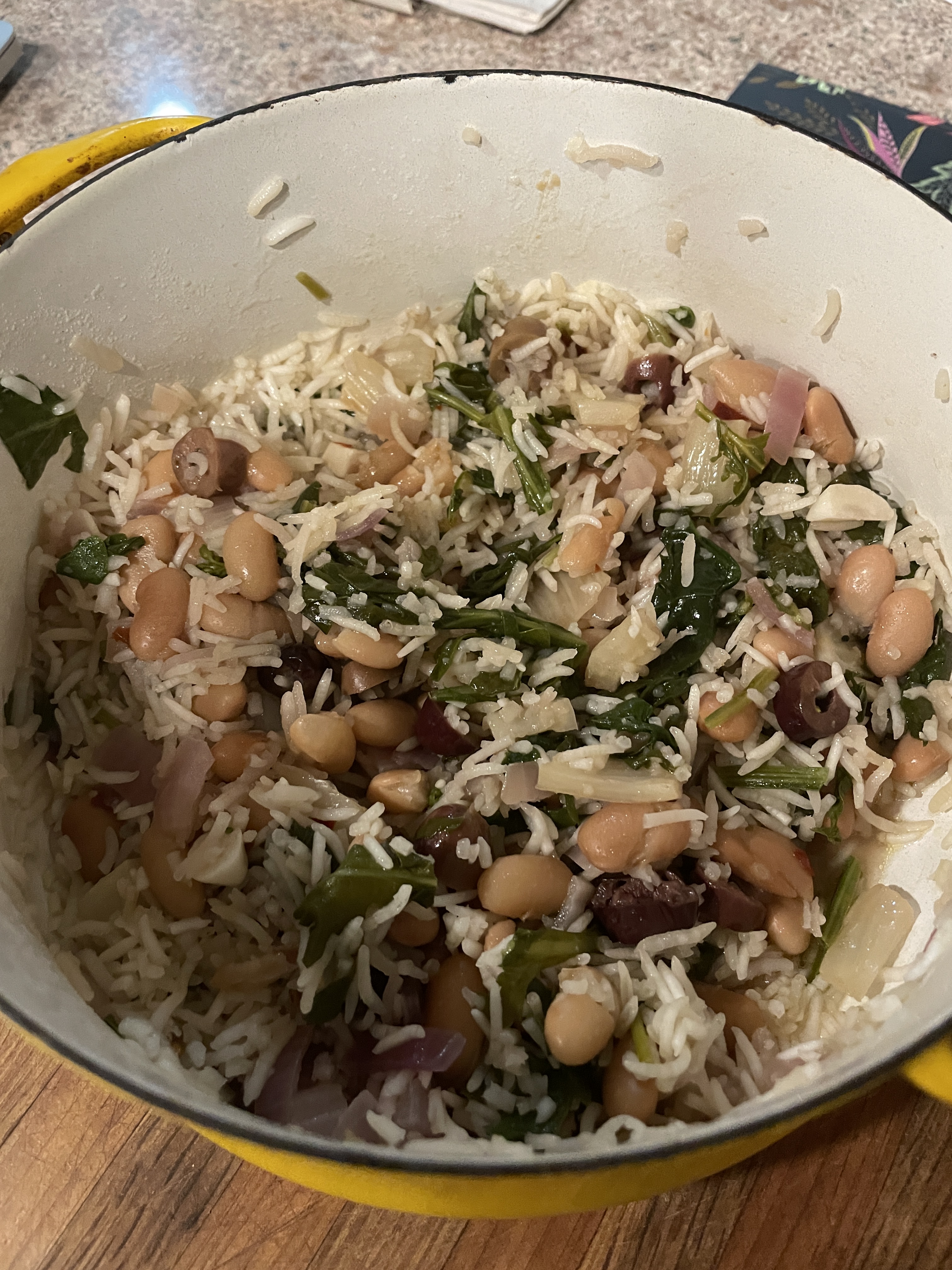
Plov is a common dish throughout Central Asia and is the national dish of Uzbekistan. All plov contains rice and usually meat like lamb or beef. Here is a vegetarian version. I found a vegetarian recipe and modified it using the ingredients I already had. The original recipe used chickpeas but I had already cooked Peruano beans so used them.
1/2 large purple onion, coarsely chopped
1/2 fennel bulb, coarsely chopped
3 cloves garlic, chopped
1/4 cup kalamata olives, chopped
1 drop coriander essential oil
1 drop cumin essential oil
1 drop cilantro essential oil
Chili flakes (optional and amount to taste)
1 cup cooked Peruano beans
2 cups greens (I used spinach and arugula), coarsely chopped
1 heaping half cup of basmati rice, rinsed
butter or olive oil for sautéing
Heat the oil or butter in a heavy casserole dish. Add onions, garlic, and fennel. Saute until tender. Stir in the spices. Scatter the beans and olives on top of the onion mixture. Do not stir! Add about 1/4 to 1/3 cup water. Layer the greens on top of the beans and olives. Flatten the greens with a spoon. Do not stir! Let greens wilt then layer the drained rice on top. Pour in enough boiling water to just cover the rice. Cook on high heat until the liquid has boiled off. Poke holes in the rice to allow steam to escape. Cover pan with lid and turn off heat but leave pan on the burner. Let the rice steam for 20-30 minutes.
To serve, stir the contents and serve in large bowls. You can add extra fresh herbs and lemon if desired. I just served as is and found it delicious. You do not have to use essential oil but can use ground herbs or fresh. If using essential oil, use a safe brand for cooking. I used Edens Garden but have used others, e.g. Doterra.
The last two books of hers that I read were set in the more recent times when Salvador Allende and later Pinochet were presidents of Chile. This one dates back to the 1800s and the Chilean Civil War. In 1866 a nun of Irish descent living in San Francisco has a passionate affair with a Chilean aristocrat and becomes pregnant. He abandons her; their daughter becomes the woman in the title of this novel. She is raised by a loving step father, an intellectual teacher from whom she learns to be independent and defy societal norms. At a young age she becomes the writer of short pulp fiction novels using a fake male name. The income from these helps her family live a reasonably good life.
Bored with writing these lucrative little books, she convinces a San Francisco newspaper to hire her as a journalist where she works along with a more seasoned journalist, Eric Whelan. Eventually, the two are sent to Chile to cover the civil war and violence occurring there. She sees this as not only an opportunity to satisfy her adventurous spirit but also an opportunity to find her biological father. She encounters dangers, almost gets killed, and sets off to find herself in the far southern reaches of the Chilean wilderness, learning from the indigenous people who live there how to survive in remote mountains.
Note: One of the places she goes was nearly impossible for non indigenous people to find during the 1800s and many never made it. Today, it is a popular area for hiking, camping, and exploring nature.

 writingontherim