Book 24 for 2024: “Inland”, Téa Obreht


While I found her first book, “The Tiger’s Wife” fascinating, I remain uncertain regarding this one. First it is long, 374 pages (I do read long books); second, it tells two different stories which do not interconnect at all until the end of the book. I kept wondering, asking myself, “What?” For me at least, the story picked up about half way through and my interest greatly increased.

One storyline is the life of one homesteading family in rural Arizona in the 1850s told mostly from the viewpoint of the wife. Her husband tends to wander off for long periods of time leaving her on her own with their children. His latest adventure is not only their homestead but also owning and running the local newspaper in the nearest town. The reader also meets some rather powerful but unsavory characters who want to own all the cattle and all the land.

The second storyline deals with the men who were hired by the government to bring camels to the West and manage them, one of whose story–a real historical person–is told. His name was Ali, a Syrian cameleer, who died in 1902. He was called Hi Jolly because people in US seemed unable or unwilling to pronounce his real name correctly. This part is told from the viewpoint of another cameleer, Hi Jolly’s friend, who has a criminal history and is trying to elude the law. Camels were brought to the US by the United States Camel Corps in the 1850s. At that time few roads existed in the Southwest, water was scarce, and camels were known to be able to go long periods without water. The experiment failed so camels were left either in the hands of the individuals who rode and cared for them or left to roam wild. Some of the men, including Hi Jolly, were able to open businesses transporting goods to remote areas via camel. This book details part of that history.

In both storylines one recurring theme is the lack of water. At one point the homesteading family have no water at all. In the other storyline people hire the cameleers to take them to places not realizing that even camels need water occasionally. I find it telling that 175 years later we continue to struggle with water issues in exactly the same part of the country.

Book 23 for 2024: “Off With Her Head: Three Thousand Years of Demonizing Women In Power”, Eleanor Herman


Starting with ancient Egypt and later with the ancient Greeks and Romans and ending in current times, this highly researched book (there are 15 pages of Bibliography) details millennia of lies told about and attacks against women in power. Ridiculous things have been attributed to women, powers that no human has, in order to control them. Here is an example: Pliny the Elder (23-79 CE) wrote that menstruating women caused hailstorms, lightning, and whirlwinds. And worse yet, demons come from this blood (various medieval medical authorities) and it can shrivel the penis.

Then there is the whole thing about raging hormones. The word hysteria, which supposedly is an ailment of women, comes from the Greek word for uterus. During the 2020 presidential campaign, Marco Rubio, currently a possible candidate for vice president, tweeted a photo of ten missiles exploding and asked if you want a woman a heartbeat away from the presidency.

During the Middle Ages millions of women were put to death in various horrible manners after being accused of witchcraft. Even in current times various male political candidates and media announcers (a Newsmax journalist, Zinke of Montana, Ben Carson, Chris Matthews–list is almost endless) have called powerful political women witches. The victims of these pejorative rantings even include Margaret Thatcher when she held office.

Marie Antoinette never said, “Let them eat cake”. Various forms of this phrase had been around for over one hundred years. Ann Boleyn originally wanted to marry the love of her life who also wanted to marry her but the powers at the time, including Henry VIII, forbade this. Many of the ridiculous stories about Cleopatra can be easily disproven, e.g her being so rich she dissolved a giant pearl in vinegar to prove her wealth. Unless powered, pearls do not dissolve in vinegar. Catherine de Medici was attacked as some sort of sex pervert when she was 42, obese, and anything but a sexy seductress.

The documented lives of many powerful women for the last three thousand years contains endless abuse of all sorts. How is this possible? Because there is an informal Misogynist Handbook that has been used for millennia to control women. The above is only a smattering of what you will learn about this Handbook if you read this book. In the last chapter, the author does provide recommendations for overcoming this abuse of women. However, she also notes currently there is a “furious backlash against this long-delayed crawl toward justice, resulting in the increasing viciousness of sexist tweets and memes, more violent threats, more savage abuse.”

Visiting Chaco Canyon


Several weeks ago, I spent a day wandering around the ancient sites where native peoples gathered over a thousand years ago.

This explains the extensive influence this place, located in the northwestern New Mexico desert, held for people from as far away as Central America. To reach this park, you have to drive on a dirt/gravel, rough road for more than 25 miles north of Crownpoint, NM. It is definitely worth the effort. However, it is impassable in rainy or snowy weather. The rangers who care for the park live there.

One of the first things you see as you get closer to the park is this rock tower, Fajada Butte.

Archeologists climbed to the top and discovered petroglyphs, “Sun Daggers”. Created between rock slabs, they align with each solstice and equinox and at these events the light projects to other sites, e.g. Pueblo Bonito. Other petroglyphs on a section of the canyon wall represent a supernova that occurred in 1054 CE.

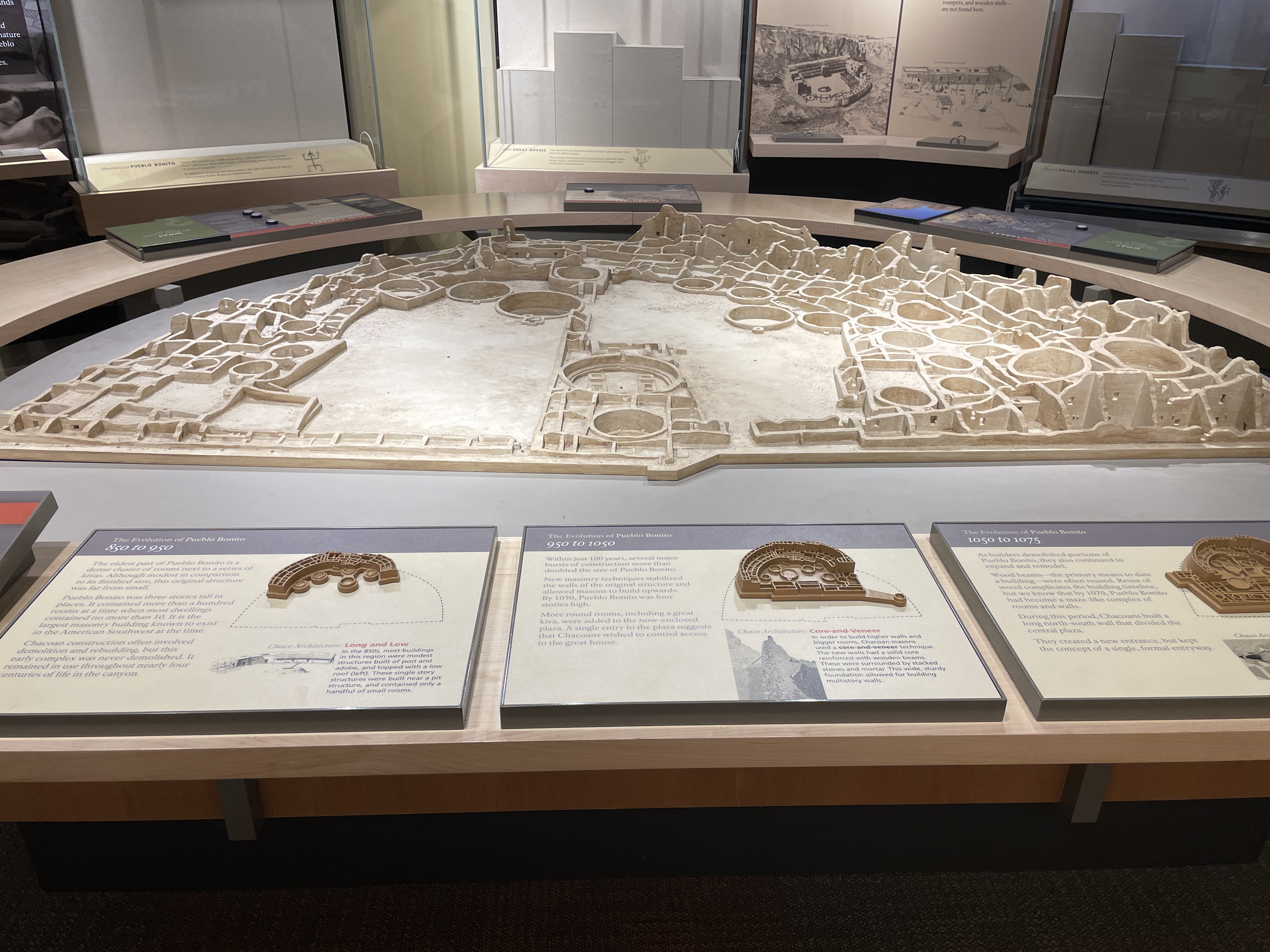
The following depicts an overview of the site as it would have been in the past. In the 1940s part of the wall of rock behind the site collapsed onto it and destroyed some of the buildings.

Here is how it looks today. Many of the doors and windows align with astronomical events, e.g. solstices, the two equinox, and astronomical events that occur only every 17 years.

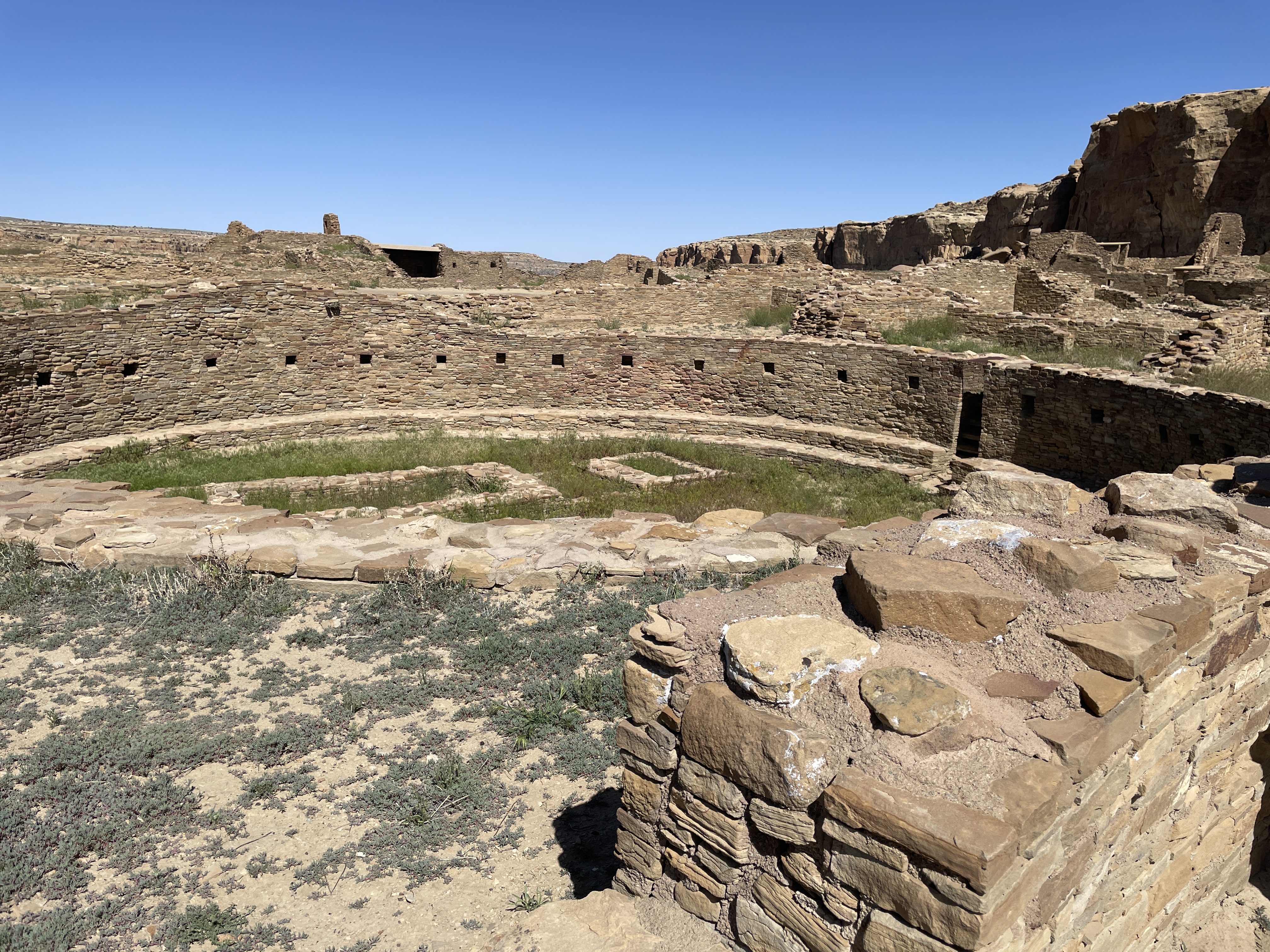
All sites here contain many kivas, many of which are very large. It is speculated that these were used for various sorts of ceremonies, including religious events.

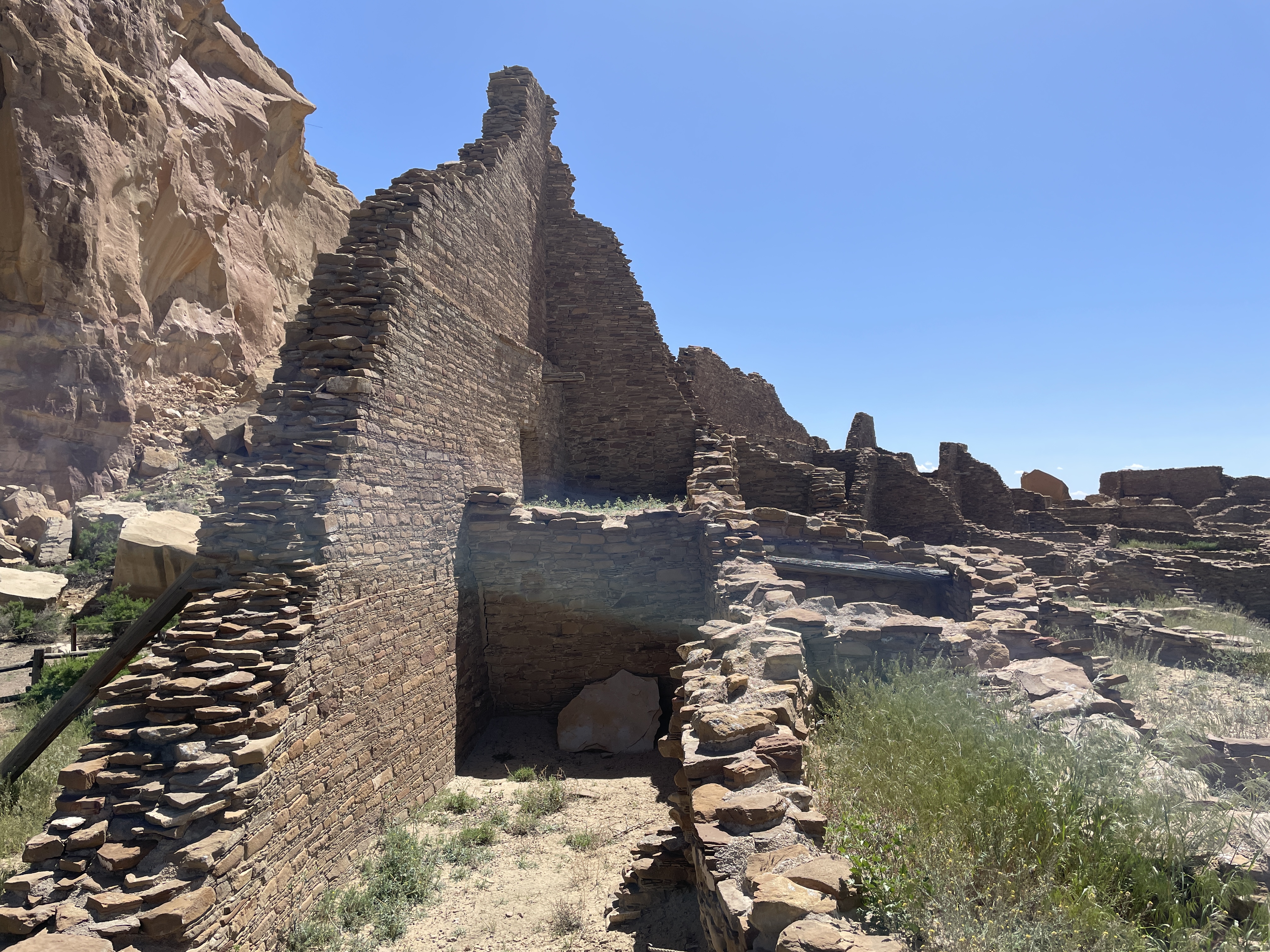
In this view you can see how the rocks that fell from the cliff have destroyed parts of the structures.

Many of the buildings were several stories high. In their heyday, they did not look like this. They were covered with something like stucco and painted white. What an impressive site they must have been–large white structures in the middle of the brown desert. Archeologists think few people lived here. It was a place for gathering, for ceremonies, for trade, for people from long distances to meet.

Across from Pueblo Bonito is the largest kiva found in the area.

Behind the bars on the far side of the photo is an area that was used for ceremonial dancers to don their costumes. At the bottom you can see a depression with a small door. Before centuries of sand filled it in, this place would have be large enough for the ceremonial dancers to enter through it.

If you follow a trail along the cliff from Pueblo Bonito, you will find another area built at different times hundreds of years ago.

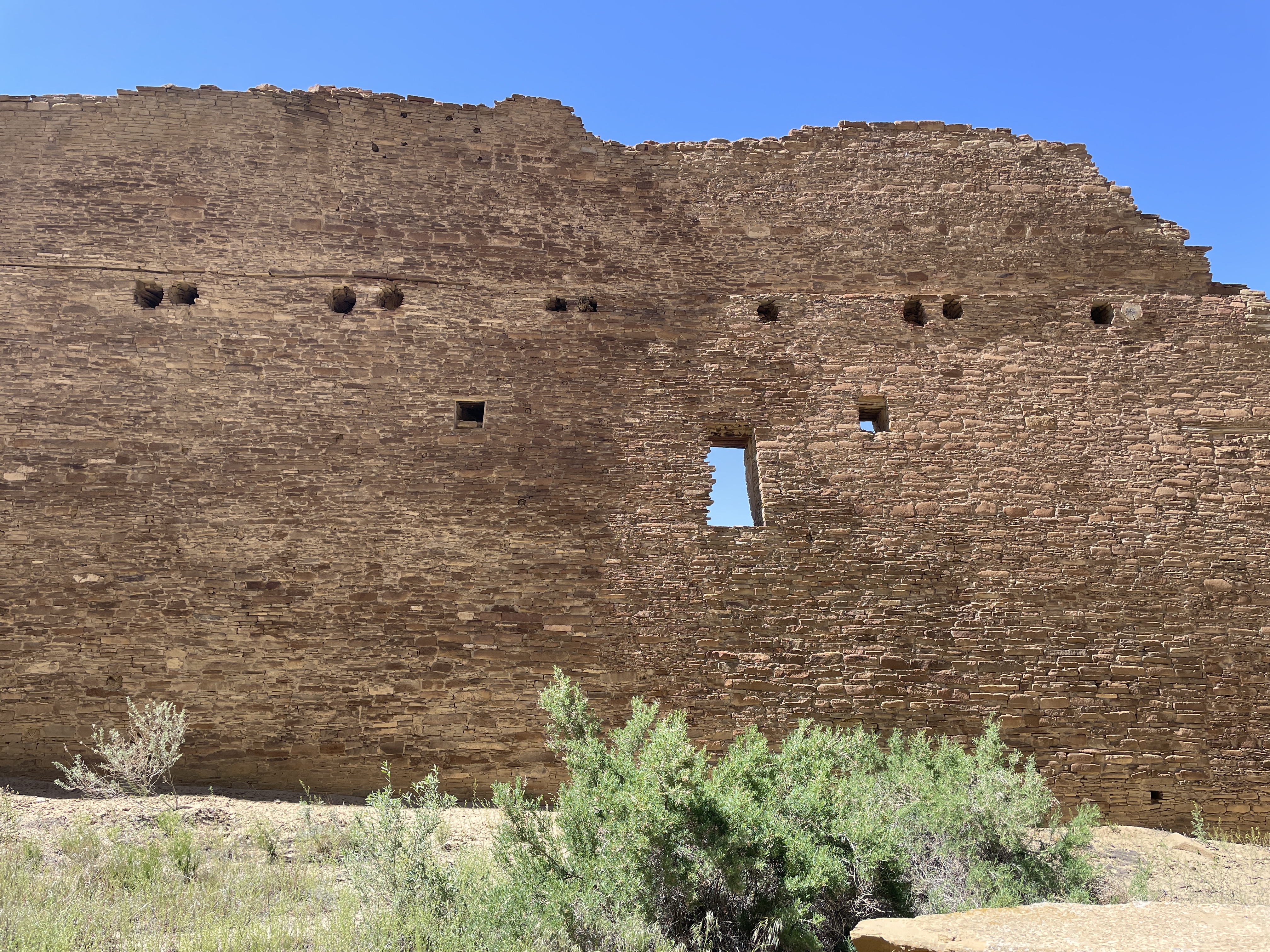
Another large kiva and many smaller ones are located at this site, including this famous long wall built at two different times.

The following shows where at some point the wall stopped, then later it was continued using somewhat different building material and techniques.

The top photo is considered the newer part of the wall.

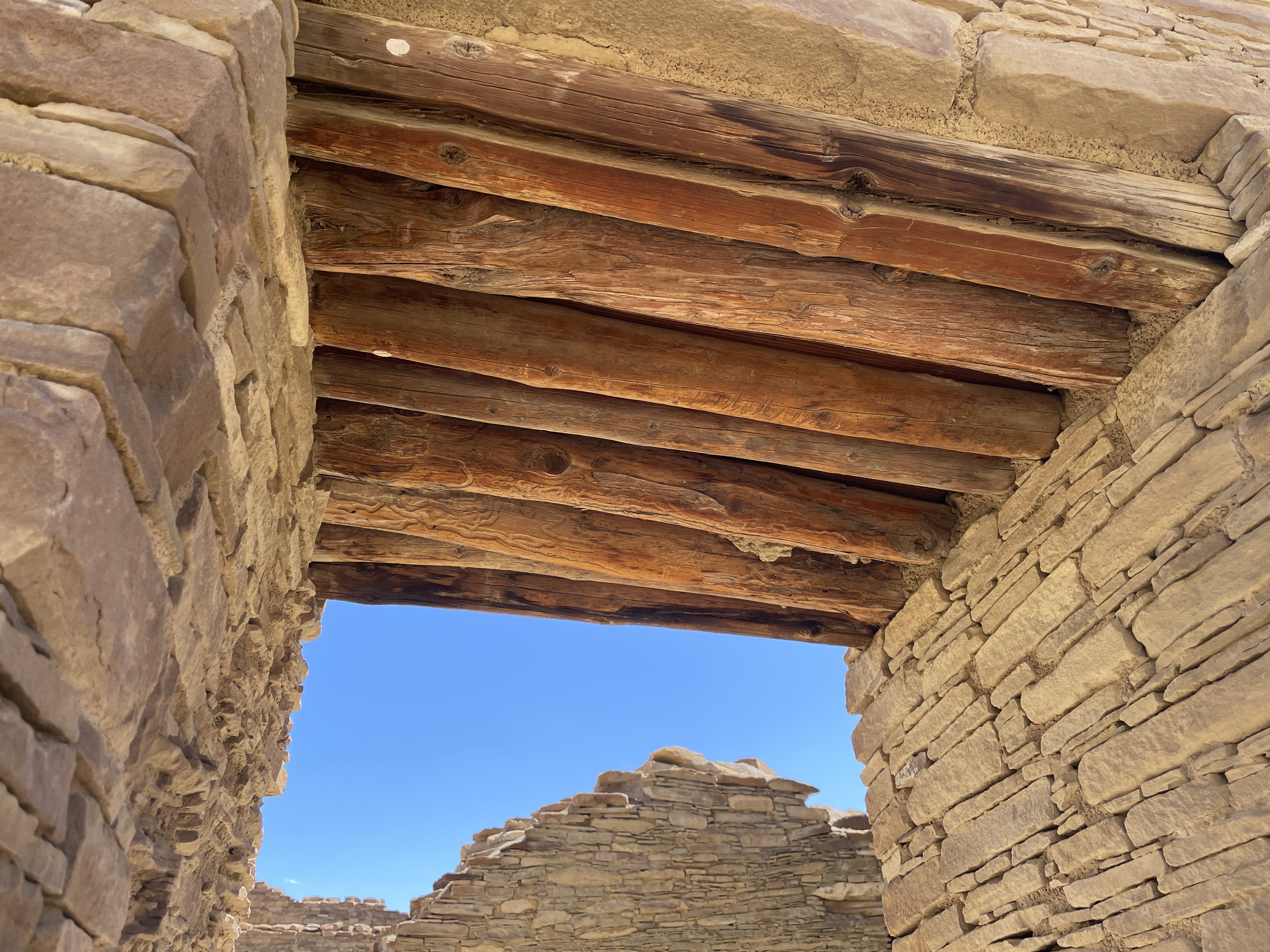
The wood used for tops of windows and doors was brought from forests hundreds of miles away. The desert air has enable it to be preserved.

When you walk the trails, you see wild flowers and native plants. This is desert rhubarb and it is edible.

While these are photos of the more impressive structures at Chaco Canyon, more than two hundred ceremonial and meeting sites can be found in this area of NM and AZ.

Book 22 for 2024: “The Reluctant Fundamentalist”, Mohsin Hamid


Written in an unusual style, the narrator, the main character, tells his story to an American visiting Pakistan. While they are sitting eating dinner and later walk to a hotel, the narrator relates his life as an immigrant who found US life too shallow, too focused on profit. The narrator, a young, Pakistani man with an Ivy League degree, attains the heights of success in the US, working in a highly desirable career position where he is the star. After 9/11 occurs, he questions who he is, what working in this sought after career means, whether it is even ethical to work in a position for a firm whose job it is to investigate companies, their profits, and ruin the lives of the people who work there. He is sent to Chile to investigate a literary firm, meets the manager who takes him under his wing and helps him look at what he is doing in a totally different light. Is money everything? Do the lives of ordinary workers matter? In addition, it is a love story. He meets a beautiful, young, wealthy, US woman, they develop a close friendship, and he discovers she is not mentally stable and does everything he can to help her.

While on the surface this appears to be a story of a young immigrant who does not ultimately fit in with US life, it is much more. It raises the questions of the definition of success, of what love is, of profit over humanity.

Book 21 for 2024: “The Thousand Crimes of Ming Tsu”, Tom Lin


If you like the unusual, violence, magic, revenge, stories of racism, classism, and Westerns, this is the book for you. Ming Tsu, a Chinese orphan at the time when the Chinese were building the railroad, is taken in by the head of a crime organization and taught to be an assassin. He falls in love with Ada, the daughter of a wealthy railroad magnate, elopes with her only to have her father (who has hired the crime organization to further his goals) kidnap her and force Ming Tsu into labor for the railroad. He eventually escapes, joins with a Chinese clairvoyant whom he calls the Prophet and a group of touring magic show performers, many of whom have supernatural abilities. He sets out to gain revenge, hunting down and killing all who helped his father-in-law kidnap Ada and put him in bondage. This is the classic Western romance, revenge story with a totally different twist and an unexpected ending.

A Tribute to My Mother


Barbie Doll

Barbara Lewis Duke, pretty, petite, blue eyed and blond, my

mother, one fearless, controlling woman. Long after Mom’s

death, Dad said, “Barbara was afraid of absolutely no one

and nothing.” They married late, 34 and 38. He adored her

unconditionally. She filled my life with horses, music, love,

cornfields, hay rides, books, ambition. Whatever she felt she

had missed, my sister and I were going to possess: books,

piano lessons, a college education. Her father, who died long

before I was born, loved fancy, fast horses. So did she. During

my preschool, croupy years, she quieted my hysterical night

coughing with stories of run away horses pulling her in a wagon.

With less than one hundred pounds and lots of determination,

she stopped them, a tiny Barbie Doll flying across the Missouri

River Bottom, strong, willful, free.

Note: This poem about my mother has been published in at least one anthology and my book of poetry. My mother loved roses, had a rose garden. I now grow roses too.

Book 20 for 2024: “The Midnight Library”, Matt Haig


Regrets and depression seem to have overwhelmed the main character, Nora. She’s lost her job, a car ran over her cat, she thinks she has failed at everything, and she says she wants to die. But does she really. Through a series of parallel universe experiences she gets to try out many different lives based on her long list of regrets. None really work because none of them exemplify her real self. She thinks she might like this new life or that new life, but none fulfill her, reflect her true self. She learns that money, fame, riches are not necessarily the answer. But what is the answer? What is the best way to live?

Book 19 for 2024: “Unearthing”, Kyo Maclear


Several months after Maclear’s father (who was a famous journalist) dies, she decides to take a DNA test to find out more about her family health and personality history, mainly because of the stories about a particular grandmother. She wonders if certain traits she and her sons have might possibly be inherited. The results of the test are a shock. Her father, the father she adored, who raised her and adored her, is not her biological father. At first, she thinks perhaps it was a sperm donor, but then she discovers this is not the case. Through the DNA test and her detective work, she finds two biological half-brothers (she was an only child before this discovery) who are willing to communicate with her, send her photos, etc. She tries relentlessly to acquire more information from her mother, who is often unforthcoming or tells her contradictory information. Then her mother gets dementia.

This is also a story of plants, of gardening. Both she and her mother are amateur botanists and expert gardeners. When nothing else works in their mother-daughter relationship, their love of plants and gardening holds them together. Even with dementia, her mother knows plants. Their other joint endeavor is ink drawings and love of art.

Additionally, this is the story of family, family secrets, inter-racial marriage, and challenging relationships. Kyo’s mother is Japanese living originally in England and later in Canada who often struggled with her status as a Japanese immigrant. Her “real” father, the one who raised her, was of British and Irish descent; her biological father was a Jewish formula one race car driver.

Book 18 for 2024: “Quiet Street”, Nick McDonell


Want to know how the top 1 percent, the super wealthy live and control nearly everything in the US? Read this book. In a mere 117 pages, McDonell explains his own life and that of fellow 1 percenters. He details his early life, the private school he attended, the family connections, summers taking sailing lessons in the Hamptons, and vacations using private jets to places like the Galapagos Islands. At 18, he was able to get his first novel published in part because of his family connections to a famous publisher. Eventually, he left this life behind to become a foreign correspondent in Iraq and Afghanistan.

In this book he details how the super wealthy hoard wealth, pass it from one generation to another, and how outsiders, the poor and those not white, are kept out. Here are a few quotes from the book:

“I began to see how, in the United States of America and elsewhere, success almost always, and predominantly, depends upon wealth–and frequently comes at the expense of the less wealthy.”

“We in the one percent like to believe in meritocracy, even fairness.” At this point he lists several of famous people who rose to wealth and power from poorer circumstance and explains how this is used to make the “one percenters feel good, they distract from the possibility of a more humane distribution of wealth.”

Why do the one percenters behave as they often do? He interviews several whom he knows through his private school connections. “The fear they share was loss of wealth. Without ever saying so, they were very much afraid of losing their country houses, the barn converted for their kids sleepovers, the space for the grand piano, the green houses, pied-a-terre where their mother-in-law stayed without interfering in everyone’s business, the airport lounge that allowed them to enjoy pleasures among their own, in quiet. They were afraid of supermarket processed cheese, preferred organic stuff which they believed would keep them alive longer….they were afraid of losing their Prada bags…the cashmere….They feared losing wealth not for its own sake but because it was justified, in their own minds, by intelligence, hard work, determination—that is by character.” They truly seem to believe they are smarter and harder working than other people.

Book 15 for 2024: “The Elegance of the Hedgehog”, Muriel Barbery


Before reading this book, I thought of French society as relatively egalitarian. Apparently, it is not if this book mirrors reality. One main character Renee, 54, lives and works as a concierge in a high class building containing eight, large, luxury apartments which the residents own. As she tells her story, she notes that this is her 27th year at this job. She describes herself as “short, ugly, plump”. She rarely says anything nice about herself or any of the residents. She notes she is uneducated, insignificant. She has one friend, Manuela, a cleaning woman originally from Portugal. Renee thinks it is her duty, her lot in life, to pretend to be something she is really not, a person totally lacking in intellectual and artistic acumen. She runs the television to make the residents think she watches mindless melodramas when she is actually reading Tolstoy as well as all sorts of literature and Marx, history, well every genre. After all, her cat is named Leo for a reason. She goes to art galleries, listens to all sorts of classical music, is basically an intellectual in the true meaning of the word, but works very hard to hide this, because she thinks she must stick to her station in life as she sees it. This works until one resident dies and a wealthy Japanese man buys the deceased man’s apartment. Both he, who notes her cat is named Leo, and a young girl, the other main character who lives in one of the apartments and plans to commit suicide and set their apartment on fire, suspect Renee is not as she appears to be. I do not want to give it all away, but this is a book with many life lessons, including that adage about not judging a book by its cover.