While his previous novel, Book Seven for the year, focused on map making, what it is like to be a refugee, and the stories of two, strong girls centuries apart, one of this novel’s main focus is birds. One narrator, at first no name and then later Nadir, relates part of the novel. His mother was an ornithologist who died in a tragic fire. Her ghost often speaks to him. The other main character, Laila, was a famous artist, an illustrator and painter of birds who mysteriously disappeared decades ago. She and a Black ornithologist insisted they had seen a new species of ibis, and she is supposed to have made drawings and paintings of this rare bird but all evidence disappeared with her.
This is also the story of various non-cisgender characters, some of whom hid their true identities from even those closest to them. Additionally, it is the tale of the lives of Syrian Americans in a NYC neighborhood, plus its destruction and renewal. As in his previous novel, the language and descriptions are poetic, often haunting, and sometimes heartbreaking. It also illustrates how our lives are often interrelated even when we are unaware, only to be discovered after years of searching.
I am guessing that the novel is at least somewhat autobiographical given that Nadir, born a girl, knows inside that he is really a boy. Between this novel and the first one, the author transitions from female to male.
Both books are beautifully written and I highly recommend reading them.
Two young heroines dominate this fascinating novel which switches back and forth between the Syria of 2011 and the 12th century. The latter is a girl who disguises herself as a boy to join the quest of a famous mapmaker. Nour, the first girl, lost her father to cancer in NYC. Then her mother, a mapmaker, decides to move herself and the three daughters back to Homs, Syria. They barely settle into their new life when the civil war breaks out and a bomb destroys their house. They become refugees. This is the tale of their harrowing journey from Syria to Jordan to Egypt to Libya to Algeria, then Morocco and finally to Cuenta, the Spainish city on the north coast of Africa, where their uncle lives.
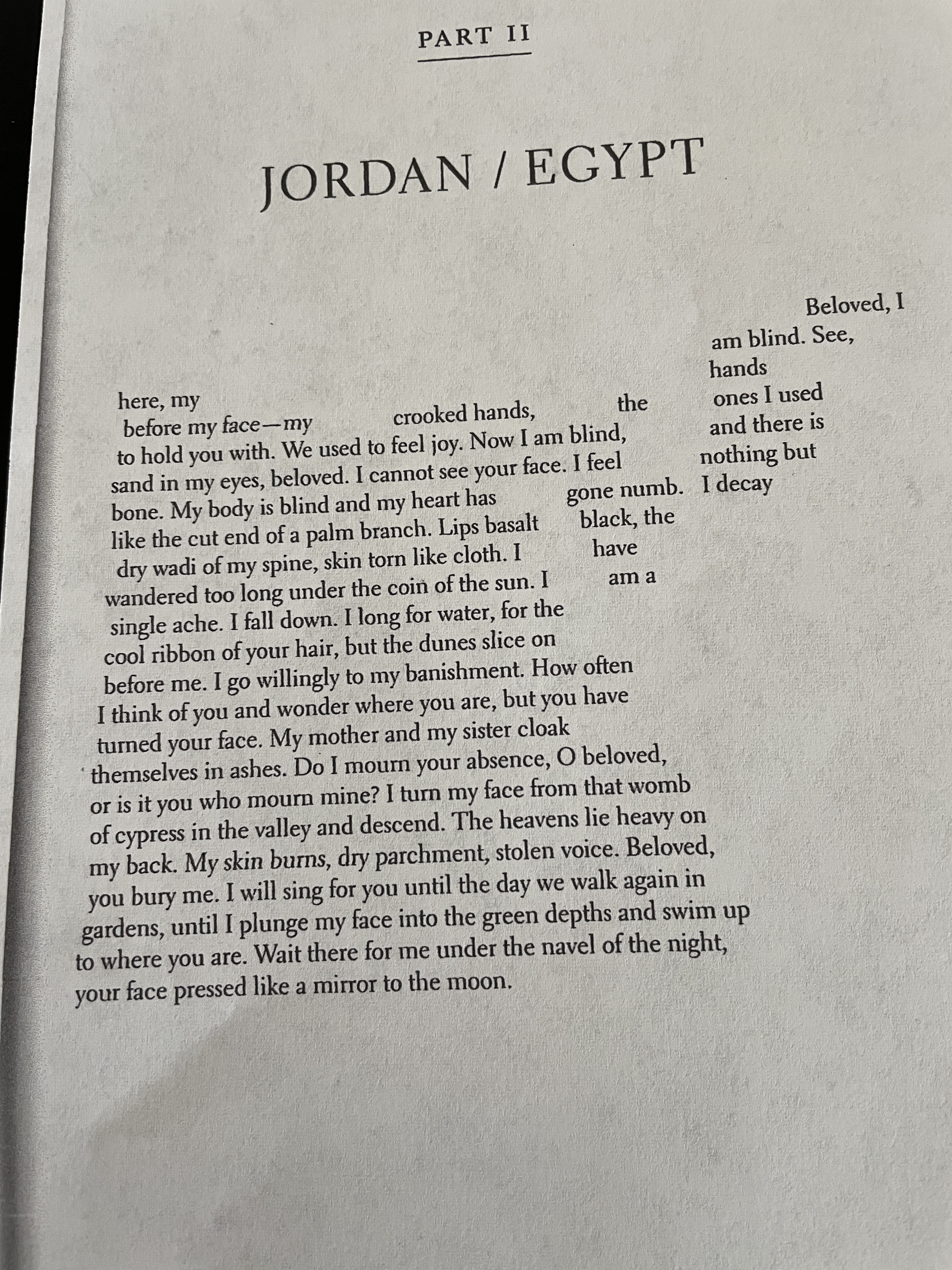
To keep sane, Nour repeatedly tells herself the story of Rawiya, the disguised girl who is an apprentice to the map maker. When he was alive, this was the favorite traditional story her father told her. The book alternates between what is really occurring to Nour and her refugee family and this ancient story. At the beginning of the section for each country through which they travel, there is a touching and beautifully written poem in the shape of the map of that country. The poem for Jordan/Egypt is printed below.
The subtitle of this book is “The War of Brothers That Shattered an Empire and Made Medieval Europe”.
The empire to which they are referring is the empire created by Charlemagne which was at the height of its power in the early 800s. He had managed to combine the territories of almost all of what we now consider Europe except for the far north and southern Italy and Spain and Greece. He managed to do this through cooperation among the nobles and the elite and it held throughout his life. He helped the spread of Christianity throughout what was previously pagan areas, e.g. the Saxons. Then not long afterward chaos ensued.
This history book details what occurs when fissures develop in what was once a stable social and political network and the bloody consequences of disagreeing on facts and reality. What happened?
For some time after Charlemagne’s death one of his son’s was able to hold the empire together by deftly giving bits of power to various sons and relatives. Once he died, a chaotic blood bath arose. Fathers and sons, brothers, uncles, nephews, everyone was killing or maiming each other for power. If they felt it was too unChristian to kill you, they just blinded you and sent you off to a monastery. If that did not work, then they would declare a female relative to be a witch and we all know what happened to witches. Meanwhile while jockeying for power, all these men declared they were doing what they were doing in the name of Christianity. If one brother won a battle, then he declared himself to be a better Christian than the one that lost. Even monks and bishops and the Pope became involved.
Then came the Battle of Fontenoy in what is now a part of France. Brothers against another brother with each leading more than 10,000 troops and in some cases as many total as 100,000. Watching was a noble who also commanded a huge army, but mostly he decided to just watch. The end result was a total bloodbath with one side violating the then current rules of battle. Normally, battles before this did not include a huge amount of killings in spite of what we now see in movies. This battle left thousands dead for the wolves, vultures, and other scavengers to eat, and the nearby streams ran red with blood. None of the warring brothers were killed so their fighting continued but no one ever really won and the great Frankish Empire created by Charlemagne fell totally apart. Some claim this battle was the beginning of the separation of a lot of Europe into what we now call France and Germany. Currently there is a marker at the place where the battle occurred. Regardless, Europe was never the same again for many centuries.
Note: Many find the world a very violent place today. Currently, wars and revolutions of one kind or another are occurring in many places in the world. Generally speaking, however, we do not find fathers and sons and brothers killing each other for power. We are seeing the consequences of what was once a relatively unified populace disagreeing on the facts and reality. Will we too fall into a dark ages like Europe did?
After reading his other collection of short stories, I ordered this one which is an earlier collection. Once again, he does not disappoint. One of the stories, “The Hunter’s Wife” won the O’Henry Award and has to be one of those most touching and unusual stories I have ever read. One main character, the man who makes his living guiding hunting parties in Montana, becomes obsessed with a young woman he sees in a magic show and follows her everywhere. When he first meets her, she is underage and he does nothing. Later when she is older he relentlessly pursues and marries her. After years of enduring the hardships of living in a remote cabin in the mountains, she leaves. She has always possessed the ability to feel the emotions of both other humans and animals and begins to make her living using this ability to help people. After never seeing her for twenty years, the hunter comes to one of her events. The story details the years between their first meeting and what happens when the hunter attends this event.
The title story, “The Shell Collector”, details the life of a blind expert on certain kinds of sea shells and the marine life that inhabit them, some of which are poisonous. He moves to a remote Pacific island, becomes familiar to those who live there. After a local child becomes ill and her father thinks the shell collector saves her, his peaceful life as he has known it becomes totally upended.
All the stories are notable but another one I found fascinating is “Mkondo”. The main character, Ward Beach, works for a natural history museum and goes to Tanzania to study and collect specimens. While there, he becomes fascinated with a young woman he sees rapidly running through the forest. The rest of the story details his pursuit, their life together, their separate lives, and questions the meaning of what is considered success in life.
I generally am not a short story reader but Doerr’s stories are unique, insightful, touching, and carry a sort of magic not found in many novels or stories.
While wandering around in the library, I found this book. His two more recent novels, ” All the Light We Cannot See” and “Cloud Cuckoo Land” remain two of the most touching and fascinating novels I have ever read so decided to try what he started with, short stories. These stories do not disappoint.
The title of the book comes from the first of the stories. It is a combination of science fiction and paleontology. Via an operation to his head a young boy in South Africa possesses the memories of an old woman. Through her memories he learns of a her deceased husband’s interest in rocks and fossils. This allows him to make a discovery that changes lives. In the next story, due to the death of her parents, a young girl in Kansas has to move to Lithuania to live with her grandfather and makes a myth come true. The following story, “Village 113”, won the O. Henry Prize. It details what happens to one woman, a keeper of seeds for an entire village, when the Three Gorges Dam was built in China. Another story tells what happens to a couple in Wyoming when they desperately want a child but cannot conceive. The shortest of the stories, “The Demilitarized Zone”, is well about that–sort of. The final story, like several others, is about memory, in this case the memories of a Holocaust survivor, who like many who survive horrible events when others they know do not, wonders why her.
I liked these stories so much that I ordered his earlier collection of short stories, “The Shell Collector.” He has won the O. Henry Prize for short stories five times and the Pulitzer for “Cloud Cuckoo Land” in 2015. I keep wondering how he knows so much about so many places. His short stories and novels are set in countries all over the world. The research must never end.
This is another great novel by one of my favorite authors. The book begins with the finding of a skeleton in a well in 1972. Since it is located near the site of an old synagogue, the police start to question a local, elderly Jewish man, Malachi, but get nowhere. Before they can come back to ask him more questions, Hurricane Agnes washes away the skeleton and many houses in the lower, wealthier part of town. When they do finally get around to hunting for him again, he has disappeared.
Then the novel goes back 47 years in this nondescript Pennsylvania town where the white people live in the lower, nicer part of town, and the Jews and black people live in or near an area called Chicken Hill, a poor area with little water and no plumbing. It is the story of a Jewish couple, Chona and Moshe. She runs the grocery store in the title, and he runs a dance theatre where he hosts dances, sometimes showcasing very famous musicians, mostly Jewish or black or Latino. It is also the story of some of their black neighbors, one of whom was Chona’s best friend in school, Jewish immigrants from Europe like Malachi, and a deaf black child, Dodo. When the state comes for Dodo because his mother has died and they think he should be institutionalized, Chona’s kindness and the courage of a local black worker, Nate Timblin, bring the black and Jewish people together to save him. While all this can be sad and serious, I also found myself frequently laughing. This novel reveals the quirks of all sorts of people, how they relate to one another, the dangers of racism, and ultimately the meaning of community, courage, and friendship and how much these things matter.
Here is a book that I never managed to read when I was reading all those other classics. Finally, I did it and I am so glad. What an amazing story. I know it takes place in another era with different language and customs and so on, but it is well worth the read. The plot is so ingenious, the story a lesson in how not to live, how leading a double life destroys not only the person leading it but so many others and for what? Does selling one’s soul for any reason pay off? Rarely, if ever.
Now that I am writing this, I keep thinking of several present day people who were living wealthy and successful in “polite” society but now have been caught with their depravity in full view for the world to see.
The Puerto Rican Ramirez family lives on Staten Island. The book begins years after one of the three daughters, Ruthy, disappears at the age of 13 while on her way home after her school track practice. Twelve years later while watching TV, Jessica, the oldest daughter, sees someone on a reality show who looks like Ruthy. The woman on the TV has red hair like Ruthy and the same birthmark mole. Jessica tells her younger sister, Nina. They concoct a plot to go to the reality show site and bring Ruthy (if she is really Ruthy) home. They avoid telling their mother, Delores, who has never ceased struggling over Ruthy’s disappearance. Delores discovers their plot and insists on not only joining them, but also bringing her older Pentecostal friend who frequently falls into spiritual spells on the floor at church. Eventually, they all head to Boston where the show is located and all kinds of turmoil occurs.
The novel is told from the viewpoint of each sister and their mother, providing endless details about their Puerto Rican culture, their jobs, their views, and how they feel about each other, all done with dialogue. Sometimes it is loving, sometimes snarky as it deals with their experiences with racism, sexism, family secrets, and violence. As a reader, I, too, wanted to know what happened to Ruthy. Definitely worth the read.
What would your life be like if you did not age like everyone else? How would others treat you, your family? Would they kill your mother because they think she is a witch? Could you love someone who grew old while you stayed young? Would you have to move all over the world to avoid detection?
These are the issue the narrator faces because unlike ordinary people, he does not age normally. At the beginning he is living in London as a forty-one year old history teacher but has been alive for centuries. He’s met Shakespeare, travelled the oceans with Captain Cook, and played piano at clubs in Paris.
One organization, the Albatross Society, hunts down and “protects” people like him. Their leader has one rule: do not fall in love. He is also convinced that certain groups want to find these non-agers and imprison them for research. What is factual, real? Does life have meaning without love?
Without doubt this ranks among the most horrifying books I have ever read. Every life story (there are ten) discussed in detail illustrates failures in the US justice system:
–inept police, sheriff departments, and judges
–judicial corruption
-criminals paid to give false testimony in return for lower sentences or pay
-sheriff departments, police, and judges unwilling to admit they made a mistake when evidence clearly indicates they are in error
-racism
In one case ten years ago, an innocent person in Texas was actually put to death. The governor refused to acknowledge the evidence given to him that proved the person was innocent. The majority of the cases discussed in this book occurred in Texas although this sort of thing occurs throughout the country.
Note: One of the authors, Jim McCloskey, founded Centurion Ministries, the first organization in the world focused on freeing those wrongfully convicted. The state with the most exonerated individuals is Texas.