Book 21 for 2024: “The Thousand Crimes of Ming Tsu”, Tom Lin


If you like the unusual, violence, magic, revenge, stories of racism, classism, and Westerns, this is the book for you. Ming Tsu, a Chinese orphan at the time when the Chinese were building the railroad, is taken in by the head of a crime organization and taught to be an assassin. He falls in love with Ada, the daughter of a wealthy railroad magnate, elopes with her only to have her father (who has hired the crime organization to further his goals) kidnap her and force Ming Tsu into labor for the railroad. He eventually escapes, joins with a Chinese clairvoyant whom he calls the Prophet and a group of touring magic show performers, many of whom have supernatural abilities. He sets out to gain revenge, hunting down and killing all who helped his father-in-law kidnap Ada and put him in bondage. This is the classic Western romance, revenge story with a totally different twist and an unexpected ending.

Canyon de Chelley–Part Two: Driving into The Bottom


Canyon de Chelley was named by the Spanish who could not quite pronounce the Diné (Navaho) word for it and hence this name which is pronounced like de shay. It is more than 30 miles long and has a river running through it at least a substantial part of the year. In summer native people live there with sheep, horses, etc. even though fewer and fewer of the younger generation choose to do so. To enter the bottom of the canyon, you must acquire a permit and hire a Navaho driver. This is to protect it from the vandalism that occurred in the past. Canyon de Chelley is jointly managed by the National Park Service and the Navaho Nation.

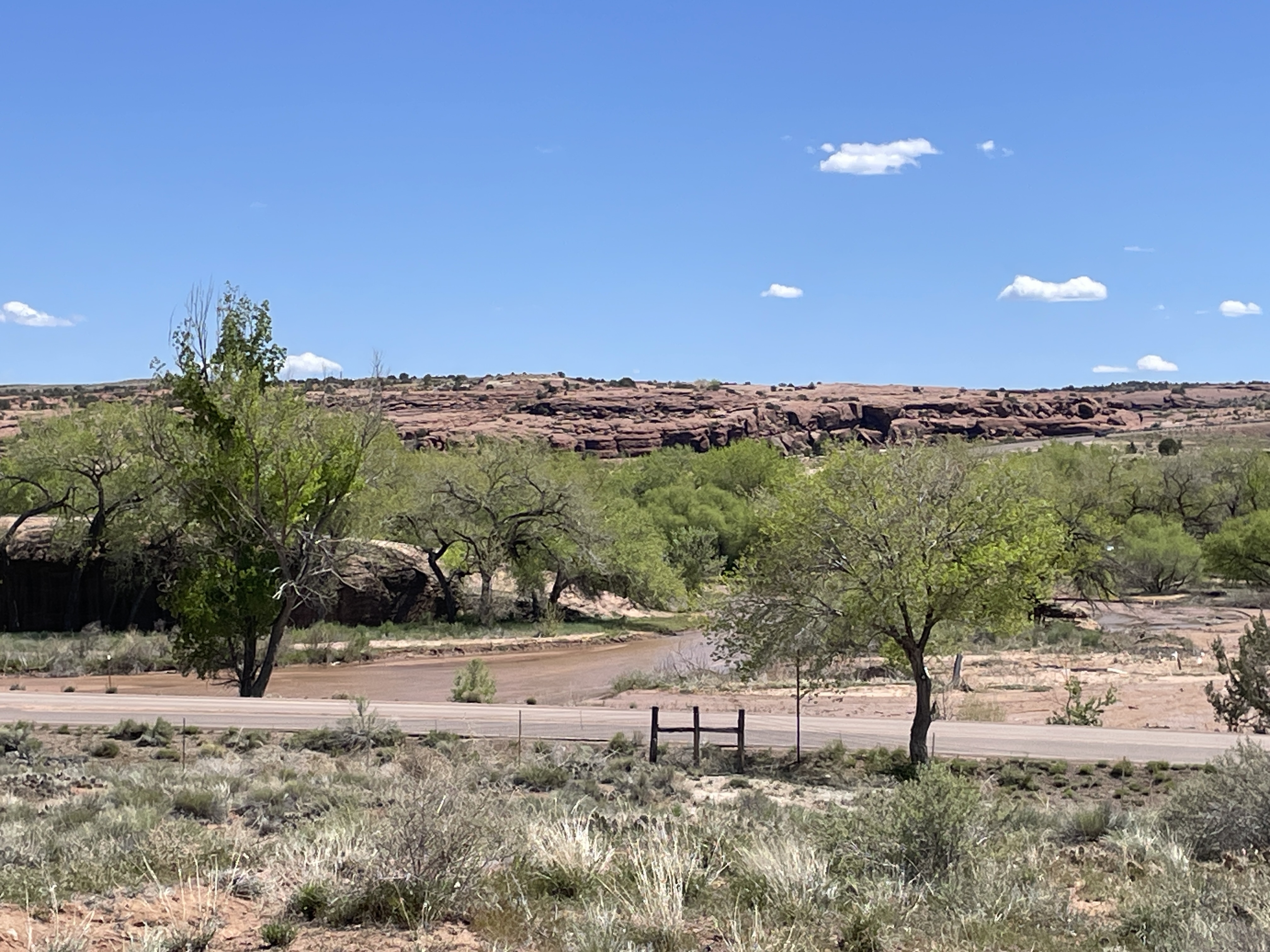
Canyon de Chelley begins at the edge of Chinle, AZ, near the Holiday Inn which, by the way, serves traditional food such as mutton stew and blue corn fry bread. Yes, I ate both. This photo shows the beginning.

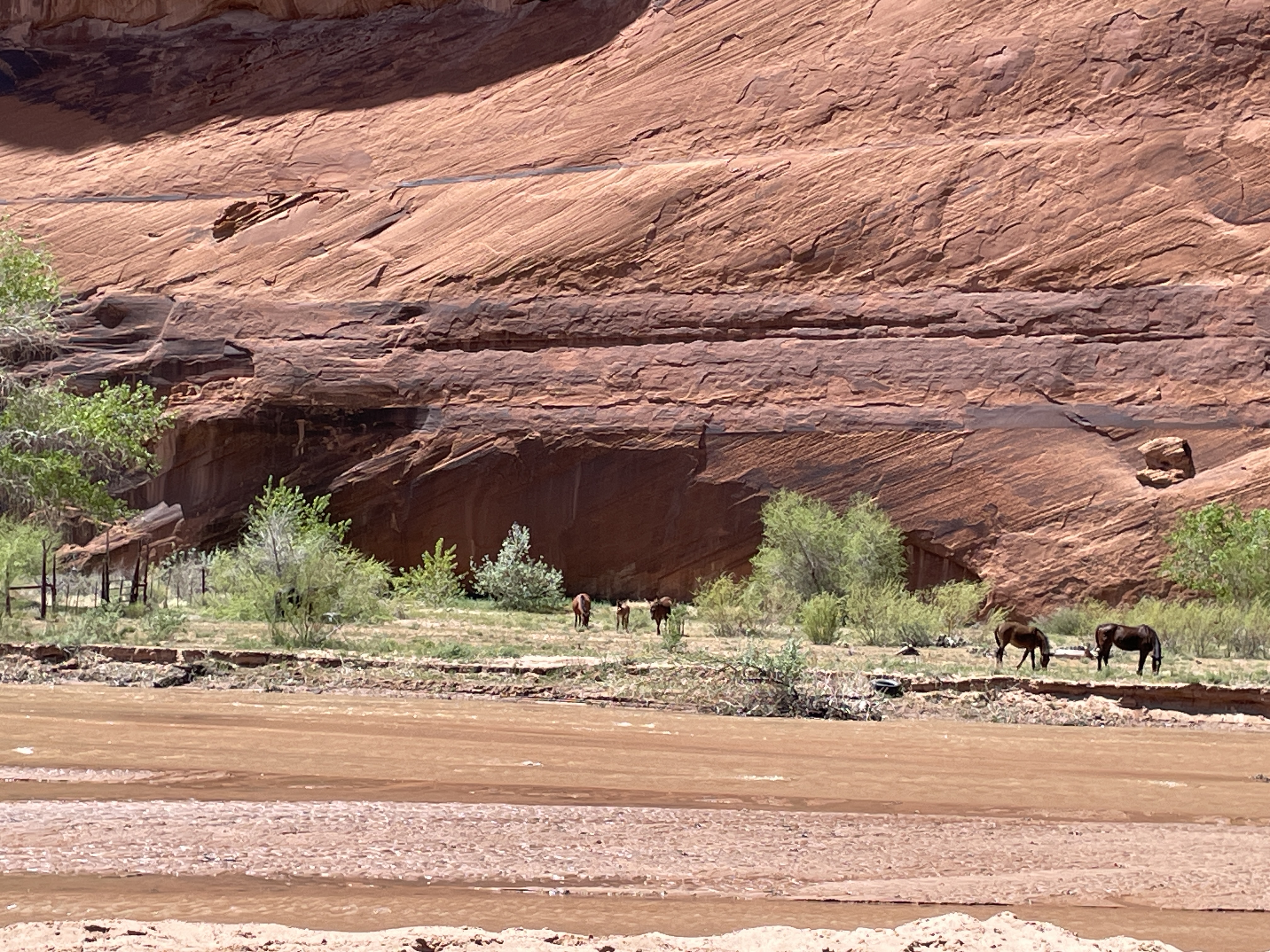
It was quite a trip; I sat between two women in the back of a Jeep with a perfect view of everything right in front of me. Oscar, the driver, knew exactly how to traverse the water, the wash (what they call this stream), run up and down the banks.

Driving right up the middle of the wash.

Petroglyphs can be seen in so many places we stopped that I lost count. Oscar said they are nearly endless and can be found throughout the canyon walls.

A few days previous to our arrival it had snowed so everything was green and lush from snow melt.

In addition to petroglyphs, there are etchings in the rock walls.

In this case an etching/rock carving of horses.

Yes, we drove under this overhanging tree limb.

Sometimes the wash was narrower and deeper and we drove up and down steep banks and through deeper water.

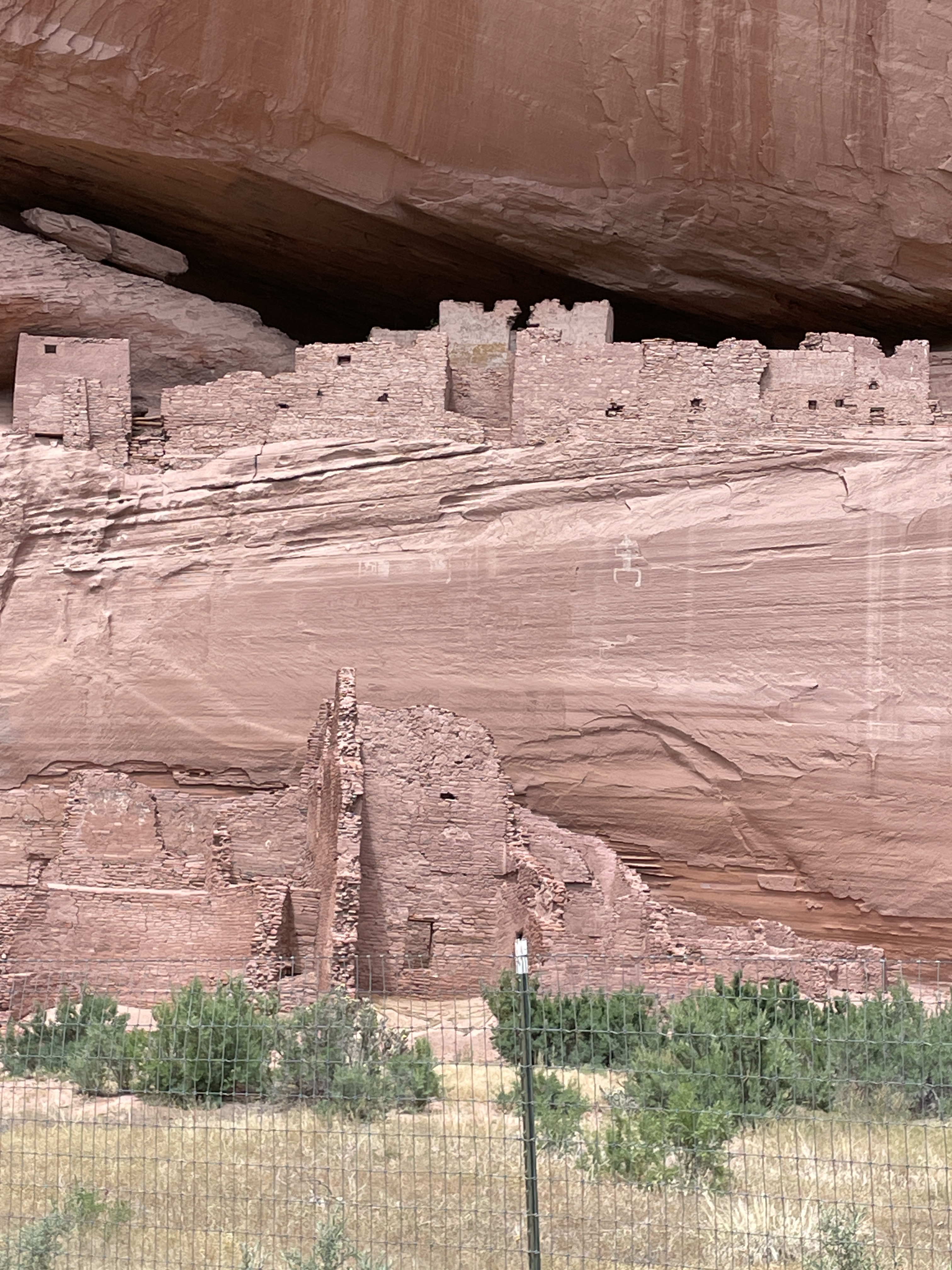
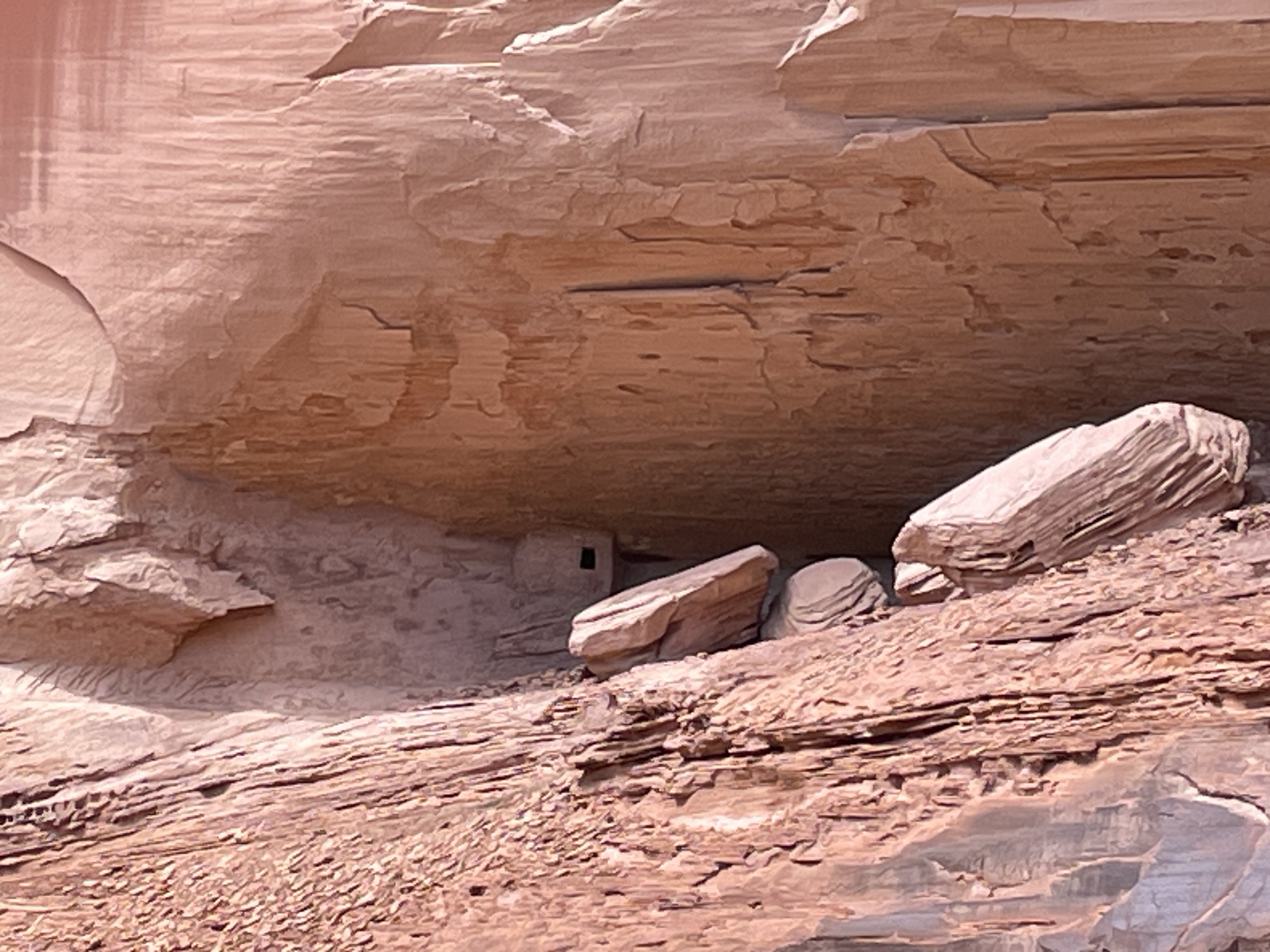
Ancient pueblo people lived here for centuries, some more than 5,000 years ago. This is one of the largest pueblo structures in the canyon (The White House–due to a white washed wall which you cannot see from this vantage point). The fence was built to protect it from vandals. We saw many smaller dwelling places and Oscar said there are hundreds in the canyon.

Headed back down the wash. This was a half day trip so only saw less than half of the canyon. You can hire for an all day trip complete with picnic lunch and go all the way to some of the famous formations that can be seen from the road at the edge of the top. There is also a side canyon called Muerto–due to a massacre of the natives that occurred after the Navaho forced long march.

The Jeep needs a bath after this trip.

Note: With a permit and guides, there is camping and horseback riding trips up the canyon in addition to this type of tour.

Book 20 for 2024: “The Midnight Library”, Matt Haig


Regrets and depression seem to have overwhelmed the main character, Nora. She’s lost her job, a car ran over her cat, she thinks she has failed at everything, and she says she wants to die. But does she really. Through a series of parallel universe experiences she gets to try out many different lives based on her long list of regrets. None really work because none of them exemplify her real self. She thinks she might like this new life or that new life, but none fulfill her, reflect her true self. She learns that money, fame, riches are not necessarily the answer. But what is the answer? What is the best way to live?

Book 19 for 2024: “Unearthing”, Kyo Maclear


Several months after Maclear’s father (who was a famous journalist) dies, she decides to take a DNA test to find out more about her family health and personality history, mainly because of the stories about a particular grandmother. She wonders if certain traits she and her sons have might possibly be inherited. The results of the test are a shock. Her father, the father she adored, who raised her and adored her, is not her biological father. At first, she thinks perhaps it was a sperm donor, but then she discovers this is not the case. Through the DNA test and her detective work, she finds two biological half-brothers (she was an only child before this discovery) who are willing to communicate with her, send her photos, etc. She tries relentlessly to acquire more information from her mother, who is often unforthcoming or tells her contradictory information. Then her mother gets dementia.

This is also a story of plants, of gardening. Both she and her mother are amateur botanists and expert gardeners. When nothing else works in their mother-daughter relationship, their love of plants and gardening holds them together. Even with dementia, her mother knows plants. Their other joint endeavor is ink drawings and love of art.

Additionally, this is the story of family, family secrets, inter-racial marriage, and challenging relationships. Kyo’s mother is Japanese living originally in England and later in Canada who often struggled with her status as a Japanese immigrant. Her “real” father, the one who raised her, was of British and Irish descent; her biological father was a Jewish formula one race car driver.

Book 17 for 2024: “Cave of Bones”, Lee Berger and John Hawks


This is the perfect book for those interested in hominid evolution. I’ve been fascinated by Homo naledi ever since I first learned about them more than a decade ago. In 2013, paleoanthropologist Lee Berger first discovered them in a sizable cave system in South Africa. The initial discovery included the largest pile of hominid bones ever found.

In “Cave of Bones” Berger details his and his teams repeated visits to this cave system and their discoveries over time which allowed them to find evidence that naledi buried their dead, used fire, and drew designs on the walls near passages from one part of the cave system to another. Before their discovery, it was thought that only homo sapiens did any of these things with exception perhaps of neanderthal. The naledi walked upright, lived during the same time as early homo sapiens, and had a feet and body structure like homo sapiens (except they were smaller than most people today), but their fingers were somewhat curved indicating they used them for climbing. Their brains were smaller than homo sapiens. This has made some scientists question the validity of the findings since it has long been held than brain size relates to intelligence and many of the abilities that are distinctively human. The book contains photos of the cave system, of some of the skeletons, the drawings, and other relevant material as well as an extensive bibliography.

Book 15 for 2024: “The Elegance of the Hedgehog”, Muriel Barbery


Before reading this book, I thought of French society as relatively egalitarian. Apparently, it is not if this book mirrors reality. One main character Renee, 54, lives and works as a concierge in a high class building containing eight, large, luxury apartments which the residents own. As she tells her story, she notes that this is her 27th year at this job. She describes herself as “short, ugly, plump”. She rarely says anything nice about herself or any of the residents. She notes she is uneducated, insignificant. She has one friend, Manuela, a cleaning woman originally from Portugal. Renee thinks it is her duty, her lot in life, to pretend to be something she is really not, a person totally lacking in intellectual and artistic acumen. She runs the television to make the residents think she watches mindless melodramas when she is actually reading Tolstoy as well as all sorts of literature and Marx, history, well every genre. After all, her cat is named Leo for a reason. She goes to art galleries, listens to all sorts of classical music, is basically an intellectual in the true meaning of the word, but works very hard to hide this, because she thinks she must stick to her station in life as she sees it. This works until one resident dies and a wealthy Japanese man buys the deceased man’s apartment. Both he, who notes her cat is named Leo, and a young girl, the other main character who lives in one of the apartments and plans to commit suicide and set their apartment on fire, suspect Renee is not as she appears to be. I do not want to give it all away, but this is a book with many life lessons, including that adage about not judging a book by its cover.

Ovid


This is poem two for National Poetry Month. A friend wrote a poem following the prompt to write a poem about a book the writer has not read for a long time. She wrote about The Scarlet Letter. My poem is about the book, An Imaginary Life.

The Roman Emperor Augustus saw Ovid’s poetry as subversive,

a power threat. He exiled Ovid to a remote corner of the Empire,

somewhere over by the Black Sea, the Carpathian Mountains,

among the destitute, the superstitious, people who did even know

how to read or write. They believed in witches, feared ghosts, saw

evil in everything and everyone different. Different equaled

death.

Paid to host Ovid, the village leader teaches him to ride horses

bareback, hunt, become stronger. Ovid transforms from a weak

revolutionary who hates this place to one who sees the barren

beauty, wanders in the forests, plants a wildflower garden,

survives.

While hunting, they see barefoot tracks in snow, tracks

of a feral child, a boy. Ovid fears for him, finds him,

rescues him. An accident occurs. The villagers blame

the boy, want to kill him. He and Ovid escape,

wander far into the northern wilds, into

infinity.

Book 14 for 2024: “The Invisible Hour”, Alice Hoffman


This is a book for those who believe in the power of books to transform life, who are fans of Alice Hoffman, and who like time travel. It also about how a charismatic man can ruin the lives of many, especially women, by controlling everything around him through fear and coercion. In his Community books and contact with the rest of the world are banned. Mia is a young woman who sneaks into a local library and finds Hawthorne’s “The Scarlet Letter”. She realizes the life she is living in the Community is like the lives in the book. Through this book she manages to attain the courage to escape such a man, the man who destroyed her mother, Ivy. She makes her way back in time to the period in the book, has a love affair with Hawthorne, and finally escapes the horrible man who tracks her everywhere she goes.

Book 12 for 2024: “Quiet in Her Bones”, Nalini Singh


If you like murder mysteries, this is a book for you. I do not normally read them, found the blurb intriguing and started it. Once I started, I did want to know what happened. I learned a lot about New Zealand, the diversity of wealthy people who live there, and the lush climate in some places. A wealthy South Indian woman suddenly disappears along with 250,000 in cash. Ten years later no one still knows what happened to her and then suddenly someone finds her Jaguar hidden in dense woods with her skeleton in it. Her devoted son has believed all this time she ran away from a horrible marriage (he cannot stand his mean dad) and is still alive. Now the son is a famous, wealthy writer and determined to find out who killed her. This is the story of her life, a horrible marriage, a wealthy neighborhood where nothing seems as it really is, and the son’s quest to find who killed his mother.

Book 10 for 2024: “The Furies: Women, Vengeance, and Justice”, Elizabeth Flock


This book raises these questions: Can women gain true safety and equality without violence? Can we end misogyny without fighting back?

The book details the stories of three women, one from Alabama, a woman from northern India, and a Kurdish fighter in northern Syria. All use a form of violence to overcome abuse and mistreatment they have experienced and see other women experiencing. The author personally interviewed all of these women and others close to them and visited them repeatedly.

The first is Brittany Smith, who shot the man who had raped her and was trying to kill her brother. Her story details how Stand Your Ground laws work for men, but often fail for women, especially in areas of the US South where men are protected by their beliefs in a male Code of Honor.

The second is the story of Angoori Dahariya, a Dalit woman, from Uttar Pradesh, India. Fed up, she creates a group called the Green Gang (they wear green saris) dedicated to defending poor, under caste, female victims of abuse. Note: Dalit refers to the lowest caste.

The third is the story of Cicek Mustafa Zibo, a Kurdish fighter in the female militia that fought ISIS in northern Syria. She and many others follow the teachings of Ocalan, a Kurdish leader imprisoned by the Turks for leading the Kurdish militia who for years have fought the Turks for independence. He teaches equality between men and women and women’s rights, which is anti the general cultural beliefs in this area of the world. Note: Ocalan is labeled a terrorist by many.